Jump to ratings and reviews
Rate this book

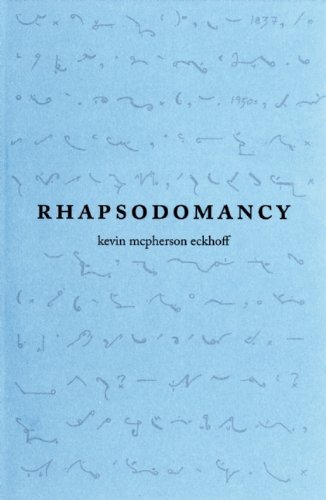
Rhapsodomancy by Kevin McPherson Eckhoff

Rate this book
Reading is slow, and writing is slower. Words are old-fashioned. Why not consider the communication of the future? In 1837, Sir Isaac Pitman began a sixty-year obsession with producing a system of Shorthand that accurately and swiftly captures voice as evidence of the mind’s movements. In the 1950s, John Malone developed Unifon, a forty-character phonetic alphabet intended for international communication by the airline industry. Both projects reached for artful utility, and both have largely been forgotten.In Rhapsodomancy, kevin mcpherson eckhoff remembers them. Exploring these two phonic alphabets as image, these poems playfully interrogate the relationship between voice and visual poetry. Can pictures represent voice? Can unutterable writing express thought? Rhapsodomancy offers an imaginative response to such questions via empty suits reciting onomatopoeia, letters defying the laws of reality, and drawings divining the future.

Paperback

First published March 12, 2010

14 people want to read

About the author

kevin mcpherson eckhoff

13 books37 followers
look at all these keyboards! most people only see one keyboard at a time, but children often simultaneously perceive many, which is exactly one 'm' more than 'any'.

placing a 'why' at the end of 'man' is another way to get many. and how! questions are usually more interesting than answers anyway?

other possible uses of a keyboard: sushi platter, percussion instrument, doormat, bookshelf, face washcloth, wagon (add 5 wheels), coffee filter--a measure of infinitude. one might think that at least part of a keyboard would make an effective lock unlocker, but one would be wrang.

'getting keyedboard' happens when someone (a foe or stranger) runs a keyboard across the paint-skin of someone else's vehicle. And if you're still reading this, you're likely getting keybored.

when people get so tired that they start emitting zzzzzz's from their face-sound-speakers while also doing anything, that thing might just turn zzzzzany!

Ratings & Reviews

What do you think?
Rate this book

Friends & Following

Create a free account to discover what your friends think of this book!

Community Reviews

5 stars
13 (59%)
4 stars
7 (31%)
3 stars
2 (9%)
2 stars
0 (0%)
1 star
0 (0%)
Displaying 1 - 3 of 3 reviews
Profile Image for Amy.
Author 5 books31 followers
May 4, 2010
If I had a unifon keyboard I could write an appropriate review.

Nevertheless

This book occurs in my life. First, or really second, through a quick study of the unifon alphabet, which this book presents, and then from an exercise in which I attempt to write a letter in unifon, at the prompt of a friend—but that felt like looking into twin suns. Then, in class, a few days after AWP, I tell my undergraduate students about the two new languages I had learned—unifon and Christine Wertheim’s litteral poetics. They beg me to write something on the board in one of these new languages, and so I whip out my unsent letter and transcribe the first sentence. They were so excited! “It looks like text messaging,” one of my students says. Yes, and we talk about alphabets and texts as shorthand, and I try to recall the conversation about unifon’s elimination of redundancy, wincing at the memory of my lazy comment about democracy, and wonder how efficiency is related to consciousness or transmission. Then, same friend from earlier, in an email last Sunday afternoon, asks me: “I have a question about what bombards the dense knot of matter to release a quantum content.” And I quote from rhapsodomancy, which includes a series of unifon letters constructed as Gordian knots:

*

Three Notes on Knots

Quipu is suspected to be an ancient Incan system of writing composed as knots on connected strands of rope. Most of the recovered Quipu remain undeciphered.

When faced with the Gordian Knot, which was prophesized to reveal the new leader of Asia, Alexander the Great sliced it apart with his sword, declaring, “I have undone it!”

Treated as entire poem in itself, the Unifon alphabet appears here as a series of looped and tethered ropes that, if pulled, would unravel into unknotted strands.

*

I continue writing to my friend, something like: Speaking of unknotting, I am working on a project, “Borealis: Time Signatures,” where language is a machine of time (it)self. Each iteration of the “borealis”—a legend of 23 writers who hold space in my imagination, deciphered and ciphered with words and the image of a tesseract—is worked through a theory of time where the language on the page enacts the theory of time posited. As far as what bombards the knot to release a quantum content, I love your idea that it is a sort of light vibration—which makes me wonder, is the vibration’s propulsive energy aimed to tie or untie? What I enjoy about these Gordian alphabet knots is that the “end” of each letter has an arrow (of time) pulling away from the knot, so that it’s all you can do from “untying” them in your mind and imagining then what else is formed as they reconfigure…

2:40 a.m., May 1: I realize that if the Gordian knot in the unifon alphabet used a linear arrow of time, such as depicted in the book, the knot would not release. In the book, time is what “bombards the knot,” and thus the arrow would have to be more like a fractal or a planck equation in order for the knot to “resolve” its own paradox. One of the elegant demonstrations of the poem is that with linear arrows, the knots stick, caught in their own limbs. The assumption I made in my friend’s question, “what bombards the dense knot of matter to release a quantum content,” is that the knot itself must be released in order to provide a content. But poems don’t work that way. In poems, the knots get tighter, and they multiply. In my borealis project, I am posing distinct versions of spacetime at the end of each letter to release a novel content. The “propulsive energy” that bombards the knot could be aimed at both tying and untying or something else. In biological terms, some knots have knotted limbs. That the Gordian knotted alphabet poem is made of letters in unifon, a tomorrowland “alphabet of the future” (see delightful comic book accompaniment), suggests that in order to encounter the knot’s paradox, which releases “a quantum content,” a shorthand messaging system is needed that speeds up the processing time it takes for the “light vibration” of my friend’s comment to reach the “dense knot of matter.” The alphabets of the future are wormholes. In rhapsodomancy, kevin mcpherson eckhoff points out that sound poetry, by resisting linguistic logic, resonates with the unmitigated voice that shorthand seems to record. Such experiments in shorthand, or what can now be called the speed of light, of sound or sight or thought, extend to physical reality, including the reorganization of the self. In the future (now), poems are quantum supercomputers, where each information-bit exists in more than one state at once, making processing billions of times faster. This is not a binary language. I no longer question the motive for speed.
Profile Image for Alison.
107 reviews7 followers
July 31, 2011
I felt the urge to re-read this after finishing Eunoia. It has a similarly uncanny way of looking at language (and mark-making!), and I can't help but love the knot drawings at the very end of this delightful book.
Profile Image for M.W.P.M..
1,679 reviews27 followers
January 20, 2022
UNSOUND WRITING

*

'In a smooth train thy mystic figures flow,
And swiftest gales of eastern winds outgro;
They pen our words paints with the nicest care
Before the fleeting voice dissolves in air;
FLying as it draws the image of the mind,
Nor one idea wandering leaves behind.
Faithful as echo thy rate art is found,
Preserves the sense as it returns the sound.'
- Anonymous


*

DISAVOWALS:
OPTICAL ALLUSIONS

*

description

*

APANTOMANCY

*

Geomancy I, for Steve McCaffery

description

*

the law is of a light who can come at me.
shalt theatre, fah, art too, 1fch!
nature, she sure should fatter with thee.
lo, but for thought, thou are recounted.

*

Ornithomancy, after Wallace Stevens

[image error]

*

solve:

only knowing oral form
limit any other field for this fuller mile
free any other bird for this little faith
order any other army for this unfair minimum
confirm any other method for this immediate animal
never value error for this assumed formality
follow nothing for this needing middle

fully owning enough order
assure any other limit for this failed english
feel any other zeal for this awful fault
share any other reminder for this ended life
fail any other value for this animal material
never form an estimate for this esteemed pharmacy
leave anything for this informed laugh

naturally avoiding myth
never remit
Displaying 1 - 3 of 3 reviews

Can't find what you're looking for?

Get help and learn more about the design.