

What do you think?

How are you peeling?: Foods with moods
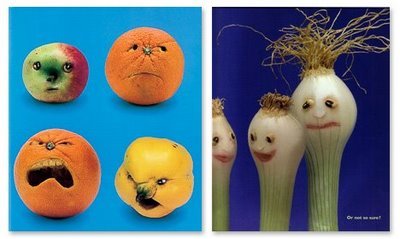
"Who'd have dreamed that produce could be so expressive, so charming, so lively and funny?...Freymann and...Elffers have created sweet and feisty little beings with feelings, passions, fears and an emotional range that is, well, organic." - The New York Times Book Review. "Use this book to discuss different moods, to introduce the names of many fruits and vegetables, to identify colors, and to inspire young artists to create sculptures of their own." - School Library Journal, starred review
Paperback
First published January 1, 1999
Ratings & Reviews
Friends & Following
Create a free account to discover what your friends think of this book!
Community Reviews
Displaying 1 - 30 of 209 reviews

September 25, 2024
I liked Fast Food by this same creative team with all it's fun and clever vehicles, but the focus on faces here leaves me a bit perturbed. Most of the emotions in this book of moods are negative, so I'm staring at a lot of unhappy and angry fruit and vegetables. Many of them seem downright evil in their expressions. And even the happy faces seem a bit creepy.
Frankly, my mood is worse after reading this book than it was before.
But my daughter liked this book when she was three, so probably other kids will too.
Frankly, my mood is worse after reading this book than it was before.
But my daughter liked this book when she was three, so probably other kids will too.

Read
September 3, 2025Wow. World peace on planet vegetable

November 16, 2018
I'm a big fan of foods with faces, so I knew I'd love this book.

There's no really story here, but it does make a great read-aloud. It was a big hit at our recent storytime about feelings.
I had to laugh at the note at the end of the book. The image of the book's creators combing New York City produce markets looking for "expressive produce" is a joy to envision.
There's no really story here, but it does make a great read-aloud. It was a big hit at our recent storytime about feelings.
I had to laugh at the note at the end of the book. The image of the book's creators combing New York City produce markets looking for "expressive produce" is a joy to envision.

June 24, 2017
Oh my god I LOVED this book. I have such fond memories of it. Even after I'd read it a hundred times, I would thumb through it if I felt angry or sad and let the emotional fruits and veggies cheer me up. Lovely little book that I still remember all these years later.

June 22, 2016
I expected more from this. Damn expectations..

May 25, 2008
As the parent of an emotionally disturbed foster daughter, I know first hand how necessary it is for young children to understand their emotions, whether positive or negative, and find appropriate outlets to express those emotions.
This beautiful book is a wonderful way to expose young children to the concept of emotions, and to help a youngster know there is a difference between "sad" and "tired" and "lonely". While the book does not always explain what those emotions mean, it presents the emotions with appropriate expressions that children themselves have held on their own faces. Tracing the down-turned "lips" of a vegetable, my daughter will say, "she's sad like I am sometimes". Then we talk about ways to express sadness/anger/frustration or whatever emotion the vegetable/fruit appears to be exhibiting. In this way, I think the book is a useful therapeutic tool for troubled children.
It's great for "normal" kids, too. The book is fun, and full of life with bright, vibrant colors that make you want to smile. In addition, there is produce in here that most kids have never heard of, let alone seen. I believe that a picky child will be more willing to try a "new" food that she has at least heard of before and seen a picture of, than if she had never heard of them. That has to be a healthy thing!
And lastly, this book isn't just for kids. I think it's a beautiful art book for people of all ages. I enjoy looking at the photos and trying to imagine how the item grew in just that way. Freyman is clever and artistic, and this book is as good as the previous ones.
This beautiful book is a wonderful way to expose young children to the concept of emotions, and to help a youngster know there is a difference between "sad" and "tired" and "lonely". While the book does not always explain what those emotions mean, it presents the emotions with appropriate expressions that children themselves have held on their own faces. Tracing the down-turned "lips" of a vegetable, my daughter will say, "she's sad like I am sometimes". Then we talk about ways to express sadness/anger/frustration or whatever emotion the vegetable/fruit appears to be exhibiting. In this way, I think the book is a useful therapeutic tool for troubled children.
It's great for "normal" kids, too. The book is fun, and full of life with bright, vibrant colors that make you want to smile. In addition, there is produce in here that most kids have never heard of, let alone seen. I believe that a picky child will be more willing to try a "new" food that she has at least heard of before and seen a picture of, than if she had never heard of them. That has to be a healthy thing!
And lastly, this book isn't just for kids. I think it's a beautiful art book for people of all ages. I enjoy looking at the photos and trying to imagine how the item grew in just that way. Freyman is clever and artistic, and this book is as good as the previous ones.
June 23, 2014
This is one of the most moving and inspirational books I have ever had the privilege to read. "How Are You Peeling" made me take an objective look at my emotional state and helped me to realize that having different feelings all the time is okay - that's what life is all about! This book quenched my thirst for literature while giving me an unusual craving for turnips.
February 10, 2022
My youngest son is autistic and he was non verbal for almost 4 years.
I read to him all of the time.
He loved this book.
One night I asked him how he was peeling and HE ANSWERED ME. He answered me.
This book made all the difference.
I read to him all of the time.
He loved this book.
One night I asked him how he was peeling and HE ANSWERED ME. He answered me.
This book made all the difference.

February 14, 2020
This charming picture book features photographs of fruits and vegetables, against a simple, solid color backdrop, that are clearly “feeling” emotions. The textual story asks the reader to explore how they feel in certain situations, while the pictures clearly reveal the facial expressions that go with the evoked emotion. With lines like, “Amused? Confused? Frustrated? Surprised? Try these feelings on for size.,” the book lends itself to be an excellent read aloud that would allow students to respond to the reader, explore and learn about their own emotions and the emotions of others. While this book is a worthy addition to a preschool or lower elementary class library, it is worth noting that the text size might be considered too small for the intended audience.
Ages 4-8
Ages 4-8

January 24, 2019
Possibly the most unsettling picture book I've ever read. It's the faces. I just can't. The other ones were okay; Baby Food was cute and Dog Food was SO adorable, but this one just gives me the heebs.

September 13, 2019
Super creative book! I found the vegetables to be very entertaining. Wish I had stumbled on this book when my children were small.. I was imagining the conversations we would have had.
My son read the book after me and seemed disturbed by the oranges for some reason.
My son read the book after me and seemed disturbed by the oranges for some reason.
February 11, 2021
I love this book! The pictures of food with faces has always made me smile. It's creative and I find it even more interesting looking at the pictures than the reading part!
This is good for all ages.
This is good for all ages.
August 3, 2026
pretty solid literature

August 22, 2011
Based on concept alone, I have to give this book 5 stars.
I ordered it for my oldest daughter a few years back from Scholastic, because, I had to admit, I wanted to read it. When her teachers saw it, they wanted to read it, too.
Now I am passing a torn, taped and battered copy down to my youngest, hoping she will enjoy it just as much.
There is something simply engaging about the bold, primary colours, the thick, glossy pages, and of course, the odd-shaped vegetables and fruits given more expression than one would ever think possible. Even babies will be entertained by this short volume for the lively colours and comic depictions of common facial expressions.
According to the final page, the authors combed New York City markets for expressive produce. Armed with only an exacto-knife for carving and using basic materials such as black eyed peas (for the eyes) and organic dyes (for the mouths), they created the memorable characters that populate the pages of this book.
Sure, the writing isn't the best, but that's part of its charm. I have to admire children for their frank, no-nonsense assessment of the world around them. The very young are not going to see any merit in literary brilliance, but instead will appreciate books that are silly, gaudy, or novel; three qualities undoubtedly found in How Are You Peeling?
I ordered it for my oldest daughter a few years back from Scholastic, because, I had to admit, I wanted to read it. When her teachers saw it, they wanted to read it, too.
Now I am passing a torn, taped and battered copy down to my youngest, hoping she will enjoy it just as much.
There is something simply engaging about the bold, primary colours, the thick, glossy pages, and of course, the odd-shaped vegetables and fruits given more expression than one would ever think possible. Even babies will be entertained by this short volume for the lively colours and comic depictions of common facial expressions.
According to the final page, the authors combed New York City markets for expressive produce. Armed with only an exacto-knife for carving and using basic materials such as black eyed peas (for the eyes) and organic dyes (for the mouths), they created the memorable characters that populate the pages of this book.
Sure, the writing isn't the best, but that's part of its charm. I have to admire children for their frank, no-nonsense assessment of the world around them. The very young are not going to see any merit in literary brilliance, but instead will appreciate books that are silly, gaudy, or novel; three qualities undoubtedly found in How Are You Peeling?

March 31, 2011
I'm pretty sure I bought this for my cousins as a thank-you gift for letting me stay with them for a time. It was probably when the book was published. I love this book--anything silly like this makes me smile. (Think the cupcake book and the Star Wars cookbooks.) But I like to play with my food and I'm glad others out there do, too.
1/25/12 A great storytime suggestion from my co-worker that was a much better choice than my previous "Squish Rabbit." The text was way too small for me to be able to read in a storytime (since I didn't really have the days to practice as I had the others). Plus, I wasn't much of a fan of the text. This book was great to just get the kids answering questions about what they thought the produce was, or what expressions they thought were being made. My favorite was telling them to pick their favorite on the page and then make the face back at me. Ah me--that was one of the most entertaining books on my side!! The kids all seemed to have fun, too. And I think both kids and parents were impressed by the creativity and talent.
1/25/12 A great storytime suggestion from my co-worker that was a much better choice than my previous "Squish Rabbit." The text was way too small for me to be able to read in a storytime (since I didn't really have the days to practice as I had the others). Plus, I wasn't much of a fan of the text. This book was great to just get the kids answering questions about what they thought the produce was, or what expressions they thought were being made. My favorite was telling them to pick their favorite on the page and then make the face back at me. Ah me--that was one of the most entertaining books on my side!! The kids all seemed to have fun, too. And I think both kids and parents were impressed by the creativity and talent.

August 7, 2008
My library copy had a page torn out so either somebody really liked it or a young child got their hands on it. I didn’t like it enough to borrow another copy to see what I missed.
I was not wowed. The poem that made up the story was only so-so, and the photos of the fruits and vegetables made into faces with various expressions were not as inventive and attractive as others I’ve seen by this artist.
And as a vegan (especially when reading to vegan kids) it’s sufficiently laborious to describe the feelings food animals have without complicating the mix by reading about the supposed feelings of plant foods. Of course, if I’d really enjoyed this book this outlook would never have even occurred to me.
I was not wowed. The poem that made up the story was only so-so, and the photos of the fruits and vegetables made into faces with various expressions were not as inventive and attractive as others I’ve seen by this artist.
And as a vegan (especially when reading to vegan kids) it’s sufficiently laborious to describe the feelings food animals have without complicating the mix by reading about the supposed feelings of plant foods. Of course, if I’d really enjoyed this book this outlook would never have even occurred to me.

October 2, 2017
I thought this was such a cute way to talk about emotions. I used it with my older (4th/5th grade) CALS (Communication and Learning Support - mostly kids on the autism spectrum or other related disorders) kids and it seemed to be interesting enough to keep their attention while also being a good springboard for a discussion on emotions.

July 7, 2008
Amazingly expressive veggies! This is the cutest book, and darned if it doesn't make me want to take a knife and a bag of dried blackeyed peas and start building myself a little veggie village....

July 8, 2014
2001, January 1
These guys, they make vegetables into faces, or animals or whatever, and then they take pictures of them. It sounds stupid, but it's brilliant, really.
Library copy
These guys, they make vegetables into faces, or animals or whatever, and then they take pictures of them. It sounds stupid, but it's brilliant, really.
Library copy
December 8, 2014
Nothing but faces made out of fruits and vegetables, and it's soooo cool to look at!
December 3, 2021
This is a book of pictures of carved vegetables. What you see is what you get. Perhaps my lack of enthusiasm is due to the fact that when I worked at Scholastic, one year, a copy of How Are You Peeling was our Christmas bonus. Yes, this is the same Scholastic, Inc., where the elderly founder just left all of his ca$h to his young mistress because she loved him for his own super-handsome self, ignoring his two sons, one of which was the poet laureate who had never had been discovered because he was what, a logger? on Martha's Vineyard?
Anyway, I called up my sister, who was working at Merrill-Lynch. She said, "I just got my Christmas bonus."
I said, "Me, too. What did you get?"
"A hundred thousand dollars," she said. Maybe that wasn't the exact number. But it had a bunch of zeroes. More than "A children's book."
"Oh yeah?" I said. "I got a book called How Are You Peeling. It's pictures of carved vegetables."
My sister yelled into the room she was in--one of those wall-street like mosh pits where money people make deals. "GUYS, I'M TAKING A VOTE, WHO GOT A BETTER CHRISTMAS PRESENT, ME OR MY SISTER."
A minute later the verdict was in.
"Sorry, sis, I win."
For that reason, I can only give this book one star.
Anyway, I called up my sister, who was working at Merrill-Lynch. She said, "I just got my Christmas bonus."
I said, "Me, too. What did you get?"
"A hundred thousand dollars," she said. Maybe that wasn't the exact number. But it had a bunch of zeroes. More than "A children's book."
"Oh yeah?" I said. "I got a book called How Are You Peeling. It's pictures of carved vegetables."
My sister yelled into the room she was in--one of those wall-street like mosh pits where money people make deals. "GUYS, I'M TAKING A VOTE, WHO GOT A BETTER CHRISTMAS PRESENT, ME OR MY SISTER."
A minute later the verdict was in.
"Sorry, sis, I win."
For that reason, I can only give this book one star.

October 17, 2025
I've read this a lot more than the two times listed, always with my child. It's a favorite!
2010: The Little Reader found this one easier to understand than One Lonely Seahorse. LR didn't have any problem seeing the faces in the vegetables, so he wasn't as distracted. I think this is a good book to read with him; he seemed to benefit from some of our discussions about emotions. When pointing to a face on a page, he initially either classed it as "happy" or "sad," but we were gradually able to expand that to "mad" or "angry" on his own, and he seemed to understand "jealous" and "shy" and a few others. I don't know how many emotions regular 2-year-olds can identify, but I think we are doing well here.
2006: The pictures are awesome. It's a fun book to look at, but it is also good to read to children, because it lists various emotions and with which emotions one might react to a variety of situations.
2010: The Little Reader found this one easier to understand than One Lonely Seahorse. LR didn't have any problem seeing the faces in the vegetables, so he wasn't as distracted. I think this is a good book to read with him; he seemed to benefit from some of our discussions about emotions. When pointing to a face on a page, he initially either classed it as "happy" or "sad," but we were gradually able to expand that to "mad" or "angry" on his own, and he seemed to understand "jealous" and "shy" and a few others. I don't know how many emotions regular 2-year-olds can identify, but I think we are doing well here.
2006: The pictures are awesome. It's a fun book to look at, but it is also good to read to children, because it lists various emotions and with which emotions one might react to a variety of situations.
February 7, 2019
This is a really good book and it was one of my favorites growing up. This book is basically focusing on the emotions that a child might be feeling. The book asks the reader if they are happy, sad, angry, lonely, confused, frustrated, etc. I think this book is really good when it come to children learning how to us recognize and express their emotions. I would use this book in the hospital because it can help me understand how they are feeling because sometimes the do not always show their emotions. Sometimes it is hard for kids to put into words how they are feeling. What I would do is print a page that asks how are you peeling? on it and would have the veggies from the book and I would allow them to color it and express themselves. This is more comforting for them then talking to me about it.
April 18, 2023
This book cracks me up seeing faces on produce. I think this would be a good book to show to children who experience emotional disturbances or have trouble naming their emotions. It does not necessarily describe what each emotion is, but it does offer pictures of what each emotion could "look" like. This is still valuable information because sometimes children do not even know what their emotions look like. They could look at these photos and decide that they too sometimes look like these faces on fruits. I also like that it describes how you may feel in certain situations. For example, "How do you feel when someone is mean? Timid? Bold? Or in-between?" This is also a good book to teach children about produce, especially those who experience a food desert. They may have never seen some of these fruits and vegetables.
April 12, 2022
This book had a "good message" (?) about all the different feelings and how to handle them, however, the vegetable aspect was more creepy than anything. There are so many books out now a days that can help a child decipher their feelings, that we don't need to stare at hand carved vegetables with eyes.

December 12, 2017
this is an interesting and unique approach to illustrating a book. My toddler was mesmerised by the different faces. we definitely had a lot of conversation after reading this book. Will read over and over.
May 22, 2019
Imagine going produce shopping with the folks behind these books. The fruit and veggie faces are laugh-out-loud funny and a joy to look at, and may inspire some readers to create their own produce creatures. The text, however, was instantly forgettable and just seemed to be a mail-in effort.
April 5, 2022
clever pictures of fruits/vegetables to look like faces, but not many words. Labeled emotions would be better for Stella right now (26 months), or maybe just if we were better at suggesting possible emotions on our own.

December 20, 2022
Went through this book as a child with my counselor. And ended up being gifted with it in middle school. Still have it to this day and decided to read it again. That counselor I had growing up has since passed away. But a great memory remains.

March 20, 2023
Key Words: Silly and funny
Summary: It's a good problem-solution book because it asks kiddos if they're feeling sad well have a friend etc. It's a good way to show kids that there's a problem with sadness etc. Also shows silly pictures but might come off as uncomfortable to most.
Summary: It's a good problem-solution book because it asks kiddos if they're feeling sad well have a friend etc. It's a good way to show kids that there's a problem with sadness etc. Also shows silly pictures but might come off as uncomfortable to most.
Displaying 1 - 30 of 209 reviews