Jump to ratings and reviews
Rate this book

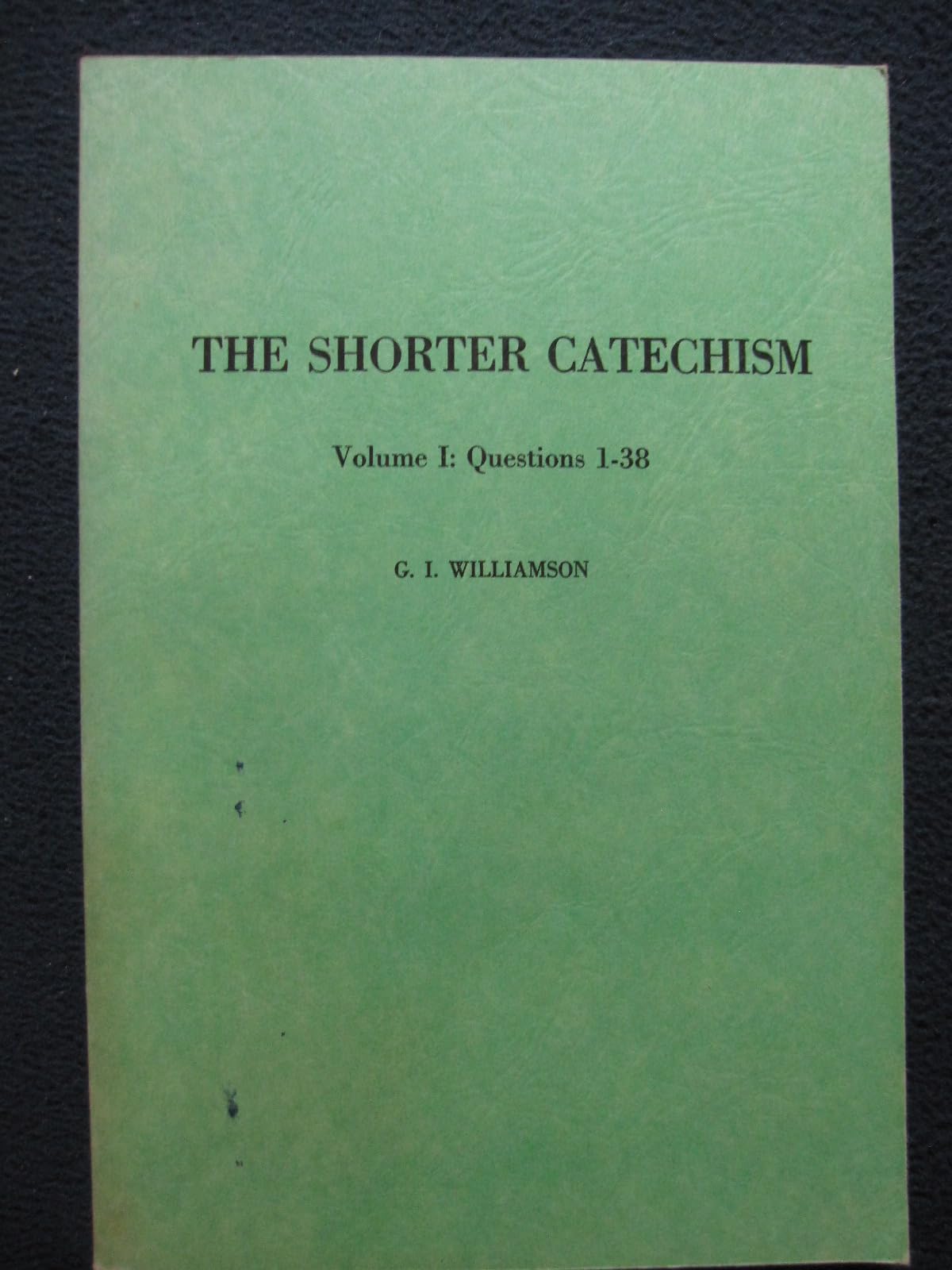
THE SHORTER CATECHISM Volume 1 - Questions 1 Through 38

Rate this book
Book by Williamson, G. I.

Paperback

Published January 1, 1974

4 people are currently reading
26 people want to read

About the author

G.I. Williamson

27 books7 followers
G. I. Williamson was a Christian minister for fifty years.

Ratings & Reviews

What do you think?
Rate this book

Friends & Following

Create a free account to discover what your friends think of this book!

Community Reviews

5 stars
12 (42%)
4 stars
11 (39%)
3 stars
4 (14%)
2 stars
0 (0%)
1 star
1 (3%)
Displaying 1 - 4 of 4 reviews
Profile Image for C.
1,244 reviews1,022 followers
November 5, 2020
Helpful explanations of questions 1-38 of the Westminster Shorter Catechism, with analogies and simple illustrations. This volume covers questions 1-38; Volume 2 covers the rest. I skimmed this, reading the sections that were of special interest.

Notes
Q7
God has eternally ordained all things (Eph 1:4, 11; 2:10; Rom 11:36; Isa 46:10; Job 14:5; Ps 33:11; Prov 16:33; Acts 13:48).

Bible teaches some will be saved and others lost, as God has decreed. It also teaches that those who are finally lost don't really want to be saved, and are lost by their own choice. God's decree doesn't weaken or destroy human responsibility.

Q9
The wine Jesus made at Cana appeared to be wine that would've taken many years to ferment. In same way, universe appeared older than it was upon completion of Creation Week.

Q11
Promises of protection (e.g., Ps 91:7) mean that God can protect His people if He chooses, not that He will do so in every case.

God controls individuals (1 Sam 2:6-8; Prov 16:1; Phil 2:13; Ps 76:10).

Q18
Total depravity means that humans are by nature totally depraved in extent (their whole nature is corrupted by sin), not totally depraved in degree (evil hasn't gone as far as it can).

An unregenerate person can't do anything to please God (Gen 6:5; 8:21; Ps 58:3; 1 Sam 16:7).

Unregenerate man is "free to do good. No one is forcing him to do evil—but he is not able to do good. His own inner nature, being evil, inclines him to do evil." See Jer 17:9. Analogy: humanity was always free to fly, but wasn't able to do so until flying devices were invented.

Q26
Amillennialism is most biblical
• Bible says no one knows when Christ will return, which wouldn't be true if we knew He'd return after 1,000 years of peace.
• Bible says we're in last days (Heb 1:2; John 6:39; 11:24; 12:48; Acts 2:17; 2 Tim 3:1) so we can't expect a millennium after these days are ended by 2nd coming.
• In parable of wheat and tares both grow together until harvest, which doesn't fit idea of period of righteousness and peace before 2nd coming.

Pre-, post-, and a-millennialism are all orthodox views.

Q27
When Apostles' Creed says Christ descended into hell, it means He suffered the pains of hell in His death on the cross.

Q29
What we call Reformed view of salvation was taught by Augustine, Luther, Zwingli, Knox, Calvin.

Reformed view of salvation: a sinner dead in sin hears gospel and is called to come to Christ. But person doesn't want to, and fights it. When Holy Spirit wills, He enters person's heart and regenerates. Sinner begins to hate sin and love Christ. He repents and believes (conversion). He is instantly justified and adopted. From then until death, he tries to live for Christ (sanctification). On last day he's raised from dead and made like Christ in body and soul (glorification).

Q30-31
God sincerely offers salvation to all; nothing in gospel prevents any person from accepting offer (Rom 1:16; 10:13).

Effectual calling is to a sinner dead in sins as Jesus' call was to dead Lazarus. Holy Spirit must give sinner ability to hear and obey gospel, just as Jesus had to give Lazarus power to hear and obey His call.

No person is lost against their will; by nature a person doesn't want to be saved (1 Cor 2:14). God didn't originally create humans dead in sin; that happened by human choice in Fall.

Regeneration isn't conversion but creating a new will.

Irresistible grace doesn't mean that God makes people do what they don't want to; it means God changes people so they want to do.

Q33
Justification by faith doesn't mean that faith is a good work that makes us righteous. It means that one must have faith in Christ whose work makes us righteous. Faith is the instrument by which we receive Christ's righteousness.

Q34
To be assured of salvation, we must have both witness/testimony of Holy Spirit and our spirit (Rom 8:16), and Holy Spirit always speaks in accord with Scripture (Isa 8:20). We experience this witness only when God enables us to say about ourselves what Bible says about true believers.

Q35
Sanctification is synergistic (Phil 2:12-13), though God gets all credit and man is never more than "unprofitable servant."
Sanctification is not a process by which we go higher and higher, until we can stand before God feeling that we are a holy people. It is rather a process by which we go lower and lower in our estimate of self, while at the same time we desire above all that we might be holy.
Q30
Bible says we can have assurance of salvation (2 Pet 1:10; 1 John 5:13; Heb 6:11).

Q32
There will be different rewards for different people on that great day [Rev 20:13]. But all—from the least to the greatest—will be "made perfectly blessed in the full enjoying of God to all eternity." And even that believer who receives the "least" reward will count himself rich beyond all imagination, and will rejoice with the man whose reward is greatest. There will no longer be such a thing as envy in the hearts of God's children then. But most of all we need to remember that all the saved will have God himself.
Profile Image for Laura.
381 reviews10 followers
May 29, 2009
The Shorter Catechism: Questions 1-38 by G. I. Williamson (1970)
Displaying 1 - 4 of 4 reviews

Can't find what you're looking for?

Get help and learn more about the design.