Arno Schmidt, in full Arno Otto Schmidt, (born January 18, 1914, Hamburg-Hamm, Germany—died June 3, 1979, Celle), novelist, translator, and critic, whose experimental prose established him as the preeminent Modernist of 20th-century German literature.
With roots in both German Romanticism and Expressionism, he attempted to develop modern prose forms that correspond more closely to the workings of the conscious and subconscious mind and to revitalize a literary language that he considered debased by Nazism and war.
The influence of James Joyce and Sigmund Freud are apparent in both a collection of short stories, Kühe in Halbtrauer (1964; Country Matters), and, most especially, in Zettels Traum (1970; Bottom’s Dream)—a three-columned, more than 1,300-page, photo-offset typescript, centring on the mind and works of Poe. It was then that Schmidt developed his theory of “etyms,” the morphemes of language that betray subconscious desires. Two further works on the same grand scale are the “novella-comedy” Die Schule der Atheisten (1972; School for Atheists) and Abend mit Goldrand (1975; Evening Edged in Gold), a dream-scape that has as its focal point Hiëronymus Bosch’s Garden of Earthly Delights and that has come to be regarded as his finest and most mature work.
Schmidt was a man of vast autodidactic learning and Rabelaisian humour. Though complex and sometimes daunting, his works are enriched by inventive language and imbued with a profound commitment to humanity’s intellectual achievements.
After Leviathan & Dark Mirrors [recently] here are 2 more stories for me by Arno Schmidt; this fascinating German author of romantic heritage & post⸗modern⸗avant⸗garde style. And once more this was a most worthwhile reading experience & I’m now slowly approaching The Big One. No apocalypse & no war (this time). Instead it’s the early post⸗war era – beginning of the 1950s – when “The Old One” called the shots in Germany. The two first⸗person narrators are modeled on the author – as it is often the case with AS [as far as I can tell from the biographical facts I know]. Once again, the two of them each meet previously unknown women, and again they start a relationship.
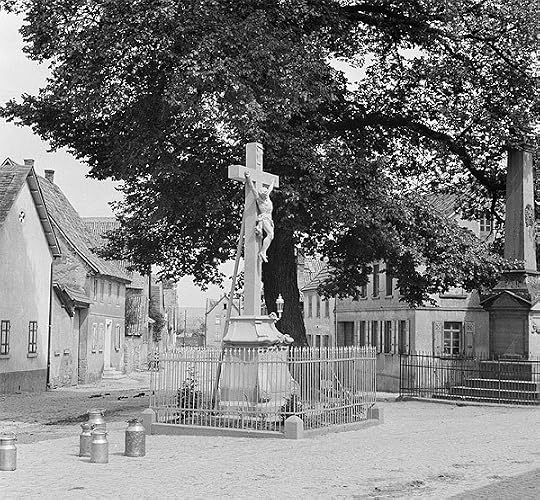
In Die Umsiedler (The Displaced) [the story you should read first IMO] the man meets Katrin on a loongloong train ride [=first part of the story]. Coming from Lower Saxony (Benefeld/Blakendorf = Brandt’s Haide – we remember) he (the two of them) arrive(s) in a dump called Gau⸗Bockenheim [=second part]. Actually; they are (dis⸗)placed there. In reality it was the town of Gau⸗Bickelheim, to which AS & his wife Alice came in 1950. The downtown market square (where all the cool folks meet) looked like this in 1951 [photo by the author himself] – – So this is a place where you don’t want to be hanging dead over a fence [as the saying goes; although this applies to pretty much any place for me]. Kartin is a war⸗widow (married for only six months; a DM 180.— widow’s pension; no chicken feed at that time). After the train ride on which they got to know each other they are assigned separate quarters [arch⸗Catholic neck of the woods; CDU voters]. They have to find clever ways to meet for their rendez-vous amoureux and avoid the disapproving looks from the locals…
Apart from the love⸗story (which is sort of tame compared to the one below) I was mostly impressed by the way Arno Schmidt manages to draw you right in and suffer along with the DP’s (“him”, Katrin, and another family of three). Schmidt’s attitude to the church, the gov., & other authorities is well known by now by me, and here he is taking the same lines again. Wonderful! And the story conveys some timely piece of advice too what with the refugee crisis in Europe and everywhere.
I couldn’t find out if this story is translated into English or not. It’s probably contained in his Collected Early Fiction, but I’m not sure. ____
In Seelandschaft mit Pocahontas (Lake Scenery with Pocahontas) the situation is much more amicable. The narrator takes passenger seat on the motorcycle of his old companion⸗in⸗arms, Erich from Berlin, and together they clatter North to spend some vacation days at the Dümmer See [in the Diepholz⸗Damme area; not to be confused with the Dümmersee], which today looks like this: Shortly after they got there they meet 2 vacationing women, who seem not to be averse. Quickly the four divided into 2 couples and spend some exciting days [& nights] in and around the beautiful lake…
The whole setting strongly reminded me of Castle Gripsholm by Ku-ert Tucholsky – relax and unwind while other body parts might become a little tense. The narrator (Joachim) calls his new acquaintance (Selma) “Pocahontas” (=the playful one), and sometimes “Undine” after the nixie in Fouqué’s book. And she really is a playful one. Although she is not as intellectual as her companion she surely finds ways to make him sweat. All in all they have a great time together, although a rather short one – every vacation has to end some time. Sigh!
But there’s quite a bit more to this story and that (plus the Sex) is what caused Arno Schmidt some trouble. As usual his target is the military (the re⸗militarization & ⸗armament of Germany under the cabinet of Konrad Adenauer) to which his answer here is LOVE. And also the church and God’s reps. on Earth to which his answer here is FREE LOVE. Shortly after the story was first published in a magazine (by Schmidt’s friend Alfred Andersch) the moral enforcers make an appearance. The indictment reads as follows:
“The writer Arno Schmidt and the editor and writer Alfred Andersch are accused of having spread [blah blah blah] a lewd writing [blah blah blah] religious insults and blasphemies [b.b.b.] contains further descriptions of a sexual nature [b.b.b.] which are likely to hurt the feelings of shame and morality of healthy sentient people in sexual ways.” [read the text (in German) here]
This looks ludicrous today, especially after I read the story. But it wasn’t funny at all back then and for Schmidt. He was notoriously pinched for money, and, if convicted, couldn’t have payed the fine, and probably would have gone to prison. He escaped, literally, by moving to another part of the country with a more lenient jurisdiction, and getting an expert’s opinion by the then president of the German Academy for Language and Literature. The case was dropped in 1956. Phew, that was quite close! ____
Both of these stories are great and I hope I have quickened your appetite to check out Arno Schmidt.
Zwei Geschichten aus dem Nachkriegsdeutschland, die aufgrund ihrer kontrastierenden Stimmung wunderbar zusammenpassen. Die Umsiedler handelt von den prekären Verhältnissen der Heimatvertriebenen, während Seelandschaft eine heitere Sommergeschichte erzählt. Arno Schmidt erweist sich in beiden Geschichten als origineller Chronist der frühen Bundesrepublik. Kann man immer wieder lesen.
Pure poetry ... what language ... what images ... there are not many books that I started to read a second time right away ... this is one of them ...
The story is really nothing complex .... far from it ... 2 characters ... o.k., make it 4, and thnking about it, not much happens ... a guy and a girl and a holiday romance ....but only serves as a scaffold for Schmidt to hang his paintings of nature and the surroundings ....
In Lake Scenery with Pocahontas, Arno Schmidt orchestrates an exquisite cartography of memory's sedimentation, where the languorous surface of post-war summer leisure becomes a deceptively translucent screen for the subaqueous churn of psychic dislocation, erotic transference, and ontological disquiet. The novella is not so much a story as a saccadic flicker of consciousness, an affective palimpsest wherein train tracks metamorphose into traumatic timelines, and a canoe’s prow slices not only water but also the strata of remembrance, libidinal impulse, and historical debris. Joachim’s gaze, fragmenting Selma into Pocahontas, Undine, cicada, is less a gesture of romantic idealisation than a desperate mythopoeic tactic: to encode the Other as symbolic salvage in a world where authenticity has been obliterated by mechanised death and moral collapse. The “photo-text units” become not narrative devices but mnemonic lesions, blistering nodes where perception ruptures into apperception, and prose curdles into metatextual weather. Schmidt’s landscape is painterly, yes, but it is the brushstroke of a fevered topographer charting the psychosocial terrain of a ruined masculinity cloaked in the casual eros of a lakeside tryst. Even the novella’s eroticism is dialectical, an oscillation between fascist phantasm and utopian escape, wherein bodily entanglement stands in as both penance and reprieve. The titular Pocahontas is not merely a trope of exoticism or cultural projection, but a shimmering cipher for the novella’s own operation: a metonym for translatio, for the translation of place, woman, self, and trauma into legible form, however unstable, however fugitive. The summer ends, the love dissipates, but what remains is not nostalgia, nor loss, but the peculiar ache of having touched something briefly truer than time.
In The Resettlers, Arno Schmidt enacts a meticulous dismantling of the linearity of memory, treating narrative not as an arc but as sediment, layered, brittle, and momentarily illuminated by the unpredictable flash of consciousness. The “photos” do not so much depict as they fracture, making visible the interstices of trauma and displacement where traditional realism stammers. Schmidt’s formal conceit, the alternation of image and explication, functions as both a mnemonic device and a metonym for the irreconcilable dialectic between experience and its articulation. The journey through a ruined post-war Germany becomes not merely geographical but epistemological, as Otto Kühl and Katharina Loeben traverse not space but a palimpsest of ideological ruins and linguistic exhaustion. Each provincial stop en route to Alzey is both a punctuation mark in the syntax of historical catastrophe and a tableau vivant of German banality, where the echoes of nationalist kitsch and Catholic inertia rot in tandem with the architecture. Yet Schmidt’s prose, acerbic and aphoristic, refuses nostalgia; his characters read, not to remember, but to survive the memory, to leech dignity from syntax itself. The paratexts, those scaffolds of fictive cohesion, dissolve in later editions, like scaffolding removed from a building too unstable to inhabit, leaving the reader alone with the brutal formalism of a text that admits no innocence, only structure. In this way, The Resettlers becomes less a story than an excavation, an archival artefact posing as a prose poem, where the real subject is not resettlement but the impossibility of ever being settled again.