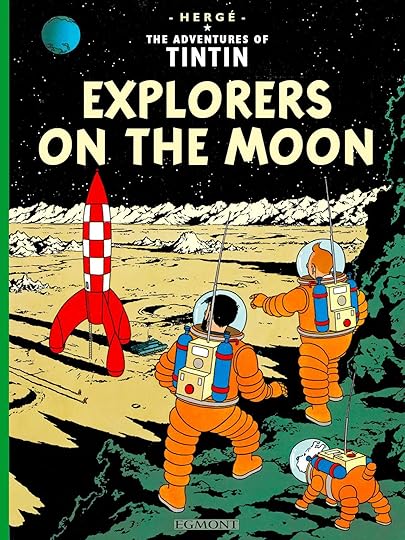
As all Tintin fans know, once you've read one of the ingenious boy detective's adventures, you've just got to read another. Volume Five contains Land of Black Gold, Destination Moon and Explorers on the Moon. Full color.
Georges Prosper Remi (22 May 1907 – 3 March 1983), better known by the pen name Hergé, was a Belgian comics writer and artist. His best known and most substantial work is The Adventures of Tintin comic book series, which he wrote and illustrated from 1929 until his death in 1983, leaving the twenty-fourth Tintin adventure Tintin and Alph-Art unfinished. His work remains a strong influence on comics, particularly in Europe.
"Hergé" is the pseudonym of George Remí, making a game with the initials of his name inverted. Throughout the evolution of his star character, Tintin, we can see the progress of this author: from the first titles marked by the ultraconservative doctrine of the director of the newspaper Le Petit Vingtième, to the breaking of conventions embodied from The Blue Lotus , as well as the evolution of the society of his time. The research carried out by Hergé to historically contextualize his Adventures, as well as his implicit social criticism, have made Tintin a masterpiece of the 20th century.
Science fiction dominates this volume with Destination Moon and Explorers on the Moon, another two part adventure. Considering that these stories date from the early 50's, we can cut Hergé some slack on the details he got wrong. The technology is on a par with other SF tales of the same era.
Just when you start to take Tintin's adventures too seriously, Hergé will throw in something goofy, like Thompson's and Thomson's reaction to the tablets in Land of Black Gold (which carries over into subsequent volumes as well.) Just enough action to be enthralling, just enough humor to keep it light and fun. Hergé rarely gets the proportions wrong.
We also get some character deaths, which I don't recall seeing in previous volumes. Either I wasn't paying attention, or Hergé just got better at giving them the proper dramatic impact to be memorable. They're quite tastefully handled.
This volume is yet another example of why Tintin is such a renowned creation. Highly recommended!
The first story is about cars blowing up mysteriously while driving, and Tintin goes to the Middle East to investigate. The second and third stories deal with a rocket the professor develops and their subsequent trip in the rocket to the moon. The moon stories gave an interesting vision of what people thought about rockets back in the 1960's.
Tintin has such an outsize influence that it's hard to capture just what is "tintin" versus the mirror-reflections radiating out from Herge over decades and decades. Proto pop culture paraliterary star from the age of early color newspapers, Tintin is cited as an influence/something to rebel against/an inspiration despite (insert political darkness) here. I know a number of gay artists online who love TinTin for its homoerotic undertones and/or its designs for beautiful men. AK Summers, in her work Pregnant Butch, draws herself as TinTin; his beardless masculinity is certainly appealing to a specific kind of tmasc or butch. Likewise, Algerian/French cartoonist Joann Sfar mocked TinTin's condescending imperialism in his own comics about Morocco and Algeria.
Today I read this on my lunch break, since our copy at my library was damaged and I was deciding whether it was too racist to put in an order form for another one. My system will undoubtedly reorder it at some point, given the series' inevitable continued popularity but my branch...will not. Lol. I think that libraries should keep TinTin but perhaps in an edition that has some cartoonists from around the world reflecting on its cultural and artistic import/its politics or with cartoonists from the caricatured countries responding with their own cartoons. To my knowledge no such edition yet exists for kids.
This one opens with an imagined political crisis in the early 1950s centered on a western oil company competing with "Arabex" oil to guarantee a contract under a sheik in a somewhat nonspecific Arab country. Relevant to that decade's oil concerns and reflecting European ideas about the Muslim world, its new natural resource issues, and its women, it pictures Arab nationalists as violent, undereducated, in thrall to Islam, and residing to a man in deserts. None of the Arabs are smart or particularly competent, though Herge allows them a kind of ancient nobility. There are no women in this world. Wrapped up in the turmoil somewhat against his will, Tintin is kidnapped by militants working for the Western oil company and rescues a sheik's son from a plot by the evil Dr Muller.
The second and third stories are about going to the moon-- a dream not yet realized but on the horizon at the time the book was written.
The thing that is worth appreciating and impossible to ignore is the seductively expert use of color, the clear, clean lines, and the evocative illustrations of very identifiable places. Somehow, using flat ink washes, there is such a strong sense of daylight, night-time, illumination. The pacing is somewhat slower and more hand-holdy than later comics, but this leads to some truly hilarious slo-mo fights where, for instance, TinTin and his opponent both sneeze before being able to land blows. Herge's comics, if they are printed for critique, discussion and engagement, should be printed large-- a crime of the American publishers is to print French comics so small as to necessitate the use of a magnifying glass, when they should be 18'' folios.
Where character designs are not flat caricatures, they're interesting, evocative and specific. Crowd scenes are mouthwatering. However, whenever a Black person appears, Herge's designs become wide-eyed and red-lipped symbols of dehumanization.
I spent the last couple of months reading through a few volumes of Tintin (Volumes 3 to 6). Since I didn’t have a lot of specific things to say for each one, I thought I’d share this summarised post/review. Here are the books in order of preference:
Volume 5 which contains Red Rackham’s Treasure, The Seven Crystal Balls, and Prisoners of the Sun – 4 out of 5 stars Volume 6 which contains Land of Black Gold, Destination Moon, and Explorers on the Moon – 3.5 out of 5 stars Volume 4 which contains The Crab with the Golden Claws, The Shooting Star, and The Secret of the Unicorn – 3 out of 5 stars Volume 3 which contains Tintin and The Broken Ear, The Black Island, and King Ottoker’s Sceptre – 3 out of 5 stars
And here is a list of the stories these volumes covered, listed in order of most enjoyable to least (least being good, but not as good as the ones above):
Explorers on the Moon The Seven Crystal Balls The Prisoners of the Sun The Secret of the Unicorn Red Rackham’s Treasure Land of Black Gold The Shooting Star The Crab with the Golden Claws King Ottokar’s Sceptre Destination Moon The Black Island The Broken Ear
Volume 3 is where Tintin begins to connect various stories. You will run across characters from previous stories after Volume 3. Which is why it may be a good idea to stick to the order the books were written in while reading them.
Regardless of how you go about reading them, don’t miss out on Tintin and his adventures. They are books and stories that everyone must try, at least once. Stay tuned for the summarised review of the rest of the volumes (which will probably come up in a few months). Until then… Happy Reading!
Land of Black Gold, starts with mysterious gasoline explosions and leads Tintin to Arabia where he works to stop a war over oil. Dr. Muller (from The Black Island and Senhor Oliveira da Figueira (from Cigars of the Pharaoh return and we're introduced to emir Mohammed Ben Kalish Ezab and his holy terror of a son Abdullah. The Thompson Twins also feature promenently and provide most of the comic relief.
Destination Moon and Explorers on the Moon return us to the Cold War as Hergé gives us the moon landing ten years early. In this, Professor Calculus is working in Syldavia (from King Ottokar's Sceptre on a nuclear-powered moon rocket. But an unspecified foreign power seeks to steal the rocket out from under them. A good pair of stories, that give a plausible moon launch ten years before Neil Armstrong. you can tell Hergé did his research.
OK, these are getting a bit boring and outlandish, all at the same time. With Haddock and Calculus doing the same schtick that's starting to get old, and Tintin playing the role of sidekick more than usual, I ended up enjoying the Thompson duo more than before. But I think it's more of a lack of excitement from the others than the Thompsons getting much better. Also Snowy seemed to have less lines than usual, which probably led to the ho-hum attitude of these stories.
The first story is about gasoline being tampered with which causes Tintin and friends to pursue a bratty kid across the desert. "Destination Moon" is really just a set-up for "Explorers on the Moon", where Tintin becomes the first human to grace the lunar surface.
Still no extras. But as a collection, this was far and a way the best so far. But still not clear if it is because Tintin got better, or I just got used to it. Land of Black Gold as an individual volume was my favorite of the series so far. But all three volumes had a little bit less of the annoying silliness. But lot's of derring-do. Still far from perfect, but pretty good. 3.5 of 5.
Read this with a glass of wine on a bright Saturday afternoon. The stories are as good as the best hollywood action thrillers. The locations are exotic and the art is cute in a vintage and timeless way. Excellent guilty pleasure for the little boy in me. I am trying to not borrow more Tintin from the library, so that I can save some as treats for relaxing weekends in the future.
Was a pretty good read. Found it on the shelf and had it to read it. I still can't believe that this book was published before the actual moon landing was done. Woah.
Fun and silly while also having an underlying mystery for you to try and figure out. The characters are fun and interesting and I really enjoy their friendships. Their adventures are somewhat predictable, but there's also enough unhinged occurrences that keep you from losing interest.
When reading Destination Moon and Explorers on the Moon, you have to remind yourself that these books were written back in the mid-50s and the technology is really impressive. I'm really enjoying re-reading these stories and would love to watch the animated series again.
In this installment of the wildy funny Tintin series, Tintin and Snowy get mixed up in an oil sabatoge scheme, and go with Captain Haddock, Tomson and Thomson, Professor Calculus and his assistant, Wolf to the moon! Will they ever return?
Seri Tintin 3 in 1 ini adalah salah satu yang menjadi favorit saya. Sudah pernah baca di waktu kecil, dan baca lagi sekarang edisi bahasa Inggrisnya. Sengaja memang tidak beli lagi edisi bahasa Indonesianya yang diterbitkan Gramedia, soalnya nama2nya lain dari yang aku kenal waktu kecil dulu. Jadi di sini masih Calculus, Snowy, Thomson dan Thompson..
Pertama adalah pertemuan Tintin dan Capt. Haddock dengan Abdullah, anak Ben Kalish Bab, pengusaha minyak kaya raya dari dataran Arab. Abdullah yang nakalnya luar biasa ini, sering sekali mempermainkan Captain Haddock. Lucu juga, perjalanan mereka di padang pasir dengan humor khas padang pasir seperti fatamorgana, badai pasir, kebodohan Thomson and Thompson berputar-putar di gurun. Juga intrik-intrik di ladang minyak dengan sejuta keberuntungan untuk Tintin.
Perjalanan ke bulan yang kocak banget! Bayangkan, seorang reporter, seorang pelaut, seorang ilmuwan, pergi ke Bulan.. (ngapain juga ada pelaut pergi ke bulan?), apalagi pelaut ini adalah pelaut yang suka minum mabuk dan suka mengumpat-ngumpat. Bayangkan apabila 'blistering barnacles!'-nya itu dipakai di luar angkasa, menjadi 'sejuta badai asteroid!' . Belum lagi keikutsertaan dua detektif yang ketiduran di dalam roket dan tanpa sengaja terbawa waktu tinggal landas. Lebih lucunya lagi, ketika rambut mereka tumbuh terus menerus..
Pengen juga bagian yang ini difilmkan, pasti seru juga. Dari cuma perjalanan orang-orang lucu ini, bisa jadi heboh banget, perang bintang, konspirasi, perebutan kekuasaan dunia.. Waktu baca ini jadi mikir seorang teman yang pergi ke Tibet karena terinspirasi oleh buku Tintin in Tibet. Lalu, sesudah baca Exploring to the Moon lalu saya tanya,”Dan, kamu kapan pergi ke bulan?”
Another great book made up of three stories. If you like comics, humor, and adventure then you'll read this book and wish it was made up of more stories!
Land of the Black Gold: In Europe, cars have been exploding when filled with petroleum. What's causing these cars to explode? What kind of chemical in this stuff is so deadly? Who's responsible for it? All of these questions will be answered in another fantastic book by Hergé!
Destination Moon: Captain Haddock and Tintin have just got back from their last adventure, when they receive a letter from their friend Professor Cuthbert Calculus who has just built a rocket ship that will take them to the moon. What threats will come of this? Will they actually make it there alive?
Explorers on the Moon: So they made it! They are on the moon, and now it's time to watch our friends as they explore the moon and make discoveries of the fantastic sight! But, it's not all fun and games for long, as they climb back aboard the rocket. Tintin discovers that he, the professor, the captain, the two detectives and his dog, Snowy, won't have a very safe trip back home with the oxygen supply running low and a guest star appearance from an old enemy of his.
I love this book for the stories and the art. I love how these books were written years BEFORE man set foot on the moon. Looks like Tintin and his pals beat Armstrong to it.
It's our great loss that the Tintin series of comics are so hard to find here in the U.S. Because they're just about the most popular comics of all time (along with the Asterix series) in Europe. Tintin is a young boy journalist who travels around the world on various adventures, solving mysteries and fighting crime. The regular cast of characters in all of these adventures include: Thompson and Thomson, the twin bumbling detectives who always seem to be completely in the dark; Professor Cuthbert Calculus, the brilliant scientist; Captain Haddock, the bearded sailor who lives at Marlinspike Hall; and Tintin's faithful dog Snowy.
The Tintin books normally come one at a time, in a fairly large, paperback cover. This book is one of a series in which each edition includes three separate Tintin adventures. Volume 5 contains the following stories:
Land of Black Gold - Tintin travels to Arabia to investigate why someone is sabotaging all gasoline so that it is unstable and explodes.
Destination Moon - Tintin and Captain Hadduck are recruited by their friend Professor Calculus to help design and build a rocket that will carry the first men (them) to the moon.
Explorers on the Moon - Tintin and friends travel to the moon.
The Tintin series is absolutely fantastic and well worth hunting down.
Another great book made up of three stories. If you like comics, humor, and adventure then you'll read this book and wish it was made up of more stories!
Land of the Black Gold: In Europe, cars have been exploding when filled with petroleum. What's causing these cars to explode? What kind of chemical in this stuff is so deadly? Who's responsible for it? All of these questions will be answered in another fantastic book by Hergé!
Destination Moon: Captain Haddock and Tintin have just got back from their last adventure, when they receive a letter from their friend Professor Cuthbert Calculus who has just built a rocket ship that will take them to the moon. What threats will come of this? Will they actually make it there alive?
Explorers on the Moon: So they made it! They are on the moon, and now it's time to watch our friends as they explore the moon and make discoveries of the fantastic sight! But, it's not all fun and games for long, as they climb back aboard the rocket. Tintin discovers that he, the professor, the captain, the two detectives and his dog, Snowy, won't have a very safe trip back home with the oxygen supply running low and a guest star appearance from an old enemy of his.
I love this book for the stories and the art. I love how these books were written years BEFORE man set foot on the moon. Looks like Tintin and his pals beat Armstrong to it.
Another great book made up of three stories. If you like comics, humor, and adventure then you'll read this book and wish it was made up of more stories!
Land of the Black Gold: In Europe, cars have been exploding when filled with petroleum. What's causing these cars to explode? What kind of chemical in this stuff is so deadly? Who's responsible for it? All of these questions will be answered in another fantastic book by Hergé!
Destination Moon: Captain Haddock and Tintin have just got back from their last adventure, when they receive a letter from their friend Professor Cuthbert Calculus who has just built a rocket ship that will take them to the moon. What threats will come of this? Will they actually make it there alive?
Explorers on the Moon: So they made it! They are on the moon, and now it's time to watch our friends as they explore the moon and make discoveries of the fantastic sight! But, it's not all fun and games for long, as they climb back aboard the rocket. Tintin discovers that he, the professor, the captain, the two detectives and his dog, Snowy, won't have a very safe trip back home with the oxygen supply running low and a guest star appearance from an old enemy of his.
I love this book for the stories and the art. I love how these books were written years BEFORE man set foot on the moon. Looks like Tintin and his pals beat Armstrong to it.