This fresh and entertaining look at the search for Sasquatch concerns more than just the startling and controversial nature of monsters and monster hunting in the late 20th century, but the more important relationship between the professional scientists and amateur naturalists who hunt them - and their place in the history of science. The traditional heroic narrative of monster hunting situates mainstream, academic scientists (the eggheads) as villains rejecting the existence of anomalous primates and cryptozoology as something unworthy of study. It gives a privileged place to untrained, but passionate amateur naturalists (the crackpots) who soldier on by themselves against great odds, and the unwarranted obstinacy of the mainstream to bring knowledge of these creatures to light. Drawing on new, original manuscript sources, Brian Regal shows this model to be inaccurate: many professional scientists eagerly sought anomalous primates, examining their traces and working out theoretical paradigms to explain them. Even though if mainstream scientific thinking held that anomalous primates - Bigfoot, Sasquatch, Yeti - did not and could not exist, these scientists risked their careers and associated themselves with eccentric amateurs because they believed these creature to be a genuine biological reality.
quite nice little book about sasquatch/bigfoot researchers, which doesn't take a position on whether bigfoot actually exists but mostly looks at the field as an area of study and how it's interacted with both amateurs and academic scientists. there is quite a lot of detail on many of the major players in the field as well as some of the most important events like the patterson gimlin film and the minnesota iceman. i also appreciated the detail that most of the major players in the yeti expeditions of the 1950s seem to have had links to the cia or other intelligence agencies. there is also some good info on the soviet almasti researchers and the approach they took to the topic, something that there isn't a huge amount of detail on in english. though it should be noted that the marxist underpinnings of the work of these guys aren't very clear in this book because the author doesn't really seem to have a good grasp of marxism. that is however a minor complaint about a small segment of the book and most of it is good.
Searching for Sasquatch: Crackpots, Eggheads, and Crytozoology is a thoroughly researched, well written, and very comprehensive study of the global "hairy man" phenomenon. Yet unlike most books on the subject, author Brian Regal doesn't really delve into actual reports of firsthand encounter narratives with legendary Bigfoot/Sasquatch and ABSM (Abominable Snowman) type creatures, instead taking a much more broad based, scholarly, textbook style approach.
I still found this to be a surprisingly interesting and very thought provoking book, however, that rather skillfully interweaves its overarching, documentary style examination of the myth and legend enshrouded creature that has, for literally centuries, been reported in various parts of the world (from Russia, to China, to the Himalayas, to Southeast Asia, to North America and even Australia) with an intriguing look at the various modern day, all too human figures who've sought (thus far, always in vane) to once and for all solve the mystery of the illusive beast since at least the middle of the 20th century.
Just as the subtitle implies, the "eggheads" (various members of the academic or scientific establishment) and a virtual army of "amateur" super sleuths who've come and gone down through the decades (including everyone from an influential Texas oil tycoon to various authors and researchers, and an amateur filmmaker and his one time cowboy sidekick - who together captured the now infamous "Patterson-Gimlin film" in 1967) are sometimes almost humorously depicted as being perpetually pitted against one another in a decades long boxing match style, knockdown drag out main event - in which the ultimate prize (the holy grail, if you will) would seem to go to whomever might eventually emerge victorious in the penultimate quest to prove the existence of anomalous, unclassified primate creatures such as Bigfoot.
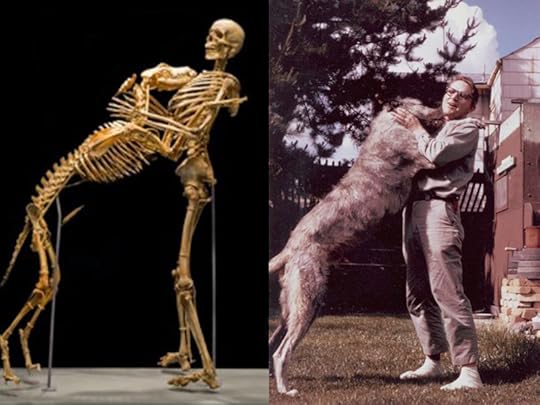
In particular, the author focuses heavily (with often poignant biographical zeal) on the life and career of American anthropologist and cryptozoologist Grover Krantz, whose skeletal remains (posed in emulation of an old family photo of the scientist with his beloved Irish Wolfhound, Clyde) are now displayed in a painstakingly reconstructed exhibit behind glass at the Smithsonian Museum. Krantz certainly does richly deserve the special treatment he receives here though, given that he was the first Bigfoot researcher to claim that he'd identified "dermal ridges" (the unique surface texture of the epidermis of the palms and soles, where the sweat pores open) on Bigfoot track casts.
image: width="40"
Upstaging even the legendary Bigfoot creatures themselves, Krantz is the undisputed star of the book, and rightfully so. He is himself very nearly overshadowed however, by Swiss-Canadian, Patterson–Gimlin film advocate, René Dahinden, who was known as much for his often cantankerous, borderline misanthropic demeanor (and antagonistic relationships with anyone who didn't happen to share his views) as for his lifetime of work in the field of Sasquatch research.
Overall, I found this to be a very absorbing, thoroughly entertaining and highly informative read. Despite the lack of all too typical, hairy, scary, firsthand encounter stories that are the usual lifeblood of the vast majority of books about the Sasquatch/ABSM phenomenon, I sincerely doubt that most folks who are interested in this sort of thing will find Brian Regal's work dull in any appreciable way.
Most importantly, the author somehow manages to sit this one out, staying thoroughly on the sidelines. Thankfully, he doesn't really spoil the fun by being presumptuous or arrogant enough to take a side in the matter one way or another - for or against the possibility of the existence of anomalous primate species, apparently preferring to let readers make up their own minds. An approach that serves this book quite well, in fact. After all, like many amateur enthusiasts, I've studied the Bigfoot phenomenon a great deal over the years, and although it definitely won't be the last, I can honestly say that this really is one of the better books that I've read on the subject thus far.
For in addition to the "relic hominid" theory extensively covered in the book, there are of course a bevy of other, perhaps much less plausible sounding explanations that the author, mercifully, does not expound upon. Theories ranging from the idea that Bigfoot and his ilk are actually hairy, undocumented aboriginal tribesmen, to the perhaps curious notion that they're all really just giant hirsute beings deposited (for some unknown reason) by UFOs! Some "researchers" even believe that Sasquatch and similar creatures may be supernaturally endowed shapeshifters - who may even have the power to "mind speak" and "phase" in and out of our dimension at will!
Maybe so. Or maybe not.... All popular theories aside, this is a great book for anyone who just wants to read an unbiased, well documented history of the Bigfoot phenomenon.
Despite its title and a number of editing errors, the book overall is a interesting read. It's more of an historical overview than a typical Bigfoot book. The author does not take sides and maintains a respectful distance from his subject matter. It is an approach I appreciate.
What I liked: The author, Brian Regal, provides an interesting overview of the history of science as academic pursuit. He points out that for much of human history, "science" was not a profession, but a pastime for individuals who enjoyed researching and learning about the natural world. Only in the 19th century, as major museums increasingly shifted towards becoming institutions of research (and funding became available to pursue said research), did a divide develop between amateur naturalists and professional scientists. Regal asserts that these divisions linger to this day, as amateurs (his "crackpots") continue a long-standing feud with the professionals ("eggheads").
I also liked that Regal did a ton of research into the lives of both Washington State professor Grover Krantz, his featured egghead; and Rene Dahinden, the quintessential crackpot. It was fun to read about these men as individuals, with individual motivations and personalities, rather than just as researchers. The author uses the infamous incident at Bossburg, Washington, where both Krantz and Dahinden came together to study evidence of a Bigfoot that allegedly lurked in the area, to illustrate their complex relationship. The Bossburg incident serves also to give us a taste of the generally frenzied, half-cocked (and most entertaining) nature of Bigfooting at that time.
What did I mean when I mentioned editing issues? Well, in the first few pages, the author tells us that Rene Dahinden lived in Calgary, British Columbia (I immediately googled this to see if there was, indeed, a Calgary, British Columbia, but found only ordinary old Calgary, Alberta). Strange punctuation abounds throughout the text, and at one point, the author mentions the movie "Harry and the Henderson's" (Henderson's what?). I tend to believe there is no reason for errors like these in a scholarly book.
Lack of proofreading aside -- and in truth, the errors may be peculiar to this particular edition of the book -- Searching for Sasquatch is worth a look. It deserves a read by anyone who is interested in the wide world of "manlike monsters."
One of the few works covering some of the cold war geopolitical aspects of bigfoot/abominable snowmen as well as the sort of jockeying that went on between amateurs and professionals in the natural sciences in this sort of field.




 width="40"


