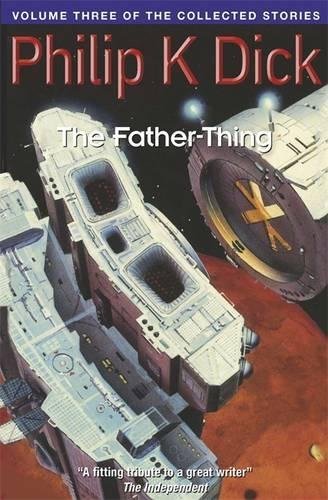
Five years after Philip K. Dick’s death in 1982, Underwood-Miller (US) published a definitive five-volume hardcover series containing a collection of all but three of his short stories, put into order of their receipt by Dick’s agent (not the same as order of publication). That year, Gollancz (UK) also published a trade paperback series of the same five volumes, but with retitled volumes 4 and 5. Unfortunately for the collector or completist, there are also other multi-volume series of his collected short stories, in other order, but with similar subtitles. If you are looking to complete the set, be sure to stick with the same series. If you are looking to read in order, I recommend the Gollancz series. To help you recognize those, here is a summary of The Collected Short Stories of Philip K. Dick, Gollancz Science Fiction, Orion Publishing Company, 1987.
Volume 1 “Beyond Lies the Wub”, 1947, 1951-1952, Introduction by Roger Zelazny
Volume 2 “Second Variety” 1952-1953, Introduction by Norman Spinrad
Volume 3 “The Father-Thing” 1953-1954, Introduction by John Brunner
Volume 4 “Minority Report” 1954-1963, Introduction by James Tiptree, Jr.
(original Underwood-Miller title “The Days of Perky Pat”)
Volume 5 “We Can Remember It For You Wholesale” 1963-1981, Introduction by Thomas M. Disch
(original Underwood-Miller title “The Little Black Box”)
This review is of Volume 3 of the Gollancz series, subtitled for “The Father-Thing”.
It has been interesting to read them in the order Dick wrote them, as it is possible to watch him develop particular concepts through different story plots – for example his exploration of psi during the summer of 1954. No blockbusters here, but my favorites from among the 23 stories were The Golden Man, The Father-Thing, and War Veteran. My overall rating is a numerical average of my individual story ratings below.
Fair Game, received 4/21/53, published in If, September 1959, ***. A senior professor is observed by giant aliens. Is it because of his expertise in nuclear physics? Tomato surprise ending.
The Hanging Stranger, received 5/4/53, published in Science Fiction Adventures, December 1953, ****. A small store owner notices a body hanging from a lamppost in his small town, but no one else seems to care. Is this a precursor to alien invasion, or is he losing his mind?
The Eyes Have It, received 5/13/53, published in Science Fiction Stories, Number 1, 1953, *. A too-cute little piece that plays on the taking of common expressions literally.
The Golden Man (“The God Who Runs”), received 6/24/53, published in If, April 1954, *****. Many years after a nuclear war, the DCA hunts down and exterminates human mutations. But their latest discovery defies previous experience, and might have survival skills superior to humanity’s. The 2007 film "Next" was very loosely based on this story.
The Turning Wheel, received 7/8/53, published in Science Fiction Stories, Number 2, 1954, *. A future in which Caucasian technos are controlled by higher Asian castes. Frankly, a racist concept. It is illuminating about post-WW2 America, that this could be published.
The Last of the Masters (“Protection Agency”), received 7/15/53, published in Orbit Science Fiction, Nov-Dec 1954, ****. A League of individualistic anarchists have toppled authoritarian governments around the world, except in one particular valley where a decrepit robotic overlord still rules. The plot demonstrates the superiority of distributed power over centralized power.
The Father-Thing, received 7/21/53, published in Fantasy & Science Fiction, December 1954, *****. A young boy accidently discovers that his father has been replaced by an alien. A childish fantasy, which in this case is actually true. The boy is powerless to convince his mother or other adults, and must address the problem himself along with a couple other children.
Strange Eden (“Immolation”), received 8/4/53, published in Imagination, Dec 1954, ***. After landing on a new planet, a crewmember encounters a beautiful immortal woman, whose race has a long history with Earth. Sex with her transforms him.
Tony and the Beetles, received 8/31/53, published in Orbit Science Fiction, No 2, 1953, ****. After centuries of successful aggression against the alien Beetles, young Tony finds what it’s like for his people to be the losers. His experience is not unlike children’s experience in human wars.
Null-O (“Loony Lemuel”), received 8/31/53, published in If, Dec 1958, **. Young Lemuel is incapable of human emotion, and desires to put everything into a high entropy state. When he goes to a psychiatrist and gets hooked up with others, things are carried forward preposterously.
To Serve The Master (“Be As Gods!”), received 10/21/53, published in Imagination, Feb 1956, ***. Mail carrier Applequist finds a decrepit robot in the ravine. The truth of the robot is key to the truth of a historical war whose entire basis has been rewritten.
Exhibit Piece, received 10/21/53, published in If, Aug 1954, ****. A future historian is responsible for an exhibit of mid twentieth century American life. When he goes native, there is trouble on both sides. But he is unable to escape. As the older of two brothers, this story triggered in me a huge nostalgic response for my own 1960s childhood.
The Crawlers (“Foundling Home”), received 10/29/53, published in Imagination, July 1954, ****. The crawling creatures which are living near the Radiation Lab are indeed pretty creepy.
Sales Pitch, received 11/19/53, published in Future, June 1954, ***. In the future, advertising has become so invasive as to make Ed Morris want to emigrate to the interstellar frontier. The robot salesman who won’t leave is the last straw.
Shell Game, received 12/22/53, published in Galaxy, Sept 1954, **. A hospital ship crashes onto a planet marooning its paranoid patients, with predictable consequences.
Upon the Dull Earth, received 12/30/53, published in Beyond Fantasy Fiction, Nov 1954, ***. I did not know that PKD wrote fantasy/horror. In this story, a young woman has been nurturing spirits from the afterlife, only to be pulled over herself in a premature death. Her fiancé connives to bring her back.
Foster, You’re Dead, received 12/31/53, published in Star Science Fiction Stories No 3, 1955, ****. A young boy, drawn in by powerful advertising and peer pressure, is embarrassed that his family has not bought their own fall-out shelter. PKD is telling us that the threat of mutual nuclear destruction is driven by an economic need for limitless consumption.
Pay for the Printer (“Printer’s Pay”), received 1/28/54, published in Satellite Science Fiction, Oct 1956, ***. Humanity has become dependent on the Biltong, who print duplicates of our every material need without need to actually make anything ourselves. It is interesting that PKD’s use of the term “print” here precedes modern 3D-printers by over a half a century.
War Veteran, received 2/17/54, published in If, March 1955, *****. An old war veteran is somehow propelled from his death during the defeat of Earth back to a time before the war began. High tension intrigue ensues as various parties act to prevent or provoke the war. The rapid reversals pulled me along right to the end of this somewhat longer story.
The Chromium Fence, received 4/9/54, published in Imagination, July 1955, **. In a world politically polarized over minutia, Don Walsh wants to ride the fence. Eventually, his society will deal with that.
Misadjustment, received 5/14/54, published in Science Fiction Quarterly, Feb 1957, *. Society must watch out for parakineticists living amongst us. The executive committee that watches out for that has created an agency of Immunes who are able to identify them, and give them 24-hour advance notification before they become subject to execution by the public at large. But who watches the watchers? Unfortunately, the policies of the executive committee seem completely arbitrary and unworkable to me, other than to deliver the ending.
A World of Talent (“Two Steps Right”), received 6/4/54, published in Galaxy, Oct 1954, ****. In a subsociety of diverse psi-talented individuals, one pair of precogs have married for breeding purposes, but share no love. They have produced a son who appears to be not just without psi, but of substandard intelligence. The husband uses a colleague to fetch a young woman from a distant planet who appears to be a new class of talent – the ability to block the psi of others. But everyone already knows that she will develop into a romantic relationship with him.
Psi-Man Heal My Child (“Outside Consultant”, “Psi-Man”), received 6/8/54, published in Imaginative Tales, Nov 1955, **. A poorly structured story that encompasses two tangentially related plots. In a post-apocalyptic setting, where psi-talented individuals exist outside the surviving militarized communes, a family desperately seeks healing for their newest child. Meanwhile, in a second plotline, a different one of the psi-talented individuals is a time traveler. Jack repeatedly swaps places with an earlier self, and attempting to convince the critical American general not to provoke his Soviet counterpart into nuclear war. Perhaps this is the groundwork for a longer novel, that didn’t happen.