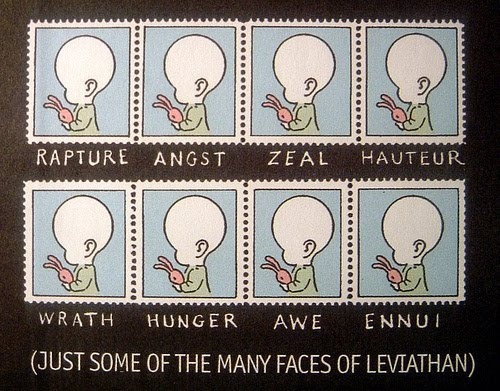
Welcome to a new strange world. In a dazzling work of graphic fiction, a surreal journey through a wonderland eerily like real life, The Book of Leviathan chronicles an infant's investigations into life's great mysteries. Endowed with a preternatural interest in metaphysics and philosophy, yet as confused as any innocent by the vagaries of adult behavior, little Levi bears the added burden of living in a world that can literally change at the stroke of a pen.
Aided by a wise pet ("Cat") and a favorite toy ("Bunny"), Levi encounters a frothing ectoplasmic Hegel and a woefully off-the-mark Freud. In less heady adventures, Levi contemplates why his parents disappear at night (and whether he is wholeheartedly pleased when they return each morning); the regrettable liberties taken with the English language; and the relationship between Bennetton and Pablo Neruda.
Peter Blegvad's Book of Leviathan assembles the cream from Levi and Cat's adventures, published in The Independent on Sunday newspaper in the twilight years of the old Millennium. Blegvad's darkly humorous work has been described by Matt Groening as "one of the weirdest things I've ever stared at". Quirky and referential, dark and droll by turn, it follows the faceless baby Levi's journeys into and out of the world. They are escapes, but as some sage once observed, only a jailer would consider the term "escapist" pejorative.
Peter Blegvad is an American musician, singer-songwriter, and cartoonist. He was a founding member of the avant-pop band Slapp Happy, which later merged briefly with Henry Cow, and has released many solo and collaborative albums. He is the son of Lenore and Erik Blegvad, who are respectively, a children's book author and illustrator.
From 1992 to 1999, The Independent ran Blegvad's strangely surreal, comic strip, Leviathan, which received much critical praise for blending some of the most interesting elements of Krazy Kat with a coming-of-age-esque story akin to Calvin and Hobbes. Some of the strips have been collected in the 2001 volume The Book of Leviathan. Other comics and illustrations by Blegvad have appeared in The Ganzfeld and Ben Katchor's Picture Story 2.
there is a great injustice in this world. and before i get back to my paper and before i write any job recommendations for anybody, i am going to sit down and make a heartfelt plea to anyone who is paying attention to help me fix one little thing that is symptomatic of everything else that is wrong in the world. i just got back from MOCCA, because i am a nerrrrrd, and peter blegvad just happened to be there signing. so of course i have to go up and buy another copy of this book i already own so i can have it signed and chat him up, because i am someone who believes in chatting up my heroes. and he told me that the guy from overlook press (with whom i already have some issues because they won't give up the rights to the first in the trilogy of kjaerstad books to open letter, and my trilogy is therefore not uniform) said that they have never ever had a book sell as poorly as book of leviathan. and i know that has to be true. because even at my store, where we always have copies, often on a display, this motherfucker just doesn't move!! and i do not understand it. seriously - i want an explanation, an excuse from each and every one of you explaining why it doesn't just reach right out and grab you. these are its merits: first of all it is a beautifully designed book. forget the insides for a minute. look at this thing -the page-edges are red, the silver on the cover is reflective and pretty, the colors are bold and eye catching, its got a cat, a bunny, and a faceless baby on the cover and a blurb from matt groening. that deserves at least a browse. and then it is opened, and the illustrations should be enough, even before reading anything, to stop your heart: the care that has gone into this - the detail, the range of his abilities...there are so many styles here - so much technique - each page could be framed and would kick anything's ass at the fucking whitney biennial. this is gorgeous, gorgeous stuff. and then, just read a panel f.t.l.o.g. - references to poetry and philosophy and math and art and physics - quotes from chesterton, and neruda and duchamp!! he is no slouch, this man - but it is not dull and academic - everything within is beautiful and funny and bleak and so well-put. it's just so... right. the man has rocked the book on every level. he deserves your money more than most people. even if you end up not liking the writing, you heathen, you will at the very least have an object of undeniable beauty.
this is what he looks like:
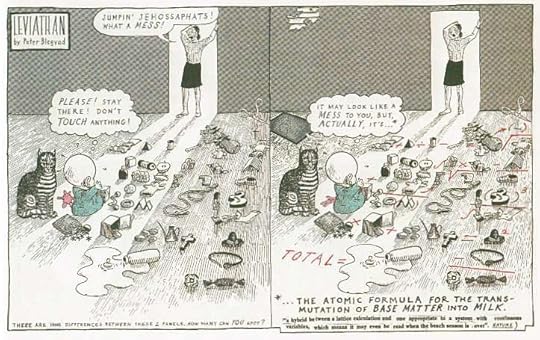
this is what his art looks like:
seriously - you all need to improve this sales rut.
Peter Blegvad was one of my creative writing lecturers at university. He was insane. I mean that in the hey-guys-I'm-zany sense, but also potentially in the clinical sense. His sessions were amazing: a multitalented creative dynamo, he would draw stuff, sing things, he would talk complete bollocks in a sort of hungover midatlantic professorial drawl; quite often he would come in with a guitar strapped to him and pluck it intermittently, like a nervous comedian. I remember once analysing a poem with him, and he ran quickly through the last word of every line and suggested for each one a slightly different word that sounded similar, so that in a few seconds he had recreated a sort of alternate-universe version of the whole poem, floating behind the existing one, but with a completely different meaning. It was ridiculous but mind-expanding – like a lot of his work.
In those days, the Independent on Sunday had just stopped running Leviathan, the cartoon he'd begun in the early 90s. It's one of the most amazing strips you'll find – bonkers, non-sequiturial, philosophical, dreamlike and thought-provoking and awww-cute all at the same time. Reading it feels like reading Calvin & Hobbes during a drug-induced paranoid episode.
The titular character (Levi for short) is a faceless baby who (so far) can only say ‘Dep!’ out loud, but who nevertheless conducts long philosophical discussions about life, the universe and everything with his cat. The ideas floating through these strange cartoons touch on, inter alia, Nez Perce spirituality, Chilean thinker Volodia Volosky, lepidoptery, Georges Bataille, advanced mathematics, origami, synaesthesia, Hegelian dialectics, antimatter, Lowell, Hobbes, Munch, Chesterton, Marlowe, Freud, eschatology, Schrödinger's cat, the history of blank pages in literature and a whole lot of metaphysics.
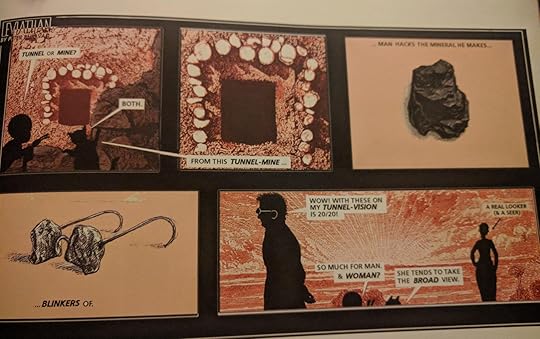
The artwork varies enormously, from precise two-tone diagrams to lushly-painted landscapes to photomontage cut-ups to artistic pastiche to various other hybrid styles that I couldn't confidently identify. The overall effect is one of oneiric weirdness, where every detail assumes symbolic importance and you feel you're soaking up something crucial, even though you can't really explain what it is.
PB is mainly a musician – his best-known song, Daughter, is the one that plays over the closing credits of Knocked Up – but every time I get this book off the shelf I wish he would do more drawn/written work. Leviathan's a uniquely odd experience, and it always leaves me feeling creatively fresh and inspired – with the added, unexpected bonus that now I've had babies myself, I'm finding a whole nother layer to the strip that I never even realised was there.
One of my biggest reviewing pet peeves—and indie-rock critics are notorious for this—is the whimsical genealogy, e.g., if the Velvet Underground reunited for a battle of the bands in a Texas honky tonk, with Cat Power sitting in for the long-dead Nico and Danger Mouse dropping beats behind a resentful Lou Reed, the results might sound a bit like the new Arcade Fire album. It’s a tired, lazy, monstrously stupid form of comparison. And I’m totally going to use it here.
Imagine, then, that Flann O’Brien and Henri Rousseau, looking to pass the time in purgatory, decided to collaborate on a comic strip. They steal the central conceit from Calvin and Hobbes—all the copyright lawyers are in hell—and hit up Samuel Beckett for some of the metaphysical gags he left out of Waiting for Godot. Then, spotting Charles Schulz in the piano lounge—
Aw, fuck it, you get the idea, and I hate myself enough as it is. That’s sort of what The Book of Leviathan is like. Needless to say, it’s marvellous, just marvellous. There’s a reason the GR punditocracy has pressed this volume to its shapely, collective bosom. Well, two reasons: because Karen told it to, and because the book is really, really good.
And here’s a fun bit of trivia: Leviathan’s creator, Peter Blegvad, is one of the co-founders of the seminal prog-rock outfit, Slapp Happy. How cool is that? Not only is the guy a cartoonist of genius, but he’s also a minor musical legend.
Buck’s conscience: So, what have you been doing with YOUR life? Buck: Well, I wrote a bunch of reviews for this really neat website and, um… Buck’s conscience (storming off): I’m staying out late and I’m coming home drunk.
Because of the stricken beseeching on behalf of this book from one who has never steered me wrong (er, out of the one recommendation I've actually followed up on...so far! there will be more), and because I have this thing I'm supposed to be doing for one more week and nothing makes me wanna do everything else like having a duty, I picked up this collection.
Marvelous! So clever, funny, endearing, smart, cool, gentle...where's my thesaurus? I know I'm missing quite a few of the allusions but I catch enough to feel good about myself and enjoy.
I need to scan in a couple and contrast with some of the junk in the newspaper. This blows Cathy out of the water. Marmaduke? Marmapuke! Die, Family Circus. Zits, you can stay. Baby Blues, for the strip showing sleepy dad getting shocked awake by hungry baby seeking out any nearby nipple, I love you. But you all pale in comparison to Leviathan. Why can't the newspaper have good things like this?
I gather than this was originally a strip, and I can see how it would be fabulous in that format. There were a lot of things I liked about it -- the puns, the cleverness, the allusions -- but reading straight though as a book, I got bored with it fairly soon on.
I've owned this for a couple, or maybe a few, years. It's been a while since I bought it. Karen had recommended it to me an even longer time ago. And now I've finally sat down to read it. I'm a little behind on following through with people recommend to me, but I see that quite a few people did listen to Karen's praise of this book. They were all smart folks and listened to her a couple of years ago. But I'm the winner because if I had listened to her back then I wouldn't have enjoyed this book on the afternoon of December seventeenth two thousand and twelve, just days shy of when Quetzalcoatl returns to destroy us all. I needed something that felt good to read on this overcast day, especially after reading a few blah books in a row.
Now I'm thinking of all the good books I could have read in the past couple of weeks, the ones that I have been saving for the future, and thinking what if those new-age lunatics are correct and the world has only a few days left, did I really need to read those books when I could have say, finally finished reading the stories in Oblivion or any of the other books I keep passing by because it doesn't feel like the right time to read a book that I'm sure to enjoy? Did I fuck my last couple of weeks of all-existence like I've fucked up most major decisions of my life?
Please don't let this be the end!
But I can at least be glad that I read this one, and that I'm going to get to see Leonard Cohen twice in the last four days of existence. Really, this book and seeing Leonard Cohen on the apocalypse-eve isn't so terrible, right?
Buck was given some shit in his comments about not saying what the book is about, so I better mention what the book is about because I'd hate to disappoint someone stumbling upon any of my reviews.
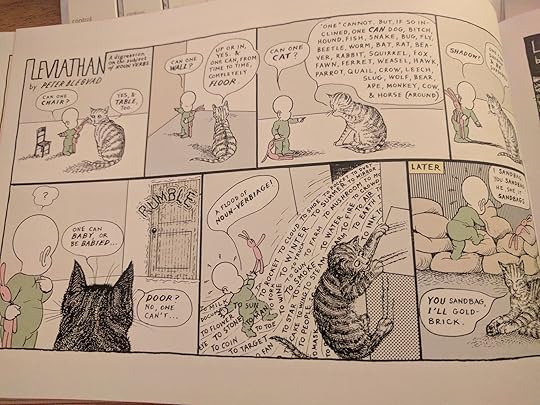
The book is about a baby, his stuffed bunny that doesn't talk, and his pet cat that does talk. In real-life the baby can only say Dep!, but in the inner-workings/logic of the comicstrip he contemplates all sorts of questions, metaphysical quandaries and engages in lots of word-play. That's what this is about.
This might be the smartest comic strip to appear in a newspaper. Possibly ever. Think mashing up some of Farside with Calvin & Hobbes (which makes me wonder about the use of philosophical names in this and Bill Watterson's strips) and some of the Life is Hell thrown in, and then sprinkle in lots of smarty pants references, Chesterton quotes, cameos from famous artists and a slew of unreferenced homages and pastiches to earlier era comic strips. That kind of almost pointless pointing towards other works to define this one fails to describe how good many of these strips are.
I'm kind of jealous of newspaper readers who got to read these when they were being published, and got to read the strips that weren't collected (although maybe with the wonders of the internets you could look through old issues of The Independent on Sunday and see them all in all their glory on your device's display device.
If you haven't read Karen's review (because goodreads won't let me create a link that actually works anymore: http://www.goodreads.com/review/show/...), you should because she has gotten lots of people to read this book, and she will probably do a better job than I'm doing at convincing you to seek out this woefully half-forgotten gem and read it in the last few remaining days we have left before those our world irrevocably changes (which it most likely won't, but do you really want all existence to end without enjoying something as good as this?)
This one I took a few days to read slowly, as it feels both familiar (like Peanuts and Calvin & Hobbes and Crocket Johnson's Harold and the Purple Crayon) and very strange. And Eisnein told me to read this guy, one of his faves. It's an art book about kids, about parenting, about the strange little animals babies are, with existentialist philosophy and surrealism thrown in. And dreams. It's both commonplace (babies and their perspectives on the world are weird, dude!) and also highly bizarre, in that it is a kind of parenting-as-mindblowing-experience-kinda-book, but also so NOT a conventional parenting book like all those you read.
It's a "parenting" book for artists of all kinds who were not prepared in the least to be parents, seems like. It's a book of reflections about babies and things about existence babies make you reflect on written by a hipster musician who has taught creative writing, a guy who was born in New York City in 1951 and now lives in London. {Full disclosure: This dude was in a number of musical groups, but I think I heard him play in The Golden Palominos when he happened to be in Ann Arbor in the late eighties) (Is this true? I think he was in the GP then!)
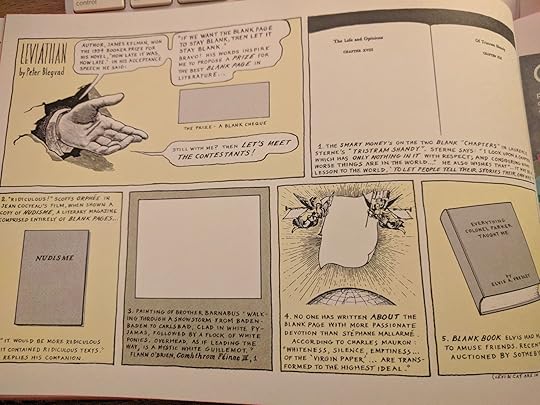
This book is a kind of compilation of strips he did in London in the nineties. And it reflects his weird reading framework, his bizarreness, his lightheartedness, his philosophical nature and goofiness. For instance, on one page he reflects, divergently, on best blank pages in novels, such as a couple pages on Laurence Sterne's Tristram Shandy, pages that invite readers to construct their own aspects of the story.
What does that have to do with an art book on parenting? I dunno. But it works for me. I have kids and read a lot of books on kids to try and figure out what to do about these small strange creatures, but this feels more like a philosophical reflection on growing up or parenting or being a baby that i would have liked to read when they were small. About human development. Clearly I have nothing useful to say about this book except I enjoyed it and found it amusing and pretty unique. Thanks, Eisnein, for introducing him to me!
Some of the entries suffer a surfeit of cleverness, quotations, and general obliqueness, but as much as I didn't want to love it, because then I'd might as well admit that I am held by the tractor beam of Karen's recommendations, I did like Blegvad's book. Very much.
The Book of Leviathan is wry, mocking, and doesn't take itself half as serious as all the ground it attempts to cover. I kept thinking I was reading a list of mnemonics from a compulsive reader of philosophy and the odd engineering textbook, who, in order to remember his lessons needs to turn his sing-song in-jokes into comics. Blegvad is funny, and from what I can tell, a really decent human being.
I picked this up used because it had great drawing of a tabby cat on the cover and when I flipped through it I liked the drawing style. It looked weird.
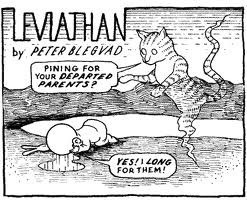
Once I started reading it, I saw that yes, it's weird, but I mean that in the nicest possible way. Ostensibly it's strips about a featureless baby with a huge head, clutching his bunny and wearing pajamas, and his cat, but jesus god, that doesn't even begin to describe it. It's not cute in the slightest, though some of the strips are genuinely moving. Leviathan does normal baby things like wake up at night and panic when he realizes he's alone but he doesn't wake up and scream, he engages Cat in philosophical discussion. One of the first ones in the book is a long quest let by Cat, to return his parents from the land of the dead. He must not turn back as he leads their shades over five mountains. And at the end, there he is in his cot with his father saying "He won't look! Do you suppose he's mad at us for going out to dinner?"
It's about philosophy, art, what-is-reality, angst, war, peace, the human condition. It veers wildly from fantasy and word play to comic reality. Schrodinger's Cat shows up too. You can get a look at some strips here. My copy is inscribed by the author to Ammon in Arizona. His loss is my gain.
I put this book down for a while, partly because I didn't want it to end, and was glad to be reminded of it by Karen's review.
I would still like to be able to draw a tabby cat as well as he does.
Blegvad's strip is endlessly fascinating and experimental but inconsistent. He hits some remarkable highs and the surrealistic artwork is a joy to look at but there are plenty of jokes that don't work, usually when he breaks the fourth wall. At first glance it seems like a more overtly adult Calvin and Hobbes, but after reading the full book I decided that wasn't the most apt comparison (even if I ultimately measured the two against each other).
The mixture of philosophical exploration, absurd wit, and mathematics is familiar to anyone who has read xkcd, though the jokes in Leviathan aren't as niche. Leviathan is arguably more literary (the first story in this collection is a retelling of the story of Orpheus), but it's far from impenetrable, particularly since almost every reference is cited in-comic. In truth, I don't think these references added much to the story. Quite a few of them just seemed unnecessary.
Where Blegvad excels is in his ability to take an idea or metaphor and draw it in a fascinating way. Levi's first step, the lightbulb picture, and the right to bear arms picture are all great pictures that display a wealth of imagination. Blegvad also loves puns, so you'll get plenty of those, including this gem . Sadly, that strip is one of the few times Blegvad's exploration goes deep enough. His philosophical strips often stop right on the cusp of being profound, but rather than Calvin and Hobbes' deliberate open-endedness and sense of adventure it just feels like Blegvad faltered.
I suppose in some respects it isn't fair to compare Leviathan to Calvin and Hobbes. The later, after all, had a much longer run and thus had the time to tackle the variety of topics it did. Yet I find it telling that even in a collection of strips from the comic's the jokes can end up being similar to one another. Blegvad is great at visualizing and making puns, but like everything else repeated over and over again it can suffer from over-exposure.
Blegvad barely even tries to characterize the cast, and this is entirely to the book's detriment. I would have liked it if Levi had some kind of consistent personality, though admittedly it would have been harder to convey given that Levi is physically unable of making facial expressions.
I just wanted more. I wanted the philosophical explorations to go deeper, the humor to be more varied, and the characters to be memorable (so, yes, I would have loved another Calvin and Hobbes). Still, I find much admirable about Blegvad's work, and it's a shame that it isn't more well-known. It would be especially interesting to see what comics creators could do if more artists drew inspiration from the astonishing and surprising art of Leviathan.
she cant sleep without a nightlight.. she's afraid of she calls the: .."DARK"..
Ha! even in the dead of night, this is NOTHING compared to darknesses i've known. just as eskimos discern dozens of gradations of "white" in a vista of ice & snow.. ..so i recall different darknesses from my recent past:
- the darkness which preceded my conception.. (from UNAIDED MEMORY) ..now THAT was dark! - the same darkness many aeons later.. lit by a twinkle in my father's eye. - the stygian depths i navigated.. as a spermatozoon. - the darkness in which i made myself, cell by cell, following instructions.. in my mother's blood.
i was born with darkness IN MY BONES!
i admit, this INNER DARKNESS... ...catches me off-guard sometimes ...but i can handle it.
...INNER DARKNESS is no match for INNER LIGHT.
completely absurd, strange and weird but oh so wonderfull journey.. >:D<
A baby named Leviathan is just plain good writing. It's like the baby Stormageddon on Doctor Who. Babies are physically small, but monstrous in the way the envelope the lives of everyone in the house. So that's brilliant right there.
What's also brilliant is that Leviathan has no face. Babies are their own selves, but to those around them they appear as blank slates, to be molded in our own images.
Then there's the writing and the beautiful artwork. The nods to philosophy and history and literature. All from the mouths of a child and a cat. It's like Calvin and Hobbes, just one level up.
Certainly worthy of its (ever growing) position as a classic.
The book contains some wonderfully inventive comic strips. It had the playfulness of Krazy Kat but infused with a darkness familiar to readers of Al Columbia.
I'm not typically a fan of comic strips, especially reading them all in a row in a large volume. But Peter Blegvad managed to make each strip extremely fresh. Highly recommended!
I owe my love of Leviathan to Jess, who found it for a ridiculously cheap price in our campus bookstore and sang its praises so much that I had to buy it. I then, naturally, stayed up ridiculously late reading it, entranced. What a beautiful, funny, remarkably intelligent book, full of strange truths and bizarre worlds.
Blegvad titled the character Leviathan because of the juxtaposition of bringing home a baby. Such a tiny helpless creature that's survival becomes the focus of its parents entire world: the leviathan in the cot. Similarly the strip confronts the word through Levi's eyes, and attempts to deal with a leviathan of topics and puns. Sometimes this works.
I borrowed this from a friend because it looked just my thing with its interesting art and weird concepts (weird is, in general, right up my alley). It's a collection of strips that ran in the Independent on Sunday (an English 'broadsheet') in the early 90's, shortly after the paper was founded. In the early 90's I was much too young to be reading the paper and I don't recall seeing it around the house so this book is entirely new material for me.
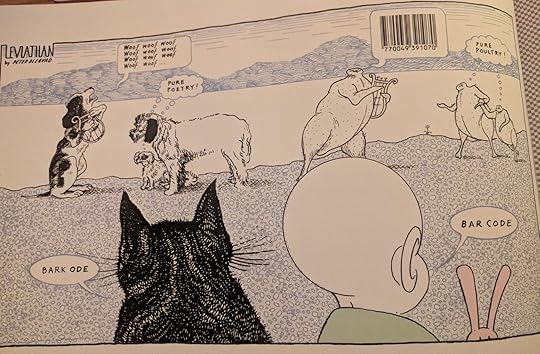
It's.. ok. The foreword is absolutely glowing, praising Blegvad's mix of humour and metaphysics but I think I didn't get some of the references and the ones that I did get didn't particularly impress me. There's a scene in which Hegel, 'father of dialectics', breaks down what the antithesis of Levi's stuffed bunny toy is. And, ok, it's some what absurd to see his ideas applied to a kid's toy but is that it? Is that the joke? I'm not convinced it's all that funny. Some of the panels on word-play, such as the one below, did make me chuckle.
But it's a 'heh' rather than a full-out laugh. The strips I think worked the best were the ones that showed some whimsy and didn't take themselves too seriously.
I didn't dislike this but didn't love it either. I actually prefer Blegvad's original concept with the Stewey-style baby and his mean older sister. The weird stuff was nice but lacked a coherent theme tying everything together. Art was simple and varied. Short-format comics meant that Blegvad tried to make use of interesting drawing styles and paneling, which is always appreciated. Overall it's fine, not the best, not the worst. -------------------- Below I include some of my favourite strips so you can get an idea of the variation in his style and tone.
Delighful, that's the word for this book. I first knew of Peter Blegvad as a clever musician who had collaborated with the dB's and had a great song called "Daughter" which I had put on a few new-parent mixtapes. Somehow I found out that he was also the creator of a comic strip, collected in this volume, which I purchased many years back and only read first couple of pages. I'm so glad it finally once again emerged at the top of the stack.
The first run of strips put me in the mind of Canadian filmmaker Guy Maddin — a dark but hopeful old-timey dreamscape. And I loved it already. (Which is not a given, considering that the comic stars a baby and a cat, two things I've been known to quickly scroll past on social media.) But Leviathan has so much more to offer! Intellectual humor and allusions, terrible excellent puns, surrealism, twisted stuff, etc. etc. It's the rarest of creative works that I did not want to end — I was sad as the number of remaining pages dwindled.
That there aren't more volumes of Leviathan out there (there are non-book panels on Blegvad's related website) makes this collection all the more special. What a gifted individual to excel in two different fields! What a world he invented in Leviathan!
I had never heard of either Blegvad or Leviathon when I happened upon this book, but as I flipped through it, I was taken fairly quickly by its bizarre creepiness. The protagonist, Levi (short for Leviathon--who would name their child that?), outdoes earlier bald child/baby comics characters such as Mickey Dugan or Henry by lacking any facial features at all. His companions are a talking cat, rendered, usually, in a more realistic style than Levi, and his stuffed bunny (which does not talk, or indeed do anything). The strip occasionally offers short continuities but more frequently is a gag strip, though the gags at times make even Gary Larson look tame. The strip mixes styles liberally, is at times whimsical, creepy, surrealistic, existential, nihilistic, and meta. In short, apart from the continuing characters (and Blegvad's fondness for groaner puns--a bonus for me when I actually read the book, as I hadn't spotted any of those in the bookstore), the strip can go pretty much anywhere. Levi even dies at least once, with no ongoing consequences. Unfortunately, this is the only collection of the strip, and I am pretty sure it is incomplete. I'd love to see more. While this work rarely inspired belly laughs, or even chuckles, it it a brilliant example of comics art.
A strange, spellbinding comic. Favorite parts: The entire first sequence, I. Lost & Foundling is harrowing and impressive and also still punctuated with humor. You know from the onset you're in for a trip.
My favorite strips are all ones that zoom in on the world from Levi's baby perspective: Levi's frustration that the realistically-drawn rabbits and ducks in his picture books don't look like Real Ducks and Real Rabbits (his cartoony toys). His investigations of dust balls (food?). Most of these are in or shortly after II. Milk.
My other favorites are in the bizarre wordplay category: Man: I'm exercising my right to bear arms! Levi: I'm exercising my right to arm bears! Bear: Arf!
But Leviathan is not a this-is-what-the-world-looks-like-to-babies comic, and it's not a punny wordplay comic. It goes on to much more ambitious and weirder things. It's a pretty unhinged comic that does whatever it wants, which is pretty cool, but also frequently left me a bit disoriented. There are a few pages I'd like to extract from the book and have framed. Overall though, I think it's one I respect as opposed to one I fall in love with.
This was... strange. So strange that after I finished reading it, I wasn't sure if I liked it or not. But after flipping through the pages a second time, I decided I liked it.
I first heard about this book here http://www.bbc.co.uk/programmes/b06cw171 where Neil Gaiman discusses the myth of Orpheus and the impact it has on artists. This book came up and I was pretty interested, so I picked it for my 2017 reading challenge as a book recommended by an author I love.
I'm not sure if I can recommend The Book of Leviathan. Again, it's strange. But maybe you're a fan of strange things.
Not nearly as deep as some reviews make it sound. There is a definite introspection here, something in the vein of "Calvin and Hobbes" but I didn't find anything earth-shattering here. On the other hand, this was funny and enjoyable to read so I found it worthwhile nonetheless.
A lot of eccentric Soviet university teacher type humour with occasional bursts of "something else", of which I was hoping there would be more. All these language jokes gathered under one cover somehow cancel each other out.
Bill Watterson by way of Ad Reinhardt, Peter Blegvad explores philosophy and myth through the mannerisms of an infant. Mining deprecated graphic conventions before it was cool, never eschewing terrible puns, Blegvad has produced a post-modern masterpiece of comics.
As strange and beautiful as the great man’s music, it might seem overly complex and tough to get into initially but once you do it unfolds majestically and enticingly just like his greatest records (although clearly closer to Slapp Happy than Henry Cow)




 come to my blog!