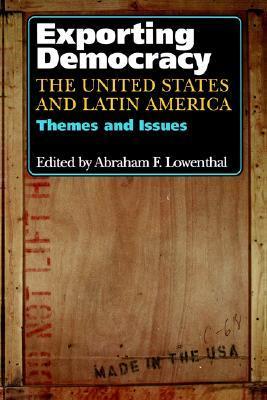
The idea that the United States can and should help Latin America achieve democracy has been a recurrent theme in U.S. foreign policy throughout the twentieth century. By the 1990s, it had become virtually unchallenged doctrine, broadly supported on a bipartisan basis. Yet no systematic and comparative study of U.S. attempts to promote Latin American democracy has ever been published ― and the policy community often seems unaware of this history. In Exporting Democracy, Abraham F. Lowenthal and fourteen other noted scholars from the United States, Latin America, and Europe explore the motives, methods, and results of U.S. efforts to nurture Latin American democracy. Contributors focus on four periods when such efforts were most the years from World War I to the Great Depression, the period immediately following World War II, the 1960s, and the Reagan years. The book tells a cautionary tale ― revealing that U.S. efforts to export democracy in the Americas have met with little enduring success and often have had counterproductive effects. Exporting Democracy is available in two paperback volumes, each introduced by Abraham Lowenthal and organized for convenient course use. In the first paperback volume, Themes and Issues, contributors and their topics are Paul W. Drake, From Good Men to Good 1912-1932; Leslie Bethell, From the Second World War to the Cold 1944-1954; Tony Smith, the Alliance for The 1960s; Thomas Reagan The 1980s; Elizabeth A. Cobbs, U.S. Self-Interest and Neutrality; Paul G. Buchanan, The Impact of U.S. Labor; John Sheahan, Economic Forces and U.S. Policies; Laurence Whitehead, The Imposition of Democracy; Abraham F. Lowenthal, The United States and Latin American Learning from History. In the second paperback volume, Case Studies, the contributors and their topics Carlos Escude, The Costs of Contradiction; Heraldo Munoz, The Limits of "Success"; Jonathan Hartlyn, The Dominican The Legacy of Intermittent Engagement; Lorenzo Meyer, The Exception and the Rule; Joseph Tulchin and Knut Walter, The Limits of Intervention; Elizabeth A. Cobbs, U.S. Self-Interest and Neutrality; Paul G. Buchanan, The Impact of U.S. Labor; John Sheahan, Economic Forces and U.S. Policies; Laurence Whitehead, The Imposition of Democracy; Abraham F. Lowenthal, The United States and Latin American Learning from History.
is Professor Emeritus of International Relations at the University of Southern California and President Emeritus of the Pacific Council on International Policy; an adjunct professor (research) at Brown’s Watson Institute and a nonresident senior fellow at the Brookings Institution. He was the founding director of both the Latin American Program of the Woodrow Wilson International Center for Scholars and of the Inter-American Dialogue, and served as a Ford Foundation official in Latin America, as director of studies at the Council on Foreign Relations, and on numerous editorial and governance boards. His AB, MPA and PhD are all from Harvard University.