

What do you think?
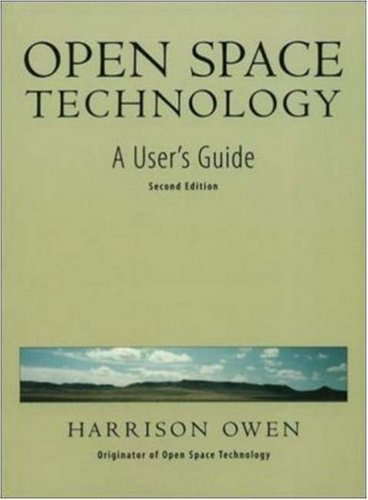
Open Space Technology: A User's Guide
Open Space Technology: A User's Guide is just what the name implies: a hands-on, detailed description of facilitating Open Space Technology (OST). Written by the originator of the method - an effective, economical, fast, and easily-repeatable strategy for organizing meetings of between 5 and 1,000 participants - this is the first book to document the rationale, procedures, and requirements of OST. OST enables self-organizing groups of all sizes to deal with hugely complex issues in a very short period of time. This practical, step-by-step user's guide details what needs to be done before, during, and after an Open Space event.
173 pages, Paperback
First published January 1, 1993
Ratings & Reviews
Friends & Following
Create a free account to discover what your friends think of this book!
Community Reviews
Displaying 1 - 24 of 24 reviews

October 2, 2013
As I don't feel such a book can be reviewed, I will just write down my notes for further use.
~ The 4 Principles ~
1. Whoever comes is the right people.
2. Whatever happens is the only thing that could have.
3. Whenever it starts is the right time.
4. When it's over, it's over.
~ The one law ~
The law of two feet
~ Additional Sign ~
Be prepared to be surprised
Find a theme of OST (often in the form of a question)
Create a schedule
______| TIME | TIME |...|
PLACE|.........................
PLACE|.........................
..
PLACE|.........................
~ Opening Ceremony ~
1. Welcome
2. Focus the group
3. State the theme
4. Describe the process
5. Create the community bulletin board
6. Open the Village Marketplace
7. Get out of the way
"Open Space Technology runs on passion bounded by responsibility."
"Take a piece of paper, inscribe the title, sign your name and announce your offering to the group: "
"The fundamental job of a facilitator is to honor (hold) the space for the people. This means that nobody can, or should, be forced to engage in any activity for which they are not ready and willing."
"Trust the people."
~ The 4 Principles ~
1. Whoever comes is the right people.
2. Whatever happens is the only thing that could have.
3. Whenever it starts is the right time.
4. When it's over, it's over.
~ The one law ~
The law of two feet
~ Additional Sign ~
Be prepared to be surprised
Find a theme of OST (often in the form of a question)
Create a schedule
______| TIME | TIME |...|
PLACE|.........................
PLACE|.........................
..
PLACE|.........................
~ Opening Ceremony ~
1. Welcome
2. Focus the group
3. State the theme
4. Describe the process
5. Create the community bulletin board
6. Open the Village Marketplace
7. Get out of the way
"Open Space Technology runs on passion bounded by responsibility."
"Take a piece of paper, inscribe the title, sign your name and announce your offering to the group: "
"The fundamental job of a facilitator is to honor (hold) the space for the people. This means that nobody can, or should, be forced to engage in any activity for which they are not ready and willing."
"Trust the people."

November 30, 2017
I read this for work! We have been doing Open Space Discussions at our conference for 3 years and started at our company meeting last year, and I was happy to take the time to read the book from the guy who started it all. We are already doing this system pretty well - we mostly do things as in the book, with some upgrades and higher tech online schedule. But there are a few bits we don't currently do and I look forward to chatting with my colleagues about if we've considered them.
Having experienced Open Space ~4 times with groups from 200 to 1000+, I can confirm it works well! I love Owen's emphasis on passion + responsibility. So key! We regularly heard on conference evaluations that people were disappointed there had been no time at our conference for X topic. Now with open space, everyone has a chance to put their own topics on the agenda, and if they don't, it's no one's fault but their own. That's similar to how he phrases it in the book, and sounds kind of harsh, but is a great way to flip the traditional responsibility model and have all attendees take part in constructing the final agenda.
Harrison Owen being pretty old and having started designing OST in the 1980s, a couple things in here are amusingly anachronistic - most notably his mistrust of laptops!, but also no details about putting the schedule online, sharing proceedings electronically, tons of detail about un-networked newsroom computers, etc. I'm not sure about newer sources for modern OST principles, but also I think we're already doing a pretty good job at my company.
Worth the read. But I do think reading the book is a tough substitute for actually experiencing an Open Space event, and would encourage anyone interested in the format to seek out a live opportunity, possibly even before reading the book. The book makes a lot more sense if you've seen it in person!
Having experienced Open Space ~4 times with groups from 200 to 1000+, I can confirm it works well! I love Owen's emphasis on passion + responsibility. So key! We regularly heard on conference evaluations that people were disappointed there had been no time at our conference for X topic. Now with open space, everyone has a chance to put their own topics on the agenda, and if they don't, it's no one's fault but their own. That's similar to how he phrases it in the book, and sounds kind of harsh, but is a great way to flip the traditional responsibility model and have all attendees take part in constructing the final agenda.
Harrison Owen being pretty old and having started designing OST in the 1980s, a couple things in here are amusingly anachronistic - most notably his mistrust of laptops!, but also no details about putting the schedule online, sharing proceedings electronically, tons of detail about un-networked newsroom computers, etc. I'm not sure about newer sources for modern OST principles, but also I think we're already doing a pretty good job at my company.
Worth the read. But I do think reading the book is a tough substitute for actually experiencing an Open Space event, and would encourage anyone interested in the format to seek out a live opportunity, possibly even before reading the book. The book makes a lot more sense if you've seen it in person!

February 16, 2010
If you've ever been a part of a well-facilitated Open Space event, this book will take you to the backstage, where you will quickly discover that the backstage looks very much like the stage. In reading this book, I was transported back to the energizing, extraordinary moments that I've spent in Open Space. The book is essentially a step by step guide to an extremely simple, yet powerful means of facilitation.
If you're looking for a way to help people self-organize, look no further than this book. Open Space Technology works and this book shows you how. I am looking forward to finding an opportunity to use it.
If you're looking for a way to help people self-organize, look no further than this book. Open Space Technology works and this book shows you how. I am looking forward to finding an opportunity to use it.
January 30, 2025
This is an handbook on how to use the Open Space Technology (OST) facilitation/group process approach.
Open Space Technology is a great way to organize a meeting where people can present their own issues, problems, ideas and let it flow on its own - it's community based, so people decide where they go - the so called Law of Two Feet - use your feet to go wherever you feel like in that Open Space.
Although too verbose to my liking, the book indeed describes the mechanics of OST and delves into neat tips & trick on what to look after as a facilitator - those parts are worthy, author's opinons, emotions and thoughts - not so in my view.
All in all - it is definitely useful for a facilitator to know how to use OST in their work. Hence I can recommend this book to any facilitator out there who wants to expand their workshop toolset.
I give it 4/5 only on the basis of being too verbose to my liking - if you don't care about too many words then you can treat it as 5/5
Open Space Technology is a great way to organize a meeting where people can present their own issues, problems, ideas and let it flow on its own - it's community based, so people decide where they go - the so called Law of Two Feet - use your feet to go wherever you feel like in that Open Space.
Although too verbose to my liking, the book indeed describes the mechanics of OST and delves into neat tips & trick on what to look after as a facilitator - those parts are worthy, author's opinons, emotions and thoughts - not so in my view.
All in all - it is definitely useful for a facilitator to know how to use OST in their work. Hence I can recommend this book to any facilitator out there who wants to expand their workshop toolset.
I give it 4/5 only on the basis of being too verbose to my liking - if you don't care about too many words then you can treat it as 5/5
August 30, 2022
The author uses a daily language which made me feel like having a conversation or stories being told. It is not written in a dry way to give instructions about how to facilitate an Open Space. He gives many examples from his experience to help the reader imagine how the elements of Open Space might work in real life.
He also invites the reader to think about why Open Space works and gives his own guess.
He also invites the reader to think about why Open Space works and gives his own guess.
January 12, 2025
This is a book about getting people work together for a common goal.
An excellent read. I enjoyed the author's writing style which is extremely practical, down-to-earth and useful.
I would strongly recommend this book to anyone who works with large groups of people and personally believes in empowerment of employees at all levels. Those who work as group process facilitators and leaders will definitely find it useful and applicable.
An excellent read. I enjoyed the author's writing style which is extremely practical, down-to-earth and useful.
I would strongly recommend this book to anyone who works with large groups of people and personally believes in empowerment of employees at all levels. Those who work as group process facilitators and leaders will definitely find it useful and applicable.

December 27, 2017
Very informative and this helpful in considering the use of Open Space Technology, but structured in a strange way

February 18, 2023
For work. Surprisingly useful concept, would recommend.

Read
April 15, 2026Interesting, though I think perhaps you have to see it to believe it. There's a lot of "it works! Trust me!" In this book. Also it could use more checklist summaries to be a true "users guide."

August 29, 2026
If you can get past some of the out of date sections and focus on the intent, I liked this different idea of how to call groups together to work on a project/solving a problem.
Discusses how you invite, work with groups of all sizes in a way where they take ownership and are charged to finish the project- almost like a sprint.
I love that, yes- it will look and feel chaotic, but when you are solving a problem, all the puzzle pieces must be thrown out on the floor. Secondly, how you get people to take ownership of issues, and if you don’t want to participate - fine, leave- you don’t want anything in the way.
Basically, who ever comes and stays are the right people. What ever they come up with is what was needed. When it starts it starts. When they are done, it is finished.
And what was truly unique is at the end of this sprint, participants took home a product of what they discussed, discovered, resolved and who will work on what to wrap up the project when they get back to their work spaces
Discusses how you invite, work with groups of all sizes in a way where they take ownership and are charged to finish the project- almost like a sprint.
I love that, yes- it will look and feel chaotic, but when you are solving a problem, all the puzzle pieces must be thrown out on the floor. Secondly, how you get people to take ownership of issues, and if you don’t want to participate - fine, leave- you don’t want anything in the way.
Basically, who ever comes and stays are the right people. What ever they come up with is what was needed. When it starts it starts. When they are done, it is finished.
And what was truly unique is at the end of this sprint, participants took home a product of what they discussed, discovered, resolved and who will work on what to wrap up the project when they get back to their work spaces

September 23, 2015
The concept behind the book is just fantastic. The author does a great job conveying it. There are times when I would have liked wording to be less mystical (and more succinct) but I was able to easily translate those times to concepts/terms based on intuition and subconscious a la Malcolm Gladwell's Blink). These were only minor distractions to genuinely powerful concepts that use just a few rules that encourage the group to self-organize.
WARNING: Your reaction (and satisfaction to this book) will likely fall into one of two camps (one negative and the other positive): THOSE WHO ARE NOT FAMILIAR with self-organizing concepts will likely have trouble believing this could work (and the mystic type language will turn you off even more). You will be at best skeptical and at worse, you won't finish the wacky book. It absolutely is that radical of a mind-shift. THOSE WHO ARE EXPERIENCED IN self-organization concepts, will not be too surprised and you will quickly see how you can leverage that power for large and complex issues. You are in for a real treat!
I found the author's observation (which many have shared) that this is incredibly simple, yet with results so amazing that it, at first glance, seems impossible. However, I'm experiencing that people need just follow a few rules/concepts to really bring out the best in them. So there's one side that makes this look like an unbelievable phenomenon, then there's the other side that simply feels like, Mr. Owen discovered a great way to bring out the best that is already in all of us (I'm firmly in that group). Now we just need to leverage this in the right contexts and it will continue to grow and hopefully, give us insights into the concepts so we can bring out the best in us more frequently.
Thanks Harrison! You rock!
WARNING: Your reaction (and satisfaction to this book) will likely fall into one of two camps (one negative and the other positive): THOSE WHO ARE NOT FAMILIAR with self-organizing concepts will likely have trouble believing this could work (and the mystic type language will turn you off even more). You will be at best skeptical and at worse, you won't finish the wacky book. It absolutely is that radical of a mind-shift. THOSE WHO ARE EXPERIENCED IN self-organization concepts, will not be too surprised and you will quickly see how you can leverage that power for large and complex issues. You are in for a real treat!
I found the author's observation (which many have shared) that this is incredibly simple, yet with results so amazing that it, at first glance, seems impossible. However, I'm experiencing that people need just follow a few rules/concepts to really bring out the best in them. So there's one side that makes this look like an unbelievable phenomenon, then there's the other side that simply feels like, Mr. Owen discovered a great way to bring out the best that is already in all of us (I'm firmly in that group). Now we just need to leverage this in the right contexts and it will continue to grow and hopefully, give us insights into the concepts so we can bring out the best in us more frequently.
Thanks Harrison! You rock!

February 8, 2010
Everyone remotely connected with conferences and meetings should read this book and apply its principles. The basic idea is to let the people attending create the agenda and then vote with their feet as to which sessions they want to attend. At the end, the group writes up the findings and decides on action steps. The idea works best with small groups (under about 300 seems good; around 65-100 seems optimal) and isn't right for every situation, but that still covers a lot of meetings that are now run badly and could be much better.

February 14, 2013
Practical step-by-step guide to the technique, with enough background to the philosophy and origins to give it context, interspersed with examples and tips from his own practice. A quick read, written in accessible language.
My reactions went from interested/sceptical, to "this seems pretty easy!", to "don't be fooled, not so easy." which I think testifies to how he manages to explain the mechanics of the process (the "this looks easy" part) but also focuses on the facilitators mindset and key role (the "not so easy" - at least for some) part.
My reactions went from interested/sceptical, to "this seems pretty easy!", to "don't be fooled, not so easy." which I think testifies to how he manages to explain the mechanics of the process (the "this looks easy" part) but also focuses on the facilitators mindset and key role (the "not so easy" - at least for some) part.

January 4, 2009
I've studied Open Space Technology with Harrison Owen and used his work for my Consultant Theory Oral section in my graduate degree program. Harrison is amazing and his work is elemental for organizations to consider if they want to bring passion alive. Having run open space events, I know how effective they are on multiple levels. To be in his presence and understand the psychic energy needed to carry such a seemingly simple procedure forward is awe inspiring.

April 30, 2010
This book is basically about creating the conditions for emergent leadership and collaboration. It turns out, surprisingly-but-not, that those conditions are:
1. Create the absolute minimum structure necessary;
2. Encourage people to talk about what they care about, with the expectation that something will happen as a result;
3. Get out of the way.
I look forward to creating an opportunity to use this, or at least participate.
1. Create the absolute minimum structure necessary;
2. Encourage people to talk about what they care about, with the expectation that something will happen as a result;
3. Get out of the way.
I look forward to creating an opportunity to use this, or at least participate.
June 3, 2011
Beautifully written account of a beautiful method for creating the space for people to work effectively together on what matters to them. In simple steps, here's all you need to know to run your own Open space event - you'll be surprised how good it turns out.

March 3, 2012
I love OST and prefer it to alternative meeting styles. The background info in the book is informative, but apart from parts IV and V, I did not find a lot of new insight in the book.
That said, the book is a must-read for people considering facilitating an OST meeting.
That said, the book is a must-read for people considering facilitating an OST meeting.

October 4, 2008
This is an amazing, mind-opening approach to addressing challenges and resolving issues in communities and groups.
October 9, 2008
Great book. Great philosophy.

March 2, 2009
Greatly inspiring yet very practical guide to conducting meetings and gatherings using Open Space.

April 15, 2013
Great book by the originator Harisson Owen and very good readable if you want to learn/do Open Space workshops.

October 21, 2014
It really works

May 25, 2015
Even after attending many open-spaces myself, I still found valuable insights or just rationale in this book.

December 31, 2015
This is the quintessential book on Open Space... Highly recommend for your library and practicing in your company...
Displaying 1 - 24 of 24 reviews