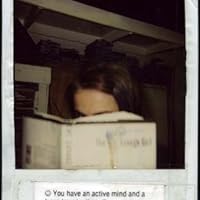
In the late 1950s, Limelight was the busiest coffeehouse in New York and the only photography gallery in the country. This is the story of Helen Gee's efforts to open Limelight and her fight to keep it afloat for seven years. The major figures in photography appear in this story - Edward Steichen, Robert Frank, W. Eugene Smith, Berenice Abbott, and others - and so do the big events of the the opening of The Family of Man, the publication of The Americans. Gee has her own personal stories as well, raising her Asian American daughter alone, dealing with a landlord with underworld ties and bookies who did business in the hall of her apartment house, and coping with unwelcome advances, quixotic employees, and suicidal photographers. This is also a portrait of a time when Greenwich Village was a center of creative activity, when actors, writers, painters, and photographers were part of a burgeoning coffeehouse scene.
In the expanding universe of photography, there are small places, but though small, some remain influential or important.
In these days of the virtual, a physical gallery space is no longer necessary to show photographs. Prior to the internet however, how did people see and buy photographs?
Helen Gee (1919–2004) was a pioneer who should be familiar in that respect, though it is quite likely you’ve never heard of her…but you will, thanks to the 2016 republication, by Aperture magazine, of her autobiography Limelight: a Greenwich Village Photography Gallery and Coffeehouse in the Fifties: A Memoir.
Previously, when I tried to purchase the out-of-print, 1997 University of New Mexico paperback edition, I found it would cost me over $200 (now $A1,200 second-hand), but just the other day I purchased the ebook for only $A11—the Aperture edition (which removes only “A Memoire” in the title, otherwise unrevised) with a new introduction by Denise Bethel, previously head of Photography at Sotheby’s USA.
Like a nova, and nearly as short-lived, Helen Gee’s gallery filled a vacuum in the space-time continuum of American photography in being the only commercial gallery devoted exclusively to photography in New York at that time, and one of the few to open since Alfred Steiglitz at The Little Galleries of the Photo-Secession (est.1905), became more interested, from 1909, in modern painting and sculpture than his first love, Pictorialist, Secessionist photography.
On the West Coast, the f/64 Group had shown their work in Willard Van Dyke‘s gallery, named ‘683’ with a nod to Seiglitz’s 291, located in a converted barn that was previously Pictorialist Anne Brigman‘s studio at 683 Brockhurst Street, San Francisco. It opened in 1930 and closed in 1935. In 1933 Ansel Adams opened an eponymous gallery in the Whittel Building at 166 Geary Street, San Francisco.
Julien Levy too owned a New York gallery at 602 Madison Avenue from 1931 that opened with a retrospective of American Photography, organised in collaboration with Stieglitz, gave Man Ray his first major show, and introduced Henri Cartier-Bresson to the U.S., but by 1932 with a landmark multi-media Surrealist exhibition of the work of Pablo Picasso, Max Ernst, Joseph Cornell, Marcel Duchamp, Levy was to champion mainly painting by Surrealists and early Abstract Expressionists, before closing in 1949. As Gee points out, his sales of photographic prints went only to friends.
Limelight’s gallery space, at only 20 by 25 foot (7 x 7.5 m.), may have been tiny (Steiglitz’s was smaller at only 15 square feet), but as Gee’s autobiography and the sound of huge names dropping throughout its pages make clear—something big was going on.
It gathered steam after opening in May 1954 with shows of photojournalism by Joseph Breitenbach—a recently-made series on Korean children; timely given the recent military division of the country— Rudolph Burckhardt, and Louis Stettner, but by the end of the year was able to muster an international cast for a huge show, Great Photographs, featuring Berenice Abbott, Ansel Adams, Edouard Boubat, Bill Brandt, Brassaï, Manuel Alvarez Bravo, Harry Callahan, Imogen Cunningham, Robert Doisneau, Robert Frank, Izis, Lisette Model, Gotthard Schuh, W. Eugene Smith, Paul Strand, Jakob Tuggener, Sabine Weiss, Edward Weston, and Minor White.
Her family’s only portrait together (Photographer unknown, c.1926 illustrated in the book) is revealing. Gee does not fit the profile of the wealthy patron of the arts like Steiglitz who lived on a generous family allowance, or the dilettante who fancies themselves as a gallery director. It is interesting to see how her shy but sympathetic gaze is directed at the camera while her brother and sister stand impassive, starring at the commercial portrait photographer directing them rather than at the lens. Her father, a conservative migrant and widower from Austro-Hungary brought up the family on his own. Trained in church decoration but in America a painter of apartments, he made art on the weekends.
His youngest daughter rebelled when he remarried to an even more conservative woman whose approval of the rise of Hitler she despised. This was the era of the Works Progress Administration, part of which was the Federal Art Project employing over 5,300 artists, employed in settlement houses and community centres to give classes to 50,000 children and adults, one of whom was Gee who enrolled at fifteen, and by sixteen was living with a Chinese modernist painter Yun Gee, himself supported by the WPA Easel Painter’s Project. He encouraged her in her emulation of Isadora Duncan‘s life of love and art of which she had dreamed since she was ten. She married him in 1942, giving birth the next year to their daughter Li-lan who went on to be an artist herself.
Despite painting an upbeat Here’s New York containing a Chagall-esque portrayal of his new wife, Yun Gee found the city unwelcoming and prejudiced against Chinese and had escaped to Europe where he’d experienced better times, but had to return at the outbreak of war. In his absence, Helen used her artistic skills to support herself as a photo retoucher with the American Photograph Corporation chain whose inexpert franchisees operated portrait studios with the company’s Photo Kandid Operating Manual in one hand, and whose products required a deal of airbrushing.
Disappointed after his return from Paris and working hard in a munitions plant to support his pregnant wife, Yun broke down, was diagnosed with schizophrenia and prescribed shock treatment. The strain shows on Helen’s pale, drawn face in a snapshot (by unknown photographer, illustrated in the book) of her holding Li-lan. Though her Limelight is an autobiography, and a heroic one, little comes through in her writing about Gee’s internal life during these travails except an understanding that she was a woman of remarkable resilience and an opportune pragmatism. Such traits prompted her termination of two impractical marriages as well as her career moves, the first of which was to graduate from painting roses on porcelain love-hearts and hampers after the photo-retouching work fell through.
Having met, through Li-lan, the wife of art director John English, he gave her work airbrushing his magazine imagery, and she taught herself to retouch the colour transparencies that were then replacing monochrome commercial imagery. By 1951, I was doing quite well. I had given up black-and-white print retouching and specialized in color, and my clients included not only McCalls (where John English was now art director), but four-star advertising agencies and leading magazines. I had a pleasant apartment in midtown, a secretary named Queen Nonnamaker, and could afford to send Li-Ian to a private school. I’d given up thrift shops, wore designer clothes, and even had a bit of a social life.
Exhibitions of photography at the Museum of Modern Art, then under the curatorship of Edward Steichen, were shown in its old building in what was called the auditorium gallery, located on the lower level of the museum next to the film theatre (and the women’s toilets, as Gee notes in her account).
These shows inspired Gee to become a photographer herself, but her attempts to learn the craft were frustrated in the advanced course run by Alexey Brodovitch and by the lack of technical instruction offered in Lisette Model‘s classes or those of the Photo League‘s Sid Grossman (who was black-banned by McCarthy). It was in the midst making street photographs at the San Gennaro festival that the conflict between getting good shots and the temptation of the food stalls gave Gee the idea of opening a gallery combined with a coffee shop that would draw the crowds.
Limelight, named after the Charlie Chaplin film, was the product of sheer determination. Using $6,000 from her retouching and from an injury lawsuit, Gee renovated an affordable, but derelict, nightclub which she rented on a dodgy lease agreement with a mafia-connected landlord. There, new triumphs—and tribulations—began.
She rounded up friends including an interior designer Peggy Tallmer to plaster, paint and transform the place, separating with screens an atmospheric Chinese-lantern lit restaurant from the brightly illuminated white space of the gallery, the small, intimate proportions of which are ideal for the close viewing of 8×10 prints pinned directly to the panels.
The first exhibition, and many afterwards, received considered reviews from Jacob “Jack” Deschin of the New York Times, then one of the few critics dedicated to photography.
He kindly ignored his disappointment that Joseph Breitenbach showed no contextual imagery of the actual conflict in Korea, but described his pictures of the children as “some of the most heartrending in documentary history”.
Given that, in the midst of Limelight’s career, Steichen’s The Family of Man at MoMA was drawing huge crowds, photojournalism, documentary and street photography were the favoured styles, anything ‘arty’ met with suspicion, even including Laszlò Moholy-Nagy’s photograms; “What? Another art photographer? … Steiglitz, now Moholy-Nagy? … Can’t you show work that’s more relevant? … these men belong in the past”
It is crammed full of the big names of the period; Philippe Halsman, Arnold Newman, Cornell Capa, Weegee, Lew Parrella, Louis Stettner, David Vestal, Morris Jaffe, Jerry Danzig, David Heath, Suzy Harris, Lee Friedlander, Sid Kaplan, John Cohen, Morris Engel, Walt Silver, Harold Feinstein, Paul Seligman, Martin Dain, Leo Stashin, Norman Rothschild, and Victor Obsatz.
That several of those were photojournalists, and that others who hung out at Limelight, Arthur Lavine, May Mirin, Leon Levinstein, Hella Hammid, Simpson Kalisher, Ray Jacobs, Ruth Orkin, and Ed Wallowitch, featured in The Family of Man represents the greater interest in documentary work amongst New Yorkers who regard West Coast photographers as ‘arty’.
But there’s also plenty of gossip; the ‘revenge’ show Portraits of Each Other by Dorothy Norman (Georgia O’Keefe‘s nemesis) in which Steiglitz’ pictures of Norman and hers of Steiglitz were hung together; W. Eugene Smith‘s drunken and benzedrine-charged dilatoriness in hanging his show (a story somewhat contradicted by James Karales photo above); Edward Steichen wearing a kimono and on crutches in hot pursuit of Gee around his apartment and other colourful episodes all make titillating reading. Gee’s closeness to Robert Frank, Lisette Model, Berenice Abbott, Edward Steichen and Sid Grossman provides historically valuable material, but it would be wonderful if she’d delved a little more into stories of the lesser known, like the enigmatic Ed Wallowitch, and while the book is supplied with excellent contemporary photographs by Arthur Lavine, Gee returns his effort with only small mention (disappointing, since he is so little known).
Gee’s Limelight is an extraordinary demonstration of generosity and bold perseverance, as anyone who has run a privately funded gallery will attest, and ultimately, it is the valuable contextualisation of photography in this formative period in its history that makes Limelight: a Greenwich Village Photography Gallery and Coffeehouse in the Fifties a worthwhile purchase. Apropos transactions, Bethel, the writer of the new introduction and former photography auctioneer at Sotheby’s, notes that while Westons, W.E. Smiths and Atgets were available on Limelight’s walls at 2019 values of $200-$500, few sold, but have since brought millions for a single print. Hindsight is a luckless Janus.
One of my biggest qualifications for my ratings is whether or not I'm interested in the subject. Writing skills and the "pull" of a book are also important. This book has all three!
Telling the story of the coffee house/photo gallery, Limelight, located in Greenwich Village along with a history of how photography was becoming an art form rather than just a way to sell products in magazines. The book tells about her life during the years she owned the gallery, her run ins with those who wanted to take advantage of her naiveite, the numbers runners who helped protect her and her daughter, along with the run ins with motorcycle gangs, beatniks and the unions wanting to incorporate into her business.
The best parts of the book were her stories about the artists and photographers which frequented her establishment. Oh...to be a fly on the walls of that coffee house!
One of those places that made Greenwich Village what it was, at least in the mind of a kid growing up in Jersey. It was mentioned in a thread on a FB group, and I found a copy. It was engaging and easy to read. You get a sense of the time and place, from the perspective of one woman whose endeavour made a mark on the world on photography, maybe a small mark, but one that has endured without following generations knowledge.
The thing that did get a little much, later on, is the way she name drops. It approaches self aggrandizement, without quite getting there, it was her life after all. Never the less, this is a book for anyone interested in photography, or the scene in the 50's/early 60's Village. I enjoyed it very much.
Anyone interested in photography, specifically the history of photography in the 20th century will appreciate this book and the unique experience of Helen Gee. This is the second time reading this book having read it soon after it was first published. Happy to have the Kindle edition.
Wonderful book about the only photography gallery in New York in the 1950's. She has many interesting stories to tell of the struggle to keep her gallery open and about the photographers she exhibited.
This was such a great book. So interesting to see how people, whose love of photography, or any medium, guides them to open galleries. Before Helen Gee opened her restaurant/gallery, there were almost no galleries that had focused on photography, but she helped pushed the medium forward as a choice for collectors. There were still many years to come - even after Limelight closed, before photography was completely accepted as an "art" form. While the lives of artist are wonderful to read about for their drama, creativity, and inspiration, those of the patrons, curators, art dealers, and critics are equally fascinating, as they are the movers and shakers of the arts. Not only do they herald the artists by helping to create an environment where the artists are supported, but they help to develop the cultural foundation for a society. In the end, however, galleries are a business, and this book allows the reader to see the process and understand the hard work and frustration involved.
Written in an effortless style, this book is a must-read for any fan of photography who wasn't there to hang out with Robert Frank and the like in 1950's Greenwich Village. Limelight was the first gallery to show only photography and became a nightly destination for the city's cultural scene. Helen Gee recalls her struggles of running a business while being a single mother, her personal dealings with many great photographers (barely known at the time), and her fondness for the medium of photography. She captures the City's vibe in a way that makes you wish, if not feel like, you were there.
I read this book at the same time with Patti Smith's "Just Kids" and the two provided a wonderful picture of NYC and The Village. Especially good read for photographers. Helen Gee's story includes great photographers of the time, mobsters and what it was like to live in the village and try to start a business, the coffeehouse/gallery called Limelight. Both of these books are written to pull you in, to live inside the words, especially Smith's beautiful prose.
Fun read for photo nerds, as well as anyone interested in the NY art scene of the 1950s or the trials and tribulations of starting and running a business.