In this extraordinary fiction debut--rich with love and betrayal, history and intellectual passion--two remarkable narratives converge on Easter Island, one of the most remote places in the world.
It is 1913. Elsa Pendleton travels from England to Easter Island with her husband, an anthropologist sent by the Royal Geographical Society to study the colossal moai statues, and her younger sister. What begins as familial duty for Elsa becomes a grand adventure; on Easter Island she discovers her true calling. But, out of contact with the outside world, she is unaware that World War I has been declared and that a German naval squadron, fleeing the British across the South Pacific, is heading toward the island she now considers home.
Sixty years later, Dr. Greer Farraday, an American botanist, travels to Easter Island to research the island’s ancient pollen, but more important, to put back the pieces of her life after the death of her husband.
A series of brilliant revelations brings to life the parallel quests of these two intrepid young women as they delve into the centuries-old mysteries of Easter Island. Slowly unearthing the island’s haunting past, they are forced to confront turbulent discoveries about themselves and the people they love, changing their lives forever.
Easter Island is a tour de force of storytelling that will establish Jennifer Vanderbes as one of the most gifted writers of her generation.
Jennifer Vanderbes is an award-winning novelist, journalist and screenwriter whose work has been translated into sixteen languages.
Her first novel, Easter Island was named a "best book of 2003" by the Washington Post and Christian Science Monitor. Her second novel, Strangers At The Feast, was described by O, The Oprah Magazine as "a thriller that also raises large and haunting questions about the meaning of guilt, innocence, and justice." Her third novel, The Secret of Raven Point, was hailed as “unputdownable” (Vogue) and “gripping” (New York Times), and Library Journal wrote: “the only disappointing thing about this book is that it has to end."
Her first non-fiction book, Wonder Drug: The Secret History of Thalidomide in America and Its Hidden Victims, is forthcoming from Random House and HarperCollins UK. Her essays have appeared in the New York Times, Wall Street Journal, Washington Post and The Atlantic, and her short fiction has appeared in Granta, The Magazine of Fantasy & Science Fiction, and Best New American Voices. Her books have received awards from the Guggenheim Foundation, the Alfred P. Sloan Foundation, and the New York Public Library. She was named a 2019-2020 NEH Public Scholar for her work on Wonder Drug.
Vanderbes received her B.A. in English Literature, Magna Cum Laude, from Yale and her M.F.A. in Creative Writing from the Iowa Writers' Workshop. She lives in New York City with her two daughters.
One of my favourite picks for Serbian market... Good book, good story that deserves to be read for years and years... I'm sorry to see that none of my Goodreads friends has read it yet... :( But you can always change that... Published by Narodna knjiga - Alfa, 10 years ago... Let say for those who liked THE LIGHT BETWEEN OCEANS...
3.5★ for this dual timeline story where the location is arguably the main character. I feel like my curiosity about Rapa Nui has been satisfied to a large extent.
In 1912 Elsa Pendleton is taking on responsibilities beyond her years upon the death of her beloved father. Forsaking the chance of happiness with her German beau, Max, Elsa enters a marriage of convenience with her father's former colleague, the anthropologist Professor Edward Beazley. He has promised security for Elsa and her younger sister, Alice, along with the possibility of adventure when he conducts field research in far-off lands. And it's not long before the trio - Edward, Elsa and Alice - are preparing to depart for Easter Island under a commission from the Royal Society for Edward to study the mysterious moai of the remote island. The voyage takes the best part of a year, and their eventual arrival fills Elsa with both relief and apprehension.
Meanwhile, the German fleet under the command of Vice Admiral Graf von Spee, which is stationed in Tsingtao Harbour on China's Yellow Sea, hears the news of the assassination of Archduke Franz Ferdinand. Former friends had become enemies overnight as war was declared.
So the British stood and dusted their lapels. The Chinese set their cups down. A strange energy pervaded the room—a game, they all knew, had begun. And, like children agreeing to close their eyes and count to ten while someone hides, they extended politenesses. Hands were shaken, apologies offered. In German and English and Chinese, good-byes were said.
In February 1973, recently widowed Dr Greer Farraday arrives on Easter Island to begin her first fieldwork in years. A botanist and palynologist, she is excited to begin what she expects to be the closest as is possible in her field to a controlled experiment, searching for the earliest pollens in order to understand more about the dispersal of flora.
Islands have long been the ideal studies of isolation, and with Rapa Nui, we have an island so isolated geographically, so isolated in its human history, it is, in essence, a perfect test tube for examining patterns of speciation, migration, and evolution.
Upon her arrival, it quickly becomes clear that not only her new colleagues, but also the island residents, had been expecting her late husband, Dr Thomas Farraday.
The three story threads across two timelines alternate and then intersect in unexpected ways. Most of the tension is provided by two things, in my view: in the earlier timeline it's the onset of World War 1 and the fate of the German fleet, while in both timelines it's the simple remoteness of the island and the fact that it takes so long for news to reach there.
Along the way I learned a lot about Rapa Nui - the island, the people and the language - and the science of palynology (possibly more than I needed). While I commend the author for her research and her craft in bringing it all together, I would have preferred more tension across fewer pages. A lengthy, but mostly worthwhile read.
150 pages in, I'm really enjoying Easter Island. It has a patient, quiet narrative and masterful grasp of subject matter (botany, taxonomy, evolution and science in general) that is unassailable and reminiscent of Sacred Hunger. It also maintains an excellent balance and synergy between the parallel narratives of Elsa and Greer. It always seems a danger, to me, in this construct that one storyline will become dominant or just more interesting than the other. But so far, alternating, I always find myself pleased to be back in the world of the other and equally eager to remain there.
Alice is an especially compelling character - unique, magical, electric - and the relationship between the sisters is remarkable.
One area that seems puzzling, possibly lacking, in both storylines (so far), is a sense of foreboding or danger to the women. With Greer, in the modern world, I'm happy to experience her day-to-day exploring, wrapped, as she is, in sadness. But with Elsa and Alice, two young attractive women, quite alone in Victorian times... I haven't quite found my footing. There's a feminist quality to it, in that Elsa remains quite in control of the situation, but also what verges on naivete to the characters and the narrative. It seems almost unbelievable that during the entire boat trip, sequestered as they are with male sailing crew, nobody makes a move, not the husband who is quartered separately, nor any members of the crew, make a single (mentioned) advance on simple, comely Alice. I'm only 150 pgs in, however, and perhaps (as I suspect) this is still to come.
This book absolutely delighted me. I went into it with no expectations - it was a random selection from the library - and I finished it a little blown away. I have a feeling this is what The Conquest by Yxta Maya Murray wanted to be - a fictional novel that wraps science and fact into its tale - but where The Conquest stumbled, Easter Island soars. The characters are flawed and not entirely likable, the plot comfortable and not especially surprising, and the ending is not tied up in a little bow, but it works. The author relies heavily on science to tell the story, and when I read the last page, it all came together - the two interweaving stories and the underlying science. I can see why book groups would select this, as it opens up endless avenues of discussion - although I will also say this is one of those books that, as much as I loved it, I recognize it's not for everyone. Highly recommended.
This is my kind of book! I love it when two or more stories come together like this. Easter Island is the story of two women who went to the island and did research. But the two women's stories are 60 years apart. There is also a small thread of a German World War I naval squadron present in the book.
Elsa Beazley arrives at Easter Island in 1916 with her new husband and her mentally handicapped sister. Her story was inspired by the true story of Katherine Scoresby Routledge and her husband. Elsa's husband has brought her and her sister there so he can research the huge statues, known as moai. Elsa helps him with his work, but eventually becomes immersed in work of her own = translating a series of ancient tablets.
Sixty years later, Dr. Greer Farraday arrives on the island. A specialist in fossil pollen, she comes to escape a painful past, which is revealed little by little as the story progresses.
Beautifully written with lovely descriptions, this book captured me with the first page and did not let me go.
Every so often it’s good to wander off into a novel and completely check out from reality. Actually, it’s good all the time, but it isn’t easy to find a book that good, that immersive, that well written. Well, this is one of those books. Found randomly and selected due to my fascination with the most remote island on earth, the navel of the world, Easter Island. Tough place to visit, even with all the modern travel conveniences, even less so back in the day, one of the narratives is set in the early 1910s and then the journey took a year. The other narrative is set in 1973, when planes have shortened the travel time considerably, but it’s still a while. Then again a destination that singular seems to almost require extraordinary measures to get to. For dedicated armchair travelers such as myself it’s a Kindle download away. And poof, you’re there. Easter Island. A place of mystery. I knew a fair amount about the place from previous reading and tv, but this was definitely the most definitive sort of trip, educational and immersive. The author has done her research, using actual accounts from various visitors over the centuries, real historical personage on note, to present a well rounded look at a microcosm in various evolutionary stages, from booming civilization to destitute starving survivors. In fact, the 1973’s storyline protagonist Greer comes up with a terrific theory as to how and why that came to be. Her chronological predecessor, Elsa, is more about studying the mysterious writings known as rongorongo. Both women are brought to the island due to regrettable, wretched really, personal circumstances, both in different ways deceived by their spouses, on the island both of them find a form of mental clarity and solace, albeit it not in the same measure. In fact Elsa’ story is much more tragic, she’s stuck with a mentally challenged sister (a genuinely loathsome girl irrespective of her condition) and determined to take care of her, even if it results in making devastating personal choices. Some 60 years later Greer has considerably more options and yet once again there’s the motif of an older man and a marriage fraught with dishonestly and disappointment. Nevertheless hers is certainly the more uplifting of the two narratives, which is probably why the author gives it a more rounded arc and ends the book with it. The spit narrative thing, in fact, was the only challenging thing about this reading experience and only to the extent that each storyline was so completely engaging that it was difficult to switch gears from one to the other. I might have even preferred it as two separate books, although of course they do complement each other. This actually read slower than the page count suggested, because I believe it commanded a certain almost languorous approach, the writing required being luxuriated in. In case you haven’t figured it out by now…I loved this book. It was exactly as good of a novel as its destination deserves and a lovely read. Not just a terrific work of historical fiction. A terrific work of fiction. Mauruuru.
The name Easter Island evokes a sense of mystery and romanticism. The book Easter Island delivers on both accounts.
Begin with an oceanic island fifteen hundred miles from any other landmass, one that had taken thousands of years for plant life to reach its shores and much longer before human life managed to land there. Add in two women, separated by sixty years as their parallel stories are told, each brought to Easter Island - one an Englishwoman who accompanies her anthropologist husband and the second, an American botanist who is researching the island's ancient pollen. Throw in the colossal moai statues, which even today are slow to give up their mysterious past. To all this mix in a German fleet running from the British as the world is plunged into the Great War in 1913.
Before beinning Easter Island I had never heard of palynology and I might not have chosen to read so much about biota and angiosperm research and plant pollen and Chilean palms, etc. However, Jennifer Vanderbes has managed to weave a thoroughly fascinating tale and delivered it with excellent writing skills.
I was looking forward to reading about Easter Island, about its people and monumental statues.
However, the style of writing is very descriptive. If you hatched out those descriptions, there wouldn’t be much to the story line.
Elsa with her husband and sister arrive at the Easter Island at 40% through the story.
Half way thorough the story, it is revealed what Elsa finds on the island and it becomes her project. “Elsa needs something on her own. She wants to secure a balance between them (her and her husband), even a distance.”
And what is most interesting, is presented in words instead of action.
It is a very dry read. It reads like an encyclopedia.
It's comforting to imagine that aliens placed those inscrutable statues on Easter Island. Such a theory protects us from the more haunting implications about human nature. The tiny island, 2,300 miles west of Chile, was settled around 400 A.D. Its early inhabitants - with or without extraterrestrial assistance - carved more than 600 giant faces from volcanic rock and then dragged them to the shore. Some weigh almost 90 tons.
In her gorgeous debut novel, "Easter Island," Jennifer Vanderbes has attempted something equally ambitious, and her success is almost as baffling. How can an unknown writer tell three stories across 60 years, balancing romance, botany, feminism, archeology, military history, academic politics, and civil rights for the handicapped in just 300 pages? The press release refers to a degree from Yale and a stint at the Iowa Writer's Workshop, but I suspect alien intervention.
The novel shifts chapter by chapter between the stories of two women, while also tracing the doomed retreat of German Vice Adm. Graf von Spee at the opening of World War I. Any summary risks making this all look like a tangle of unrelated events, but Vanderbes displays Mother Nature's genius at spinning a web of life.
In 1913, Elsa Pendleton has lost both her parents and finds herself the guardian of her 19-year-old sister, Alice, who is mentally handicapped. Their father was an enlightened academic who spent his life (and his fortune) fighting to defend the freedom of "feeble-minded" people at a time when England was moving toward forced sterilization and institutionalization.
Without him or any money of her own, Elsa consents to a marriage of convenience with an archeologist, a much older colleague of her father. The arrangement is peculiar, but apparently agreeable to all involved. Elsa's husband treats her like a beloved niece, never presuming on her affection or expecting any marital intimacy.
Their honeymoon, with Alice in tow, is an expedition to Easter Island, under a commission from the Royal Geographical Society. Though it's a 12-month voyage to a speck in the Pacific Ocean without any modern conveniences, Elsa is thrilled with the prospect of adventure, which has the added benefit of removing her sister from their increasingly intolerant homeland.
Exploring this unusual sibling relationship takes Vanderbes into a region more foreign to most readers than anything they'd find on Easter Island. The intensely private, beautifully intimate moments captured here between these sisters are, in fact, like nothing I've read anywhere else. But Vanderbes perceives this unique relationship with the kind of insight that eventually sheds light on the evolution and design of all relationships.
Elsa has grown up in a state of "constant vigilance" to maintain her sister's safety. Alice is a funny, frustrating, unpredictable young woman, but Elsa's sense of duty "has produced in her a seriousness that makes others uneasy" and blinded her to the costs of trying to shield Alice from any unhappiness. When Elsa realizes that the exotic world they've sailed into offers myriad opportunities for danger, she believes "she doesn't even deserve to sleep." In the emotional calculus Elsa has maintained since childhood, her sister can never be blamed for anything; Elsa must turn all frustration, all disappointment, all anger on herself.
The other story takes place in the 1970s and involves a young woman named Greer Faraday, who comes to the island to study pollen dispersal. The scientists already stationed on the island have mistakenly expected her world-famous husband, but for Greer the trip is a chance to recover from the shock of his death and make sense of their brief, troubled marriage.
As a female graduate student in an all-male department at Michigan University, Greer had to work through the benefits and liabilities stemming from her relationship with a hotshot professor. Her classmates' assumption that she was being favored academically eroded the value of her work, and her husband's appropriation of her research corroded the foundation of their marriage.
Vanderbes takes shortcuts with this modern story that sometimes make it less satisfying than the older one, but again she's brilliant at portraying emotional ambiguities.
For very different reasons, both Elsa and Greer married scientists they barely knew. They enjoyed real benefits from those unions, but both women are eventually forced to confront their own naiveté and the crimes hidden in their marriages. For Elsa that confrontation is unimaginably tragic, but the modern story that eventually merges with it provides just the right note of affirmation.
Among the many pleasures of this novel are the scientific issues that Vanderbes laces so gracefully through these lives. Both heroines share an interest in Charles Darwin and (though they don't realize it) the same copy of his groundbreaking book.
Elsa's archeological study is particularly fascinating, and eventually downright suspenseful. In less deft hands, Greer's investigation of the island's pollen could have sounded like an investigation of the island's pollen, but Vanderbes keeps the science always accessible and thematically relevant.
"Easter Island" makes a strong case that no man, woman, plant, or moment is an island. By its lovely conclusion, those enigmatic statues seem as familiar and poignant as the private monuments of grief we erect in our own minds. Here's a good reminder that they, too, can be abandoned.
A beautifully written and genuinely fascinating novel that loosely interweaves two stories, set in different time periods, of women scientists coming to Easter Island, one of the most remote spots on the planet, and there managing to overcome the sexist prejudices of their day and establish themselves as independent individuals. While following their stories, we pick up along the way lots of juicy bits of information about sciences like botany, paleobotany, linguistics (did you know that Easter Island was one of only five locales where humanity invented written language, the others being China, Mesopotamia, Egypt and Mexico?), palynology (the study of small particles in nature, in this instance of pollen) and biogeography, not to mention dollops of science history and a plausible explanation of one of history's great mysteries. I've probably missed a few of the sciences the narrative touches on.
The first story is that of Elsa Beazley, recently married to a much older husband because it's the only way she can think of to protect her intellectually challenged younger sister from the attentions of the eugenicists, then enjoying a political vogue in the UK. Easter Island seems the perfect refuge for Elsa, a place where she can study her beloved botany -- although quite soon she becomes absorbed instead in studying rongorongo, the untranslated written relics of the long-ago Easter islanders. Thanks to an elderly leper who remembers something of the old days, she in fact makes some headway in translating the pictographic inscriptions.
The other tale, interwined in the narrative with Elsa's, is that of palynologist Greer Farraday, who comes to the island still reeling not so much from the death of her famed-palynologist husband eight months ago as from the knowledge that he stole from her the most important scientific work she's done to date, claiming it as his own, and later was disgraced on the international stage for having falsified some epochal results. Greer is interested in establishing the past botany of Easter Island, in particular as to how it might relate to the island's environmental denudation and the consequent collapse of its civilization. This gives her, too, reason to focus on the moai, the famous Easter Island statues: why did the descendants of the people who'd put so much societal endeavor into creating the statues, transporting them from their quarry and erecting them along the coast so determinedly cast them down?
There's really a third tale here, the tale of the doomed final voyage of Graf von Spee's fleet as it fled the Allies after the outbreak of World War One. While Elsa's story is loosely based on that of a genuine scientific expedition to the island at about that time and Greer's story is a fiction, albeit a fiction moored in real-life scientific research, the voyage of the doomed fleet is a matter of historical record. The author manages to hook the actuality up with Elsa's story, although this was the one time while reading the novel that I rolled my eyes a bit.
Vanderbes indulges in the occasional injoke. The one that really made me grin appreciatively concerned Greer's postgrad galpal at the University of Wisconsin, Jo Banks. The name didn't ring a bell at all for me until, toward the novel's end, it's somewhat selfconsciously revealed that Jo's full name is actually Josephine -- a tip of the hat to that doyen of naturalists, Joseph Banks.
Venderbes's writing is quite dense, and not conducive to skimming. This, combined with her attention to detail, means the book can move quite slowly, especially in its earlier parts -- it's a gripping page turner, or at least I found it so, but the pages don't turn all that quickly. She's also among the relatively few modern writers I've come across recently who can offer a narrative in the present tense (the whole of Elsa's story) without making a complete hash of the past tenses within that narrative. It may not seem like much to you, but to me it was a delight not to be wincing every other paragraph at some new grammatical blunder.
In the very real sense that it's fiction about science and scientific discovery, Easter Island is science fiction of a high order, although no one would ever think of it in terms of that genre -- in the same way that most readers of The Handmaid's Tale don't think of it as science fiction, even though it manifestly is.
Take two very moving tales of self-discovery, add the thrill of scientific discovery plus oodles of intriguing nuggets of science, and then write it all beautifully to form an absorbing narrative. That's the task Vanderbes set herself, and by golly did she succeed.
I enjoyed reading this historical fiction. It is becomming my favorite genera, and with stories like this one it makes it totally worth my time.
This story was written with three different sub stories involved. All of them converging on Easter Island on two different time lines. One story is about Elsa Beasley, her husband Edward and her sister Alice. Alice is what we call today a special needs individual. I could not exactly say what was wrong with her, but she was a high matenance charge. The three of them sailed from Hertfordshire, England in 1912. Edward is an anthropologist and is working for the Royal Geographic Society to study the culture on Easter Island. They took a year sailing aroung the tip of South America in a 52 foot sloop to get to the island, after crossing the North Atlantic on a White Star liner to Boston. The second time line involves Greer Farraday, a Palyologist, who had lost her husband to a heart attack, 8 months before arriving on the island in 1973.
The characters are all well written and believable. I liked them all. Some of them are based on real characters in history and many of the events and things discussed are also. I enjoyed all of the sub characters and things that happened in the book as well. Much of the technical language about the environment and scientific practices were well written easy to understand. The language of the Easter Islanders, and the Spanish speaking settlers was a compliment to the story and the events.
This story did not have a typical happy ending, but it ended well. I was not baffled nor sad for it to be over. Actually, I was left with a very good feeling. It was satisfying to have read the book and gotten to the end.
Oh my what can I say about this book, except I seriously don't recommend it. Although it presents very interesting history and facts of Easter Island I would have been better off reading Wikipeadia. If you want to read about every scientific plant species grown on the island since it's volanic conception, go ahead and be my guest.
I kept waiting for the three separate stories to blend and make a wonderful marriage somewhere along the way, but geez by the last couple chapters I kept looking back to see if somehow my bookmark had fallen out of the book and I had skipped a section or two.
This book has no emotion, it introduces far to many characters who just ramble on like the book. I seriously think I laughed out loud when Elsa's married true love forgot-his-name whom she was nanny of his children just happened to show up on the Island. And oh my, forgive me, but what was that whole part about Elsa's mentally challenaged sister and Elsa's husband was that "for real"? Oh I must hear a parrot in my ear!
Easter Island is one of those mysterious places that I've always found fascinating, likely because of the sheer distance away that it is. A novel like this merely whets my appetite. The author moves between the two stories, each of a woman who travels to Easter Island after a huge change in life -- Elsa Beazley after her marriage of convenience in the beginning of the 20th century and Greer Farraday decades later in the 70s, after the death of her husband. As each finds her place and true calling we learn more about what came before, and much more about Easter Island itself. The stories intertwine with the help of some WW1 history thrown in.
The writing is lovely and captivating. My one complaint is that Elsa's tale ends so abruptly -- very disappointing after getting to know her.
Reading this book was so peaceful, I almost didn’t care what happened. The education about Easter Island, the moai and rongorongo, and the study of pollen was much appreciated.
Η συγγραφέας έκανε προφανώς πολύ μεγάλη έρευνα για το Νησί του Πάσχα/Ράπα Νούι, αλλά η μεγάλη έρευνα και το πλήθος των πληροφοριών δεν αρκεί για να γράψεις ένα καλό μυθιστόρημα. Το λογοτεχνικό/μυθοπλαστικό μέρος του βιβλίου δεν μου άρεσε από καμία άποψη...
Let me start by telling that I disagree with the trend of labeling books by genre all the time. Following specific structures and using same old same old tropes and patterns deprive originallity and creativity from books. On the other hand, some authors are better than others when they try to write a more composite, sophisticated work that touch on many varied subjects, themes, writting styles and techniques.
Easter Island falls on this trap. Trying to follow many different threads and point to many different directions, it ends up a bit of a mess, disjointed and all over the place. At first the writting on the chapters taking place on the 1910s seemed very artificial to me, although it smoothed somehow latter. The dialogues didn't feel natural to me in most of the book. At the chaters on the 1970s, the main character often keeps repeating words and sentences both in English and Spanish while the locals of Easter Island/Rapa Nui form perfect sentences in English at one moment and skip verbs or proper grammar the next (why do authors always do this when they write local characters? People immediately get the meaning of words such as cores when it come to scientific terms, but have difficulty to use "will" for future sentences?) At other points of the book there are some German dialogues without translation or explanation.
Then neither the plot, neither the characters were convincing. Most of the people in this book were teribbly cliche and the ones who were not were just very weird, but no one was described on a very fleshed out way. The two or three different story lines have some parallels between them, but the lesser WW1 story that ties with the other 1910s story at the end felt irrelevant and the way it ties is absolutely unbelievable. I hate it when authors create a great impossibility or coincidence in order to get their story moving or offer a conclusion. The main 1910s story took nearly half the book before getting the characters on Easter Island and was kind of beating around the bush all the time. The 1970s story with its many flash backs, was all over the place. The main character was ridiculous as was the way everyone seems to fall for her on Easter Island. The information on her science got too much and while up to a point having a look on academic politics etc was interesting, then this part of the book dragged out too much. I hate the trope of someone going somewhere in the middle of nowhere confused, with a broken heart and seen the light, especially through meeting a patroniging man and then patronize someone else. How American is the attitude towards Mahina towards the end of the book?
I can write many more complaints of this book, but my main one is this: I could see some elements of the stories coming from miles away, but still, I was waiting for the author to connect and tie up the two main stories at the end of the book. But they are very very loosely tied and especially the 1910s story ends abruptly.
All in all, although the author felt she had to throw infromation in my face all the time, what I enjoyed most is the setting of the Easter Island, its interesting history and culture, the reports when outsiders "discovered" it, its geology and plants, the scientific research and projects taking place there and all things Easter Island in general. There is lots of feedback, trivial and not so trivial in this book and the author covers more or less all aspects surrounding the subject.
I can see different people like different parts of this book and hate others and v. v.
I first read this book in 2003 and enjoyed it very much. It was destroyed along with many other books in a flood and was delighted that I was able to download it from Kindle. Prior to my first reading I had spent an all too short a time on the incredible and remote Rapa Nui (Easter Island) and wondered if that visit influenced my high rating for the book. The answer is definitely No.
This book may not be for everyone. It has much scientific research and history interwoven with the work, trials and tribulations of two remarkable women attempting to solve the mysteries of Easter Island. One is Elsa who has married an older anthropologist. It is a marriage of convenience as her younger sister has mental and emotional problems and Elsa has assumed the duty of protecting her. They leave England in 1913 on a long perilous sea voyage where her husband plans to study the colossal moai statues, their meaning and why they were knocked down. Once there Elsa learns the native language and attempts to interpret the old pictograph writing. She learns much of the Island history through speaking with older natives. She also watches her marriage disintegrate. Her relationship with her younger sister is in shambles. They do not know that WW1 has broken out and a German naval fleet is on the run across the Pacific trying to hide from the British and French ships in pursuit.
60 years later Dr. Greer Farraday, an American botanist arrives hoping to discover why tree covering and other wild vegetation barely exists on this tropical island, unlike the dense jungle like covering on other islands. She had been married to a brilliant scientist who plagiarized her research resulting in her doctorate thesis being initially turned down as she was blamed for copying him. The marriage fell apart and he died. She does painstaking work on the island. There is also a small group of other scientists and a native woman who befriends her. One scientist is still trying to solve the mystery of the ancient writing while an architect is attempting to find a way to set the giant statues upright once more.
The past connects in a startling way enabling Greer to discover the reason for the lack of trees and how the heavy statues were transported from a distant quarry.
A remarkable book, heavy in research and with a vivid description of Easter Island. The characters are flawed but well developed and believable in both eras. Being dedicated to their work there is little room for love and romantic connections. I love a book which transports me to remote, exotic places and invests me in the lives of its characters.
Opening: The decisive moment for Germany's fleet in the Great War was, indisputably, its ill-timed arrival at the Falkland Islands. Having avoided detection by the Allies for three months since the outbreak of hostilities, it was their great misfortune to head straight for the Falklands just hours after the British Fleet put in to coal there.
This book read too much like a textbook, so I skimmed through quite a bit of it. The only thing that kept me reading was to find out the answers to the few mysteries in the book, and then was quite disappointed at the vague answers that were revealed. I don't like it when authors leave endings up to the readers to figure out. Give me a definite ending, let the characters in the book actually find the answers to the questions asked throughout the book! I also hate when the theory of evolution is crammed down my throat. If you have an interest in botany, Darwinism, evolution, etc. then this is the book for you. None of these things are of interest to me, so my rating is only 1 star.
I read this years ago, when it came out in 2003. It became one of those books that I will never forget, and periodically I look to see whether the author has managed to sneak anoather title out while I wasn't looking. (She hasn't until this year, when in August 2010, Scribner is publishing Strangers at the Feast, which has already garnered several five-star ratings.)
This particular book struck such a chord because it was about a graduate student trying to make headway with her research and discovering that much of the credit for her work was being sapped away by an erstwhile lover...I must reread it to see if the feelings and motivations rang as true today as they did then.
Jag hade höga förhoppningar på den här boken men den var långsammare än jag trodde och tog mig nästan två månader att läsa ut trots de få sidorna.
Det finns två primära narrativ och ett med kortare inslag, men de känns som fyra eftersom det nutida spåret också väver in väldigt detaljerade och långdragna tillbakablickar som jag tyvärr hade noll intresse av. Jag ville ha Påskön men fick istället läsa alltför många sidor om relationer med antingen osympatiska eller intetsägande män…
Varför vi i korta inslag följde en tysk armada vid första världskrigets början tyckte jag också kändes väldigt out of place, men det fick till sist sin förklaring. Väldigt osannolikt, men det bidrog i alla fall med en oväntad plot twist.
Storylinen från 1913 var den jag gillade mest, både i handling och karaktärer, men jag tycker att den drog iväg väldigt abrupt mot slutet och jag är besviken på hur den landade. Om den ens gjorde det, vet inte alls vad författaren ville förmedla med karaktärernas livsöden…
Jag hade också hoppats på att de två primära narrativen skulle vävas ihop snyggare, men också där kände jag att det föll platt. Även språket var oinspirerande och saknade nyans. Forsknings-info dumping blandat med dialoger så uppstyltade att jag ibland inte förstod vad folk pratade om. Jag kan inte avgöra om det beror på översättningen.
Trots detta fanns det bra partier, och när jag väl tog tag i läsandet plöjde jag igenom andra halvan av boken snabbt. Miljöerna på Påskön, öns historia och kontrasten i hur forskning bedrevs i de olika tidslinjerna lyfte helheten. Bara en sån sak som att det för 100 år sedan tog över ett år av hårt slit att segla till Påskön från England med en liten segelbåt satte verkligen saker i perspektiv. Stark känsla av isolering och vilken unik plats Rapa Nui är, vilket jag önskar att boken hade utforskat ännu mer, istället för karaktärernas tidigare relationer.
Easter Island’s another read that haunts me a bit after closing it. So tragic.
Deforestation hits home for me, draws me in to the island thread BIG time. I must confess, I knew absolutely nothing about the ‘piece’ of naval history (WWI) around which two of the three threads were set in their telling. And the history always pulls on me. The third thread re. palynology 😂 way way out of my league. I do not believe I have ever read another book on studies on spores. So it really stirred an interest.
It seems many contemporary writers are crafting these multi-layered stories. Some are beautifully done eg. “The Weight of Ink”. Others may come up lacking particularly in the ‘measures’ of development given to their characters in each thread. And if that lack shows up on one cast as ‘marginal’ in the story who has no voice and yet happens to be the very ‘link’ / connection, 😬 It’s quite damaging to how the reader receives the story. So that explains my 3⭐️ rating.
“Extinction, genocide, survival of the fittest. Someone always had to leave the game.”
“... a people destroyed themselves by building monuments to their dead.”
What nags at me still... deeper deeper... relationships, losses, connections and disassociations, and how what happens within a people can happen within individuals.
Two capable and curious women arrive on Easter Island in very different circumstances. In 1913, Elsa lands on its barren shores in a boat with her new husband and sister. In the early 1970s, Greer, a botanist with her PhD focused on ancient pollen, has come to Easter Island to study its early ecological story. What these two women learn about this rugged, isolated land and what they learn about themselves, will tell a remarkable story of trust gained and lost, of what we dream of but then what we must adapt to and the insatiable curiosity of those committed to studying the world around them.
Wow. This book. It took me away from my life and to another world, a world of mysteries and ancient flowers, giant statues and the people who carved them, life's complicated relationships and the strong women who had to weather them. I loved the threads that tied these two women and their time periods together and even the tiny thread of a German fleet caught in the ocean at the beginning of a war, I just found myself transported. Even though it was a slow story, the narration and the depth, the intrigue of all the flora and fauna scientific inquiry, just refused to let me give it up. So glad I didn’t.
In 1913, Elsa Pendleton's father has recently died, leaving Elsa and her mentally delayed sister, Alice, in a dire financial situation. With The Feeble Minded Control Bill threatening Alice's future, Elsa makes a quick decision and agrees to marry her father's former colleague, Dr. Edward Beazley, who is thirty years older than she and not exactly the man of her dreams. And so, fleeing painful memories and a bleak future, Elsa, her new husband, Edward, and her sister, Alice, travel to Easter Island where Edward will study the island's moai structures. Later, in a parallel story in the 1970s, Greer Farraday's husband, Thomas, has likewise recently died in the middle of a career scandal, and Greer, also fleeing painful memories and an uncertain future, travels to Easter Island as a palynologist to study the island's pollen and plant life. With this book, I enjoyed the various plot lines and diverse female voices telling this story, but really, I was most gripped by the setting. Easter Island was incredibly compelling to me. Its structures, its mysterious history, and its bleak landscape were the perfect backdrop for these parallel tales of women finding themselves after major life disasters and learning their identity apart from the men in their lives. At first, I felt like I needed to keep going back and review what time period I was reading about, who was the star of this section, and what historical events were important in that context (I did think a date and the name of the protagonist featured in that section would have been helpful), but as I read and settled into the rich narrative, I found that the time periods, the setting, and the strong females leads captured my interest and made this a thoroughly enjoyable read.
Very conflicted with this book! The writing was superior but I was put off with the scientific and anthropological detail, while well-researched, I felt it weighed down the narrative and disrupts the emotional flow. Vanderbes clearly aimed to blend intellectual inquiry with emotional storytelling, but for me it got to dry at times and I felt myself skipping paragraphs about samples and how these stone "beasts" got to the island. Why there was no trees or wood, but how blah blah blah, the scientific interludes was big distraction for me
Dual timelines I love: (one set in World War I England, the other in 1970s Easter Island) are ambitious and mirror each other in interesting ways. Thematically, both explore isolation, loss, and the pursuit of understanding—emotionally and academically. Though the characters were a bit distant and lost in the science, I Kept wanting to know more about them!
An amazing book! This one should become famous! Vanderbes has collected unique information about the Easter Island and created her characters by that. It combines history of the island from the first residents till now, everything that is known so far, knowledge of the plant population that existed there and how it affected the life of the people. The situation that was going on at universities with women students and women scientists, romance and many more. Her writing style is beautiful and it doesn't get you tired of the book, the history and the science related facts.
Elsa Beazley came to Easter Island in 1913 and in the 1970’s Greer Farraday comes to Easter Island. Both come with a research agenda. I was slow to like this book, but it is a good story and by the end I was enthralled by the way the author overlaps the stories and uses the island’s famous secrets to tell how women make decisions.
Love this book- not just because I read it while visiting Easter island- but because it was filled with strong and interesting women characters plus I learned a lot about a unique and rich culture rife with mysteries still unexplained.



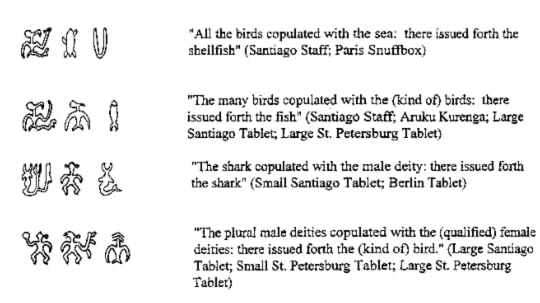 Rongorongo