Jump to ratings and reviews
Rate this book

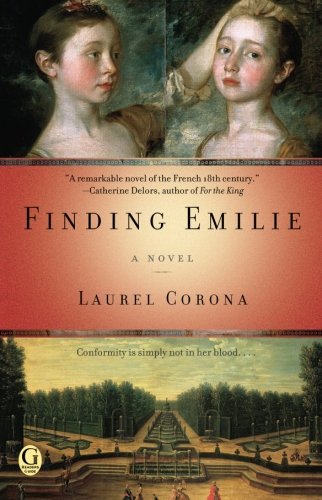
Finding Emilie by Laurel Corona

Rate this book
Woman is born free, and everywhere she is in corsets. . . . Lili du Châtelet yearns to know more about her mother, the brilliant French mathematician Emilie. But the shrouded details of Emilie’s unconventional life—and her sudden death—are elusive. Caught between the confines of a convent upbringing and the intrigues of the Versailles court, Lili blossoms under the care of a Parisian salonnière as she absorbs the excitement of the Enlightenment, even as the scandalous shadow of her mother’s past haunts her and puts her on her own path of self-discovery. Laurel Corona’s breathtaking new novel, set on the eve of the French Revolution, vividly illuminates the tensions of the times, and the dangerous dance between the need to conform and the desire to chart one’s own destiny and journey of the heart.

Paperback

First published April 12, 2011

11 people are currently reading
1749 people want to read

About the author

Laurel Corona

31 books136 followers
I have loved reading and writing ever since my older sister came home from first grade to teach me what she had learned that day. My first publications were in the Oakland Tribune in a weekly section for children called "Aunt Elsie's Page," and a newspaper I put out for my family which featured reviews of what I was reading and news about what was happening in the lives of my dolls.

I was lucky enough to have parents who encouraged me from the beginning, and who showed their support by giving up much of what they must have wanted for themselves so my sister and I could get the best possible education. As a result, by the time I graduated from The Bishop's School in 1967 and enrolled as an English major at the University of California at Davis, I had come to appreciate that good writing is extraordinarily difficult but well worth the effort. I couldn't believe I could get a degree by devouring novels and poetry in bed in my pajamas, and writing papers on ideas that burned in me as I read, but it turned out to be largely true. Graduate school at the University of Chicago (MA 1972) and again at Davis (Ph.D, 1982) followed.

Professionally, early in my career I was both an instructor and an administrator of academic support programs at San Diego State University and the University of California at San Diego. I came to San Diego City College in 1990, first as a dean and then as a full-time professor of English and Humanities. I also freelanced in the 1990s, writing approximately 20 Young Adult titles for Lucent Books.

Lately, i have been enjoying the opportunity to serve as an enrichment lecturer on Silversea Cruises, and in my spare time, I am an avid tennis player, novice golfer, voracious reader, and a pretty good chef.

Ratings & Reviews

What do you think?
Rate this book

Friends & Following

Create a free account to discover what your friends think of this book!

Community Reviews

5 stars
89 (22%)
4 stars
150 (38%)
3 stars
101 (25%)
2 stars
38 (9%)
1 star
11 (2%)
Displaying 1 - 30 of 64 reviews
Profile Image for Annette.
955 reviews605 followers
July 12, 2019
“On September 3, 1749, shortly before her forty-third birthday, Gabrielle-Emilie le Tonnelier de Breteuil, the Marquise du Chatelet, gave birth to a baby girl, Stanislas-Adelaide. Six days later, already back at her translation of and commentary on Newton’s Principia Mathematica, Emilie du Chatelet complained of a headache, and within hours this charismatic and brilliant woman of letters was dead. This is a work of fiction about the daughter she left behind.”

“Historical records indicate that she (the daughter, Lili) died of unknown causes before her second birthday.” The story of Lili is a pure fiction.

The story alternates between two times: when the mother Emilie is alive, a brilliant woman translating work of Newton and having an affair with Voltaire; and Lili growing up in a convent and also under a supervision of her godmother, exposed to the thinkers of her time and encouraged not to just follow what convent imposes, but to use her own judgement.

It sounds as it should be a very interesting read, but the story and characters are flat. I felt no connection to the story or characters.
355 reviews11 followers
April 20, 2011
This review first appeared on my blog: http://www.knittingandsundries.com/20...

In real life, Emilie du Chatelet, married to one man, long-time mistress and friend of Voltaire, gave birth to Stanislas Adelaide (Lili), child of yet another of her affairs, at the age of 43 and died 6 days later from a sudden illness. Lili died before her second birthday.

This novel is a fictionalized account of Lili's life had she lived, growing up with her godmother Julie de Bercy, who was in the house when Emilie died, pregnant with her own daughter Delphine. Her father pays a living stipend, but never visits, and her progress is monitored by her father's sister-in-law, Baronne Lomont, a strict adherent to society's protocols.

Lili is loyal, questing, and intelligent in an age when female intelligence and knowledge is still an affront to a proper society - a society where only the working class, not nobles, pay taxes, and she is shielded from the knowledge of her true parentage and her mother's scandalous life.

Lili's scientific mind and refusal to simply "be satisfied with being ordinary" are at the center of this novel. In her search to find her mother's story, she finds herself as well.

QUOTE: "I've tried to explain to her that her intelligence was charming on a girl, but not in a young lady. I've told her more than once that no man of quality will choose to marry someone whose head is buried in a book all day and every time she insists she'd rather have the book than the man"
Profile Image for Farin.
29 reviews9 followers
May 15, 2011
It is 1749, and brilliant and scandalous scientist and mathematician Emilie du Châtelet dies suddenly, and only a week after giving birth. Her daughter, Lili, is sent away to be raised by Julie de Bercy and the strict Baronne Lomont. Finding Emilie is told through Lili's eyes, and as she navigates through a changing society during the era of the Enlightenment, she discovers her mother's rich intellectual and philosophical legacy and uses it to take hold of her own life.

Finding Emilie is my favorite kind of historical fiction novel. Laurel Corona explains in her introduction that her aim as a historical fiction writer is to answer the question of "What might have happened?" while keeping as true to the period as possible, and she does exactly that. The oppression Emilie and Lili felt as intelligent and questioning thinkers in an era where women were expected to be little more than sparkling ornaments was palpable, and I loved the various foils that Ms. Corona created, both human (Lili and her foster sister Delphine, who conformed a bit more to society's expectations) and atmospheric (the rigid atmosphere of the convent vs. the enlightened discussions at Julie de Bercy's salon, the darkness of Baronne Lomont's home vs. the freedom at the Jardin de Roi). The ideas and discoveries of the Enlightenment are introduced into the narrative by the philosophers and scientists themselves, which serves the dual purpose of teaching the reader something new while giving the lesson great context and color. I also liked that Ms. Corona tempered the moments of reversal with the characters' various gains so that I got the feeling of suspense without getting frustrated by a constant storm of bad news.

Lili reminded me a bit of Harry Potter at points. Like Harry, Lili had a brilliant and famous parent who died tragically but left a network of supportive people behind who loved her, first because she was Emilie's child but then because of the bright and sensitive person she became in her own right. Also like Harry, Lili had to lose her safety nets (and cruelly) before she could come to terms with her past and live her life. And like Harry, I was fully invested in Lili's story and rooted for her every step of the way.

I enjoyed every second of Finding Emilie, from the opening sentences to the supplemental fairy tale/satire at the back, and I highly recommend it.
Profile Image for Lucy Bertoldi.
111 reviews33 followers
March 28, 2012

Finding Emilie is a precious gem. I say this because rarely do I fall this much in love with a novel that is not totally the ‘true’ history. Laurel Corona’s book has added to the history by writing a story about ‘what might have been’ and created a novel that captivated me in all of its beauty and prose.
Based on the lives of both Emilie du Chatelet (Voltaire’s love) and (mostly) her daughter, Stanislas-Adelaide; known as Lili- the story takes you into the pre-Revolution time of the 18th c. This was a time in France where women were not supposed to dabble in the sciences and other ‘higher’ learning subjects-let alone write.
Emilie’s death a few days after giving birth results in Lili being raised by Julie de Bercy (Emilie’s close friend). Julie's daughter, Delphine and Lili are raised like sisters. Lili however presents herself as quite trying and out of the ordinary in terms of all her questioning at the convent where she and Delphine were schooled.
Lili finds herself intrigued by her defunct mother and wants to find out more about her. Knowing that she resembles her not only physically, but also in spirit, Lili desperately wants answers for her own life through ‘finding Emilie’. This becomes a difficult task since her aunt is reluctant in sharing anything about Emilie’s remarkable life (she was the one who actually re-wrote Newton's work! Anonimously...one can only imagine how deep her understanding and knowledge of the material stretched)- But Lili is adamant about finding out the truth about her mother.
Unlike her despicable aunt, Julie is a constant and wonderful support for Lili as she blossoms into a great philosophical writer and lover of science. Lili does publish her work, but because this was a time where women’s brains were not something deserving of praise or recognition, she does this under a pen name.
I love that the author put this twist in history and added Lili’s life into it to give closure to what could have been a continuation to Emilie’s life. I almost bet you Emilie would have expected nothing less of this remarkably strong and intelligent daughter!
Bravo Laurel Corona!
Profile Image for Mary  BookHounds .
1,303 reviews1,966 followers
April 23, 2011
This is a wonderful historical fiction novel that details the age of Enlightenment, an intellectual revolution that occurred in France during the late 1700's and the Revolution.. The story revolves around Lili, who is taken in by the de Bercy family after his mother dies while she is an infant. Lili's mother, ahead of her time, was a mathematician and lived an unconventional life. Lili tries to discover her mother's secrets and shows her intelligence at a time when woman are to be seen and not heard. Corona does an excellent job portraying society in pre-revolutionary France while describing the consequences of going against the community.

This story also will have you enjoying math and physics and the author works them in seamlessly. I was really intrigued with some of the ideas put forth in the novel and probably spent way too much time looking them up. I found it interesting that Lili's tale really comes alive through the Meadowlark stories that appear throughout the book. The end of the book contains the completed works. If you enjoy Philippa Gregory and Jean Plaidy, you will love this one!
Profile Image for Mommalibrarian.
918 reviews62 followers
June 13, 2011
The amount of philosophical and scientific information and actual life of Emilie Du Chalet in this book is scarcely more than that in the liner notes. The amount of insight into the French 18th century would not fill a thimble. There were no surprising facts. What is left is a pleasant, feel-good story of two girls growing up together. Because of the tenor of the times and the controlling presence of the church women's lives were circumscribed. Our heroine, like her dead mother, chafes under this pressure to conform. Because of that it is also a book on women's issues. A quote from Emilie the brilliant and rebellious mother. "Judge me for my own merits, or lack of them, but do not look upon me as a mere appendage to this great general or that great scholar, this star that shines at the court of France or that famed author. I am in my own right a whole person, responsible to myself alone for all that I am, all that I say, all that I do." I do not think this book was written for young adults but I would recommend it for middle-schoolers and up if the idea of an affair does not offend them. It will be easily accessible. It is not literature.
Profile Image for Hunter Dukes.
65 reviews1 follower
February 4, 2022
“Maybe we never really know other people. We only know what we expect of them, and sometimes only notice them at all when they do something else instead.”

i was very gently reminded how much i love historical fiction with this book. very good, new comfort read.
Profile Image for Beth.
805 reviews370 followers
July 13, 2011
Just finished the book! Review to come :)

Okay, review time! Finding Emilie is officially one of my favorite books of 2011 and by far my favorite historical novel that I've read thus far. The story is not complex, but Corona tells it in a way that really captured my interest. It's her imagining of the life of Lili du Chatelet, daughter of mathematician Emilie du Chatelet. It is definitely a "girl power" book, which I really enjoyed. 18th Century France doesn't allow women many privileges, and throughout the story, we see how Lili overcomes those circumstances to live a life where she can be truly happy, but also live a life that strives to be happy no matter what the circumstances are; choosing to be happy sometimes makes all the difference.

One interesting thing about this novel is that the prologue comes all in the form of letters, either from Julie de Bercy (Lili "foster-mother") and Baroness Lomont (Lili's official guardian). I thought it was a great way to set up the differences in worldview of both of those characters and also the opposing views they held of Emilie. Interspersed throughout the novel are letters from Emilie to various others and also parts of her story. Sometime we find out more about Emilie than Lili knows, which makes Lili's journey all the more important.

I loved the characters of the novel. Lili was great, of course, and I loved the relationship between her and her adopted sister, Delphine. They are opposites in many ways, but still greatly care about each other. Julie De Bercy was also a terrific character. It is admirable to think that there were real women like her who still managed to have worthwhile discussions with the brilliant minds of the time without being ostracized for it elsewhere.

I can't imagine living in a time where everything was so controlled by an elite few and where women have so little power. Reputation was everything, whether what is said was true or not. In that time it really could mean life or death, and even if the death wasn't physical, it certainly could be a death of free will and choice.

The scientific and philosophical discussions in the novel were not boring or heavy handed either. They were quite interesting and helped advance the plot. I also fully expected that none of these great thinkers would discuss God, but I was mistaken. As Emilie says, "Science is really the purest form of beauty. Through study, we can come to see God's hand, and I for one want to do that."

And call me cheesy, but I like that the book has a good ending. Life certainly isn't perfect, and Lili raises the issue of being a mother and still pursuing her studies, which I found I could relate to as a woman who hopes to be a mother some day. Overall though, it is a "happy" ending.

Highly recommended!
Profile Image for Marialyce.
2,234 reviews679 followers
May 17, 2012

The premise of the book is wonderful and floats back and forth between the life of Emilie De Chatelet and her illegitimate daughter Lili. Emilie, a brillant woman was the mistress of Voltaire and although he was not Lili's father, the author has the two meet and share knowledge and stories of her mother. Emilie died in childbirth having Lili and in real life so did Lili, but this book explores the "what if" factor, that of Lili surviving and facing her life under the reign of Louis XV. While the story might have followed Emilie, it more follows the life that might have been for her daughter who was wonderfullyraised by her godmother, exposed to the thinkers of the day, encouraged to use her marvelous intelligence, and lived with her godmother and her daughter, Delphine.

The characters created by Ms Carona were charming and one could not help but feel for Lili as she comes of age wanting to know about her mother, a brillant woman who rewrote Newton's principles so that people would understand it better. Lili battles against the times where women certainly were looked upon as brainless playthings forced into corsets and made to prance around for men's enjoyment. Lili, intelligent and questioning all, with a huge desire for knowledge attracts the attention of her convent sisters and is punished for being bright and not accepting everything on face value. She is rescued by her godmother and enjoys life at her godmother's salon where she is free to ask and explore science and philosophy without the religious constraints of the time.

Life has its many challenges in this Frence aristocratic society and Lili battles and establishes herself as a charming intelligent woman. An arranged marriage is averted and Lili ends up with a man who shares her desire to know and learn so the ending is a happy one.

I was disappointed however, in the lack of story involving Emilie. Of course this was fiction so the author had free reign to explore he possibility of Lili living and coming of age in a world where women were second class citizens. The book was engaging but in the end it tended to be female fiction while I wanted the more historical aspect of historical fiction.
Profile Image for April.
1,850 reviews74 followers
April 12, 2011
FINDING EMILIE by Laurel Corona is an interesting historical novel set in 1749 France. It is based on real French people such as Voltaire,LaBarre,Saint_Lambert and Marquins de Chatelet,Emilie,a female mathematician who is not only scandalous but who was also brilliant.This story is se during the French Enlightenment and the pre French Revolution. It is a complicated story with multiple facet plots including the story of Emilie du Chatelet and her daughter,Lili. Emilie deads right after Lili is born,so Lili is sent to live with a friend of her mother's,but Emilie's husband's sister-in-law is in charge of Lili.Lili's life if full of surprises,mysterious journeys in search of the truth about her mother and her own happiness. In the end she finds she has a lot in common with her mother.She also find a father who is not her father.A father who does't want her,friendships that last a life time,love enduring and happiness. Along the way she learns more about her self and her mother. This is the story of self discovery,tensions of the times,dangerous path between the need to conform,the desire of one's destiny and the journey of one's heart. If you enjoy a good historical novel with facts on historical people,historical times and a great story than you will enjoy this one. Oh,did I forget to mention romance along the way. This book was received for the purpose of review from the publisher and details can be found at Gallery Books,a division of Simon and Schuster,Inc. and My Book Addiction and More.
778 reviews57 followers
April 27, 2011
Finding Emilie by Laurel Corona
Historical Romance -April 12th, 2011
4 stars

In the 1750’s, Lili du Chatelet grew up not knowing much about her mother, the fiery and controversial Emili du Chatelet. Taken in by Madame de Bercy, her mother’s close friend, Lili passed her childhood years with Delphine de Bercy. Years pass as they must learn to navigate the treacherous waters of the French court, the rigidity of social norms, and the social expectations while finding happiness...

Less of a romance novel, but more of a historical, Finding Emilie is a rich novel about a young girl’s journey in life. Lili is highly intelligent and yet, because of her gender, she is expected to not voice her opinions or ideas. Madame de Bercy tries to cultivate her philosophical side by encouraging Lili to attend salons and introducing Lili to thinkers and scientists. As Lili gets older, she, too, longs to express herself even though the strict Parisian nobility disapproves. Highly detailed and vibrant, this novel reminds me of the movie Marie Antoinette. Finding Emilie is full of insights into the lonely and difficult existence of a woman in that era, especially when the woman is intelligent and unwilling to settle for a normal, shallow existence. Lili must find the courage to be herself and not conform to what society demands.

Thought provoking and full of bittersweet moments, Finding Emilie is a must read for historical drama lovers.

Reviewed by Pauline from the Bookaholics Romance Club
Profile Image for Tomi.
36 reviews2 followers
April 14, 2011
Finding Emilie was a great tale of a young lady on a path of discovery as told through the eyes of a daughter and the mother she never knew. The story itself isn't complex but the manner in which author Laurel Corona intertwines the two stories is magnificent. What makes the story fascinating are the historical aspects. The story is fictional but if you're familiar with Corona's previous works you know she has a gift for mixing fiction and non-fiction.


I love how Lili comes into her own discontent with society's view that she should succumb to a life her spirit cannot accept. This is an empowering tale of a young woman who, for reasons neither she nor those close to her, can understand why she is drawn to question traditional societal roles. Along her journey she realizes she is more like the mother she never knew. It is through Lili's search we are introduced to the remarkably gifted scientist, Emilie du ChÂtelet, whose contributions to the world of science and free will as written in some of her earlier writings. du ChÂtelet died shortly after birthing a daughter and it is through Corona's imagination this daughter comes to life for us. The story is not autobiographical it is Corona's depiction of a life this daughter may have lived.
Profile Image for Diane.
573 reviews6 followers
July 6, 2012
Austen meets Disney in 18th century France! No singing critters or cutlery, but there is a small monkey and a pink orchid mantis, plus guest appearances by Voltaire and a French version of My Little Pony! WILL our sister-girls find true love and make happy marriages despite evil witches and predatory cads, etc? What do you think? Not sure why it isn't classified YA, although it would need some whittling down no doubt. Which would be good. It bogs down a bit in its ample midsection. Bonus: if you ever wondered how women maneuvered in dresses with panniers (those substantial hip bustles that look like personal side tables) here's your chance to find out.
Profile Image for Bish Denham.
Author 8 books39 followers
April 11, 2020
I'd like to give this a strong 31/2 stars.

What I liked:
Great detailed descriptions of the lives of women and minor nobility in mid-18th century France. It was interesting to learn things like, sugar water was used to keep a lady's curls in place. (I kept imagining bees being attracted to her when she took a stroll outside or her skin getting sticky if she happened to get sweaty.) Or how difficult it was to maneuver those ridiculous dresses through a room full of people, furniture, and objects. Or the extraordinarily complicated social etiquette one had to learn on how to greet people of varying social status.
Enjoyed the scenes (too few) when Voltaire was on the stage.
Learning about Emilie du Chatelet was an eye-opener. Truly she was an amazing and brilliant woman!
I adored Lili's stories of Meadowlark and Tom.

What I didn't like so much:
The detailed descriptions got to be too much and I found myself skimming, particularly through the middle section of the book when it seemed to drag.
This is strictly my personal opinion but I think I'd rather have had Emilie's story told more fully than the long drawn out story of her imaginary daughter. Any reader should be able to figure out how it's going to end and it was like, why did it take nearly 400 pages to get to that predictable point? As readers, we catch tantalizing glimpses of Emilie's life, but not through Lili's eyes so I never felt as thought Lili was "finding" her mother. In fact, all of the people in Lili's life who knew her mother, told her next to nothing or kept things hidden from her.
This book left me wanting to know a lot more about Emilie du Chatelet.
Profile Image for Pamela.
1,114 reviews35 followers
October 11, 2017
Maybe it's my fault, or maybe it's the book blurb fault, but my expectations of this novel was different than what it turned out to be. I expected a book about a girl growing up trying to explore science and math. Instead it was more about getting married to the guy who will make you happy.

The book is set in the time about a decade or so before the French Revolution. The people are the aristocracy. The main character is Lily, and her mother Emilie died shortly after the childbirth. Emilie was the spunky mathematician and scientist and we do get a little of her story, in small pieces between the long chapters of Lily growing up. Lily is a little different than her adopted sister, who is consumed by clothes and court, as Lily would rather write her stories.

But Lily too gets consumed by who she shall marry and wills she be happy with the husband. And I really didn't want to read a book about that. The book ends with the "happily ever after" ten years past both happy marriages and several children, on the cusp of the French Revolution, that will end that happiness. And do we get many hints about that forthcoming history? No. Lily once in the Salon her adopted mother hosted brought up the topic, but it's so cursory.

While the book is good for those who like regency court, who shall be married, and how the aristocracy makes these contract marriages, well it may be a good book for you. But if you're more interested in an outlier woman mathematician and scientist in the age of Enlightenment, this book may not entirely satisfy.
Profile Image for Linda Johnson.
521 reviews
June 21, 2018
I enjoyed this story centered on a girl who, in real life, died before she was two. But the imagined story of 'if she had lived' was good. I also enjoyed the snippets we learn about her real life, scientific mother, Emilie, who had a curious mind at a time when women weren't allowed to be smart. There's also a bit in there about Voltaire.
Profile Image for Erica.
586 reviews2 followers
January 1, 2020
I give this novel 4.5 stars. A richly embroidered historical fiction account of the life of Emilie du Chatelet. An enchanting woman who was brilliant at a time (1700's) that women were expected to be pretty and flirtatious, mothers and little else. I thoroughly enjoyed this trip in to the past and will look for more works by this author.
Profile Image for edel.
530 reviews3 followers
February 19, 2017
I did enjoy this. However I feel like I have read this story before in different variations. Maybe I'm getting tired of the intelligent and independent woman trope. Or maybe I just need to read less historical fiction.

15 reviews
April 30, 2025
Historical fiction set in France, some in Palace of Versailles. Beautiful location descriptions. Very interesting characters and their circumstances.
Profile Image for Melissa.
1,007 reviews35 followers
April 15, 2011
The first quote in the blurb is a version fictionally written by Lili du Châtelet of the more well known version of Jean-Jacques Rosseau quote: Men are born free and everywhere in chains. This sets the ideals of the child's mother and for Lili's life as well. Emilie du Châtelet (portrait to the right) was a real person in history who not only studied science and rewrote Neuton's laws so everyone could understand his theories and other treatises in physics, but also lived and encouraged to live a life true to yourself. Much of this book is based in well researched history. However, Emilie did die shortly after the birth of Lili and in reality the child died a few days later. In this story the author takes the birth of Lili and changes her outcome. Instead of dying, she lives and does not suffer the fate most likely a child would of that circumstance. Instead of going to a convent, she is adopted of sorts by a close friend to be raised with her child. This book is Lili's fictional story.

I admit when I first started this book the blurb made me think this was a book where the child, Lili, learns of her mother and is besotted by her philosophies. Thinking them through and coming to epiphanies of her own. That is not quite what happened but it came close. We follow Lili through her life. Starting with her childhood and her problems at the convent where she was tutored for her schooling. It was not pleasant for a child full of questions about the world. Luckily being raised by her foster mother who encourages her quick mind she is not beaten down by piety. Instead she is invited to attend the Solon that meets frequently at her house to discuss politics while trying to learn to be a lady worthy of marriage. A line precariously drawn since women of that time were supposed to be vapid and arm candy; nothing more.

To me this book is what the author wished Emilie's life could have been. It was the ideal life situation at that time and age. However, I don't think it would have made her the woman she was nor Lili either. Greatness does not come in a vacuum. And while Lili's life was not totally perfect nor totally in a vacuous state, it did come close. She really only touched upon the problems and prejudices she would have to endure if she was to pursue the path she wanted to undertake in science and writing. I've always felt that sometimes we need the oppressive state to encourage greatness as the brightest light always shines the best in darkness. However, who am I to criticize as sometimes people can see the world in their back yard and some keep their blinders they were born to even when they travel the world. Regardless, I still would have preferred epiphanies rather than what seemed like small revelations within Lili's life in her life's philosophy.

So, how do I rate this book? I did enjoy it, but I admit it did drag a bit a times. However, those seemed to be small because the book quickly interested me after a small lull. The book also starts with 2 quotes to set the stage for Lili's philosophical life. One by Voltaire: Common sense is not so common. as well as a wonderful quote by Emilie herself:
"Judge me for my own merits, or lack of them, but do not look upon me as a mere appendage to this great general or that great scholar, this star that shines at the court of France or that famed author. I am in my own right a whole person, responsible to myself alone for all that I am, all that I say, all that I do. it may be that there are metaphysicians and philosophers whose learning is greater than mine, although I have not met them. Yet, they are but frail humans, too, and have their faults; so, when I add the sum total of my graces, I confess I am inferior to no one."

These quotes actually made me more interested in Emilie herself more than her daughter. With her improved life story wise, I don't know if I was as interested. I will say that Lili's philosophy about the social situations in this book could also be used in today's situations. For example:
...in the dreary half a year she had lived with the Baronne Lomont, she had never heard laughter, never heard anyone express a thought except to disparage someone else's, never glimpsed joy in being alive.

I know people like this, don't you? Those that would rather be right or righteous than happy? I guess the old idiom is true. The more things change the more things stay the same.

Oh, and yes, I am aware I did not answer the above question. I will rate it 3 1/2 stars. I recommend the book to people who live historical fiction written with a small slice of social commentary. I would have rated it higher but I just don't think that our ideal lives will produce the greatness we always hope it will.
Profile Image for Julie.
166 reviews9 followers
October 16, 2011
My 4 JEWEL review can be read at One Book Shy of a Full Shelf

This was a very interesting book. I haven't read all that much about the French Revolution and the years leading up to it. Seeing it through the eyes of both a mature woman of science as well as a young, passionate girl was a brilliant storytelling technique.

The main character Lili is a very likable girl. I enjoyed reading of her journey from a young girl into a young woman and then finally, a mother herself. Her best friend Delphine was a bit trying at times, but the love between her and Lili was the type that stands the test of time. Their relationship ended up being very similar to that of their mothers, Julie and Emilie. It was also very helpful learning about Emilie and the influences upon her life and choices.

Lili's love of science and learning is a direct inheritance from her mother Emilie. Emilie was a brilliant woman who was forced to watch as men took credit for her scientific finds and discoveries. She dies shortly after giving birth to Lili, leaving Lili to be brought up by Julie de Bercy. Julie's daughter Delphine and Lili are brought up as sisters. Julie was also a woman who craved learning and freedom. She encouraged Lili's quest for knowledge and the right to make her own choices.

Laurel Corona's extensive research is very apparent throughout the book. She offers very detailed descriptions of clothing, scenery and everyday customs and duties. I really liked a particular scene where the girls are practicing walking and sitting while wearing panniers. I could feel their discomfort and irritation as they were forced to spend hours repeating the proper steps to ensure they wouldn't knock things over and that the train of their dress would be centered as they turned around. They were preparing to meet the French Queen and everything had to be absolutely perfect. The presentation to the Queen was one of my favorites.

The perfectly blended tale of history and fiction make for an enjoyable read. While Emilie du Chatelet was an actual woman, Lili was a fictional version of her youngest daughter if she'd lived. The author told Emilie's story using flashbacks and then alternating them with Lili's present adventures. Fans of history, romance and intrigue will do well to read this book. There is a very helpful Gallery reader's group guide at the back of the book that offers some great discussion questions.
Profile Image for Patty.
727 reviews53 followers
December 31, 2015
Émilie du Châtelet was a French noblewoman in the early 1700s, most remembered for her translation and commentary on Newton's works, and for being Voltaire's longtime lover and supporter. In real life, she had a daughter who died in infancy not long after Émilie's own death. This novel explores what might have happened if the daughter had lived. Lili – the daughter – is raised by a family friend, shares her mother's interests in activities outside of what is socially approved for women, and struggles to uncover the secrets of her mother's life.

Or at least that's what the cover promises. In terms of what Corona actually wrote, Lili occasionally mentions having other interests, but the last third of the book is entirely given up to her very standard romantic drama, complete with an epilogue that assures us she has lots of beautiful children and a happy family life (though apparently she's stopped writing, her one 'socially unapproved' interest, because who cares about that, right?). No one really attempts to hide her mother's life from her so much as they don't frequently mention advanced physics to a seven-year-old because... why would you? Occasionally the narrative stops for a brief flashback to Émilie's life, none of which are long enough to be engaging and tell you only as much as you already knew from Lili's plotline. These bits apparently exist just so you can get the sense that Corona would much rather have written a book about Émilie, but for some reason felt obliged to make a fictional character instead. Also, there seem to have been absolutely no social, political, or cultural changes in the forty years between Émilie's life and Lili's. And speaking of social changes, I'm sadly impressed by how little the French Revolution is alluded to, for a book about French aristocracy in the 1760s. I think there might be two sentences of "oh, yeah, poverty! I guess it exists!" in the whole thing.

I was irritated by Lili's attitude to Delphine, who is supposedly her best friend and adopted sister, because Delphine is into fashion and boys, and of course Lili is much better than all of that. When your main character is disdainful and patronizing even to her 'best friend', I am not sympathetic. Overall, the writing style is simplistic and doesn't really engage with the issues that it wants to. Which is too bad, because it has a lovely cover and I really wanted to enjoy it.
Profile Image for Lanie.
50 reviews15 followers
November 22, 2015
If you're looking for a book that gives an in depth look at pre-Revolution France, this is not it. If you're searching for a book that wraps a glimpse into that time period around a lovely story about an unconventional girl, you've found it.

I think when I started reading I was expecting the former, which lead to my being disappointed upon reading the first few pages. Only after letting go of my preconceptions did I start to enjoy the book for what it was.

I'm not going to go into specifics, as I always give too much a way (and really, you can check the the summary for that), but I will tell you what I liked.

The books put a lot of emphasis on French customs, manner and etiquette among the aristocracy. But unlike many things I've read or movies I've watched that take place in the 18th and 19th centuries, it focuses on the differences between what happens behind closed doors and what happens in public. I've never believed that people can be so proper all of the time and this book explores that in really nice way.

There's a bit of romance. I'm kind of a sucker for romance, so let the cheesy grins ensue.

It reignited my interest in philosophy. I've had a list of works that I've meant to read for ages, but that I forgot about long ago. These books have now moved up in my list and I can think this novel for that.

When it comes down to it this book is a starter book. A nice, light read that will get a reader interested in the specifics in this time period. It's very much a coming of age story, suited for a young adult reader. I love the relationship between the two young women as it's something that many people can relate to. That childhood best friend that you grew up with, the one you love even though you're complete opposites. I can see that friend in my head now.

As to the ending. Yes, it is wrapped up in a bow, but I appreciate that. There is no certainty in the future of these characters, so I will gladly soak in their happiness now, because the rest of their lives may not be so bright.

Overall I recommend this book because as long as you go in with the right expectations I see no reason why you shouldn't enjoy it. I do plan on looking up other books from this author and hopefully if I review those the reviews will be more coherent than this one. ;)
Profile Image for Christy B.
344 reviews227 followers
April 15, 2011
Finding Emilie is the story of Lili, daughter to the brilliant Émilie du Châtelet.

The real story goes: Émilie du Châtelet gives birth, at age 42, to a daughter. Six days later she dies unexpectedly. Records show that her daughter didn't live to see her second birthday.

However, Laurel Corona writes the story of Émilie's daughter as though she did live beyond the age of two. It's the story of a little girl who has no mother and has a father that never wants to see her. Lili lives with her mother's friend Julie de Bercy and her daughter Delphine, who is the same age as Lili.

Unbeknownst to her, Lili is a lot like the mother she never knew. As she grows up, Lili becomes more resistant to the expectations of a young woman of the time. While young women were groomed for marriage, Lili preferred to learn and discover new things. And as for marriage: Lili prefers to wait for love.

Through her childhood and into adulthood, Lili expresses her thoughts and worries through writing a story starring a charcter called Meadowlark. Through Finding Emilie we see bits of the fascinating fantasy story Lili is writing. By reading the characters that Lili creates, we see how Lili truly views the world, frustrations and all.

In Finding Emilie there are also small chapters dedicated to Émilie herself. We see into her brilliant mind and discover the true connection between mother and daughter.

I really loved Finding Emilie. 18th century France came beautifully alive. Lili was a fascinating character. I loved how she thought for herself and took control of her own life. And when she truly 'meets' her mother, by looking through the rooms she once occupied, Lili realizes that something has come over her. It is as though her mother is helping her decide what she needs to do to live life for herself and to be happy.

And something neat: at the end of Finding Emilie are the complete Meadowlark stories that we see bits of throughout the book.
Profile Image for Daring.
65 reviews12 followers
December 26, 2014
I can describe this book in two words: inspiring and satisfying. The writing style was refreshing; Corona's descriptions were not mired in detail. She explained things in context and had no info dumps. The characters were incredible-- especially Lili and Emilie and Julie de Bercy. All three are exceptionally strong and wise; they did not allow society to dictate who they were. Sometimes,, they had to do what society claimed was proper for women, yet they never allowed their spirits and hopes to be broken. Emilie especially was ahead of her time: she loved who she wanted and did what she wanted. While I didn't agree with some of Emilie's decisions, I think it was brave of her. Lili was just brilliant. She figured out how to play the games; she is a fantastic role model. Julie de Bercy certainly was a force to be reckoned with. I thought it so cool that she ran a salon.

One of my favorite things about this book was Lili's writing. She is a great satirical writer-- and a determined one. I would have loved to meet her and read any actual writing she did. I would love to meet all three women.

Corona also did a great job of showing the time. I never had to guess how someone would react; I new what certain people would say and do and I understood why. I understood why the occurrences that occurred did so. I loved the history and it was clearly shown. I also loved that Corona included French in every piece of dialogue-- that was cool and made the story very authentic.

It was a little confusing with all the names, but I got it eventually. The only other thing is something no one has control over: we know little about Emilie and Lili. I really wish we knew more. Oh well, thank you Ms. Corona for this wonderful story.
Profile Image for Carla.
31 reviews
March 31, 2011
I nearly gave this book 5 stars because I thoroughly enjoyed it and seldom put it down, but I found two important faults in it. For one, I expected an in-depth historical novel for adult readers looking for a greater understanding/education about the French Enlightenment, but overall it seems better suited for young women since it is written from the perspective and deals with the struggles of a 11-18 year old girl, however charming she is. Also, though the ending was pleasing since everything pretty much worked out perfectly, I was slightly dissatisfied because that perfection seemed unrealistic for the time. But then again, it is fiction.
Now, for the positive review: What a lovely, original premise. Corona took the last daughter of the famous and controversial French scientist Emilie du Chatalet and imagined her life had she lived past infancy. Young women should read about this intellectual trapped in the snares of pious noblewomen and gain an appreciation for the liberties our minds are allowed in the 21st century. And young readers will appreciate this introudution to French philosophes and their saloons' free thought, especially if they have taken a European History class or the like, since it is pleasantly available in the novel but not over-powering. To avoid spoilers, I'll end with this: I am glad I won this book from Goodreads before it was published.
Profile Image for Yvonne.
37 reviews16 followers
April 15, 2011
Because I really enjoy feminine literature and historical fiction, choosing to read Finding Emilie by Laurel Corona was a no-brainer for me.

The two young, main characters are quite endearing and the pre-French Revolution/Age of Enlightenment settings and situations are vividly described. I also thought the premise of the book was very intriguing -- who wouldn’t want to imagine an exciting life for a young lady known to have existed, but no one really knows anything about?

Friendship, romance and self-discovery are a few of the themes explored in Finding Emilie. Although Ms. Corona can be wordy with her writing and the story is sometimes confusing, there are no obvious grammatical errors and the syntax flows nicely.

The Meadowlark and Tom stories written by Lili included at the end of the book were a nice touch, though a few illustrations by Delphine would have made it better.

On a personal note, my nineteen-year-old daughter is a sophomore in college and she’s exactly the type of person who’d love Finding Emilie. I can’t wait to pass it on to her!

(Received complimentary copy for review purposes only.)
Displaying 1 - 30 of 64 reviews

Can't find what you're looking for?

Get help and learn more about the design.