This is a fascinating collection of sometimes brilliant, often unlucky, and occasionally downright daft inventions, all of which, for various reasons, fell at the first fence - or maybe the second.Since time began, people have been singled out by their need to invent things. "Eurekaaargh!" delves into the thinking and working of some of the greatest, most creative and craziest inventors in our history and reveals why it was they got so far but no further with their creations. Cyclists will undoubtedly be intrigued by one patentee's velocipede seat with an inflated cushion to protect the "organic parts", but may draw the line at mounting Paul Herrmann's cycle made entirely of cane lashed together with string - even the wheels. Balloonists may not be queuing up for Herr Rudolph Diesel's invention for supplying electrical power to balloons, and sailors would do well to avoid Sir Henry Bessemer's anti-seasickness boat, which proved so unmanageable on her maiden voyage that she demolished the pier at Calais. Beautifully illustrated with original drawings, and with over a hundred stories of weird and wonderful bicycles, boats, flying machines, engines, medical marvels and domestic appliances, "Eurekaaargh!" is a tribute to the tireless inventiveness of man, and to the triumph of hope over experience.
This book is a treasury of Victorian “inventions that nearly worked.” The author, Adam Hart-Davis, is a well-known scientist and TV commentator in the U.K., and he is, I might add, the son of the well-known publisher and man of letters, Rupert Hart-Davis. I found reading a chapter or two of this little book at bedtime ensured good humor before I drifted off.
The author divides Eurekaaargh! into alliterative thematic chapters, including “Nautical Nightmares,” “Tragedies of Transport,” “Batty Bicycles,” “Flushed with Failure” (a chapter on toilets), and “Domestic Difficulties.” The book is illustrated with vintage engravings of many of the devices, and Hart-Davis does a splendid job of explaining how the inventions were supposed to work but why they didn't.
In the “Domestic Difficulties” chapter, the eternal problem of mothers who need to rock their babies to sleep is addressed. Among other cradle-rocking devices, one American gentleman in 1873 proposed a combined cradle rocker and butter churner. The inventor explained:
By this means the hands of the fair operators are left free for darning stockings, sewing, or other light work… Fathers of large families of girls are thus afforded an effective method of diverting the latent feminine energy, usually manifested in the pursuit of novels, beaux, embroidery, opera-boxes, and bonnets, into channels of useful and profitable labor.
He also suggested that the device could “supply power for washing machines, wringers, and other articles of household use.”
How very thoughtful of him! However, I think most mothers are a step ahead of him, in that we have all, at one time or another, dreamt of putting our small offspring onto treadmills and powering the entire household.
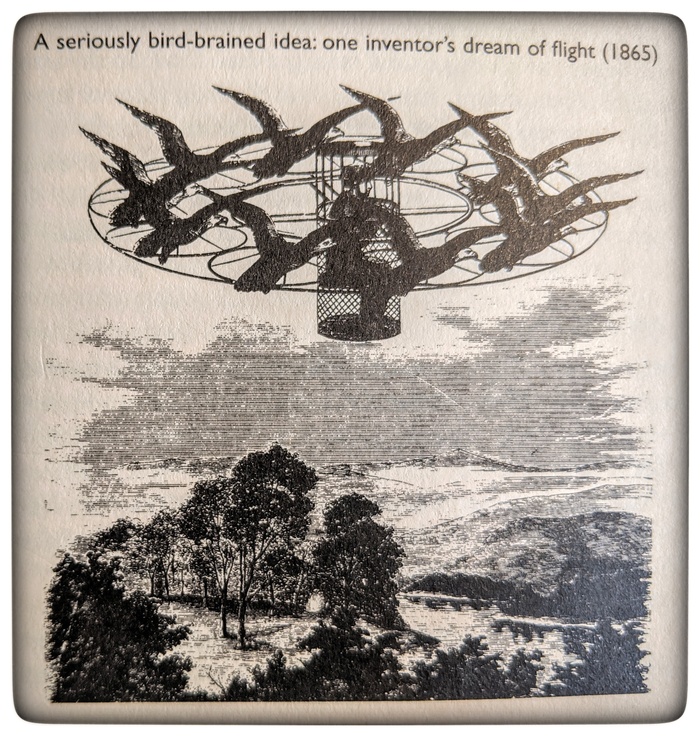
Speaking of babies, one of the most harebrained schemes was concocted by a man from Baltimore in 1865. He reckoned that “since a brown eagle can carry off a baby or a lamb, weighing perhaps 20 pounds (9 kilos), then 10 eagles should be able to carry an adult human.” He suggested that “the eagles should have fitted jacket which would be attached to a circular framework of hollow tubes which in turn would carry a basket.”
Alas, the inventor omits to consider such problems as how to persuade the birds to fly at all, or how to prevent them from plunging to earth if they spy a tasty rabbit.
Another animal-centric invention was the bike-powered sheep-shearing machine envisioned by an enterprising Australian. It is not clear if the machine was successful, but as Hart-Davis dryly comments, “I almost wish I had a sheep to try it out on!”
Even the most gifted engineers and inventors’ reach exceeded their grasp on occasion. Take, for example, Isambard Kingdom Brunel’s “atmospheric” South Devon Railroad, which he originally envisioned as running out into the Teign estuary for 20 miles on stilts one hundred yards offshore. (He was dissuaded from building the aquatic section by enraged locals who felt that the railway would spoil their views and he opted for dry land.)
An “atmospheric railway” was propelled along tubes by air pressure, and in fact wasn’t a half bad idea as the trains ran quietly, and without generating dirty smoke and smuts. The maiden runs went well, but soon technical problems developed along the pipes, which would freeze or become clogged. Nor could pneumatic trains reverse, which was a problem if the train overshot the platform.
Brunel and others tinkered endlessly with their pneumatic railways, but ultimately they all were failures. However, the idea lived on, in miniature, with the use of pneumatic tubes to deliver messages in large buildings.
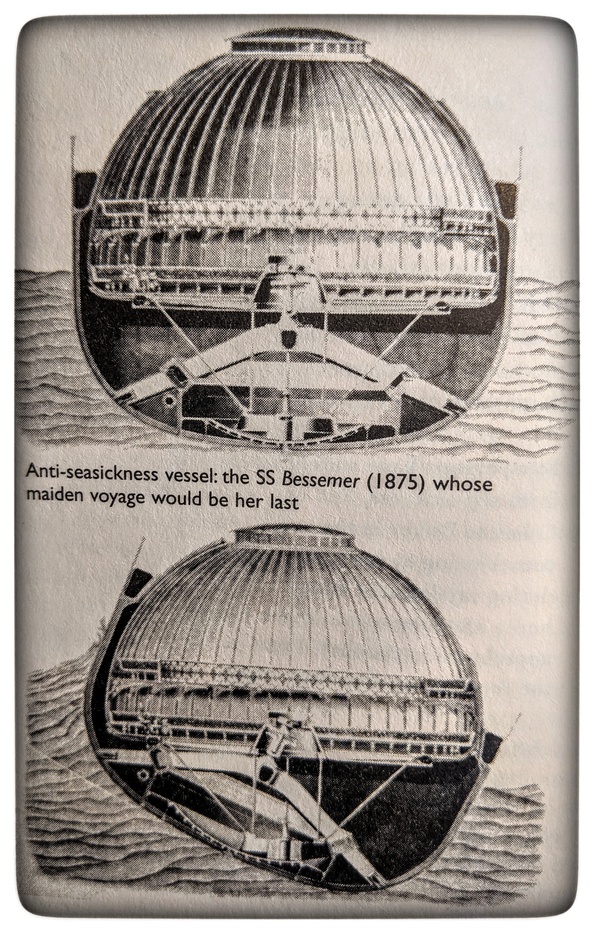
I think my favorite invention, though, was by another great inventor, Henry Bessemer, who earlier had come up with a process for converting iron to steel. He made a vast fortune from his Bessemer convertor and other brilliant inventions. However, Bessemer was prone to seasickness, so he found business trips across the channel to be an ordeal. He turned his fertile imagination and considerable fortune toward designing an “anti sea-sickness” vessel. Thus the SS Bessemer was built. As Hart-Davis explains:
Boats rock in two directions – they pitch from end to end, and they roll from side to side. The ship he designed was very long, so that she would not pitch, but rather sit across the waves. To eliminate the effect of rolling, he suspended the entire cabin on trunnions, with a huge weight underneath, so that, however much the ship rolled, the cabin would always stay level.
The SS Bessemer was launched from Dover on May 8, 1975. “She sailed majestically from Dover on a fine calm day, crossed the Channel, and slowly but comprehensively demolished the pier at Calais. The SS Bessemer was completely impossible to steer, and she never put to sea again.”
Hart-Davis’ description, and the mental image it evoked of this behemoth sailing into the Calais pier made me guffaw. Priceless!