This is it - the long-awaited fourth and final graphic novel collecting the adventures of Elijah Snow, a powerful, hundred year old man, Jakita Wagner, an extremely powerful but bored woman, and The Drummer, a man with the ability to communicate with machines. Infatuated with tracking down evidence of super-human activity, these mystery archaeologists of the late 20th Century uncover unknown paranormal secrets and histories, such as a World War II supercomputer that can access other universes, a ghostly spirit of vengeance, and a lost island of dying monsters.In this volume, the team encounters an abandoned alien spacecraft -- but will the heroes beat their rival, Jacob Greene of the villainous "Four," to the ship? Then, Elijah Snow begins to pull back from his allies, acting increasingly in secret. Will he be able to draw the last of the Four out of hiding, and can he act before his teammates lose their faith in him?Collecting: Planetary 19-25
Warren Ellis is the award-winning writer of graphic novels like TRANSMETROPOLITAN, FELL, MINISTRY OF SPACE and PLANETARY, and the author of the NYT-bestselling GUN MACHINE and the “underground classic” novel CROOKED LITTLE VEIN, as well as the digital short-story single DEAD PIG COLLECTOR. His newest book is the novella NORMAL, from FSG Originals, listed as one of Amazon’s Best 100 Books Of 2016.
The movie RED is based on his graphic novel of the same name, its sequel having been released in summer 2013. IRON MAN 3 is based on his Marvel Comics graphic novel IRON MAN: EXTREMIS. He is currently developing his graphic novel sequence with Jason Howard, TREES, for television, in concert with HardySonBaker and NBCU, and continues to work as a screenwriter and producer in film and television, represented by Angela Cheng Caplan and Cheng Caplan Company. He is the creator, writer and co-producer of the Netflix series CASTLEVANIA, recently renewed for its third season, and of the recently-announced Netflix series HEAVEN’S FOREST.
He’s written extensively for VICE, WIRED UK and Reuters on technological and cultural matters, and given keynote speeches and lectures at events like dConstruct, ThingsCon, Improving Reality, SxSW, How The Light Gets In, Haunted Machines and Cognitive Cities.
Warren Ellis has recently developed and curated the revival of the Wildstorm creative library for DC Entertainment with the series THE WILD STORM, and is currently working on the serialising of new graphic novel works TREES: THREE FATES and INJECTION at Image Comics, and the serialised graphic novel THE BATMAN’S GRAVE for DC Comics, while working as a Consulting Producer on another television series.
A documentary about his work, CAPTURED GHOSTS, was released in 2012.
Recognitions include the NUIG Literary and Debating Society’s President’s Medal for service to freedom of speech, the EAGLE AWARDS Roll Of Honour for lifetime achievement in the field of comics & graphic novels, the Grand Prix de l’Imaginaire 2010, the Sidewise Award for Alternate History and the International Horror Guild Award for illustrated narrative. He is a Patron of Humanists UK. He holds an honorary doctorate from the University of Essex.
Warren Ellis lives outside London, on the south-east coast of England, in case he needs to make a quick getaway.
A friend who works in a comic book store gave me this series to read back in 2006, I think.
I loved them. It might have been some of my first exposure to Warren Ellis. Back before I was a fan of his who specifically hunts down anything new he writes.
I read the first book, and the second, and the third...
Then I tried to buy the fourth book. But I couldn't. The series had apparently been canceled or abandoned back in 2004.
I went back to the friend and said to him, "If you ever get me started on a series that you *know* has been canceled. We are going to have a problem."
I was not best pleased.
Luckly, this fourth and final book of the series came out in 2010. Allowing me to finish the story arc I so loved. What's more, I no longer felt the desire to choke my comic-recommending friend.
This is it. The culmination of the Planetary series. Does it live up to the hype? Does the climax match the build up? Well, read on and we’ll see.
Issue 19 – “Mystery in Space”: There’s a strange artifact approaching earth from deep space and Elijah plans on seeing what mysteries it contains. Ellis pays homage to the Big Dumb Object in sci-fi and also draws on the ideas of generation starships, orbital habitats, and the remnants of precursor races. Elijah has a plan to draw out the one member of the Four he’s never seen and hopefully deal with him…permanently. We’re getting more and more of a feel for just how extensive the holdings of Planetary are and the resources that Snow can bring to bear when he needs to.
Issue 20 – “Rendezvous”: Jacob Greene, Ellis’ version of the Thing, is in the house. How do you deal with a super-powered killing machine with a planet-sized grudge against the human race who is little more than a weapon of mass destruction in the hands of the Four? Hopefully Elijah has a plan that will work. Snow proves that he can be ruthless in the face of necessity and Jakita and Drummer aren’t sure they like it.
Issue 21 – “Death Machine Telemetry”: In the great tradition of consulting mystics in comic books (Dr. Strange, Madame Xanadu, etc.) Elijah goes to see an old friend who also happens to deal in mind expansion and vision quests. Snow wants to get his memory back and start putting together the pieces of the mysteries he’s been unravelling. Some answers to the underpinnings of Ellis’ universe, the mystery of the “Century Babies” who have been gaining greater prominence in the series throughout, and the nature and purpose of super-powers are all explored.
Issue 22 – “The Torture of William Leather”: Snow once again proves that he’s willing to push the limits in order to get what he wants when it comes to the Four. William Leather (Ellis’ analogue of the Human Torch) has a sad, cynical story to tell and in it we get further revelations about the Century Babies, the nature of super-powers and the agenda of the Four. Ellis also throws in a flashback story that references his versions of both the Lone Ranger mythos and the Shadow and which lead right up to William Leather and the present day.
Issue 23 – “Percussion”: We flashback to see where the Drummer came from, how he got involved with Planetary, and just why he might have a bit of a grudge against the Four himself. It was nice to get this insight into the Drummer and gain a little clearer understanding not only of just how his powers work, but also how they really might affect the way he relates to both other people and the world at large. We also get to see that the Drummer has a pretty good handle on just who Elijah Snow is and how this nature affects the actions he takes and ways he undertakes them as leader of Planetary.
Issue 24 – “Planetary Systems”: Elijah lays his cards on the table for Jakita and Drummer, explaining his moment of clarity regarding his role in the multiverse and the urgent need to deal conclusively with the Four. The Four respond with extreme prejudice to Snow’s recent activities and the stage is set for the end-game.
Issue 25 – “In from the Cold”: Snow confronts an old friend about his clandestine activities and we learn the real secrets of the Four, their powers, and their ultimate agenda. Some very cool nods to Kirby’s Fourth World stuff and of course the obvious Nick Fury and S.H.I.E.L.D. parallels that have been thrown around since we were first introduced to John Stone. Lots of revelations this issue and they were quite satisfying ones at that.
Issue 26 – Untitled: The penultimate issue of the series where the real resolution to the duel between Planetary and the Four takes place. Elijah lays his cards on the table and forces the hand of Randall Dowling, the Four’s evil genius version of Reed Richards. Coming full circle the teams meet up in the desert near the diner where we first met Snow and Jakita way back in issue 1. The confrontation is tense, and the culmination of things wasn’t exactly disappointing, but I have to admit that after 25 issues of build-up to this moment things felt a bit anticlimactic in some ways. Was it too easy, or did the setting up of the pieces along the way point to the appropriateness of the ending? I’m torn a bit, but overall short of spinning out the climax to several more issues of little more than a world-spanning battle (that would have been exactly what DC or Marvel would have done…even making it span multiple comic book series and forcing the reader to jump from issue to issue to get any real clarity) I’m not sure what else Ellis could have done. The elegance of things was, I must admit, rather enjoyable.
Issue 27 –Untitled/ Series Epilogue: One more loose end remains for the Planetary team: what really happened to Ambrose Chase on that ill-fated mission many years ago? We’ll find out the answer to that question as well as to the concerns of Jakita that now that the Four have been dealt with, what’s a girl with an addiction to death-defying thrills to do? Drummer’s new place as a real leader in light of the revelations of the Four’s hidden cache of data and technology, as well as his unique ability to exploit it based on his special skill set, was also nice to see. In a sense the final tag line to this issue could have been “The Beginning” instead of “the End”. Alas it did not lead to a new series outlining the further adventures of the Planetary team , though perhaps given the penchant for comic book companies to spin out the stories of their cash cows until they lose all relevance or interest I should instead say, “hooray!”
All in all this re-read has proven to me that my initial love for the series was well-founded. The ways in which Ellis took tropes from comic books, sci-fi and numerous other elements of pop culture and spun them into an intriguing and fun series still blows my mind. For me this was, and still is, one of the benchmark moments in comics and ultimately showed how you can be meta-textual about the medium without having to be morose or lose all sensawunda. Highly recommended!
Spacetime Archaeology (what a fabulous title!) is the fourth and final compilation of Planetary, containing issues 19-27. It was one of the best science fiction comics of all time, with a mysterious and small team fighting a battle behind shadows against evil and equally mysterious and shadowy villains. John Cassady's art and Laura Martin's coloring are nonpareil throughout and greatly enhances Ellis's story (which is almost entirely crisp dialog). Many of the loose ends are tied up (no spoilers) and explanations offered, though the ending is kind of open-ended and leaves the reader wishing there was more. Ellis has sadly become one of the authors that it's been suggested should be avoided due to cases of misconduct, like Kramer and Monteleone and Bradley and Gaiman and too many others, but I maintain one can support and appreciate the art without being seen as endorsing the actions of the individual artist.
I've never read a series from start to finish and left wondering what the hell it was all supposed to be about. In this final book (four volumes, who knew?) the evil Fantastic Four are diminished in number and then taken out by Planetary, while we discover their motives - something I'm still not clear about. They sold out the planet to a group of paranoid eternal post-humans or something? But if this Earth is one of so many and doesn't mean anything, then why does it mean something to these post-humans?
Their friend Ambrose who was killed in a previous volume is brought back in a mind-bending and utterly confusing epilogue - he was trapped in a time bubble of his own creation that made him invisible to time so they built a time machine to bring him back...? Warren Ellis also riffs on the Lone Ranger and Green Hornet characters (called something else of course) and we learn more about the evil Fantastic Four (also called something else) as well as a giant human god or something. Oh yeah and space angels and a chapter that will make you feel like you're on psychedelics.
It might be because I'm not a huge sci-fi fan, but Ellis takes the reader on such a bizarre trip through time and space with these characters that even at the end I'm still scratching my head as to what it was all about. I thought the way Planetary finally defeated evil Mr Fantastic and Sue Storm was a bit uninspired (and again totally perplexing) but despite looking back on the stories and realising that while I was reading them I felt that I understood them but really didn't, I still really enjoyed the journey.
Ellis and artist John Cassaday produce such a massive canvas and convey a story of such an epic scope that it's inspiring and awesome to behold. The artwork is truly impressive and is easily Cassaday's best work (he won an Eisner for his art in this book) and there's even some back story to Drummer, a character I've felt up until now to be poorly underwritten.
"Planetary" is a comic book series that might be understood by acid casualties and mental patients exclusively but I feel glad to have been an observer to the strange thoughts of Warren Ellis. It's definitely his most weird work but definitely worth a look for comics fans everywhere.
Warren Ellis is so eager and enthusiastic to show off his fantastic vistas, bizarre other worlds, spaceships, and angels - build his own high concept comicbook fantasy mythos on the vein of Sandman and Promethea and others... that he utterly neglects what is important to the story, the strength of its characters and plot. With the foundation cracking, all those imaginary dreamscapes crumble and collapse, unable to carry their own weight. It's a shame, really.
Basically it's all about an immortal superbeing saving the world with the help of his equally extraordinary friends. He's pretty much a white blood cell of the universe, set to protect the world from things that would do it harm - a pretty inventive superhero origin that could just have used a better story to carry it on. Problem is, it doesn't look like he's ever even remotely challenged in the story, isn't changed by its events, doesn't come to any big mind-bending realizations - he just breezes through everything like it wasn't there. Same thing with his accomplices. They sometimes stop to ponder, and navel-gaze, and spin yarn about the universe and their own place in it, but none of it ever actually results in any character development or growth. As a consequence I can't relate to them nor especially care what happens to them: for all its impressive action and great big gods and weirdass angels, none of the stories actually lead anywhere. They don't have adventures: in each issue they just come to a place, see something weird, spill out exposition and infodumps, then leave with no conflict.
The antagonists are completely toothless. We're always told how evil and terrible they are, what they've done to the world and what they plan for it later, but for what we're shown, whenever they do appear in the story they go down like a bunch of chumps. Two of them show up for a few pages, are hyped up some more, then get brought low without any effort whatsoever; the last two get to gloat for a while and be stereotypically villainous and irredeemable, and then down they go as well. They were never developed as characters, they never brought any new perspectives or dimensions out of the main heroes, and I never came even close to taking them as seriously as I should have.
As a consequence, what we get is a rather pretty and well-drawn world tour with no conflict, no stakes, and no substance.
At one point the main villain wonders why Snow even cares about this one little world, when there are countless others out there just yearning to be explored. Well, that's a good question - why do we care? The very beginning, the discovery of the multiverse snowflake, could have set up a vast cosmic adventure, so why didn't we get to see any of that? Why were we stuck down here doing nothing of consequence?
This is the end of the main storyline in Planetary and I must say that this was absolutely brilliant. The fact the Warren Ellis even came up with these ideas is brilliant in itself. It's as if the whole universe he has created is based as a Master Universe which encapsulates the Wildstorm, Marvel and DC universes and others as well. There are several references to Marvel Characters, they are very in your face. For example "The Four" is obviously a rip off from the fantastic four. There is also references to the Hulk, Green lantern core, Godzilla and monster island, Thor and obviously there is the justice league tie in with batman, wonder woman and superman.
So, where to start? At the outset we appear to have a simple story of a somewhat more exciting version of The X Files, where our team is taked by a mysterious 'fourth man' to go around and investigate anomalous events in order to discover the secret history of the twentieth century. We still have a nerd and a sexy woman, only this time the nerd is a borderline psychotic who can interface with the internet without needing boring things like computers to do it, the sexy woman is very definitely in charge, and has a taste for ultraviolence. Oh yes, and there's a third person: a grumpy old man. In the course of the narrative we learn a fair bit about these individuals, but, rather wonderfully, it's part of a greater narrative which assumes things that Ellis doesn't bother to explain to us - after, all the characters know what a 'millenium baby' is, so why would they bother to explain it to one another? And another nice example of the subtlety of approach is that it's only very gradually during book 1 that we discover that Jakita (the sexy woman) is superhuman in more than being, well, a very sexy woman. Just how superhuman she is only fully emerges in book 3, and likewise Drums (the nerd) only reveals his full awesome powers gradually.
Volume 1, then, it made up of a series of apparently disconnected stories in which the team go and investigate something. And we learn fun stuff, like the existence of a black Moon Programme which made its first launch in 1961. That's right. And it's all amusing, but seems a bit light, until near the end of volume 2 where you realise that it's been one story all along. So I'm not going to say any more about the plot, save that multiverses are involved, and Ellis makes really neat of ideas from holographic cosmology. Let's just say that volume 2, in isolation, would seem really incoherent, dotting around in time and space (with a wonderful rip-off of the whole Superman origin story, which comes to a premature end when a US soldier empties a rifle into the boy 'just to be sure') with no clear plan. Until you get the big revelation and, with that, are ready for the massive struggle that makes up books 3 and 4 (though even they play merry hell with time, place and location).
Another nice feature is that we see at work the way that apparently nice people can be seduced into doing terrible things. And I don't just mean the bad guys. Jakita, despite her affection for hitting things really hard, is clearly a very moral person, and is repelled when her mysterious boss reveals that he's been torturing people. But by a gradual wearing-down, she reaches the point where she's willing to indulge in extra-judicial killing and so on and so forth, because she's been convinced it's for the greater good. This aspect of human behaviour is, I think, one of the most mysterious of all: how good, decent people can become, if not monsters, then monstrous, and all from the purest of motives. Nobody really understands it, but it happens, and it's good to see Ellis admitting to it (the sheer uprightness of Mulder & Scully was always one of the sillier aspects of The X Files).
Is there anything bad to say? Well, at first you'll wonder what you're getting into. But that's meant to happen, because you're then put on a footing with the principles, who don't have a clue either. So plough on. On a minor point, Jakita starts out as a strong character, but by book 3 she's faded a bit, and by book 4 she's in danger of becoming 'sexy woman in black neoprene who hits things' version 94. She doesn't, but she does feel a little underwritten in the latter stages of the narrative.
So, don't be put off, and make sure you have all four volumes available for cross-referencing.
Elijah Snow, el Doc Savage/Steven Seagal del misterio pop, alter ego de Warren Ellis, se enfrenta a las supercorporaciones que han secuestrado y explotado hasta el agotamiento la imaginación popular creada por sufridos currantes del triste entramado de la industria del entretenimiento del s.XX (lástima que el tebeo se publicase en una subsidiaria muy menor de Warner). De todos modos se trata de un concepto interesante arruinado en su desarrollo: personajes vacíos que únicamente son capaces de ofrecer arrogancia, un plot que lo mismo y diálogos que no pasan de intercambiar sarcasmos y descargar sobre el lector abundante información seudocientífica. Los Cuatro son los villanos que más rápido he visto ir de una omnipotencia invencible a la nada; hay una regla de oro en el manga y es que el villano tiene que molar más y ser muy superior al héroe para que la victoria posea auténtico valor. Este no es el caso, desde luego. Gracias a sus férreos principios y su superioridad moral (los mecanismos del autoengaño son fascinantes), Ellis/Snow sale triunfante de todos los enfrentamientos de una forma tan facilona que el tebeo acaba perdiendo todo interés, a ratos la historia parece un cruce entre un confuso manifiesto reivindicativo y una fantasía consolatoria de la que sólo se salvan los ocasionales momentos de sense of wonder que consisten en dar un giro a conceptos de cultura pop, sobre todo de tebeos de superhéroes, ya existentes. Al final, como en muchos de estos pretenciosos productos superheroicos de guionistas ingleses, sólo queda el comentario sarcástico, la meta-referencia ingeniosa y poco más. No pasa nada por reconocerlo, yo también me los creí en su día.
An excellent final volume, confusing at times (especially some of the science in the last chapter) though I think that's one of the things which makes the series so interesting! Especially recommended if you are familiar with lots of classic comics and characters, you'll find many references throughout the series!
No hago spoilers no por vosotros, lectores, si no que si me pongo a pensar en el final y en mis partes favoritas de este último volumen me echo a llorar.
Damn near perfect ending to a wild and crazy sci-fi series. Planetary at times is pretty hard to wrap your head around, lots of abstract futuristic ideas that ...could be possible? I don't know if Ellis is just a master of BS or really really into science but I bought into wholly. The final book has lots of closure and you finally get to the bottom of what the "four" are up to and its not good... like selling our planet not good. But our white knight, Elijah Snow is pretty much a super bad ass that is so calm its scary. In the end we get a showdown with the final 2 of the "4" and Snow and we also get a really cool conclusion to Ambrose's story. I especially like the origin story to Drums, creepy and cool. The art from John Cassaday is also fantastic start to finish, good good stuff.
Que felicidad releer estas páginas y atesorar de por vida estos cuatro volúmenes que reunen Planetary. Agradecido a Warren Ellis, John Cassaday y equipo por el genial viaje que es Planetary. Lo leo con una sonrisa años después y sé que me seguirá robando sonrisas en cada relectura y que seguiré encontrando detalles de joyas encubiertas. Feliz por Planetary. No conozco a nadie que no la haya leído y haya disfrutado el viaje. Será hasta pronto... seguro.
What a series. Visual quotes from the rest of comic story world abound in this series, yet it's all it's own creature. An evil fantastic four, a murdered wonder woman/green lantern/& superman, a crippled Doc Savage, a james bond with better toys and more kickass than the movies ever had, a john constantine wearing spider jerusalems tattoos, a godzilla corpse WITH a yukio mishima name drop scene, a voodoo woman who insists shes a scientist but talks like a psychologist, a dark lone ranger, a snooty tarzan, all wrapped cleverly and neatly into a conspiracy plotline with giant uber-technology AND lots of ideas that i never saw coming. I'm impressed. If they made a t-shirt for this series still, i'd totally buy and wear it.
Also the 2001 sex joke i did not see coming. I had no idea you COULD make a sex joke about the space odyssey movie. that might be in volume 3. if you read this, make sure you have all four volumes and an evening free, you wont want to stop till the story is done.
Well that was pretty much fantastic. Ellis weaves a tale (among the four books/27 issues) as intricate and well thought out as any I've seen. Loose plot threads get picked up, great characters grow and show us where their quirks have been coming from, and there are still a few surprises along the way.
Ellis sneaks in an incredible amount of layered thinking about physics, time travel, the limits and purpose of human achievement and some honest-to-dog philosophy. My mind is still reeling trying to take it all in and synthesise it into my own reality, and I'm blown away how effortlessly the characters just accept and build upon this mind-blowing way of re-looking at the world.
Cassaday & Wright's art is just fabulous - detailed, nuanced and conveys just enough option to draw the reader in (rather than keeping them at arm's length).
I'm really pleased that Fraction & DeConnick convinced me to finally pull this series off my shelf and read it. It's a real work of genius and art.
Okay, Planetary gets better and better, this is a highly recommended series to any comic book fan, you will get here a smart and respectful tribute to almost all comic book genres, pulp, western, monsters, super-heroes, along with creative use of known characters from classic literature and even reinterpretations of comic book characters. Also, it's a short series that it's something good since you don't have to spend much to reunite the whole run. Highly recommended.
A fantastic finale to this fantastic superhero series. I especially like how satisfying the ending felt - it was satisfying because it answered the questions we had, and completed the quest the characters had started, but left things very open ended, so we can imagine the characters in endless adventures. I feel like I understand, but I still want to go back and reread the series to find the clues that were left and the dots that ended up being connected.
Bu seriyi herkesin okuması lazım. Hikayeleriyle ve çizimleriyle öyle etkileyici ki, bitirdikten yıllar sonra bile aklınızda özel ayrı bir yeri olacak:)
I enjoyed the Western one and the one with Drummer's past. The ending was pretty cool and I liked the idea of it. Otherwise this theme of comics isn't for me and I failed to understand majority of the plot. The art work is still some of the best!
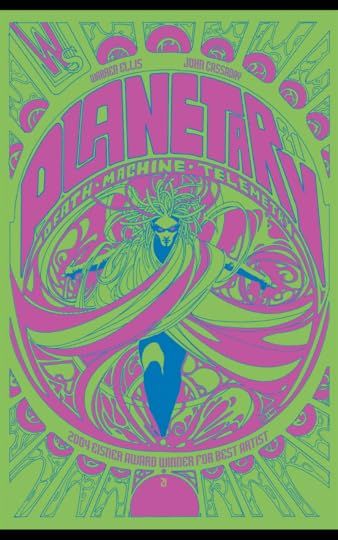
I loved this final volume; I couldn't stop reading it, had to finish in one sitting. This comic got better by the issue I think, and it especially took off after the second volume. The concept, at its heart, is just intensely interesting. Warren Ellis has done a fantastic job in creating this strange, strange world. When the multiverse is real, and bleeds through to hundreds of thousands of dimensions, your comic is not limited by any constraints of reality. In fact, it can get downright psychedelic (issue 21 makes that clear enough, and it may have been my favorite issue of the series). It's part of why I liked the Sandman so much (this is like the third time I've compared Planetary to Sandman, and though they're quite different, that can only be a good thing). Sandman breaks reality barriers by mostly revolving around dreams, and the power that accompanies them. Planetary does it by revolving around the multiverse, and the possibilities that go with it. Ellis, like Gaiman, handles the possibility for such a vast story extremely well; building compelling characters, situations, and philosophical questions. And above all, it's fun.
I always want to touch on the art. John Cassaday grew more impressive by the page. I am especially a fan of the covers during the series. The cover art for each issue is different, very different; and aside from the word Planetary being plastered across the front, you'd sometimes have a hard time telling they belonged to the same story. It's a really unique way of doing covers, and I loved it. Issue 21, which I mentioned earlier may have been my favorite of the bunch, has an especially well done cover. I'd like to include a picture of it below (if I can figure out how...).
So there it is. At 27 issues Planetary is not all that long, but it's a story that packs a punch. And you should read it.
Planetaryssa on monta palikkaa kohdillaan. Se on hyvin piirretty ja kelvollisesti väritetty, joskin visuaalinen jälki on kuitenkin melko geneeristä eikä sinällään erotu sarjakuvien massasta. Toimivaa kuitenkin. Hahmot ovat supersankareita, mutta juoni kompleksisuudessaan kaikkea muuta kuin tavallista pahisten ja hyvisten välistä supervoimien mittelöä. Intertekstuaalisina viittauksina Planetaryssä vilahtaa niin Tarzania kuin Sherlock Holmesiakin ja heistä saadaan totutusta mielenkiintoisen poikkeava kuva. Näissä sivujuonteissa on jotain samaa kuin Neil Gaimanin Sandmanin "sivujuonissa". Luonnollisesti käydään kurkkaamassa takaumin neljän päähenkilön historiaa.
Mutta kuitenkin... kokonaisuus jäi minulle hieman sekavaksi. Elijah Snowta lukuun ottamatta päähenkilöt ovat melkoisen tylsiä ja geneerisiä. Ja kun piirrosjälkikin on minun makuun vain tavanomaista ja toimivaa, niin jäin pohtimaan, että mistä tämän sarjakuvan kohdalla oikein on kohkattu.
Toki sarja on 27 numeron mitassaan mukavan kokoinen kokonaisuus (tämän mittaisia sarjoja saisi olla enemmänkin) ja myönnän, että juonessa on multiversumeineen ihan kivoja koukkuja. Lukukokokemus odotuksien ja alkuinnostuksen jälkeen jäi kuitenkin kovin kädenlämpöiseksi.
I often find Warren Ellis's protagonists to variations on a particular Generation X cynicism, at times, this is tiring, but Elijah Snow would be the cosmic archetype of that cynicism. Furthermore, Ellis grounds in his backstory primarily in this volume. This run ties up all the lose and tangled end of Planetary and the mystery mongering finally gives way to more concrete answers. Furthermore, this actually makes the prior plot lines much more comprehensible, so it makes the entire series re-readable. The backstories to all major characters are explored enough to make the series more compelling and Elijah's relationship to Jakita and the Drummer more believable. (That said, Jakita does feel a bit underwritten in the entire second half the series). The thematic exploration of Nietzsche's dictum that flighting monsters causes one to become them is given appropriate gravitas here.
This is the big conclusion. We find out the Lone Ranger and The Shadow are tied together to the (Fantastic) Four. The drummer's origin is revealed and we get to see the conclusion of the war with the Four. The mystery of Ambrose is solved as well. Overall not a bad ending to a great series, but honestly I think this series still has a lot of potential. It's like the series only scratched the surface and there are still many stories left untold. Maybe one day?
This series must be one of my favorites. The characters are all written so well and are consistent throughout the entire run. Even though there is little character development for Jakita and Drummer, they still feel whole and full. When the series came to an end I understood it fully; their story has only just begun.
I'm mourning now, because I will miss them. Hopefully they will return, some day. With Ellis and Cassaday. Hopefully.
Strange and interesting. I'm not sure what was going on most of the time, but I sure loved the ride. Especially the visits to strange alternative and alien worlds and the creatures living there. Also, this book gave me some interesting science theories to think about regarding invisibility and time travel.
Other reviewers have said it before and I echo their comments, this is the best collection of Planetary yet. Full of adventure and sci-fi action. Well written and great art.
Sentimientos encontrados. Planetary no me ha terminado de dar lo que esperaba, el resultado final me ha sabido a poco. Sin embargo, la historia, el guión, el dibujo... todo tiene sus momentazos. Me gusta aunque no convence.
Wow. In this final volume, Ellis and Cassaday drop the one-shot storytelling and finally go serialized, as Elijah Snow systematically goes after the Four, and Jakita and Drums try to pull him back from the edge. They take us from outer space to innerspace with ease and bring the series to an immensely satisfying conclusion. And we finally get the Drummer's backstory!
The repeated theme of the book is "It's a strange world. Let's keep it that way." It's a beautifully odd mission statement, but what this final book does hammer home is that Planetary is also a book about the team, Elijah and Jakita and Drums and even Ambrose, the small family they have made for themselves (Ambrose is the only one who seems to have a family outside Planetary).
John Cassaday's art, as always, is simply astonishing, and Warren Ellis is able to take complicated sci-fi concepts and make them just accessible enough so that even if you don't fully comprehend what's going on, you still feel the impact of the story. There is not a weak issue among the 27. Planetary is a hell of a book.