Jump to ratings and reviews
Rate this book

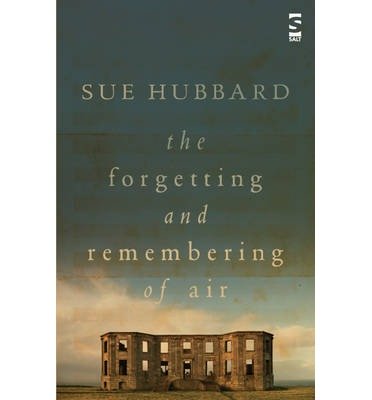
[(The Forgetting and Remembering of Air)] [Author: Sue Hubbard] published on

Rate this book
In this, her third collection, Sue Hubbard meditates on art and the natural world. By going to the extreme edge of western Ireland, to a Cornish beach, to the rim of the Solway Firth and the mouth of the Thames she explores, in these disarmingly direct and evocative poems, in a language that is muscular and lyrical, painterly yet spare, the illusion of romantic love and the letting go of childhood grief. In the central section, based on paintings by the artist Rachel Howard, she examines the psychology of different women in extremis.

Hardcover

First published April 15, 2013

8 people want to read

About the author

Sue Hubbard

50 books20 followers
Sue Hubbard is a freelance art critic, novelist and poet. Twice winner of the London Writers competition she was the Poetry Society’s first-ever Public Art Poet. She was also commissioned by the Arts Council and the BFI to create London’s biggest art poem that leads from Waterloo to the IMAX. Her latest collection Ghost Station was published by Salt Publishing in 2004. Depth of Field, her first novel, was published in 2000. John Berger called it a “remarkable first novel.” Sue is a regular contributor to The Independent and The New Statesman where she writes on contemporary art. In 2006 she was awarded a major Arts Council Literary Award.

Ratings & Reviews

What do you think?
Rate this book

Friends & Following

Create a free account to discover what your friends think of this book!

Community Reviews

5 stars
0 (0%)
4 stars
0 (0%)
3 stars
0 (0%)
2 stars
0 (0%)
1 star
0 (0%)
Displaying 1 of 1 review
Profile Image for Jim.
Author 10 books83 followers
Read
July 25, 2016
Sue Hubbard's not a painter although I suspect she might quite like to be; poetry’s a poor second to most visual art. When I was first offered this collection for review my initial response, after scanning an excerpt, was, “I’m not a great lover of nature poetry (I’m frankly not sure what’s new to be said on the subject) but let’s see if she can win me over.”

To be honest I probably should’ve walked away from the project but I decided to have a go.

In an article Hubbard writes:
Today landscape painting is viewed as marginal, peripheral to the philosophical and conceptual concerns of contemporary art. Traditionalists see it as upholding a nostalgic vision of timeless values, whilst for most modernists the landscape is essentially urban, tainted and dysfunctional.
The same could be said about landscape poems (and I’m talking here about landscape poetry in general; I’m not suggesting that all the poems in this collection are landscape poems). In Hubbard’s poetry Nature’s role is to provide a giant metaphor for the human condition: trees aren’t lonely, winds don’t drink, stars might no longer be visible but they’re not hiding. Long descriptive passages (and there’s no doubt that Sue has a way with words) set the scene/tone and then the human observer appears to add a touch of profundity or pathos. “What do things know?” Hubbard asks in the opening poem followed by “What do they tell us?” in the second. In the third we find her walking through a wood “in search of a poem”:
I try to write a line of colour,

but words are a string of biro scrawls
Without air or light or hue,

[White Canvas]
I know exactly where’s she’s coming from. I, too, once wandered aimlessly seeking inspiration and have the bad poetry to prove it. She writes:
Open your heart like a door
and listen as the world hums quietly
to itself

[Love in Whitstable]
I did try but evidently was looking in all the wrong places. (To clarify: I’m not saying that Sue’s poetry is bad; mine was bad.)

Nature’s huge and we’re so small. This is evidenced in ‘riverrun’ which devotes a whole page to setting before the observer holds her “breath/ and listens to the wood/ waiting for something to happen”; a tiny diamond in an overpowering setting.

The book is divided into three parts:

‘A Meaningful Speech’ could’ve come out as a chapbook in its own right. There’s interesting stuff here but the poems don’t cohere as well as the second and third sections. There are some good pieces though like ‘Keeping Hens’ and ‘Naked Portrait, 1972–3’.

‘Over the Rainbow’ comprises ekphrastic poems responding to the suicide paintings of Rachel Howard. Minus the accompanying art, the poems inevitably feel like they’re missing something. Shame too there’s only nine; this would’ve been a nice chapbook in its own right.

‘The Idea of Islands’ has already been published separately accompanied by paintings by Donald Teskey and so also suffers a little from the estrangement.

“[W]riting a poem, as for the visual artist drawing from life, is a ‘process’, a ‘reaching towards’ something that is largely unknown,” writes Hubbard. That may be the case but it can’t stay unknown. It becomes known during the reading. I wasn’t entirely won over by these poems—my fault undoubtedly—but I can see why others might be and have been.

You might want to compare my review with Helen Ivory’s, David Green’s and Ellen Bell’s before making up your mind on this one. I was clearly the wrong reader for this book.
Displaying 1 of 1 review

Can't find what you're looking for?

Get help and learn more about the design.