Set in Londonderry in 1970, this gripping drama by the acclaimed author of Faith Healer and Translations explores the ongoing Irish "troubles" that plague the country to this day.
Brian Friel is a playwright and, more recently, director of his own works from Ireland who now resides in County Donegal.
Friel was born in Omagh County Tyrone, the son of Patrick "Paddy" Friel, a primary school teacher and later a borough councillor in Derry, and Mary McLoone, postmistress of Glenties, County Donegal (Ulf Dantanus provides the most detail regarding Friel's parents and grandparents, see Books below). He received his education at St. Columb's College in Derry and the seminary at St. Patrick's College, Maynooth (1945-48) from which he received his B.A., then he received his teacher's training at St. Mary's Training College in Belfast, 1949-50. He married Anne Morrison in 1954, with whom he has four daughters and one son; they remain married. From 1950 until 1960, he worked as a Maths teacher in the Derry primary and intermediate school system, until taking leave in 1960 to live off his savings and pursue a career as writer. In 1966, the Friels moved from 13 Malborough Street, Derry to Muff, County Donegal, eventually settling outside Greencastle, County Donegal.
He was appointed to the Irish Senate in 1987 and served through 1989. In 1989, BBC Radio launched a "Brian Friel Season", a series devoted a six-play season to his work, the first living playwright to be so distinguished. In 1999 (April-August), Friel's 70th birthday was celebrated in Dublin with the Friel Festival during which ten of his plays were staged or presented as dramatic readings throughout Dublin; in conjunction with the festival were a conference, National Library exhibition, film screenings, outreach programs, pre-show talks, and the launching of a special issue of The Irish University Review devoted to the playwright; in 1999, he also received a lifetime achievement award from the Irish Times.
On 22 January 2006 Friel was presented with a gold Torc by President Mary McAleese in recognition of the fact that the members of Aosdána have elected him a Saoi. Only five members of Aosdána can hold this honour at any one time and Friel joined fellow Saoithe Louis leBrocquy, Benedict Kiely (d. 2007), Seamus Heaney and Anthony Cronin. On acceptance of the gold Torc, Friel quipped, "I knew that being made a Saoi, really getting this award, is extreme unction; it is a final anointment--Aosdana's last rites."
In November 2008, Queen's University of Belfast announced its intention to build a new theatre complex and research center to be named The Brian Friel Theatre and Centre for Theatre Research.
حرية المدينة مسرحية ثورية من جميع الجوانب، من القالب الأدبي المغاير للإطار المسرحي التقليدي، والقصة التي تناولت ثلاث فئات من الطبقة الكادحة في أيرلندا.
أما عن الثورية في القالب الأدبي فكانت في جعل المسرحية فصلين بخلاف الشكل التقليدي، كما أن طريقة عرضها مميزة لم أرها في مسرحيات كثيرة، تبدأ مع مشهد يحقق فيه القاضي في مقتل ثلاثة أشخاص، يتم التعرف على كل شخصية فيهم، ثم يعود بالزمن عند تفريق قوات الأمن لمظاهرة سلمية تطالب بالحقوق المدنية للفرد، ثلاثة أشخاص من المظاهرة سيرهربون ويلجأون إلى مكان سيكتشفون بعد هذا أنه مقر مهم للدولة، وسيتم اتهامهم بأنهم إراهبيين مستوليين على المبنى، يظل القاضي يحقق في موت الأشخاص الثلاثة، ونعيش مع نفس الأشخاص الساعات التي قضوها في المكان الذي هربوا إليه، إلى أن تلتقي الخيوط في النهاية.
أما عن الثورية في قصتها فهي وإن كانت تبدأ مع مشهد مظاهرة للمطالية بالحقوق المدنية فليس هذا هو الغرض الرئيسي منها، بل الغرض كان في مناقشة الفقر المنتشر في أيرلندا من خلال رسم ثلاث شخصيات الشخصيات الرئيسية هنا ثلاثة فقط، الباقيين ليسوا سوى شخصيات لموقف وتختفي، أو شخصيات ذات جانب واحد لا حاجة لرسمها.. بعض الأشخاص تظهر في المسرحية تظهر للحديث ولكنها لا تتحدث مع أحد، مثل: دودز عالم الاجتماع، والقس. ثلاثة شخصيات تتناول ثلاث أمثلة من االطبقة الفقيرة، هم: مايكل غير المتزوج والعاطل، سكنر عاطل ولبس له مكان يسكن فيه بل كل يوم في مكان، ليللى وهي أم لأحد عشر طفلًا ينامون في شقة من غرفتين وتسعى لإطعامهم.
نكتشف أن كل واحد من الثلاثة لم تهمه المطالب الأساسية للمظاهرة، بل هي رغبة منهم في تجاوز فقرهم بأي شكل.. يتناول الكاتب الموضوع ويعالجه بطريقة مبهرة من جميع الجوانب.
A very touching play based on the events of Bloody Sunday in Derry, Ireland, 1970. The play follows Michael Hegarty, an activist and protester for Civil Right, Lily Doherty, a mother of 11 living in the Catholic Bogside and Adrian "Skinner" Casimir, an insightful, quick and spontaneous man also involved in the protest. The three cross paths and end up in the Guildhall, where their stories and lifestyles are revealed to the audience giving us a wider understanding of three very different types of people, marching for 3 very different reasons. But by glimpsing the events happening outside, the unease for the three characters inside the Guildhall builds until the last moment, when Michael, Lily and Skinner come face to face with consequences that have been evident since the start.
Throughout the play, we glimpse different parts of the characters' lives. As we understand more about them, and where they come from, especially Lily and Skinner, we begin to see why are they are the way they are and feel sympathetic towards them. It's a very subtle character development, or more so, discovering the characters. Lily is first a gossip with no regard for the outside world, but we learn of the poverty she lives in and the situation with her family, husband and home. The Michael we meet is at first a strong leader who stands up for the rights of others, but we being to see him as narrow minded in the sense that he is stubborn about his opinion of people and for the government. Skinner is at first a very rude and disrespectful character, but as e go through the play, we realise he is a very insightful man, who underneath his flippant exterior, cares a lot about the disadvantaged, understands the situation, even before the audience does, and is a realist who grasps onto the opportunities life gives him while he can.
Freedom of the City is a Naturalistic play first performed in 1973 in Dublin, after the events of Bloody Sunday the year before. The play is set in the Mayor of Ireland's parlour in the Guildhall with tabs items and asides to show events happening outside the Guildhall. The stage directions are of vital importance and the intended mood of the play relies strongly on them to convey the metaphors or imagery of the story line.
Freedom of the City was a very touching play, also very tragic and made a huge impact on me, especially the character of Skinner. It also, for once, doesn't shower glory all over the conflict the British Army faces, instead, portraying the events in a very real and unbiased way. The imagery and characters are extremely well portrayed and the emotional response was very touching and memorable.
The Widgery Report (2010) was the official report written as an understanding of the British that the victims of Bloody Sunday were innocent. This lead to the apology to the citizens of Ireland who witnessed a tragic mistake and were not believed for 28 years before.
I would highly recommend to those interested in history and revolutions, but also to those studying psychology of humanity. It's fascinating to get a glimpse into this world only 4 years after the formal apology of Bloody Sunday by the British Government, David Cameron.
5 out of 5 stars for a very touching play that will be remembered by me for a long time.
المسرحية سياسية بامتياز عبّر الكاتب عن الوضع السياسي المتردي بدون أيّ صخب أو حتى شعارات سياسية فجة، ولكن بمنتهى الأريحية والتمكّن من خلال الثلاث شخصيات الرئيسية ودمج زمن ما قبل قتلهم وما بعد قتلهم، من خلال سخرية الأبطال من الاجتماعات التي يعقدها مجلس المدينة والقرارات السطحية التي يتخذونها بدون أيّ نفع أو مصلحة للمواطن المغبون. اختيار الكاتب لأعمار الأبطال كان نموذجيًا للغاية فهذان شابان تقريبًا في نفس العمر أحدهم حالم للغاية بالطهارة الثورية ونقاء الآخر في التعامل مع مطالب الشعب والآخر واقعي يعرف ما يدور في أرجاء الحكم ويقابل كل هذا الزيف والصلف بالسخرية اللاذعة، أما المرأة في تعمل على أكوام من اللحم ويضنيها العوز والفاقة فوجدت في التظاهر مع أشباهها من المطحونين متنفسًا لإخراج غضبها وحاجتها
المسرحية رائعة للغاية في تمثيل الغضب الشعبي العام وكذلك السخرية اللاذعة التي يوجهها الجماهير للحكّام
آشناییم با فریل برمیگرده به کتاب «فوکو و ادبیات داستانی» که نویسندهاش، الیری، با در نظر داشتن ملاحظاتی نظری از فوکو دربارهی ادبیات و تجربه میره سراغ ادبیات ایرلند، از جمله کارهای فریل. الیری به سیاسی بودن کارهای فریل و نحوهی استفادهی اون از زبان اشاره میکنه: «نزد فریل نوشتن در متن سیاست ایرلند شمالی، در دههی 1970، تلاش برای صورتبندی یک اجتماع جدید هم هست، اجتماعی که میتواند به ورای نیامانندی گذشته برود.» (الیری، 1396) و بیشتر روی نمایشنامهی ترجمهها مانور میده که فکر میکردم ترجمه نشده ولی الآن دیدم ترجمه شده تحت عنوان «برگردانها». . نمایشنامهی «شهروند افتخاری» دربارهی قتل سه معترضه؛ سه معترض با روحیهای متفاوت، اما خواستهای تقریباً مشابه. تقریباً کل نمایشنامه رو با دستهای مشتشده خوندم و نیازی نیست که بگم چقدر دیالوگها و وقایع آشنا بود؛ آشنابودگیای منفور :))) برای همین خیلی نیازی به تحلیل نداره. . فقط یه پیوست میارم دربارهی همین یکشنبهی خونین و خوندنش براتون مساویه با هر معرفی یا تحلیلی: «یکشنبه خونین – گاهی به نام کشتار باگساید– نیز شناخته میشود، حادثهای خونین است که در ۳۰ ژانویه ۱۹۷۲ در منطقه باگساید شهر دری ایرلند شمالی اتفاق افتاد. در این حادثه سربازان انگلیسی به ۲۶ شهروند غیرمسلح که در راهپیمایی اعتراضی علیه توقیف دیمیتریوس شرکت کرده بودند آتش گشودند. چهارده نفر در اثر این تیراندازی جان خود را از دست دادند که سیزده نفر آنها در حین این حادثه کشته شدند و نفر چهاردهم چهار ماه بعد بر اثر جراحات حاصل از این تیراندازی جان خود را از دست داد. بسیاری از قربانیان هنگامی مورد اصابت گلوله قرار گرفتند که در حال فرار از سربازان بودند و برخی نیز در حالی که سعی میکردند به مجروحان کمک کنند کشته شدند. معترضان دیگر طی اصابت با گلوله های لاستیکی یا باطوم مجروح شدند و دو نفر نیز توسط اتومبیلهای ارتشی زیر گرفته شدند.این پیادهروی توسط گروههای سازمان حقوق مدنی ایرلند شمالی و جنبش مقاومت شمال سازماندهی شده بود.
دو تحقیق توسط دولت بریتانیا در این باره انجام شد. دادگاه ویدگری که تقریباً بلافاصله پس از حادثه برگزار شد تقریباً بهطور مشخصی سربازان و مقامات انگلیسی را بیتقصیر تشخیص داد. این دادگاه تیراندازی سربازان را با عنوان "مرز بیپروایی" خواند ولی ادعای آنها را که آنها با گلوله افراد مسلح و بمب-انداز را مورد هدف قرار دادند را قبول نمود. گزارش این دادگاه به عنوان یک "ماست مالی" بزرگ مورد انتقاد قرار گرفت. درخواست ساویل که به ریاست لرد ساویل از نیوجگیت در سال ۱۹۹۸ مجدداً این حادثه را بررسی نمود که پس از ۱۲ سال جستجو گزارش ساویل در سال ۲۰۱۰ به اطلاع عموم رسید و به این نتیجه رسید که این کشتار غیرقابل قبول میباشد و نمیتواند توجیهپذیر باشد. این گزارش به این نتیجه رسید که تمام کسانی که به ضرب گلوله کشته شدند غیر مسلح بودند و هیچ یک از آنها به عنوان یک تهدید جدی است مطرح نبودند و اتهامات پرتاب بمب و تیراندازی به عمد برای توجیه عمل سربازان مطرح شده بودند. "در پی انتشار این گزارش نخست وزیر بریتانیا دیوید کامرون از طرف انگلستان به صورت رسمی عذرخواهی نمود." پس از این پلیس با شروع تحقیقات به قتل درباره این کشتار کرد.» (ویکیپدیا) . گاهی به این فکر میکنم که جملهی «تاریخ تکرار میشه»، چندان درست نیست. تاریخ همیشه در جریانه. تکرارْ مقطعی بودن رو پررنگ میکنه، اما این وقایع همیشه در جریانه، تو نقاط مختلفی از دنیا. همزمان یا ناهمزمان.
Skinner, Lily, and Michael, three working-class Northern Irish protestors, find themselves in the Mayor of Derry's parlour in the Guildhall after fleeing a Civil Rights Association march that became violent after the police turned on the march. Inside the Guildhall, the three are awed by the grandiose surroundings of power as they admire the polished sterility of the parlor. For the first time, the colonized sit in the seat of the colonial power that oppresses, and eventually massacres, them and the Irish people. While waiting for the fervor to die down outside, they casually discuss their lives, philosophies, their reasons for marching, and make plans to see each other after they leave. They also play act with the robes and the swords within like little kids who have never seen such exciting toys before. I love the way Friel describes the parlor as being filled with untouched ceremonial instruments designed to be looked at rather than used. It feels as though a room that claims itself to be the heart of justice was always barren, empty, and superficial, just as British justice in the North has always been. At one point, Lily states it’s a shame that these nice robes (robes worn by judges in court) should sit in this room, untouched and unused. As Skinner, Lily, and Michael talk, laugh, and play with each other, the British army and media outside the Guildhall are spinning a propagandic narrative, claiming they are violent armed terrorists who have taken the Guildhall hostage. The audience can feel the aggression and tension mounting outside the building, while the protestors unknowingly relax within.
Reliant on the emotional impact of dramatic irony, the play is told non-chronologically, and opens with the dead bodies of all three protestors, as a court case on the incident plays out, the media reports, and journalists take pictures. To the Irish who lived during the Troubles, this trifecta of spectacle-horror feels familiar. The image of the Irish body is first understood as dead, transgressive, and torn apart, rather than alive in its integrity. Their horrifying deaths – and the manner with which it is woven into a series of various propaganda narratives - abstracts and flattens the vibrancy and nuance of their real and complicated lives. There is a great line by Skinner later in the play when he says only his dead body is respected: “And should I die the welfare people would bury me in style. It’s only when I’m alive and well that I’m a problem.” (75) Any colonized people would recognize this sentiment. The massacred colonized body evokes sympathy, but that same body doesn’t deserve that same respect and protection in life. You’re only treated as a human being long after you’re dead.
The three main characters are fascinating, as they represent a large population of protestors in the North, as well as a dynamic that was common during the Troubles. Both Michael Hegarty and Adrian "Skinner" Casimir represent 14% of unemployed young men in the North. However, their philosophies and approach towards the British occupation vary greatly. Michael believes that the British are only interested in stopping the criminal and degenerate element in Ireland (very heavily implied to be the IRA). Like many colonized who try to grasp onto a small grain of autonomy by attempting to embody the ‘good’ colonized body, he is convinced that if one acts lawfully and keeps one’s head down, a person will have the same opportunities as a British citizen. The British are inherently just and fair, and it’s the rebel Irish who make them defensive and oppressive. When Michael leaves the hall with his hands in the air, he does not believe he will be shot. The last thing he thinks before the bullets rip through his body is that his faith in the self-proclaimed justice in the British system is a “terrible mistake”. He dies “in disbelief, in astonishment, in shock.” (71) Michael frequently gets upset at Skinner, whom he believes to represent these Irish rabblerousers with no respect for authority who ‘make everything bad for everyone else’. Skinner, albeit initially glib and nihilistic, sees through this façade, and is very aware that the opportunities for him are limited and the colonial system is operating as it was designed, to keep the colonized trapped in an endless violent cycle of poverty. As a result of the hopelessness that arises from such a dynamic, he becomes defensive and flippant, believing that he has no future. Unfortunately, he is correct. He is also the only one of the three to predict that the trio will be shot upon leaving the courthouse.
The final member, and the most important in my opinion, is Lily Doherty, a forty-something working-class mother of 11 children. She and her family live in an inhabitable hovel and she briefly mentions that she got married at 17 and immediately started having children. I have often stated that Ireland can be viewed as a matriarchal state, due to a variety of factors resulting predominantly from colonization. When Irish men were shot, imprisoned, or forced to emigrate to find work, the women and the children were left behind. As a result, women became responsible for keeping society running, and they absolutely did. One can see many pictures of women putting on their headscarves and walking past burnt-out cars and rubble to go to the supermarket can one see in pictures during the Troubles. Lisa McGee, the creator of the amazing show Derry Girls, deliberately wrote the show to highlight how society was kept together by women despite the fact that pretty much only male violence is addressed in most depictions of the Troubles and Irish conflict in general. It’s clear that Lily doesn’t understand the philosophies and intellectualization of many of the protestors. She eventually admits that the reason she marches is for her son, who is implied to be mentally impaired. She doesn’t have strong intellectualized reasoning for why she marches, unlike the other two, with whom she agrees at different points. This intellectualization is touched upon with the character of the sociologist, who explains poverty and its culture at various intervals in the play. She often asks Michael and Skinner what she should believe, and it becomes clear she comes to view them both as her sons. However, she knows that she marches because she has to – she may not have the explicit philosophy, the words, to describe why she feels she has to, but she knows she must. When Skinner asks her reasoning for marching, she responds: “I’ve no head. All I do is march.” (76) . He continues to push her and she recites some things she’s clearly heard from the movement previously, as if rehearsed. Skinner, clearly having received more education than Lily, is finally able to verbalize the instinct that drives her (and many other working-class people): “Because for the first time in your life you grumbled and someone else grumbled, and someone else, and you heard each other, and became aware that there were hundreds, thousands, millions of us all over the world, and in a vague groping way you were outraged.” (77) He sums up the sentiment of the plight of the poor: “It’s about us-the poor- the majority-stirring in our sleep. And if that’s not what it’s all about, then it has nothing to do with us. (ibid) Lily eventually reveals that she marches, not for some philosophy or vague nationalist dream which she describes as “sensible things like politics and stuff”, but for her son Declan, who is heavily implied to be mentally impaired (78). She is the heart of the play, just as all the mothers are the heart of the Irish struggle.
Freedom of the City was first performed in 1973 in Dublin, only a year after the infamous Bloody Sunday. For the uninitiated and non-Irish, Bloody Sunday, or the Bogside Massacre, took place on January 30th, 1972 when British soldiers from the 1st Battalion of the Parachute Regiment shot 26 unarmed civilians during a peaceful protest march in Derry. They were marching against the unlawful British act that allowed the government to indefinitely inter civilians without a trial. After the massacre, the British government and media attempted to claim that the protestors were armed and that the soldiers were justified in their shooting of the Irish 'terrorists'. Two investigations initiated by the United Kingdom cleared the soldiers of any blame (they investigated themselves and found themselves innocent). The Saville Inquiry held in 1998 found the exact opposite. It claimed that no protestor was armed in any capacity and that the soldiers deliberately lied as a means to avoid accountability for their participation in war crimes. The report was so damning that then-Prime Minister David Cameron was forced to formally apologize on behalf of Britain. To this day, Bloody Sunday remains the worst shooting to happen in the North of Ireland. Just like the British court proceedings did in Bloody Sunday, the judge finds the soldiers who shot the innocent and unarmed trio justified in their massacre, and assumes that the protestors must have had weapons to make the soldiers believe they had to shoot. As the fictional court finds the soldiers innocent, the audience sits in horror, knowing the truth of the fictional situation and many real ones like it in the North.
I read in Say Nothing by Keefe that this play debuted in London with Stephen Rea and it received a very icy reception by the English audience. I'm not surprised. It's a play critiquing British colonialism in Ireland written by an Irishman, playing in the capital of the British Empire.
This play is especially timely in 2025 because the trial of British Soldier "F", whose real name is David James Cleary, is set to begin in September of this year. These proceedings will be a historic event that all of Ireland will watch attentively, with both a hopeful and cynical eye. The trial is especially spectacular as Cleary will be the only officer from the battalion taken to a court of law over the war crimes he committed during Bloody Sunday. For those who don't know, David Cleary shot peaceful protestor Patrick Doherty in the buttock (in the back) on Bloody Sunday while he was crawling away on the ground. The bullet destroyed Doherty's spine. Barney McGuigan rushed forward, waving a white handkerchief, to help Doherty. The aforementioned officer dropped to one knee, aimed his rifle and shot McGuigan in the head. Cleary has also participated in the 1971 Ballymurphy massacre that happened several months before alongside other members of the British 1st Battalion of the Parachute Regiment ("1 Para"). All members of the 1st Battalion of the Parachute Regiment participated in both massacres of innocent Irish protestors.
Whatever the future holds, David James Cleary and the other British butchers of the 1st Battalion of the Parachute Regiment will go to hell for what the war crimes they inflicted on the Irish people.
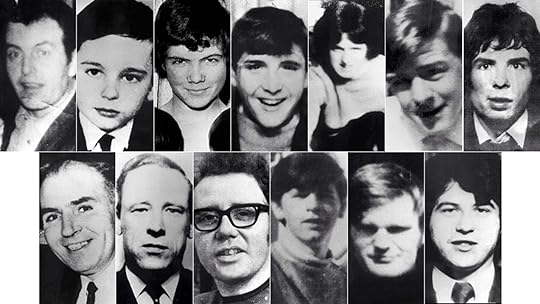
List of those (many of them adolescents) killed on Bloody Sunday: -Patrick ('Paddy') Doherty (31) -Gerald Donaghey (17) -John ('Jackie') Duddy (17) -Hugh Gilmour (17) -Michael Kelly (17) -Michael McDaid (20) -Kevin McElhinney (17) -Bernard ('Barney') McGuigan (41) -Gerald McKinney (35) -William ('Willie') McKinney (26) -William Nash (19) -James ('Jim') Wray (22) -John Young (17) -John Johnston (59) (Johnson was shot twice on 30 January 1972 and died on 16 June 1972. His family is convinced that he died prematurely and that his death was due to the injuries received and trauma he underwent on 'Bloody Sunday'.)
The victims, top row (l to r): Patrick Doherty, Gerald Donaghey, John Duddy, Hugh Gilmour, Michael Kelly, Michael McDaid and Kevin McElhinney. Bottom row : Bernard McGuigan, Gerard McKinney, William McKinney, William Nash, James Wray and John Young
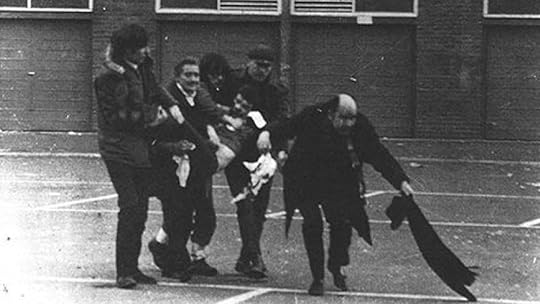
Father Edward Daly, a Catholic curate, waving a bloody white handkerchief so that a group of men (including medic Charlie Glenn, the one wearing glasses) could carry 17-year-old Jack Duddy, who had just been shot and killed as he was trying to run away. When Daly, with the white handkerchief, and three men tried to help him, the British soldiers shot a few more times at them. Duddy was an aspiring boxer and only went to the march at the behest of his friends.
The Troubles, the conflicts in Northern Ireland that lasted approximately three decades in the 20th century, consume a large proportion of Ireland's history. Wikipedia defines these times as a period of ethno-political conflict in Northern Ireland which spilled over at various times into England, the Republic of Ireland, and mainland Europe. The duration of the Troubles is conventionally dated from the late 1960s and considered by many to have ended with the Belfast "Good Friday" Agreement of 1998. Violence nonetheless continues on a sporadic basis. The principal issues at stake in the Troubles were the constitutional status of Northern Ireland and the relationship between the mainly-Protestant unionist and mainly-Catholic nationalist communities in Northern Ireland. The Troubles had both political and military (or paramilitary) dimensions. Its participants included republican and loyalist paramilitaries, the security forces of the United Kingdom and of the Republic of Ireland, and politicians and political activists on both sides.
A rather dry overview. So why not read a play by Irishman Brian Friel? Friel may be the best living dramatist of our time. Many of his plays are at least part political drama that portray snippets of these conflicts. I had the pleasure of seeing Friel's play "The Freedom of the City" at the Abbey Theatre in Dublin in 1999. It is a dark two-act play about an incident in Derry during the height of The Troubles. Here's the Wikipedia edited description:
"The Freedom of the City" is a play by Irish playwright Brian Friel first produced in 1973. It is set in Derry, Northern Ireland in 1970, in the aftermath of a Roman Catholic Civil Rights meeting, and follows three protesters who mistakenly find themselves in the mayor's parlour in the Guildhall. The plight of the protesters is that their circumstance is interpreted as an 'occupation'. The play illustrates their final hours in the Guildhall, their failed escape and the tribunal into their deaths. Following a Northern Ireland Civil Rights Association march on 30 January 1972, an event now known as Bloody Sunday (in which Friel participated), the British 1st Battalion Parachute Regiment opened fire on the protesters which resulted in thirteen deaths. Friel wrote an early form of his play, having started it approximately ten months prior to Bloody Sunday; he modified it following the conflict to entail certain links to the events."
The play was so powerful that I still recall the magnificent single set and the pleasant lilt of the Irish actors. Friel's play "Translation" is his masterpiece. It's political drama, an historical tale, a funny and clever play on language and a tender love story. But "Translations" is a longer play: "Freedom" will give its reader a mighty but smaller taste of Friel.
Of course, Brian Friel's plays are hard to find in American libraries. But do not dismay. Perhaps your library (and surely Netflix) has a DVD of DANCING AT LUGHNASA, Friel's play made into a film starring Meryl Streep and Michael Gambon. This story is set in 1936 Donnegal and explores a mythical almost pagan landscape of Ireland. Not my favorite portrait of Ireland but a Friel play!
"Because...you grumbled and someone else grumbled and someone else, and you heard each other, and became aware that there were hundreds, thousands, millions of us all over the worlds, and in a vague groping way, you were outraged." This play is extremely topical and well written. The feeling of dread and disappointment you feel at the displays of incompatible police brutality and the decision by the law that those actions were just is a macabre reminder that the world of this play is not just textual, but also contextual.
Excellent read dealing with the Troubles. Despite knowing the ending, the non linear story heightened the stakes and made the ending all the more poignant.
أولى التجارب المسرحية مع الرائع فرايل المسرحية تتكلم عن 3 أشخاص منضمين لحركة الحقوق المدنية ضد إنجلترا. و تدفعهم الشرطة للدخول في مكان ما بسبب ضرب النار والغازات وتبدأ المسرحية من حيث النهاية وليست بداية الأحداث استطاع فرايل أن يقدم صورة لثلاث أشخاص مختلفون في كل شيئ ولكنهم تجمعوا في مظاهرة ضد الوجود البريطاني في ايرلندا وجميعهم فقرا ومن خلال رأى( وودز) عالم الاجتماع نعرف تحليل الفقر وأثره عليهم وبداخل كل شخصية قصة إنسانية وراء الانضمام للمظاهرة بناء المسرحية من فصلين وتحليل للشخصيات و الفكاهة التي كانت على لسان( سكنر ) وتعاطفي كان مع شخصية (ليللي ) والمسرحية واقعية وهذا أكثر ما ميزها بدون التعاطف مع أحد الشخصيات وأراها قريبة من فيلم الإرهاب والكباب ولكن في الفيلم قرر( عادل امام) احتلال مبنى التحرير ولكن نهاية مسرحيتنا على عكس الفيلم ودفعتهم الظروف لدخول مبنى البلدية التابع لانجلترا بالصدفة ونجد مواقف السلطة الإنجليزية ومؤسساتها التابعه من حيث تصوير هؤلاء انهم إرهابيون في المسرحية هذه يأتي دور رجل الدين الذي يقرأ الصلوات على الضحايا ولكنه يرى أن هناك ما يريد أن يحول البلاد لشيوعية و عناصر أخرى أفسدت المظاهرة. أكثرية رجال الدين يقفون ضد الثورات و يطلقون الأكاذيب دائما. وهذا وليد كل الثورات والمظاهرات المسرحية بسيطة ولغتها سهله وبها مقطعين محاكمة انجليزية لهؤلاء وتحقيق فيما جرى لهم والحوار بين الشخصيات داخل مبنى البلدية أما عن الترجمة فهي بائسة وعامية والمترجم والمراجع لا أعرف ماذا كان يفعلان عند المراجعه النهائية للنص وهذا ما دفعني لاعطها 3
Absolutely riveting and heartbreaking this play perfectly captures the tensions surmounting in Northern Ireland during the times of the Troubles and its devastating consequences. The characters come to life from the page and detail the injustices and pain felt by the oppressed populations and the various perspectives taking center stage during this time of great political upheaval.
A very touching account of The Civil Rights' Campaign in Northern Ireland during the Troubles. The play follows three campaigners - Michael, Skinner and Lily and explores their personal stories about why they joined the campaign. I found the ending particularly upsetting and it is an ending that will stay with me for a long time.
AMAZING PLAY! There was just the right amount of action and Brian Friel's writing allows the readers of the modern generation to understand the truth behind the 1970's Irish-Catholics Civil movement.