WARNING: SPOILERS INCLUDED
(and oh, is this thing spoiled!)
First, a quick note about spoilers: I don’t see how someone can write a review of a book without including some spoilers. No one wants to read an entirely subjective, emotive response to a work without some indication of what brought on that particular response. “I was carried on wave after wave of unmitigated joy, interspersed by troughs of terror and impending doom, before being washed ashore on a beach of confusion, to be left sweating and crying upon sands of turpitude and gastro-intestinal distress” just doesn’t cut it. Nor does “I liked it a lot until the ending, which sucked.” What sucked? What turpituded? Didja just vomit a little there in the back of your throat or was a full-blown, freight-train-commin’-through-and-not stoppin’-till-there’s-nothing-at-all-left case of the sh…
Never mind, you know what I mean. So there are spoilers in this review, some mild and some major. The ending is kind of given away, which I had to do in order to explain why I didn’t like it. Read on to understand what I consider to particularly turpituding about this one (and really, it was just mild cramps resolved by a swig of Pepto).
This is the first Tepper book I have read, and in many ways it was a really interesting page-turner. At least for the first 18 of the 20 chapters. Then it collapsed – maybe down into quicksand, maybe into itself like a singularity, maybe like a building suddenly succumbing to some inherent, heretofore unseen design flaw. I’m not really sure what metaphor works best, but the point is it goes from pretty damn good to pretty damn bad pretty damn quickly.
Oh, there are some minor issues throughout the first 18 chapters: a couple too-Dickensian coincidences, uneven character development, things like that which don’t really need mentioned as they play no role in my overall assessment. These would prevent me from ever considering this a great novel, but through 18 chapters I did consider this to be a really good novel. Then – well, we’ll get to that.
The gist of it is that there is a group of seven women who meet in college in the late 1950s, form a bond, then a group called the Decline and Fall Club, pledging to each other that they will not allow themselves to decline and fall but will rather pursue their diverse goals come what may. The bulk of the story (everything except the prologue) takes place in 1999. One of them has apparently died (or at least has disappeared) and the other six are preparing for their annual get-together. A radically misogynistic wave is sweeping through the world and is seemingly about to come to a head when a strange plague starts to rapidly spread, the main affect of which is to cause people to lose their sex drive. The six remaining women (and a new seventh, kind of) confront this misogynism, the plague, their ideas of womanhood, and their feelings for/about each other as the story moves along. The story is compelling and well-written and moves along at a brisk pace.
Some reviewers here have commented on Tepper’s time frame for the events. The book was written in 1996 and takes place in 1999, so it definitely falls in the “near future” category of SF. In these types of stories, the setting is usually very similar to the world at the time the book is written, with maybe one foreseeable, believable change that separates the book world from the real world. Tepper’s 1999 book world is very similar to her 1996 real world, with two notable exceptions, neither of which prima-facie seem to be realistic extrapolations from her real world. The first item is sociological - the wave of misogynism sweeping the world and the impending fascist take-over of the US. Smack-dab in the middle of the Clinton years this likely seemed ridiculous, but from the perspective of 2023 it’s probably more accurate to say that the rumblings were there, she was just a decade or two too early. I’ll give her this one, no problemo. The second item is technological - instead of being jailed, criminals spend their sentences in a state of suspended animation. This is treated without wonder, as just a natural normal part of everyday life and how the world is. This one is not really justifiable. There is nothing in the technology of 1996 (or today) that would have indicated that something like this would be possible (and commonplace) by 1999 or at time in the foreseeable future. Furthermore, if some sort of paradigm-shifting technological breakthrough were made, why is there no other indications of this? Things like this aren’t invented in a vacuum and most technologies have multiple uses, but no other technological aspect of the world appears to be have changed and no other aspect of life seems affected. Any breakthrough of this nature, in addition to having been researched, experimented with, and tested for much longer than three years, would have effects on other things and other aspects of life, but there are none. Other than this one single item, the book world of 1999 is technologically the same as the real world of 1996. That just doesn’t make sense.
But this has nothing to do with my misgivings concerning chapter 19.
Other reviewers have commented on the feminist slant of the book. I take this to be a good thing – in fact, one of the best things about the book. As a middle-aged, middle-class white American heterosexual male I understand that there are some things I can never truly know – I can’t know what it’s like to be black, or gay, or Muslim, or Russian, or female. I can read all the books ever written, I can talk to as many different people as I can find, I can listen and ponder and introspect, but I can never possess that first-hand, immediate knowledge of what it’s like to be someone other than who I am, to have gone through anything other than what I have gone through. However, what good literature can do, and what this book does through 18 chapters, is to give some perspective on the world as seen through the eyes of others, to achieve some level of understanding of what it is like for them to live in this world, to exist in this reality, to be. No, it will never be a full and complete understanding, it will never be KNOWLEDGE in the true sense, but it can be the basis of mutual understanding. Tepper gives me this by convincingly presenting the world through the eyes of these very different women. This apparently makes some folks uncomfortable. Sometimes good literature does make us uncomfortable and takes us out of our too-easily-fallen-into, egocentric, static ways of understanding. This is a good thing. Thank you for this, Ms. Tepper.
So what is my real problem with this book? My real problem is chapter 19. This chapter contains two of the things I most despise in fiction – two of the biggest, laziest cop-outs an author can use: A giant info-dump disguised as revelations from a mystical source, and an excruciatingly tedious infiltration/chase sequence that tries for suspense but delivers only drudgery and more dumping of info.
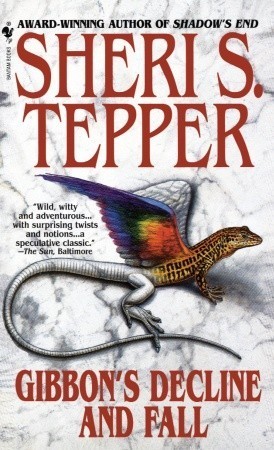
Also, snake-people and a space-vampire.
Yes, that’s right – completely out of nowhere, totally non-foreshadowed, inexplicably placed into this feminist near-future critique of modern society, we get snake-people. And a space-vampire. Not only that, but these function both as deus ex machina (the snake-people) and diablo ex machina (the space-vampire). All the evils are explained by the existence and actions of the space-vampire, and salvation comes only through the existence and actions of the snake-people. The humans – male and female alike – are only pawns in their great battle. Oh, the ending leaves open the possibility that the entire future of the human race will be decided by these six women, once the snake-people and the space-vampire have finished their shenanigans and gone away, but even then the options are limited to what the snake-people will allow.
Really. Snake-people. And a space-vampire. Please stop here for a moment and let that sink in.
As an avid reader of science fiction, I LIKE the idea of the snake-people, a separate intelligent species that evolved from reptilian ancestors and co-exists with us here on earth. The idea has been used before in SF, but it is far from exhausted. There are many different things that can be done with this, many different stories that can be told, themes that can be explored, etcetera. Even the idea of the snake-people being mystical shamans in the American southwest may be salvageable, though it is a bit cliched. The problem is they just don’t belong in this story. This is a story about a group of very human women struggling to achieve their dreams and goals in a very human world, and then all of sudden we find out that they are incapable of salvation without the intercession of the snake-people. With only one exception, we don’t even see the effect that the revelation of the existence of the snake-people has on these women. “We have problems, here’s snake-people to explain the cause of those problems and show how to solve those problems (and actually do the solving), that’s nice isn’t life good?”
Blah.
As far as the space-vampire goes, the less said the better. To attribute the ills of the human race to some sort of energy/life-force-sucking creature from the beyond is trite, cliched, unbelievable, and downright stupid.
These may have worked better if the novel were written as Sophy’s story – yes, I know Sophy dies off-screen and doesn’t appear after the prologue, but that doesn’t prevent the book from being her story. Hell, a character doesn’t have to appear in a story at all for that that story to be about that character, explored through the effects they have had on the actual characters. But Tepper doesn’t give us that. If any of the characters can be considered the main protagonist, it is Carolyn. Sophy’s “presence” is alluded to, mentioned, felt here and there, but she doesn’t drive any of the action or motivate any of the other characters (until the Great Revelations of chapter 19, of course). She almost incidental.
And what do we finally discover to be the root of the problem? What is it that the Soul-Sucker from the Great Beyond has inflected on us and from which the Mystical Snake-People of the American Southwest must save us? What could possibly be the horrible, terrible, all-encompassing malignancy that befalls and almost destroys the human race?
Lust. Sexual lust.
Yep, that’s it. Everything would be fine and grand and hunky-dory and A-OK if men and women (but particularly men) did not feel sexual lust.
Lust. You know, that completely normal, natural, basic drive that exists up there (or down there, rather) with things like, oh, I don’t know, hunger and warmth and such as some of the most basic, most fundamental drives of human nature? For the sake of anyone still reading, I’m not going to go too deeply into my issues with this. It will suffice to say the vast majority of human beings who have ever lived have experienced sexual lust at some point or the other in their lives (or at many different points). The problems come with the actions some people take in order to satisfy that lust, not with the feeling of it in and of itself. Must of us are able to control it, or even guide it toward productive and moral ends, but some folks can’t or won’t. It’s not the feeling of lust which is problematic, it is the actions some people (yes, mainly men) take in order to try to satisfy that lust. But that’s not what Tepper says – the benevolent Southwestern American Mystical Snake-People don’t feel lust and the Alien Soul-Sucker uses human lust to achieve his ends. Lust is bad, folks. I wonder if hunger and warmth are too?
One final note on morality that just struck me as I was finishing this up (yes, it ends soon!): At the end of the book, after the representative of the snake-people has defeated the space-vampire, the space-vampire and three of his cronies are punished by being placed into suspended animation for what we are led to believe will be at least a very, very, very long time, if not forever. This is probably justifiable for the space-vampire, but for the three humans who were ultimately under his control (not that this absolves them – they didn’t really put up any kind of fight against his control)? Really? A small group of people takes it upon themselves to sentence three humans to an eternity in suspended animation with no trial, no attempt to come up with a better solution, and apparently no remorse or regrets or empathy whatsoever? And this is a good thing?
There is no way to read just the first 18 chapters and come away feeling satisfied, so if you are interested in some of the feminist themes or are looking for this perspective, go ahead and read this one – just don’t be surprised when the snake-people show up. Or the space-vampire. They’re the real spoilers here.