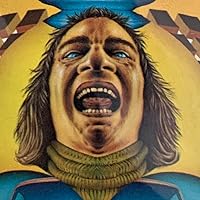
This is Jeter's first published novel. An early "cyberpunk" work, Seeklight is the story of a quest for identity by Daenek, scion of an assassinated thane, or clan leader. The action occurs during some future time on an Earth-like "seed planet," to which human genetic material, or seed, was transported while shepherded and nurtured by protective robots.
Kevin Wayne Jeter (born 1950) is an American science fiction and horror author known for his literary writing style, dark themes, and paranoid, unsympathetic characters. He is also credited with the coining of the term "Steampunk." K. W. has written novels set in the Star Trek and Star Wars universe, and has written three (to date) sequels to Blade Runner.
Science fiction pulp or sweaty nightmare made real? A tense and often inexplicable fever dream? You be the judge! Seeklight is about the son of a so-called traitor, his flight across a curiously lifeless colony full of curiously lifeless humans, his slow movement into understanding of his purpose and his powers. It has clones & fake angels & screamingly murderous robots; it also has a female character who in any other novel would be a romantic interest, but in this one is just as mindlessly, frustratingly, monomaniacally small-minded as every other character. It has a low-key, downbeat tone and a style that manages to be simultaneously sinuous, hypnotic, and blandly prosaic.
It has a kind of theme: HUMANS ARE FUCKING MISERABLE BUGS. They are not worth the effort of saving; downward is their natural trajectory.
Jeter is not interested in making you happy and he is not interested in letting you understand the nuances of the human condition. He wants you to know about entropy, about the inherent piggishness of human nature, about quests that go nowhere, and answers that deliver questions that have no answer. He wants you to understand there is actually no hope. I hate that message and I didn’t particularly like this book. But I also really respected it, its choices and its insularity and its bleak and rather pure logic. Color me impressed. Alienated and saddened, but impressed.
This is Jeter's first published novel. Apparently he arrived in the science fiction world fully-formed and already equipped with the cynicism and world weariness of several lifetimes. Kudos? Yes, kudos!
A version of this review is part of a larger article on Jeter posted onSHELF INFLICTED
Seeklight was the seventh novel published by Harlequin in the Laser line edited by Roger Elwood. It was Jeter's first published novel and was introduced and possibly mentored by Barry N. Malzberg. It does have a lot of the same kind of depressed feel and dark tone of a Malzberg novel. It's set in an undefined future on an unnamed colony world and follows Daenek, a young son of a disgraced former ruler. Everybody seems to be going mad and becoming uncommunicative and everyone's under constant surveillance and interrogation by crazed monks disguised as angels for unknown reasons. Even all of the robot priests are going crazy. Daenek gets a key and the people who raised him die and he goes on a quest and meets a girl who sings and acts like a boy and it's all very strange. Then it ends. It has a New Wave vibe and is quite different from most of the other Laser titles, but it's well-written and interesting. The ending is abrupt and unsatisfying, but it was good up to that point. As did all of the Lasers, it has a Kelly Freas cover; the crazy robot priest looks quite imposing.
Seeklight is a splendid debut by K.W. Jeter. Barry Malzberg wrote the introduction for Laser Books calling it one of the three or four best SF novels he has read from an emerging author. If you've read Malzberg, the aesthetic connection with Seeklight will be apparent within a few pages, both writers navigate that existential lattice concerned with the darker aspects of the human condition.
Rarely do first novels show this level of focus and intent. Clearly, Seeklight is a personal statement made by an author who had long been living next to his ideas and worldview before publishing.
The story follows Daenek, son of an assassinated and posthumously disgraced thane, living as a pariah in his village and marked for death at 17 by the new regent. The atmosphere is in the dying earth tradition but while landscapes and structures are withering, it's the human spirit that is the fulcrum which breaks the world around. The environment is not so much an aesthetic choice as a mirror for internal desolation, patina-molded cities and souls that have given up without a fight.
Jeter populates this existential wasteland with some of the more unique and tamely bizarre creations I have come across in the genre. This is not a novel of ideas, but when the science fiction elements show face, it's done with impressive originality. There are the Sociologists, angelic figures who descend upon random citizens to collect data for unknown purposes, and a mysterious syndicate of cabalistic robotic priests that roam either in detached peace or commit horrific acts of violence. The presence of these symbolic renderings transforms the novel from medieval fatalism into science fiction proper (with a touch of what Jeter would later deem steampunk), though Jeter keeps their true nature tantalizingly and effectively obscured.
Where Malzberg often pushes to the limits of what any person can reasonably handle, Jeter leaves it open to possibility. But he doesn't fold this into some hero's journey wrapped in a Christ complex or religious allegory. Instead, he offers a real-world diagnosis of why people accept their conditions, how they become stall-warted by the very systems that oppress them. The cure may lie not in heroic action but in the radical belief that life can change, if only you cared enough to change it.
Seeklight is entertaining, meaningful, and melancholic, while never taking cheap shortcuts. Even when Jeter decides to info-dump, he connects the dots with surprise and confident thematic development. Given this is only my first novel by Jeter, if he grows from here, and matures and refines his style, he will surely be a mainstay on my ever-growing bookshelf.
"K.W. Jeter’s first published novel is a promising one (*). On a nameless colony world, entropic forces influence all. Humankind speaks less and less and resorts to animistic grunts. Robotic priests go mad. Speculation abounds of a “Dark Seed” (52) implanted by the eugenicists on Earth in the colonist gene pool creating an increasingly crude and lazy population, “wretched and fearful of any change or effort” (46). The landscape itself is inscribed [...]"
While most of the book is not very memorable, and some dialogue falls into the category of "Golden Age Sci-fi Schlock", Seeklight is elevated by elegant prose and an ending which provides an incisive commentary on human nature. In terms of the Laser Books, I'd still say it's a 3 out of 5, but that three is strong and very well earned. In other words, Jeter, you are on this council, but we do not grant you the rank of Master.
Obviously not for everyone, but if you enjoy a high-concept "men's adventure" novel, this one is just the dish. It's tightly written, and vivid. And, being written by Jeter, Weird.
An interesting but scattered dissertation on entropy that shares a small amount of DNA with Priest’s Inverted World and carries the endorsement of Barry Malzberg but is still Laser Book pulp in its heart of hearts.
I was supposed to be reading a different Jeter book for a group read, but ended up reading this instead. I bought a lot of signed Jeter paperbacks on EBay last year, so I have quite a few to read. This was excellent for a first novel. It definitely kept my interest. There was a great twist at the end I wasn't expecting. My one complaint is the minor info dump near the end of the book. I suspect it was there to shorten the book to keep it within a manageable length for Laser Books. I think my favorite part of the book was the creepy mechanical priests who managed the colony. Some go mad and you can never know what they might do. Definitely a nod to PKD, though I'm not sure if Jeter was friends with him this early on. My main interest in Jeter's work came out of his friendship with Philip K. Dick. It's kind of cool his early books came out as paperback originals just like PKD's and Laser is a pretty oddball publisher for his first two. I'm thinking I may do a Jeter marathon and move on to his other Laser novel.
Laser Books has a deservedly bad reputation because they did publish a lot of garbage. However, the line does have its high points, and Seeklight is one of them. Jeter is an interesting author, and I have read quite a few books by him. Standouts include Farewell Horizontal and Death Arms. Seeklight was his first book, and it is solidly entertaining. The scenario is set on a colony planet where human civilization is starting to crumble with people leaving their simple towns to live in the wilderness. The hero is the son of the former ruler who was overthrown for his beliefs. The son is about to face a mind wipe so he flees, seeking answers to his father's death. Jeter is a good writer, and the scenario is interesting. However, it is certainly a first novel, and the book is just not engaging enough to rate higher than a 3, average but entertaining.
It was fine. The worldbuilding was unique. As the story unfolds, the reader discovers more and more about the world along with the protagonist. The story itself was disappointing, though. It amounts to “the characters did some things, then the story ends.” There’s not really any sense of rising action and climax, it’s more like the book just… stops. The overarching theme of the story is encroaching entropy, and it kind of feels like entropy overcomes the forward motion of the plot itself.
Not as good as this author's later work, but worth reading. Kind of a hero's journey story. It felt like he didn't quite know how to end it. I think I might have read this 35 or 40 years ago. A few elements seemed familiar, but for the most part it's as though I read it for the first time this week.