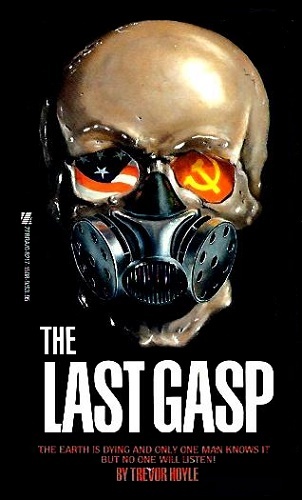
A large, dense, frightening novel from the UK author of This Sentient Earth. In 1990 the ocean's oxygen-producing plankton are dying from pollution. Maverick oceanographer Theo Detrick predicts a disastrous drop in the air's oxygen content within 20 years. Nobody believes him. Polluter-industrialist J.E. Gelstrom is furiously empire-building. The US/USSR military have abandoned nuclear weapons for a better deterrent--environmental warfare. Marine biologist Gavin Chase teams up with Detrick's daughter Cheryl to gather facts & alert the public. The climate warms, the protective ozone layer thins, equatorial regions become uninhabitable. The military, led by maniacal Major Madden, unleashes environmental weapons while retreating to secret, sealed labs to breed mutants able to survive anaerobic conditions. Eventually the dying Gelstrom has a change of heart & gives funds to Chase & friends who work desperately to reverse the ecological transformation.
Global warming taken to it's inevitable conclusion. This is a work of fiction but could be seen as a cautionary tale about what we are doing to the planet. A bit dated but entertaining. It made me more aware of how I acted and made me clean up my act early on.
A coworker was talking about this 1983 near apocalyptic read and it really caught my attention. It's now set in a (mostly) past future between the years 1990 and 2028. For the most part I enjoyed this sci-fi environmental disaster story, but I started to loose interest with it because it's quite slow paced and it's pretty heavy on the science. My eyes might have started to glaze over a time or two.
The Last Gasp was originally published back in 1983, set in the future (which actually starts in 2016 here) it follows a series of scientific types who realise that the Earth is moving towards being unable to sustain life rather too fast and political types that have their own agendas – and ends up being a wildly sprawling yet intriguing and fascinating novel that hits quite close to home.
It was not without its faults for me, the concept was sound and definitely thought provoking, the characters are brilliantly drawn and for the majority of its rather tome like length I was completely immersed. The action so to speak takes place over a number of years, this is a slow burner of a literary fantasy novel with a hard scientific edge.
However, for want of a better way of putting it, it did bang on a bit in places. I enjoyed the scientific elements very much, Trevor Hoyle writes it so it is easily understandable whilst making his characters sound professional, but there were moments in this novel that I was begging him to PLEASE not tell me anything else about plankton. Or oxygen. Or how it all works within the eco system. I get it already. Lack of Oxygen bad!
Even having said that though, despite my preference being for less science more story on occasion, The Last Gasp is really very clever, definitely will give you pause for thought and descriptively speaking is stunning – so it has an awful lot going for it. And if you love extending your knowledge with a lot of added information as well as being entertained you will adore this from first page to last. I thoroughly enjoyed almost all of it and would definitely recommend it to science fiction and fantasy fans.
Even though this chilling book was written almost thirty years ago, it reads like today's headlines. If Hoyle's description of ecological catastrophe doesn't persuade you of the necessity to act against climate change, nothing will. On one level, this is the "Uncle Tom's Cabin" of the Green Movement.
Breathing hard, or hardly breathing? Al Gore would love this book! Okay, picture China's air quality right before the Olympics. Now imagine that same air quality spread globally, times 10! In this novel, Hoyle presents a world where pollution is out of control. Can the scientists convince the public and politicians to take action? Written in 1983, it seems like it was made for the debates of today. I enjoyed it.
I just read this book again and it still makes me a nervous wreck concerning the environment. I read this initially in the early 70’s. I can say that the novels of the late 60’s and early 70’s were mostly dark.
This is an amazingly prescient novel. It was written in the 1980s and set in the future (beginning in 2016) and it has correctly predicted the projection of many of the biggest problems facing humanity together. Hoyle has been massively ambitious in his scope - telling the story of the planet over decades through a few characters. I enjoyed the odd chapters from the perspective of other people whom we don't come back to. Hoyle has made difficult scientific concepts easier to understand and presented some extreme theories of where climate change may lead. Ultimately this certainly reads like a novel, an apocalyptic thriller, rather than anything too scientific. I thoroughly enjoyed it, despite the sections that veered into the bizzare and some of the plot lines that trailed off.
A hard book to classify. Hoyle wrote this in the early 80s and it consists of a near future where the planet, due to humanity, is facing ecological disaster. Pretty good read, if a bit slow at times. 3.5 stars.
FINALLY! This book took me forever to read, mostly because it was pretty damn terrifying, but also because of the ridiculous amount of science the author decided to throw in (I feel much smarter coming out the end of this though) It would have been four stars if not for an unnecessary rape that I really didn't want to read. Other than that harrowing experience, it was actually a damn good story with some terrifying visions of the future that have messed me up beyond belief. Nearly cried today because I used a plastic bag...
This is a big book, 566 pages, which are needed because the story covers the period 1990 to 2028, a challenging project for the author, Trevor Hoyle. The book was published in 1984, so I guess it was written in about 1982, just before the technological explosion began. For this reason the story at times seems very old fashioned, in that the characters don’t have mobile phones, which seems strange to us, of course. The author should not be criticised for this – how many of us in 1982 could have predicted 4G phones, tablets, Blue Ray and personal computers becoming ubiquitous after only a few decades?
The basic premise of the book is fascinating, if a little scary – the phytoplankton (teeny weeny creatures) in the world’s oceans that produce most of the world’s oxygen begin to decline and the oxygen content of the atmosphere begins to reduce compared with other gases.
This leads to massive climate change, with large parts of the world becoming uninhabitable, deserts and jungles being created in formally temperate zones and people having to wear protective suits and breathing apparatus just to survive – not to mention the mutants and weird creatures! The main story deals with a corporate/military plot that makes the situation worse, though unbeknown to the ‘baddies’ it is happening naturally as well.
It starts as an environmental disaster story but Mr Hoyle takes it further, his vivid imagination taking us into the realm of science fiction. He writes well and despite some elements that don’t fit with modern life as it turned out (as discussed above), the political and commercial behaviours feel realistic, at least to this cynic!
The story does not have a happy ending but it is a cracking read that is difficult to predict, so you want to keep reading to find out what will be thrown at the main characters next. The scope of the book is huge and there is quite a lot of science here – Mr Hoyle clearly did masses of research before he wrote it.
If you believe the earth is at risk from our greed and stupidity, if you like science fiction and if you like conspiracies, you’ll love this book.
It's pretty rare for me not to finish a book. I normally try to give them the benefit of the doubt, particularly when it's a review copy I've been given. The best way to review something fairly is to finish it, so that it can be judged as a whole. When I do abandon a book unfinished, it seems to be normally at about the 40% mark. By that stage, I've read enough to be confident abandoning it is the right thing.
I gave up on Trevor Hoyle's The Last Gasp (Jo Fletcher, who provided a review copy through NetGalley) at 10%. Yes, 10%.
I'd been feeling pretty ambivalent about it from the start. There were the slightly skeevy scientists doing research in the Antarctic. There was the very heavy-handed plot about climate change killing off the oxygen-producing algae in the planet's oceans, slowly rendering the atmosphere unbreathable. There was the ensemble cast straight from a disaster movie (hero scientist! plucky scientist daughter! global elite ignoring all the evidence!). There was even a cigar-chewing general, who reminded me of General Ross from The Incredible Hulk cartoon series.
But the moment that made me walk away? When that general uttered the line "Weapons of Climate Degradation."
I read this book years ago and loved it. In the process of moving I realized that I no longer had my copy. I went on Amazon and bought a replacement.
This book was written almost 30 years ago. It was a chilling look at the end of us. I remember clearly about the red algae in the ocean, then years later watching about the red tides on the news. Scary stuff. Wonderful read. You can't borrow my copy though cause I'm going to dive into it once again.
One of the greatest unsung novels I've ever read. I picked it up at a discount store in the 80s, but it has haunted me for years. An outstanding apocalyptic nightmare, maybe relavant today than ever.
You can really tell that this is an old book. I suppose you can say that about any book but rarely does it spin in your head. The whole way thru you can tell it was written in the 1980s not with the cliches but the way Hoyle writes. So, take that as you will. I recognize the effort put into this one, even if Russia vs USA is bit over-saturated.
I enjoyed my time with this one, the time-skip is a little jarring and I put it down for a couple days when I got to that point. But I like the politics. Like many Sci-fi books its very word heavy. And the pacing can be slow for some, it wasn't for me. But if you want a quick read, this isn't really for you. This title needs your attention. The book covers 1990 to 2028, and with the content it covers it should to no surprise on how dense it is.
The theme of ecological disaster is something I think we can connect to much easier now then ever before;Climate change being in the forefront of politics etc. and it can be kinda spooky thing to read before bed if you tend to overthink things.
Unexpectedly good for a genrebased clifi. The usual sexism is there as is the sensationalism that can't really help the cause of climate change but quite refreshing as a hero narrative..
I received a free digital copy from the author/publisher via Netgalley in exchange for an honest feedback.
2.75 Stars (I couldn't decide between 2.5 and 3 stars so I'm compromising)
The Last Gasp tells the tale of a slowly-dying planet earth and its human occupants ignoring the obvious signs of illness. An eco-disaster is growing and become irreversible and as environmentalists crying out for the world to change, and for people to take notice, they're killed off by a corrupt government. Slowly, the air becomes poisonous, the sun grows hotter and people and animals start to mutate.
This book was a tough read and there were several times I thought I wouldn't make it through. At almost 800 pages, it's not only long with a very small font, but it's dense too and not just in scientific facts. At first I was like 'oh, no' when I began to read and I realised this wasn't going to be the thrilling survivalist novel I was expecting but I did find myself getting into the story and I did want to know the end conclusion. I can't say I loved the book though. I didn't find myself wanting to pick it up when I wasn't reading it. The science in the book isn' too hard to grasp and it's quite easily explained in most parts so the damage done to the world and the effect it's having is actually understandable - and scarily, very realistic.
There are some triggers in this for sexual assault, specifically rape. There are a few scenes in which rape is mentioned, threatened or implied, and the book fell into the trope/trap of the world falling to pieces and the menfolk thinking that meant they had a free pass to rape any women they came across. I hate that trope in such books.
I did like the end, mainly because right up to it I was despairing for the characters and I had no idea how they were going to get out of it. I really enjoyed seeing you know who come back and save the day as I had wondered where he had gotten to.
Overall, I can't say I enjoyed this book...but it was interesting.
This book is divided into 6 parts, spanning 38 years. It's set in the near future (at the time of writing) and describes what could happen if mankind fails to take action and continues to upset the natural balance of the planet. In particular, the book discusses in some detail what would happen if the algae within the oceans is killed off, reducing the composition of the air we breathe (there would be less oxygen).
This environmental message is told in a fairly accessible way. Although some specialised scientific issues are discussed between characters, it's done in a manner that most people can understand without having to follow all the technical details.
The story follows a group of people over the years as they attempt to warn the relevant authorities about the possibility of oxygen depletion, and then describes how they, and society, deal with it as the situation becomes increasing worse. The story itself is fairly well thought out but it's hard to say what type of book this is. In some respects it's a work of fiction, but based on fact, some of it reads like a thriller, but it becomes more like apocalyptic fiction as the story progresses. It's quite a long book and takes a while to get to the more interesting sections, and there are some major plot lines that ultimately don't really go anywhere, but overall it's an interesting concept and well written (even though I thought the ending was slightly unbelievable personally).
I reread this book because I was reminded of the evil in our politics today. In this book scientists begin to discover an environmental problem that faces the earth. The author takes the problem in a way that is not actually occurring - but he uses real problems that we are facing in our environment. The book was written in 1983 Anyway, as the scientists discover the environmental problems - leaders in governments and the military dismiss and get rid of these warnings. ... they have their own agendas to gain power by using the environment to gain more world power It does not turn out well for the earth - and it's inhabitants Kind of a reminder for me of what greedy people do for power, control and money - since we seem to have those kind of people in power today.
Unlike most of the nuclear apocalypse novels of the time, environmental disaster is one thing I can still see happening.
It's been at least ten years since I've read this, so I can't remember the exact details, but the general gist of it remains stuck in my mind and crops up whenever I hear of any new sign of global warming and various other ecological disasters.
It's still a timely work, despite "global warming" never being heard of when it was written.
end of the world story written in 1983 about global warming complete with greedy corporate CEO's and Dr.Strangelove type military involved in destroying the ecosystem for personnal gain. Sounds like BP in the Gulf!
I reread this book last summer. I was thinking about scenes that are scary and remembered one from it that scared me significantly. The reread was interesting because the science is all the stuff we are seeing happening now. In fact it is more relevant today than it was when written.
Depressing read. Even after it becomes evident that there is a global environmental catastrophe, one of the subplots (as I recall) involves the Pentagon making Strangelovian plans to make things worse overseas.
Extremely Plausible Read I believe well written and rather scary in it's predictions of what can and will happen if the human virus doesn't do something about the damage done and being done to Oceans and Land Masses Right Now.