

What do you think?
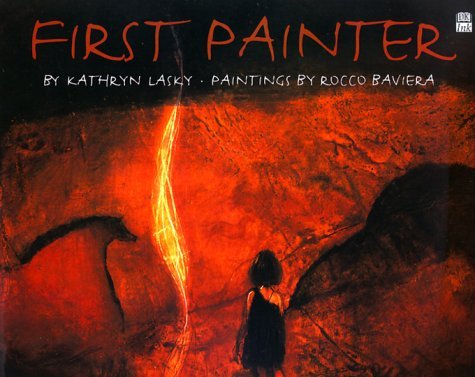
First Painter
Following the death of her mother, Mishoo the new shaman, must find a way to help her preshistoric tribe during a drought, so she enters the cave of the she-tiger and begins drawing her dreams on the cave wall.
40 pages, Hardcover
First published September 1, 2000
About the author
Kathryn Lasky
257 books2,328 followersKathryn Lasky, also known as Kathryn Lasky Knight and E. L. Swann, is an award-winning American author of over one hundred books for children and adults. Best known for the Guardians of Ga’Hoole series, her work has been translated into 19 languages and includes historical fiction, fantasy, and nonfiction.
Ratings & Reviews
Friends & Following
Create a free account to discover what your friends think of this book!
Community Reviews
Displaying 1 - 17 of 17 reviews

April 20, 2009
I found this fantasy on what may have spurred the first cave painter to be believable and warmly told. The illustrations are gorgeous, the narrative plausible and the research well-documented. There's so much that we can never know, and Lasky acknowledges this with grace while offering up the portrait of a young shaman doing her best to bring rain. Highly recommended.

April 20, 2009
This is a picture book length book and it is a picture book, but it has way too many words in it for many picture book fans, for most very young children.
The illustrations are absolutely amazingly terrific.
The story I found somewhat boring. Also, I’m very interested in prehistoric cave paintings, and I know it is unreasonable of me but I felt almost affronted by this speculative story. I suspect I’d have had no problem if I’d enjoyed the story.
There is a page of information about cave paintings in the back of the book, and while it was skimpy, I appreciated that it was there.
The illustrations are absolutely amazingly terrific.
The story I found somewhat boring. Also, I’m very interested in prehistoric cave paintings, and I know it is unreasonable of me but I felt almost affronted by this speculative story. I suspect I’d have had no problem if I’d enjoyed the story.
There is a page of information about cave paintings in the back of the book, and while it was skimpy, I appreciated that it was there.
June 19, 2019
The cave paintings of Europe will always hold a mysterious allure to them. Their origins may be shrouded in mystery for eternity.
This book ponders a possible story to them. A young girl is visited by ancestral spirits to save her people from drought.
The illustrations have a dark earth tone and fit the mood of the story well.
Like any good children's book, I hope this will inspire the reader to learn more about the history of cave paintings.
In the meantime, pi k this book up and enjoy the story of Mishoo.
This book ponders a possible story to them. A young girl is visited by ancestral spirits to save her people from drought.
The illustrations have a dark earth tone and fit the mood of the story well.
Like any good children's book, I hope this will inspire the reader to learn more about the history of cave paintings.
In the meantime, pi k this book up and enjoy the story of Mishoo.

April 11, 2022
I wanted to like this book, but just didn't. It does contain some cultural elements that could spark some interest in the actual caves/paintings this book was written about, but the story itself is choppy and leaves the reader with many questions. Not very well written and I find myself more interested in the actual facts mentioned in the afterward.
The illustrations are not special.
The illustrations are not special.

March 16, 2018
Beautiful artwork! Absolutely stunning
sony-or-android
January 11, 2020Dan's podcast recommended.
Should Dan Read this?
Should Dan Read this?

March 13, 2022
Great concept but too many words.
February 20, 2017
This was, for me,
a perfect introduction into a cross-curricular unit on science/social studies. I used it for my sixth grade in California, which studied ancient civiliations in social studies and earth science, which included early man. It is short, the artwork was interesting, and it included the idea that hunter-gather societies may have sometimes had periods of starvation. The idea of starvation is something I didn't want to gloss over because I wanted to impress upon their minds that out of that experience, the necessity of farming grew, which led to the establishment of villages, etc.
a perfect introduction into a cross-curricular unit on science/social studies. I used it for my sixth grade in California, which studied ancient civiliations in social studies and earth science, which included early man. It is short, the artwork was interesting, and it included the idea that hunter-gather societies may have sometimes had periods of starvation. The idea of starvation is something I didn't want to gloss over because I wanted to impress upon their minds that out of that experience, the necessity of farming grew, which led to the establishment of villages, etc.

March 27, 2013
This is a wonderful tale about a young girl who becomes a dream catcher in order to bring back the rain and save her people from starvation. The narrative is a fictional account, but helps to explain how and why early Cro-Magnon people might have created the cave paintings discovered in France and Spain.
The narrative is very engaging and emotionally charged. The dramatic experiences of Mishoo led her to create images of her world, especially the animals her people relied on for food.
Overall, we thought this was an informative and entertaining story and we really enjoyed reading it together. I especially liked the short afterword by the author that explains the background and inspiration for the tale.
The narrative is very engaging and emotionally charged. The dramatic experiences of Mishoo led her to create images of her world, especially the animals her people relied on for food.
Overall, we thought this was an informative and entertaining story and we really enjoyed reading it together. I especially liked the short afterword by the author that explains the background and inspiration for the tale.

April 3, 2013
The cave paintings found in Lascaux were exciting to learn about this year while teacher my daughter World History. Our textbook didn’t cover many of the other cave paintings found throughout Europe. The one in this story were loosely based on the paintings in Chauvet Cave. I wish I had this picture book when we were reading about these earliest examples of artistic expression, but it was just as interesting to read about now. The story is a work of fiction with the main character being a young girl who has taken over as being the community “dream catcher,” during a time of severe drought that is killing off her people.

September 5, 2011
This picture book is an imaginary recreation of early cave painting, specifically inspired by the Chauvet cave. The illustrations truly capture the essence of the time period and of cave painting. The prose capture just one possibility of the beginning of human artwork.
This picture book is for 3-5 grade more so than younger kids.
This picture book is for 3-5 grade more so than younger kids.

October 24, 2012
Picture book that shows what the cave painters of early human civilizations might have been thinking when they decorated the caves of Europe. Kathryn Lasky tells the story through the eyes of a young girl who is taking on the mantle of her mother as the tribes weather witch.
Nice illustrations. Good piece of sci-fi/fantasy.
Nice illustrations. Good piece of sci-fi/fantasy.

August 14, 2014
I felt like this book was good enough to use in our homeschool lesson about Prehistoric art. It is wordy and takes a while for the story to get going.
I really like the art.
And I love how the artist feels the art that she is making. The bit at the end about the Chauvet Caves is also interesting.
I really like the art.
And I love how the artist feels the art that she is making. The bit at the end about the Chauvet Caves is also interesting.

Read
November 25, 2013genre: historical fiction
This book is a great depiction of a clan of early people and the challenges that they faced. It has beautiful artwork that keeps readers engaged which is hard to do with this topic.
This book is a great depiction of a clan of early people and the challenges that they faced. It has beautiful artwork that keeps readers engaged which is hard to do with this topic.

September 16, 2011
Weird story--but good exposure to cave painting.

June 13, 2014
Gorgeous book, so strong. The words and pictures are beautiful and take you right into the character's mind. Good on so many counts.
July 11, 2014
Loved the art work however it was very lengthy.
Displaying 1 - 17 of 17 reviews