Jump to ratings and reviews
Rate this book

Shinano!: The Sinking of Japan's Secret Supership

Rate this book
Recounts how the Shinano was secretly converted to an aircraft carrier, but was sunk by an American submarine before it could fire a single shot

250 pages, Paperback

First published March 1, 1987

4 people are currently reading
129 people want to read

About the author

Joseph F. Enright

4 books1 follower

Ratings & Reviews

What do you think?
Rate this book

Friends & Following

Create a free account to discover what your friends think of this book!

Community Reviews

5 stars
41 (31%)
4 stars
61 (47%)
3 stars
23 (17%)
2 stars
4 (3%)
1 star
0 (0%)
Displaying 1 - 16 of 16 reviews
Profile Image for Pramod Nair.
233 reviews212 followers
July 13, 2019
They say one's heart leaps into one's mouth, and that is exactly what I felt. In the glass I saw a huge fireball erupt near the stern of the target. Then we heard the noise of the first hit, carried to us through the water. Then Archer-Fish felt the stock waves created by the 680 pounds of torpex explosive.
- Commander Joseph F. Enright, who commanded USS Archerfish, which sank the Japanese aircraft carrier Shinano, the largest warship ever sunk by a submarine.

Shinano, the battleship-turned-carrier, was the largest aircraft carrier in service during the World War II and, was the supreme hope of the Imperial Japanese Navy (IJN) and the Japanese Empire in regaining the Japanese naval supremacy in Pacific. Against all odds and fast dwindling naval resources, the Japanese Navy believed that this super-carrier will tilt the balance of equation in their favor in the Pacific, but this hope lasted only for a few hours. Shinano!: The Sinking of Japan's Secret Supership, is the first hand account of the tragic fate of the hastily commissioned Japanese aircraft carrier told by Captain Joseph F. Enright, who was in charge of the US Navy Submarine Archer-Fish, which sank ‘Shinano’, on her maiden voyage.

Captain Enright brings the battle between the Japanese giant and the 2000 ton Archer-Fish alive in front of the reader with multiple perspectives of the naval action and taut narrative. He reports the adrenaline rush and the frantic activities onboard both Shinano and Archer-Fish by switching the viewpoints of the narrative effectively and presents both the Japanese and American side of the battle for the reader to inspect. For this, Enright relies extensively on wartime reports and eyewitness accounts from both sides.

The Yamato Class Battleships

By early 1941, the Japanese Navy had about 10 fleet carriers in the Pacific – compared to only 3 from US Navy – and they were thought totally invulnerable. Shinano was initially designed as a gigantic battleship of the Yamato Class. The decision to build the Yamato Class battleships were made by the Japanese as a part of increasing their naval supremacy in the Pacific. During that time the Japanese - even Germans – were under the influence of the philosophy of building gigantic weapons, so it was natural that the vessels of the Yamato class composed of some of the biggest battleships ever built.


The twin Yamato class battleships, Yamato and Musashi anchored in the waters off of the Japanese held Truk Islands. Photo taken in early 1943.

The first two vessels of the class were Yamato and Musashi, both 70,000 ton behemoths with nine massive 460-mm naval guns and were commissioned in December 1941 and August 1942 respectively. Two more battleships of the same class were in the design board during that time.

But the Battle of Midway in June 1942 changed things dramatically for Japan. They lost their main naval strike-force – including fleet carriers like Akagi, Kaga, Soryu and Hiryu, which sank and carriers like Shokaku, which suffered major damages - in this battle.

This setback forced the Japanese Navy to redesign and alter the third ship in the Yamato class, Shinano, whose hull was already built as a battleship, into an aircraft carrier. There was a fourth vessel in the Yamato class – unnamed and only known by the code number 111 -, which was never finished. It was only 30 percentage complete when the project was stopped in December 1941.

Things were going bad for the Imperial Japanese Navy. Musashi sank at the The Battle of Leyte Gulf in October 1944 and they lost Yamato [Glorious Way to Die: The Kamikaze Mission of the Battleship Yamato by Russell Spurr provides a solid account of the final mission of Yamato. (review)] at Okinawa in April 1945, both falling prey to massed US airstrikes, conducted by hundreds of carrier-based aircrafts.

The ‘Mystery Ship’, IJN Shinano

The plan to convert Shinano into a super carrier was shrouded in complete secrecy and at that time the allied powers were totally in the dark about the existence of the third ship in the Yamato class. Shinano, which had a length of 872 feet had a full displacement of 71,890 tons, was designed and built to withstand both airstrikes and torpedo attacks.

Instead of going for a full-fledged fleet carrier, the decision makers in Imperial Japanese Navy decided to build Shinano as a support carrier, a very rare class of vessel in the naval history. The plan was to make Shinano a floating resupply platform for other fleet carriers and after much deliberation she was also provided with features which enabled her to act as a small fleet carrier for defensive purposes.

She was designed with an enormous flight deck and a massive hanger for storing her own dive bombers and torpedo planes along with replacement aircraft intended for other fleet carriers.

The massive setbacks suffered by the Japanese Navy in the The Battle of Leyte Gulf put immense pressure on the immediate launch of Shinano. Due to this, Shinano, which was far from complete was launched on 8 October, 1944.


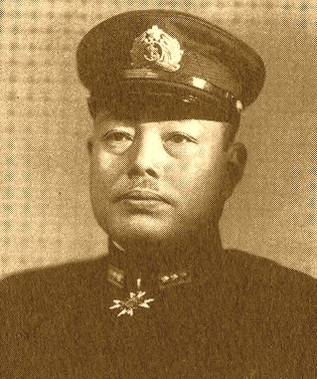
Captain Toshio Abe

She was led by Captain Toshio Abe, and Shinano underwent some hurried sea trials in the Tokyo Bay during the next few weeks.


The recon photo of the Imperial Japanese Naval Base at Yokosuka Arsenal taken by a long-range photo-recon F-13 (B-29) Superfortess on 1 November 1944. The partially completed aircraft carrier Shinano can be seen in the top right (marked with red lines), undergoing sea trials in Tokyo Bay.

While undergoing sea trials outside the entrance to Yokosuka Harbour, she was photographed from an altitude of 9,800 m by a B-29 recon aircraft. This fly-over by a recon aircraft panicked the Japanese Navy, and hastened decisions were made to move Shinano from Yokosuka to a safe place. Shinano was officially commissioned on November 19, 1944, and she was ordered to move to the comparative safety of Kure Naval Base, on the Seto Inland Sea, were she was to be provided with her bombers and fighters.


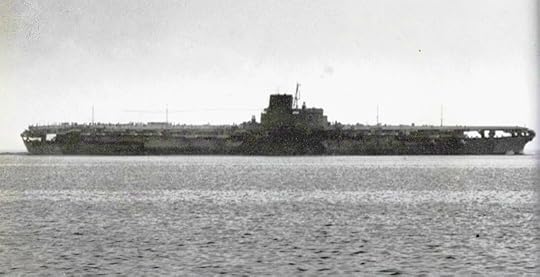
A photograph of Shinano undergoing sea trials in Tokyo Bay, taken by a civilian photographer on 11 November 1944. Apart from the aerial view of the carrier from the recon photo, this is the only known photograph of Shinano.

Shinano departed from Yokosuka on 28 November, 1944 for Kure, a journey of 500 miles, with 2,515 crewmen and was accompanied by Japanese destroyers Hamakaze, Yukikaze and Isokaze. In her maiden voyage she had a load of 50 MXY7 Ohka rocket-propelled Kamikaze flying bombs and six Shinyo suicide boats onboard.


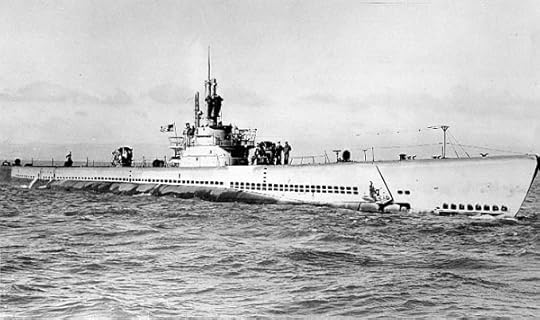
Photo of the U.S. Navy Balao-class submarine USS Archerfish (SS-311) near San Francisco on 5 June 1945.

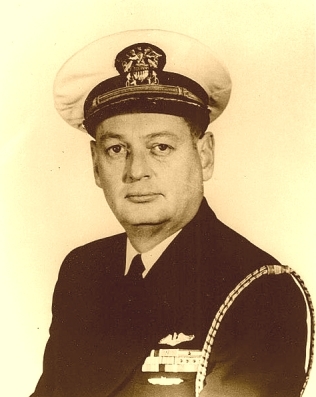
At the same time, a lone US submarine, Archer-Fish, was operating in the enemy waters of Tokyo Bay, providing lifeguard service for the B-24 bomber raids that were conducted on Tokyo. USS Archer-Fish (SS-311) was a Balao class submarine commissioned on 4 September 1943. After a year of active duty at the East China Sea and Midway, she was undergoing her fifth patrol and was under the command of Commander Joseph F. Enright in November 1944.


Capt. Joseph F. Enright

Archer-Fish picked up Shinano on November 28 1944 – just 2 hours into the maiden voyage of Shinano – while patrolling south of Nagoya. When Archer-Fish made contact with the super carrier on radar, she was a total Mystery Ship, as the US Navy knew nothing about Shinano and the carrier was not in the US Navy’s Recognition Manual. After tracking the prey for over six hours, Archer-Fish fired six torpedoes at Shinano. Four of these torpedoes found the target and struck Shinano, causing massive flooding and within hours total sinking of the super carrier.

OUT OF 2,515 PERSONNEL ABOARD SHINANO, MISSING 1,435; SURVIVORS 1,080; SURVIVING OFFICERS 55; COMMON SEAMEN AND NONCOMMISSIONED OFFICERS 993; CIVILIANS, 32. THE EMPEROR’S PORTRAIT IS SECURE ABOARD HAMAKAZE. ALL SECRET DOCUMENTS SANK WITH THE SHIP IN A LOCKED SAFE IN 4,000 METERS OF WATER



Japanese Naval Headquarters was informed by radio message about the fate of Shinano, which sank just 17 hours into her maiden voyage. With a tonnage of 72,000, Shinano became the biggest warship in history to be sunk by a submarine.

At the time of sinking, Enright and his crew didn’t knew about Shinano and they knew only that they killed a big Japanese ship. It was only after the war that the identity of Shinano surfaced and Archer-Fish received a Presidential Unit Citation and Captain Enright received Navy Cross post-war for the action against Shinano.

By referring to eyewitness accounts and naval reports filed by survivors of the Shinano with Imperial Japanese Navy, Capt. Joseph F. Enright, reconstructs the events of the entire battle between Shinano and Archer-Fish for the readers using details, clarity and engaging reconstructed dialogs.

Why Shinano became the Aircraft Carrier with the shortest Imperial Navy Career?

Shinano was commissioned in a situation when the Japanese Navy was in really dire straits. The revised plans for Shinano along with pressure to complete before the estimated time-frame has resulted in design and build compromises that ultimately led to the quick sinking of the ship. Shinano was not complete when she was commissioned and substantial amount of work was pending on her when the Navy was forced to make her operational. She was not ready for the sea, she was not properly tested and she was manned by untrained and inexperienced crew, which all made her irrelevant as a weapon.

Many of the defensive measures on Shinano existed only in paper, and the unfinished pumping systems, issues in waterproofing, untested watertight compartments, unfinished firefighting equipment’s and lack of know-how on using them by the crew all contributed to the ultimate tragedy of Shinano.
Profile Image for Nooilforpacifists.
991 reviews64 followers
October 9, 2016
The is not the sub book you're looking for. One chase; one shot; one sinking. It's not enough for a book. Richard O'Kane's book "Clear the Bridge" is much more interesting.
Profile Image for John Bond.
Author 7 books12 followers
March 3, 2021
An excellent short book about a fascinating ship's demise at the end of WWII. Anyone who is interested in this era, must read and learn about this story. Highly recomend.
Profile Image for Kevin Barnes.
337 reviews2 followers
September 15, 2020
From the drawings and the one photograph of the Shinano that is available I think she was a beautiful ship. Her life was not as long as her sisters were, but their fates were the same. The background given on both commanders was just the right amount. Both were professionals and served their countries with honor. Captain Abe's fixation on a "Wolf Pack" attack instead of a single ship attack is what doomed his ship. A good book to read and I highly recommend it.
Profile Image for ТАИСЛАВ МЫЛОВАРОВ.
21 reviews
August 6, 2025
Stellar book about one single engagement. Incredibly well researched on the IJN side as well, seeing that nearly all materiel concerning the IJN Shinano having been destroyed before the U.S. technical mission managed to get to it.
121 reviews1 follower
May 13, 2020
Great book. It's not the longest or the best written book I have ever read, but I really enjoyed it. I think if you enjoy submarine stories and WWII history, you will enjoy reading this book.
Profile Image for jj Grilliette.
554 reviews1 follower
December 24, 2020
Definitely an interesting and informative read. Learned a lot about this ship
1,138 reviews6 followers
January 16, 2025
Didn’t like the swearing by the author who used his rosary like a good luck charm. He seemed more intent on his own accolades.
Profile Image for Eric Brown.
Author 3 books6 followers
August 18, 2021
A fascinating book with notes and interviews from sailors on both sides of the conflict.
Profile Image for John Nevola.
Author 4 books15 followers
September 10, 2012
The sinking of the super-carrier Shinano by a single American submarine (The Archer-Fish) is one of the most unlikely and compelling ship engagements of the War.

The Shinano started life as a super-battleship in the Yamoto and Musashi class. She was over 900 feet long and displaced 75,000 tons. Before she was completed, the Imperial Japanese Navy decided to convert her to an aircraft carrier. Her conversion was such a strictly guarded secret that the Americans were totally unaware of her existence.
The Archer-Fish was led by a Captain Joseph F. Enright who had previously stepped down from command in disgrace for failing to sink an enemy aircraft carrier on a prior cruise while in command of the submarine Dace. Given a second chance, Enright took his boat right to the doorstep of Japan where this unlikely encounter took place.

Enright co-wrote the book so first hand experiences, feelings and emotions abound. He even solicited input from some survivors of the Shinano. The action is fast and furious in a story of redemption that is stranger than fiction.

There are some photographs, a bibliography and an index. The book is short and an easy read but no collection of submarine books would be complete without Shinano; a ship so secret that Enright was not given credit for sinking her until well after the War was over!
Profile Image for Alex.
10 reviews
August 12, 2011
While this book is a compelling account of an actual sea battle, the story just isn't really novel length. As a result, there's a lot of repetition and padding to wade through. Also, the part of the book the takes place on the Shinano is necessarily far more fictional than the parts that are on the Archer Fish. This is a good read for those interested in details of the changing fortunes of the war, but not for those just looking for a good war story to enjoy.
Profile Image for Jim.
169 reviews6 followers
February 6, 2010
Shinano was Japan's largest aircraft carrier, a converted sister ship of the super-battleships Yamato and Musashi. Enright was the captain of the US submarine that sank her on her maiden voyage. This is his tale of that fateful encounter. It's a great slice of little-known WWII history, told in a very readable and enjoyable way.
Profile Image for Eric Hägerström.
6 reviews2 followers
April 9, 2014
This is the finest account of submarine warfare I have ever read. Shinano was the largest ship ever sunk in the history of submarines. The book is a turn by turn account of the maneuvers of both ships. Played like a poker game of high stakes, bluffing and risk-taking.
3 reviews
March 7, 2013
Very exiting book, I thought the Japanese side of the story was more interesting than the American side, either way great action sub story and TRUE too!!
Displaying 1 - 16 of 16 reviews

Can't find what you're looking for?

Get help and learn more about the design.