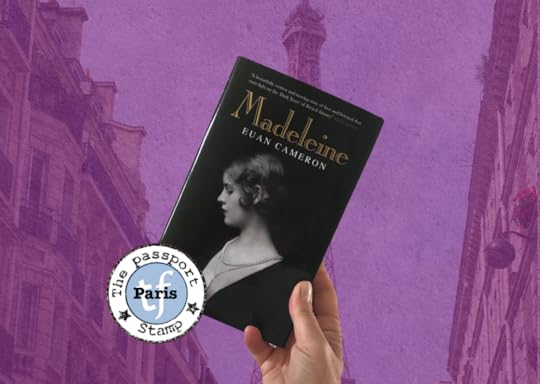
"A beautifully written and moving story of love and betrayal that casts light on the 'Dark Years' of French history, 1940-44." ALLAN MASSIE Family history has always been a mystery to Will Latymer. His father flatly refused to talk about it, and with no other relatives to consult, it seems that a mystery it shall always remain. Until of course, Will meets Ghislaine, his beautiful French cousin, in a chance encounter that introduces him to his grandmother, Madeleine, shut away in a quiet Breton manor with her memories and secrets. Before long, Will has been plunged headlong into the life of Madeleine's great love, his longlost grandfather, Henry Latymer. Reading Henry's old letters and diaries for the first time, Will discovers an idealistic young man, full of hopes and optimism - an optimism that will gradually be crushed as the realities of life under the Vichy regime become glaringly clear. But the more Will delves into Madeleine and Henry's past, and into France's troubled history, the darker the secrets he discovers become, and the more he has cause to wonder if sometimes, the past should remain buried.
Will Latymer, violinist, knows nothing about his family history because no one spoke about it. His father, now deceased, resolutely refused to tell Will anything about his childhood and his mother supported his silence, claiming that it was too painful to probe. All he knows is that his paternal grandfather was a figure of mystery, something of a black sheep, and that he had disappeared in South America before Will was born. And then, while playing with his chamber group in Paris, Will receives a note from his cousin, Ghislaine de Valcros, suggesting that they should meet and that Will should learn about the French side of his family.
Ghislaine takes him to a remote Breton manor where he meets Madeleine, Ghislaine’s mother and also Will’s grandmother. Madeleine, too, has kept the past secret but has been prompted into revelation by the arrival of a letter and package from Henry Latymer, Will’s grandfather, who is on his death bed in Argentina. She entrusts the material to Will and he begins a quest to unearth the truth about the romance between Henry and Madeleine and what happened to the child they had, Will’s father. Henry’s diaries reveal a very idealistic young man, whose hopes and dreams are gradually squashed under the reality of war-time France.
From this point the narrative splits into two parts – a first person account by the young Henry beginning in October 1939 and following his life through to Vichy, meeting Madeleine, and his later flight to South America. The other part takes the reader with Will as he continues his research, becoming in the process, ever more besotted by Ghislaine. The wartime account makes for the most interesting element of this novel. In Henry Latymer, Cameron has produced a subtle and skilful portrayal of a young man, full of the self-centredness and single-mindedness of youth. He’s certainly not always likeable, particularly in the way that he seems able to dispense with people who no longer meet his needs, but Cameron undoubtedly helps the reader understand how the idealism of youth is capable of blinkering people to the reality around them.
Madeleine is a fascinating read but, in a sense, more as an historical account than a novel. Madeleine’s affair with Henry is probably very true to life, but it’s a bit disappointing to the reader, as it rather fizzles out into nothing and it’s also hard to accept the welcomed and sanctioned romance between Will and Ghislaine, which would surely be bordering on incestuous.
This is, however, beautiful, literary writing, clearly very carefully researched and, as such, it is extremely informative about life in Vichy and life in wartime France under German occupation. Present-day Paris is brought to life for the reader, but again, the most fascinating portrayal is of Paris during that awful period in its history.
I actually disliked this book. I had problems with the idea of forgiveness, self pity, cowardice shown all through these life stories. I had problems to forgive a collaborator (Vichy France, WWII), who felt great remorse after ensuring that Jewish people were deported (after using them), when this collaborator never had the courage to face justice after the the war but exiled to South America instead. Something is not right here in my opinion. I also had problems with the mother who regretted giving up her son, but never tried to meet him again (she knew where he was and with whom). What about that child's growing up without his parents? What about all the holocaust victims? I can't take those regrets seriously when none had the courage to at least officially confess it. Tactless approach, in my opinion.