Jump to ratings and reviews
Rate this book

Futility and Other Animals

Rate this book
Stories of modern, urban tribes.In some ways, the people in these stories are a tribe - a modern, urban tribe - which does not fully recognise itself as such. Some of the people are central members of the tribe while others are hermits who live on the fringe. The shared environment is both internal - anxieties, pleasures and confusions - and external - the houses, streets, hotels and experiences. The central dilemma is that of giving birth, of creating new life.The experiences of the inner city ambience are shown through stories of growing up, leaving home, coming to the city from the country, or returning there; first love affairs, hetero- or homosexual; and finding a peer group, a life style, an ideology, and the anti-ideology of Libertarianism.

Paperback

First published January 1, 1981

3 people are currently reading
49 people want to read

About the author

Frank Moorhouse

54 books55 followers
Frank Thomas Moorhouse AM (21 December 1938 – 26 June 2022) was an Australian writer. He won major Australian national prizes for the short story, the novel, the essay, and for script writing. His work has been published in the United Kingdom, France, and the United States and also translated into German, Spanish, Chinese, Japanese, Serbian, and Swedish.

Moorhouse was perhaps best known for winning the 2001 Miles Franklin Literary Award for his novel, Dark Palace; which together with Grand Days and Cold Light, the "Edith Trilogy" is a fictional account of the League of Nations, which trace the strange, convoluted life of a young woman who enters the world of diplomacy in the 1920s through to her involvement in the newly formed International Atomic Energy Agency after World War II.

The author of 18 books, Moorhouse became a full-time fiction writer during the 1970s, also writing essays, short stories, journalism and film, radio and TV scripts.

In his early career he developed a narrative structure which he has described as the 'discontinuous narrative'. He lived for many years in Balmain, where together with Clive James, Germaine Greer and Robert Hughes, he became part of the "Sydney Push" - an anti-censorship movement that protested against rightwing politics and championed freedom of speech and sexual liberation. In 1975 he played a fundamental role in the evolution of copyright law in Australia in the case University of New South Wales v Moorhouse. - Wikipedia

Ratings & Reviews

What do you think?
Rate this book

Friends & Following

Create a free account to discover what your friends think of this book!

Community Reviews

5 stars
14 (25%)
4 stars
22 (40%)
3 stars
17 (30%)
2 stars
0 (0%)
1 star
2 (3%)
Displaying 1 - 5 of 5 reviews
Profile Image for Ian "Marvin" Graye.
947 reviews2,781 followers
December 8, 2023
CRITIQUE:

Discontinuous Narrative

When this book of "interlinked stories" was written in 1969 (as now), it could equally have been regarded as a novel (or, given its brevity, a novella).

In a brief prologue, Moorhouse writes:

"...Although the narrative is discontinuous and there is no single plot, the environment and characters are continuous..."

It's true that there is no single plot. In fact, there is no plot to speak of. Instead, each chapter or story is a portrait of the relationship between the members of the group of characters.

The characters in each story don't necessarily know the characters in another story, although sometimes they do. They live in adjacent suburbs (inner western Sydney - Balmain, Rozelle, Glebe, Annandale) and might run into each other in the street, at the shops, or in the pub.

Similarly, the narrators and perspectives change from story to story. No one narrator is the primary focus. Often, we don't learn the name of the first person narrator (when there is one), although we could work it out by analogy with another story. There is, after all, some continuity of characters.

Longing (for "Happiness and Hobnob Days")

Parents and children excepted, the characters seem to belong to the one milieu, with similar lifestyles and preoccupations. Once again, in the prologue, Moorhouse suggests:

"In some ways, the people in the stories are a tribe; a modern, urban tribe which does not fully recognise itself as a tribe...

"The shared environment is both internal (anxieties, pleasures and confusions) and external (the houses, streets, hotels and experiences).

"The central dilemma is that of giving birth, of creating new life."


It's soon after the sexual revolution of the 1960's, and these vaguely bohemian characters (they live in Balmain, and work in advertising or retail) are still seeking a type of relationship (whether hetero-, homo- or bi-sexual) that is different from conventional bourgeois love, monogamy and marriage. A female character declares:

"I am still for free loving and against conventional marriage..., and yet I see an involved relationship and its mutual dependence and I am not frightened...

"I may want other lovers but other lovers would be for passing pleasure and not for the sharing of the dependence...The mutual dependence and that kind of relationship is a track down which only two can walk comfortably."


Her male partner responds:

"Perhaps our way of life is a sort of group therapy."

Rarely do their parents approve of their non-conformist ways. Inevitably, their parents are the focus of their therapy sessions (whinging at the pub, or during or after sex), although the characters seem to be the source of their own problems.

Involvement

The above two unidentified partners seem to envy a conventional couple (who move in "square circles"), of whom the male says:

"What they want and the way they live fits together. No conflicts. It all fits with the the way they were brought up. They don't kick against it and it doesn't kick against them."

Their own relationships (in pursuit of freedom and happiness, if not necessarily love, because that would be dependence) cause conflict both within the self, and between the partners.

Margot lets Danny know, "I could sleep with her but never to become emotionally involved with her because she was going to live with Perry."

Danny's other relationship is not that straightforward:

"Before Margot, he had had an affair with Marylou and had been with her once or twice while living with Margot. Margot didn't know that. Oddly enough she had been a sweet, close friend to them both."

description
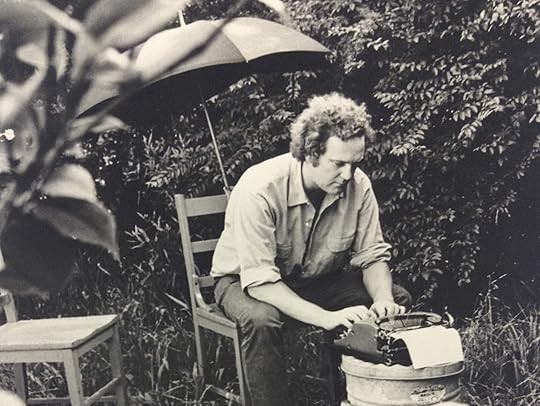
Frank Moorhouse writing in his backyard in Le Ghetto de Balmain (Source)

Futility

The duplicity of these relationships is the source of their titular sense of futility.

Robyn says to Roger, "If you loved you would not find life to be futile...Futility came from a life which was ungratified."

They long for love, but are afraid to admit it, let alone commit to, or try, it. There is too much self-gratification for true, mutual gratification.

Inevitably, the futility of their relationships frustrates their own contentment and happiness, as well as their desire (or, in some cases, reluctance) to have and raise contented children.

Reading, Writing, Rating

I originally rated this collection five stars based on my first reading in about 1977. However, after an equally enjoyable second reading, it still stands as an accurate portrait of the state of bohemian relationships in the late 1960's and early 1970's, even if it might sound precious to younger generations of readers (who might or might not have equally problematical relationships - if not problems unique to their own generation).


SOUNDTRACK:
Profile Image for Greg.
396 reviews146 followers
August 18, 2014
Mostly very short stories, each one is like a snippet of life. The names re-occur throughout the book in the various stories. All the stories are about relationships or personal quirky habits.

Some stories are interesting, like 'What Can I Say', about Thomas, the narrator, and Jimmy. Another good one is 'Lou Shouted "Hey!". Some of the stories are boring, like 'Will Power+Sex Drive+Intelligence+Personal Organisation+Aggression=Sexual Success. Some stories I couldn't see the point of what it was about.

The stories somehow remind me of Katherine Mansfield.
Profile Image for Codie.
4 reviews
August 13, 2024
Amazing. I can imagine I’ll be revisiting (and re-reading the stories of nature)
Profile Image for Christine Collyer.
44 reviews
January 30, 2024
Loved it! A very therapeutic read at this time in my life; resonated in so many ways. I want to pick it up again and take a dive even deeper into the characters and their relationships.
Displaying 1 - 5 of 5 reviews

Can't find what you're looking for?

Get help and learn more about the design.