Kenny dreams of a fabulous land where he would like to live always, and in his search for it discovers many things about himself and about growing up. ‘An unusual, imaginative story . . . in which reality blends with make-believe.' 'SLJ. 1956 Children's Spring Book Festival Honor Book (NY Herald Tribune)
Maurice Sendak was a visionary American illustrator and writer best known for transforming the landscape of children's literature through his emotionally resonant stories and distinctive artistic style. He gained international acclaim with Where the Wild Things Are, a groundbreaking picture book that captured the emotional intensity of childhood through its honest portrayal of anger, imagination, and longing. Widely recognized for his ability to blend the whimsical with the profound, Sendak created works that resonated with both children and adults, challenging conventional notions of what children's books could be. Born and raised in Brooklyn, Sendak was a sickly child who spent much of his early life indoors, nurturing a love for books, drawing, and storytelling. The son of Polish-Jewish immigrants, he was deeply affected by the losses of the Holocaust, which shaped the darker emotional undercurrents in his work. His art was influenced by a range of sources, from comic strips and Mickey Mouse to Mozart, Blake, and German Romanticism. Though he began his career illustrating other writers’ books, he soon transitioned to authoring his own, beginning with Kenny’s Window and then The Sign on Rosie’s Door. It was Where the Wild Things Are, published in 1963, that solidified Sendak’s reputation as a master of children’s literature. The book, which won the Caldecott Medal, was initially controversial due to its depiction of unruly behavior and ambiguous emotional tone. However, it was later recognized as a revolutionary work that respected children’s inner lives and psychological complexity. This theme continued in his later works, including In the Night Kitchen and Outside Over There, which formed a loose trilogy exploring the emotional and imaginative experiences of childhood. These books, celebrated for their dreamlike narratives and lush illustrations, often tackled fears, fantasies, and the challenges of growing up. Throughout his career, Sendak illustrated more than a hundred books, working with authors such as Ruth Krauss and Else Holmelund Minarik. His visual style—characterized by its intricate detail, dynamic line work, and expressive characters—evolved over the decades, but always retained an unmistakable emotional intensity. He also designed sets and costumes for operas and ballets, bringing his imaginative worlds to the stage. Notably, he created productions for works by Mozart and Prokofiev, combining his love of classical music with theatrical design. Sendak was known for his sharp wit, fierce independence, and deep empathy for children. He openly criticized the sanitized and moralistic tone of much of children's publishing, insisting instead that young readers deserved stories that acknowledged their full emotional range, including fear, grief, anger, and wonder. He was also an openly gay man in a long-term relationship, though he only spoke publicly about his sexuality later in life. Later in his career, Sendak continued to produce new work, collaborate with artists and institutions, and advocate for intellectual freedom. His final books, including Bumble-Ardy and My Brother’s Book, reflected both a return to his childhood memories and a meditation on aging, love, and mortality. Though his stories often ventured into the dark or surreal, they remained rooted in a deep respect for the emotional reality of children and a belief in the power of imagination to confront life's challenges. Maurice Sendak’s legacy endures in the countless writers and illustrators he inspired, the cultural impact of his stories, and the enduring affection readers of all ages hold for his wild things, mischievous children, and tender monsters. Through his work, he redefined what children’s literature could be: rich, honest, haunting, and, above all, deeply human.
Maurice Sendak's first children's book is about a boy named Kenny, just like me! In fact, Sendak wrote this book specifically for me.
Kenny goes on a quest to find a garden he had been dreaming about. To do this, Kenny must answer seven questions given to him by a rooster. Kenny’s pet dog, toy soldiers and stuffed animals and help him out along the way.
Wonderfully charming, and the hero has such a cool name!
Baby curled up in Kenny’s lap. “For a whole afternoon,” she whispered, “I pretended I was an elephant. But I couldn’t sleep because I was too big to fit under your bed. I couldn’t eat because elephants don’t like hamburger. And I couldn’t chew my favorite bone because my long nose kept getting in the way. And most of all, I was afraid you’d stop loving me. I thought, ‘Kenny has lots of love for a little dog, but does he have enough for an elephant?’”
“Poor Baby,” said Kenny softly, and he rubbed her back.
“And just before suppertime,” continued Baby, “I stopped pretending and it was just in time. I was so hungry. And do you know what I said to myself?”
“Yes!” shouted Kenny. “You said, THAT was a VERY narrow escape!’”
“Right,” answered Baby, and with all the talking and back rubbing, she fell asleep in Kenny’s lap.
When this book was written, Maurice Sendak had been known only as an illustrator, but with this book, his he became known as an author and complements in words the poetic quality of his pictures. Kenny is a boy with a window in his room, as most of us have had. He has a dream one night in which he sees a garden he would love to live in and in the garden is a four-legged rooster who gives him seven questions to answer. Kenny hopes the answers will let him live in the garden but as they reveal themselves he learns a thing or two about life-about loving and promising and wanting only what he really wants and about the will-o-the wisp imagination he will never lose. The window has become a key to the wonders of the world. This is a beautiful book, written with real feeling.
This is one of my least favorite stories of Maurice’s. The text is dense and it’s very long. A boy has a dream about a 4 legged rooster and this wonderful land. If he complete’s 7 tasks, he can live there. I think this story is a mess. The artwork is bland and the story was uninspired. He is trying to conjure up magic and it didn’t work, in my opinion.
The kids were not into this. The nephew wanted to give up on this. He was very bored. He gave this 1 star. The niece didn’t understand what all was happening and the boy said he would take care of toy soldiers and he never really did and other things. She also gave this 1 star. It’s not a family favorite.
If you can make it through to the end, I did find a theme that was good, but it took too long to get there. The boy wants to get to this prize and the Rooster tells him, “You made a wish and a wish is halfway to wherever you want to go.” I like to think of it as, we have to decide we want something before we can really go after that thing. We have to decide to try to do something. Did I feel this little nugget was worth the whole story, not really. This is early Maurice and he needed more development at this point in my opinion.
A very special book about a little boy answering life's hard questions. The illustrations are very beautiful, but not what we are used to from Sendak. The story is simple and simply told, but it is also dark - or rather somber and philosophical. The boy's relationship and interactions with his teddy bear, toy soldiers and his puppy are poignant without being sentimental.
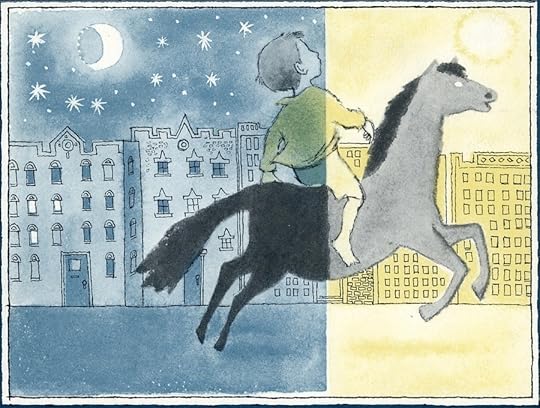
Sendak's first book, and a hidden gem. In writing on the "suck fairy", Jo Walton describes a child reader's ability to spin an entire experience out of a single descriptive line, and that feels like both the intent and effect of this entire book. It's longer than most Sendak, but deceptively so: the plot moves in fairytale-esque repetitions, and something numinous but unexplored sits in the four-legged rooster dream guide, in the horse on the roof that no one can see. These brief and evocative lines are nearly eclipsed by more detailed dialogs with toy soldiers and talking goats, but those scenes have a whimsy and an inward-looking, philosophical bent. It's ironically less surreal than most Sendak, but dreamlike, childlike. The art is less accomplished than his later work, but the expansive panels frame the extensive text beautifully.
This really grew on me as it went along...I started out pretty annoyed with it in the first half and almost quit (the 4-year-old did quit) but I stayed with it and ended up liking it quite a bit in the end. It's too long for the target audience...I think it was probably too long for the target audience when it was written and picture books have gotten shorter. The questions Kenny has to answer are weird at first and start to make more sense as the threads get pulled together. I wish it was more consistent and better paced but of course it is Sendak so you need it just for the illustrations and the characters of the toys and the dog are just great. Definitely worth the read and if this is the book he needed to write to get to WTWTA, I'm good with that.
I'm still contemplating the book, and I may end up bumping it to five stars...
It's a children's book that most adults could stand to should read. It's full of concepts that kids should be exposed to, but they're also concepts most kids aren't going to wrap their heads around, the first time around. Do you want what you think you want? How do you discover what you really want? And how do you handle it when what you want doesn't jibe with what someone else wants?
Only logging the best of the books I've read to V this year, and this is totally one of the good ones. It's been part of our quest for junior chapter-ish books, divided into 7 'questions'. It's poetic and symbolic and beautiful and I kinda want to make everyone read the chapter about how an only goat is a lonely goat. Beautiful simple illustrations on every page too, so charming.
V's verdict: absolute approval. We are reading it a fourth time over, at her request.
Interpretar los sueños, a veces, sólo a veces nos permite entendernos un poco mejor. Kenny sueña con un gallo de cuatro patas que le da 7 preguntas para responder y le promete cumplirle lo que desee. Pero al ir contestando cada pregunta descubrirá lo maravillosa que es su vida: sus amigos los juguetes, su perrita e incluso su hogar tendrán un nuevo significado para él. Incluso al responder cada una de las preguntas su deseo cambiará con sus nuevas experiencias. Hermosa alegoría sobre la introspección que nos permite observar desde una ventana que sucede alrededor de nosotros y nosotras. Una lectura para ir acompañando el crecimiento.
Picked up in a bundle of lovely vintage childrens books for peanuts at a flea market a few weeks ago. All from a local school library. This was the first book Sendak wrote and illustrated. I’ve never read it before. It has a nice gentle dream like melancholy. First edition. Nice to think of all the children who’ve read it since the early 60s….
In a dream, Kenny looked out his window and saw, among some other things, a rooster with four feet. The rooster gave Kenny a piece of paper with seven questions and told Kenny he must find all the answers in order to stay in the magical land. Little does he know, these are actually life lessons we ourselves can take from the book while growing up in the real world. But either way, Kenny proceeded with his days and found the riddles' answers and got what he wanted! I normally really like the odd ball stories made from Maurice Sendak, but I couldn't really get into this one. Maybe I got lost on Kenny's journey? The story seemed to lack a point besides just following Kenny's imagination. What was cool is that, because of the shown power of the child's imagination, it was beginning to be more of a psychedelic read. But, the story ended up to be too bland for me.
This entire review has been hidden because of spoilers.
What a strange, fascinating book this, Sendak's first, is. It plays on the riddle trope--if Kenny answers the seven questions given him by the four-legged rooster, he can have whatever he wants--but does so very unconventionally, as it blurs the line between reality and imagination and shows that, even from the beginning of his career, Sendak had a keen insight into the complex emotional landscape of children. Despite the cool simplicity of the illustrations, there is a lot of angst bubbling beneath the surface here (one of the question is "What is a narrow escape?" and the answer is, "When someone almost stops loving you"), not to mention sadness and rage. It feels a bit padded and meandering beside Sendak's later masterpieces of economy, but it's nevertheless a striking success.
The first thing that struck me about Kenny’s Window is that the illustrations were different. Maurice Sendak used some watercolor in this book. The dedication in this book is also touching; Maurice dedicates it to his parents. The majority of the art is similar to others by Maurice, pencil drawings with one accent color, yellow. On some pages the text is part of the illustration and others it is separated. Most pages have the words on one side and the illustrations on the other. The story is about Kenny’s friendship with his bear Bucky. Kenny forgot to bring Bucky to bed with him last night and he had strange dreams. Bucky was hurt by being forgotten so Kenny must find a way to make him happy again. He writes a poem and draws his teddy bear on the chalkboard.
We follow a dream of a boy named Kenny. He must go on an adventure completing riddles given to him in order to stay in the magical land. Little does he know, these are actually life lessons we ourselves can take from the book while growing up in the real world. Slowly, his dream becomes a reality.
Overall, a good book. Once again, I love Maurice's drawings and coloring of the images. The character development of Kenny was interesting and fantastic to watch. I liked watching Kenny go through his obstacles.
I don't think I would teach a lesson with this, but i would have this on my class shelve and would read this to my kids.
Reading this book now to my children creates a new sense of calm and emotional exercise totally unreachable by a children’s author since. The questions are delivered with such deep meaning, and yet they are more even than that.
We’ve All had very narrow escapes, been lonely goats, and looked inside and looked outside. I still want to ride a train through the alps and find myself plucking blue gentians and pink mountain roses
This is a book with such significance that when I would go to sleep as a child, the very first thing I met was a rooster with four feet, two tin soldiers and a piece of chalk and Baby and Bucky.
Highly Recommended and loved story with a few crucial life lessons.
Hmmmm. I didn't know there was anything Maurice Sendak did which I could feel hohum about, but here you go. In a dream, Kenny looked out his window and saw, among some other things, a rooster with four feet. The rooster gave Kenny a piece of paper with seven questions and told Kenny he must find all the answers. Kenny proceeded with his days -- and found the riddles' answers in the everyday! Yay! The illustrations are bland, the story is bland. Do you suppose Where the Wild Things Are and The Nutcracker sets have ruined me for any other Maurice Sendak work?
A very surreal children's story debut from Maurice Sendak. The themes are very subtle and kind of lost even to adults. It seems to lack a *real* theme or point other than the power of a child's imagination. A very psychedelic read that will probably be more interesting to adults than kids for its surreal and existential tone.
Kenny dreams of a fabulous land where he would like to live always, and in his search for it discovers many things about himself and about growing up. ‘An unusual, imaginative story . . . in which reality blends with make-believe.' 'SLJ. 1956 Children's Spring Book Festival Honor Book (NY Herald Tribune)
The wonderful illustrations I expect from Maurice Sendak. Not for me, though I have no real complaints other than the persona. I simply didn't connect with the story or character, which might just be where I'm coming from. It might be that Sendak got better over time (this was the first book he both wrote and illustrated), or that I have trouble relating to a 1950s story.
Utterly delightful. When I was 9, we moved into a house and I used to star out my window and look out over the backyards of our neighbors and sing out the window. I daydreamed about being discovered by Frank Sinatra or Dean Martin, two singers my parents listened to often. Never happened.
But oh the adventures I had looking out my window. But my toys never spoke to me.
"What is a very narrow escape?" "When somebody almost stops loving you," Kenny whispered back. I love this book. Maurice thought it was over written and didn't like the illustrations, but this is one of the most moving children's books I've read.
Kenny's Window is Sendak's first book--that he both wrote and illustrated. It gives great insight into all of his following work. My Master's thesis on the subject is only 30 pages and should be done soon if you care to read more...
I found this at a used book store this past week. See review of The Sign on Rosie's Door. Not terribly impressed. I felt like it was Sendak's answer to Alice in Wonderland, except for smaller children. I also thought he might have been just a bit high when he wrote it.
Beautiful with a tinge of melancholy, like the best of Sendak's books. I always slip into a specific reading pace and volume while reading "Little Bear" and "Where the Wild Things Are". This book was no different. He writes a special kind of hushed magic.
A large part of this story was Kenny figuring out responses to 7 questions he received in a dream. Love the idea, but only loved a few of the questions. Note, though, that I am an adult reading a children's book.