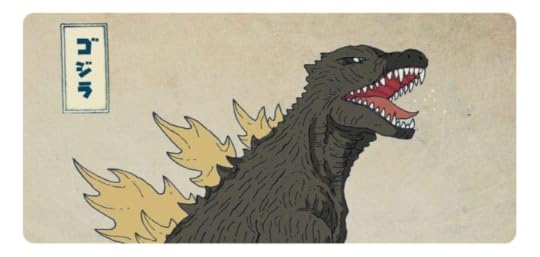
“You should be here; he’s simply magnificent.” These are the final words a biologist hears before his Margaret Mead-like wife dies at the hands of Godzilla. The words haunt him as he studies the Kaiju (Japan’s giant monsters) on an island reserve, attempting to understand the beauty his wife saw.
“The Return to Monsterland” opens 'Where We Go When All We Were Is Gone,' a collection of twelve fabulist and genre-bending stories inspired by Japanese folklore, historical events, and pop culture. In “Rokurokubi”, a man who has the demonic ability to stretch his neck to incredible lengths tries to save a marriage built on secrets. The recently dead find their footing in “The Inn of the Dead’s Orientation for Being a Japanese Ghost”. In “Girl Zero”, a couple navigates the complexities of reviving their deceased daughter via the help of a shapeshifter. And, in the title story, a woman instigates a months-long dancing frenzy in a Tokyo where people don’t die but are simply reborn without their memories.
Every story in the collection turns to the fantastic, the mysticism of the past, and the absurdities of the future to illuminate the spaces we occupy when we, as individuals and as a society, are at our most vulnerable.
SEQUOIA NAGAMATSU is the author of the National Bestselling novel, HOW HIGH WE GO IN THE DARK (2022), a New York Times Editors’ Choice, and the story collection, WHERE WE GO WHEN ALL WE WERE IS GONE (2016). His work has appeared in publications such as Conjunctions, The Southern Review, ZYZZYVA, Tin House, Iowa Review, Lightspeed Magazine, and One World: A Global Anthology of Short Stories, and has been listed as notable in Best American Non-Required Reading and the Best Horror of the Year.
Other honors include a fellowship from the Bread Loaf Writers Conference and shortlist inclusions for The Waterstones Debut Fiction Prize, the Ursula K Le Guin Prize, and the Barnes & Noble Discover Prize, as well as long list inclusions for the Andrew Carnegie Medal for Excellence in Fiction, The Dublin Literary Award, and the PEN/Hemingway Award. He was educated at Grinnell College (BA) and Southern Illinois University-Carbondale (MFA), and he teaches creative writing at Saint Olaf College and the Rainier Writing Workshop Low-Residency MFA program. He is originally from O’ahu, Hawaiʻi and the San Francisco Bay Area and currently lives in Minneapolis with his wife, the writer Cole Nagamatsu, their cat Kalahira, their real dog Fenris, and a Sony Aibo robot dog named Calvino.
More at SequoiaNagamatsu.com. Follow him on Twitter @SequoiaN or on Instagram @Sequoia.Nagamatsu
short magical realism story collection about the beauty of being alive...this book is for me, specifically.
mini reviews for each story:
THE RETURN TO MONSTERLAND pretty traditional parent abandonment story, except what if your mom left your family to pursue the scientific study of godzilla. rating: 3
PLACENTOPHAGY this was just about the opposite of the last one: short and extremely unique. rating: 3.5
ROKUROKUBI if i were a demon and my only power was having a stretchy neck i would be so disappointed. all this guy does with his power is steal underwear and get cheated on by his wife. rating: 3
GIRL ZERO finally, some good f*cking food (if gordon ramsay was talking about a unique, emotional story that reminded me of why i loved the author's other work).
even if it lost it along the way. rating: 3.5
PEACH BOY i do love a fairytale vibe.
maybe now is a good time to point out that there are fun one-page interludes between these stories, which i enjoy even though they're messing with my format. rating: 3.5
THE INN OF THE DEAD'S ORIENTATION FOR BEING A JAPANESE GHOST the concept: :) the execution: ... :/
(this is the reaction of when you really want to like something but it's kinda just trying too hard and you have to cringe a bit.) rating: 3
THE PASSAGE OF TIME IN THE ABYSS contents aside, we've got some great titles here.
sorry but if i were taking my grandchildren on a fishing trip, i simply wouldn't go out when a huge storm was coming "because the catch is better before the storm." i'm just kind of built different like that. rating: 2.5
THE REST OF THE WAY sad one. but not sad enough? does that make sense? more depressing than emotional. rating: 2.5
WHERE WE GO WHEN ALL WE WERE IS GONE title story title story title story!
if you asked me to guess what this was about i probably would have had to go for a while before getting to "dystopian style dance party." rating: 3
THE SNOW BABY okay. rating: 2.5
HEADWATER LLC no matter how many interchangeable upsetting stories there are about human greed destroying nature, they will always be depressing. rating: 3.5
KENTA'S POSTHUMOUS CHRYSANTHEMUM i mean, the title is very literal. rating: 2.5
OVERALL i'm so disappointed by this book as to be actually confused. the author's novel is so emotional, so evocative, so powerfully rendered that each of its many perspectives feel unforgettable. with a few exceptions, this was...weird? trying to shock the reader? totally emotionless? shallow plays at feeling? i have no idea how the same person could have written both.
this book is not bad, but compared to the author's other work...sheesh. rating: 2.5
This was my first introduction to Sequoia Nagamatsu's work, and it turned out to be a rather mixed experience. The collection opens strongly, and I genuinely enjoyed the first few stories, but somewhere along the way it started to feel like a chore to finish. While every story had an interesting premise, many of them simply did not find the middle ground.
The book contains twelve stories that are not directly connected but revolve around similar themes: humanity's relationship with the Earth, grief, parenthood, Japanese folklore and the strange ways people cope with loss and change. The stories begin with ordinary situations before veering into surreal science fiction and fantasy, ranging from Godzilla Island preserves to supernatural marriage therapy. They are imaginative, absurd, and often pensive.
I think this collection is best suited for readers who enjoy weird sci-fi, speculative fiction, and stories that conceal their meaning beneath layers of dreamlike imagery and mysticism. Unfortunately, those are not the genres I naturally gravitate toward, which probably explains why so many stories did not quite click for me. I had mistakenly assumed it would feel similar to one of those translated Japanese literature, only to realize it was originally written in English. It carries a distinctly different voice and atmosphere, perhaps because there is no distance created by translation which made it feels more immediate, fresh, and unique in its own way, even if it wasn’t entirely for me.
As luck would have it, I read this while I was hyperfixated on Godzilla and Japanese folklore, so I thought that interest would make me appreciate the collection more. Instead, while it helped me recognize and enjoy some of the cultural references, it was not enough to keep the momentum going. The slow, contemplative pacing and surreal blend of tragedy, mythology, and speculative fiction made it difficult for me to stay the course.
Like most short story collections, this one was very hit-or-miss, which is perfectly normal for a collection. Some stories were memorable and thought-provoking, while others felt too abstract or simply were not for me. But when the misses outweigh the hits, it is difficult to fully appreciate the collection as a whole. I ended up alternating between the physical book and the audiobook on Everand, though the audiobook was not always the easiest format since the stories are so unconventional that it was sometimes difficult to tell where one ended and the next began.
If nothing else, Nagamatsu has given me twelve stories I can confidently say I have never read anything quite like. That is a compliment and a confession because 'quite like' does not always mean 'would read again.' Imaginative to a fault, but fault it did, for me.
4.0 stars I loved the author's debut novel, How High We Go in the Dark so I was thrilled to discover this short story collection by the same author. I rarely read SFF short stories but these ones were great. These speculative stories were so weird and yet so emotional. Once again, the author pulls on the experience of parents which hit close to him.
Disclaimer I received a copy of this audiobook from LibroFM's review program.
It is probably not fair to compare an author's books to each other but for me, many of the short stories in this collection have the same dreamy quality as Nagamatsu's better-known work How High We Go in the Dark. Nevertheless, there is more quirkiness here – a universe where Godzilla and his fellow Kaijus are real, where a man who can stretch his neck to impossible lengths tries to save his marriage, a never-ending dance competition exhausts aliens and humans alike...
I think these stories are even more fantastical and optimistic but still maintain melancholie and I'm really enjoying the writing of Sequioa Nagamatsu.
This collection of speculative short stories is strange, but beautiful and deeply touching. Central themes explored are parenthood, death, birth, loss and grief- often through the lens of Japanese mythology and folklore. By turns whimsical, tragic, and darkly funny this is an excellent collection and the audio narration is very good. I received an audio review copy from Libro.FM, all opinions are my own.
I loved these weird and wacky stories from the genius mind behind one of my recent favorite novels, How High We Go in the Dark, Sequoia Nagamatsu. This rather short book (~160 pages) contains 12 stories that don't exactly intertwine but hover around many of the same motifs including: humanities relationship to earth, Japanese folklore (especially yōkai), grief, parenthood and more.
This book is definitely for fans of weird sci-fi and stories that hide their meaning under a facade of strange imagery and mysticism. If you liked his novel and haven't gone back to read his debut story collection, I think you will really enjoy this. It's not *quite* as strong as HHWGITD, but you can see the threads he's pulling at that he later uses to weave together a much more cohesive and compelling narrative. It's fun to see how his earlier work informs his later writing, while still working on its own to be an exciting, fun, melancholy, and bizarre series of stories!
My favorite stories were: -The Return to Monsterland -The Passage of Time in the Abyss -Where We Go When All We Were Is Gone -Rokurokubi -The Rest of the Way
After absolutely LOVING How High We Go in the Dark, I was eager to read more of Sequoia Nagamatsu's work. Unfortunately, this short story collection was very hit or miss for me - some stories were great, some were a bit too odd, some we just not for me. Still, I really enjoy the author's writing style and the ideas he's interested in exploring, so I would definitely read his next book.
Can an author be your favourite after writing two books? 😅
"How High We Go In The Dark" was phenomenal, instantly an all timer. "Where We Go When All We Were Is Gone" is different, but no less special. Like Nagamatsu's debut novel, this short fiction collection is as bleak as it is beautiful, it's sad yet hopeful, and I don't know how he does that. How does he do that?!
Reading this collection of short stories rich with magical realism was such a delight while I was in Japan and afterward. For months beforehand, I had been watching a lot of Japaneses TV and listening to a lot of Japanese podcasts to work on listening comprehension. One of the things I watched was a kids shows that told simplified, cartoonized Japanese folktales. So as I read this book, there were a lot of moments where I already knew the story it was based on and I feel like I got more out of some of them. But, at the same time, there were several things that were very surprising to me (such as the long neck demon Rokurokubi, which is probably even more unsettling than it sounds). Both situations were fun to be in. Each story dives headfirst into a creatively imagined world where something from Japanese popular culture (i.e. Godzilla) or folklore (i.e. the kappa) is real. I loved this book for its fearlessness and its strangeness.
As is expected with short story collections, there are going to be some that are better than others. The ones that were good were really good. I think Girl Zero would have to be my favorite, due to how much gasping I did while reading it. There are a lot of moments of beauty throughout. But, unfortunately, a few of the stories fell kind of flat despite their interesting concepts. In a couple I just wasn't 100% sure why I was reading what I was reading, which isn't a great feeling to have. The stories that are good are magical and creepy and funny. It would be a shame for anybody interested in Japanese folklore and popular culture to miss out on these tales.
Sidenote: I went to Sequoia Nagamatsu's reading which was a ton of fun with a big crowd, but I was sad to find out that he had other readers there because that meant he only read one story, and it wasn't a favorite. I wanted him to read more!! Oh, also I won a big stuffed Godzilla at the reading, so I'm pleased. And this does not affect my review at all because it was a random raffle and I need my bribery to be more direct than that.
My favorite stories: 1. // Girl Zero 2. // Rokurokubi 3. // The Peach Boy 4. // The Inn of the Dead's Orientation for Being a Japanese Ghost
Short stories all exploring the nature of mostly failed relationships set in truly bizarre environments. Kaiju form the backdrop of the first and shapeshifters form the basis of a later one. All have struggling relationships at their core.
I thoroughly enjoyed all of them if a little weird to wrap my head around Godzilla being the cause of marital strife.
Nagamatsu’s is an incredible entry into the world of hybrid fiction, taking epistolary, pseudoacademic, and straightforward SF / literary forms that still aren’t afraid to play with words, don’t, grammar, and white space. These bittersweet myths ring brutally true, both in their macro-implications for Japan in the aftermath of Hiroshima and Nagasaki, and for the quotidian pain of family trauma, childhood, and grief. That this is accomplished in well under 200 pages is truly remarkable. Excited to read more by this author.
This is my first time reading Japanese folklore and mythology and I have to say I enjoyed it a lot! The writing style and pace was perfect. It touches topics such as mortality, love, family, power, life, among other things in a very interesting way that makes you think about everything around you. I didn’t want to stop reading but I also didn’t want it to end. In love with this book💖
A surprisingly lovely collection of tales that is equally bleak as How High We Go in the Dark, but also equally beautiful in tone and ideas.
Where We Go When All We Were Is Gone is the whimsical title of Nagamatsu's short story collection, which successfully explores humanity through blending reality, fantasy and science fiction elements.
It's fun, because while the themes tackled are relatable and realistic, the plot points through which they're portrayed all have magical elements that are derived from Japanese popular culture and folklore. These stories are essentially set in our world, but then Godzilla appears to be real and creatures like kappa exist. It adds a strange and intriguing level to these narrations. There's also a rebellious dancing contest that quickly becomes existential and a guy who has to cope with having to stretch his neck every now and then, a secret that leads to problems in his relationships. It definitely doesn't get boring!
Nagamatsu tackles some heavy subjects. This is a fearless and experimental exploration of grief, parenthood and our relationships with death and the dead. There's loneliness, but there's also the occasional spark of hope. With just under 200 pages, this is a slender release, but contains a rich and varied set of stories that I am glad I've read.
Thanks to libro.fm and the publisher for granting me access to this!
Really rather disappointed in this collection, which is saying something as I had no expectations going into it. The main reason I disliked this book is that nearly every story has the same core plot: a young couple grows apart because a) their child dies, or b) one of them cheats. Literally the only exceptions to this formula are The Snow Baby, Headwater LLC, and The Inn of the Dead’s Orientation for Being a Japanese Ghost. Despite the different kaiju and yokai between stories, they all blurred together. Maybe it was just too weird, or the writing style wasn’t what i’m used to; maybe it just wasn’t my cup of tea. Either way, it was a relief to finish this book.
The Return to Monsterland. A man struggles to find the beauty his biologist wife saw in the kaiju after her death at the hands of Godzilla. The husband's narration is interspersed with passages from his wife’s letters and entries about other kaiju. Actually liked this one; a somewhat unique concept. 3.5 stars.
Placentophagy. A couple consumes the placenta as a way of processing grief after their infant dies. Very brief; alright. 3 stars.
Rokurokubi. A rokurokubi (a man with the ability to endlessly stretch his neck at night) spies on women, visits his dissolute friends, and gets cheated on by his wife. That’s it. 2 stars.
Girl Zero. After their little girl accidentally drowns, a man attempts to bring her back by imprinting her likeness on a shapeshifting yokai he encounters in an underwater cave. Began rather strongly but had lost some of its effectiveness by the end. 3 stars.
The Peach Boy. Brief as well. The Peach Boy Momotaro grows up and marries; his wife, saddened at their lack of children, lines each failed peach pit child up on a shelf. When they are planted, however, large peaches grow, each cut open to reveal an infant. A happy story. 2 stars.
The Inn of the Dead’s Orientation for Being a Japanese Ghost. Entertaining, at least. Weird but i think that’s the point. 3 stars.
The Passage of Time in the Abyss. Despite a brewing storm, a man takes his two grandchildren fishing far out onto the Sea of Japan. 3 stories entwined in one, which made it very difficult to follow at times over audiobook. 2 stars.
The Rest of the Way. A man crafts tiny figurines from his wife’s ashes and imagines trips they would have taken had she lived. 2.5 stars.
Where We Go When All We Were is Gone. Extremely puzzling and not in a good way. A dystopian future where lives are reset when bodies grow old, history is rewritten, and one woman starts a dancing craze as a sort of protest. I have many questions about this, none of which got answered. 2 stars.
Headwater LLC. A world where Kappa are industrialized for their addictive head water. Interesting. 3 stars.
The Snowbaby??? A story presumably about a Yukinko, but other than that idk. 2 stars.
Kenta’s Posthumous Chrysanthemum. Yet another story about a couple who have lost their child and grow distant in their grief; but this one involves fireworks. 2 stars.
This is a great collection of stories soaked in Japanese folklore and magic realism. The best stories here, most notably "Return to Monsterland," "Girl Zero," "Rokurokurobi," and "Headwater, LLC" bring creatures from Japanese mythology into the modern world, using fantasy as a way to explore grief and the loss of innocence. Unlike a lot of their slipstream brethren, the stories here rarely feel contrived, and the overall effect is hypnotic. I put this on my to-read list after seeing a blurb about it right after seeing the film Kwaidan, which draws on similar folklore, and it just became one of my favorite contemporary collections.
نثرش شاعرانهست و فضای خاصی داره، ولی متأسفانه نتونستم باهاش ارتباط برقرار کنم.
شخصیتها و فضاها برام خیلی دور و ناآشنا بودن، شاید چون از دل اسطورهها و افسانههای ژاپنی میان که برای منِ خوانندهی ایرانی، اونقدری ملموس نبودن. در مقایسه با کتابهایی مثل چقدر در تاریکی بالا میرویم که با وجود غم و ابهام، پیوندی عمیقتر با احساساتم ایجاد میکردن، این یکی بیشتر شبیه تماشای یک فیلم صامت از پشت شیشه بود.
مطمئناً این سبک برای خیلیها میتونه جذاب باشه، ولی متأسفانه برای من اینطور نبود. یک ستاره از سر سلیقهی شخصی.
This was a weird, strange little book. This short story collection focuses very heavily on the Japanese culture. This book is translated from Japanese, so I personally was expecting that. This takes people trying to escape their life or their death through the paranormal and fantastical creatures from Japan, such as various Yokai and Kaiju. It was a journey, but a journey I found enjoyable. A trippy little collection.
I was so excited to read Where We Go When All We Were is Gone by Sequoia Nagamatsu because I loved his novel How High We Go in the Dark and I love short stories. I really enjoyed this one! I listened to the audiobook narrated by Brian Nishii and June Angela and they were both great! I loved that there were two narrators to portray the different perspectives. These stories revolve around the dead and I loved the story giving the rules for ghosts. It was interesting how each story was told in a different way and I liked the touches of the fantastical. Interesting writing for sure and I’m eager to read his future work.
Thank you to Dreamscape Media via NetGalley for my ALC!
Nagamatsu's books leave me kind of speechless. Like, the stories are just the right blend of touching, thought-provoking, humorous, weird, and emotional. I listened to the audiobook for this collection and I do find myself wishing I had a physical book to flip back through. I've already read his other book, How High We Go in the Dark, and I think that I liked this one better, though both were very good. This one had a stronger emotional thread throughout the whole collection, I think, and was more thematically focused. I enjoyed the Japanese folklore aspects as well.
A kooky collection of short stories that bounce from folklore to yokai, the afterlife, kaiju, and even the supposed benefits of eating your dead baby’s placenta. Definitely weird. A few hits, a few misses, but overall a solid read. Not sure what that says about me.
Really interesting book, nice blend of speculative and literary fiction. The underlying themes are really dark -- and I don't mean the spooky creatures sometimes represented. Lost children, and the effect their loss has on the lonely families left, for example, is a primary theme -- and into this fissure of loss the living legends of Japan are turned to an answer -- always partial, always to varying degrees of balance a monkey's paw -- to the tragedy. The title is spot-on.
I did find both the characterization and the physicality of the writing -- the sonic rhythms of the sentences and so on -- a little unvarying. One effect of these qualities being so depressed as a matter of subject, I suppose. And the book had the misfortune of, in my hands, being read contemporaneously with James' "Portrait of a Lady," which would not be to anyone's advantage! Anyway, cool book. Would recommend.
I don't want to get too much into what each of the stories are about, there is a book description for that. I do, however, want to get into how each one made me feel.
Some of them, like the Godzilla one, was both tragic and very cool. But then the one like the Inn for the Dead was just down right hilarious. I really enjoyed The Passage of Time in the Abyss. There were 3 stories going on simultaneously, but were woven in such a way that it was beautiful and heartbreaking all at once. In the title story, I loved the idea of dancing until you simply can't anymore, or can't remember why you started to in the first place. But the last story, oh the last one, Kenta's Posthumous Chrysanthemum. I almost started bawling. So good. Definitely worth the read if you are into short stories and old Japanese Mythology and Folklore.
Where We Go When All We Were Is Gone - Sequoia Nagamatsu
العنوان جميل، الغلاف من أجمل الأغلفة التي رأيتها مؤخرًا، القصة الأولى تفطر القلب برقتها وجمالها، الكاتب رائع كالعادة، وكنت قد قرأت له العام الماضي رواية How High We Go in the Dark وهي رواية+مجموعة قصصية في واحد، متعددة الأصوات وجميلة ومختلفة ربما تذكر قليلًا برواية|Cloud Atlas.
إذًا أين المشكلة؟ لا أحب الرعب، وقصص الوحوش بكل أنواعها وأشكالها أو قصص الفلكلور المرعبة، وهذه المجموعة من القصص تعج بكل هذا وأكثر ..
هذا العمل لم يكن لي، بالتأكيد سيحبها القراء الذين يحبون قصص الرعب وقصص المثيولوجيا المرعبة والوحوش الخيالية وحتى غودزيلا.
A BRILLIANT start to my new year! Literary horror/sci-fi set in a modern-day Japan that is still inhabited by youkai and other creatures from ancient Japanese folklore. I'd seen some of these creatures in old paintings, but reading about them as sympathetic characters living amongst us was something else.
Really interesting short story collection. I don’t often read books with mythical creatures but I liked how the author wove them seamlessly into a more realistic world. The author created intimate portrayals of loneliness, grief, and animal suffering through the use of these magical worlds not too unlike our own.
This was my first short story novel, as well as my first novel by Sequoia Nagamatsu. The short stories investigate Japanese Folklore, into stories that makes each personal but each different from the next. A umbrella theme being misunderstanding and relationships (sometimes being an underlying theme), and some stories being just simply jaw dropping. While reading this novel, I researched each folklore to find out what each monster, curse, mythology contained so I could get a better understanding of each (which is not necessary).
My top stories being tied between (plus my small description): "Girl Zero," (What we know as a shapeshifter?) "The inn of the Dead's Orientation for Bring a Japanese Ghost" (What category do you fall in?) "Where We Go When All We Were Is Gone" (Dance party!)
I'm excited to follow this novel with How High We Go in The Dark by Nagamatsu!















![Profile Image for laurel [the suspected bibliophile].](https://i.gr-assets.com/images/S/compressed.photo.goodreads.com/users/1645808644i/7494844._UX200_CR0,6,200,200_.jpg)