Jump to ratings and reviews
Rate this book

Manifest Destiny: A Guide to the Essential Indifference of American Suburban Housing

Rate this book
In 2002 Jason Griffiths and Alex Gino set out to explore the American suburbs. Over 178 days they drove 22,383 miles, made 134 suburban house calls and took 2,593 photographs. In Manifest Destiny, Griffiths reveals the results of this exploration. Structured through 58 short chapters, the anthology offers an architectural pattern book of suburban conditions all focused not on the unique or specific but the placeless. These chapters are complemented by an introduction by Griffiths and an afterword by Swiss architectural historian Martino Stierli.

142 pages, Hardcover

First published January 1, 2011

22 people want to read

About the author

Ratings & Reviews

What do you think?
Rate this book

Friends & Following

Create a free account to discover what your friends think of this book!

Community Reviews

5 stars
0 (0%)
4 stars
5 (71%)
3 stars
1 (14%)
2 stars
1 (14%)
1 star
0 (0%)
Displaying 1 - 3 of 3 reviews
Profile Image for Lori.
1,376 reviews60 followers
July 18, 2023
Manifest Destiny is a collection of photographs taken by an architect on his 2002 journey through several US states, each accompanied by a brief essay, written with that characteristically dry British irony. Such a combination of foreignness and professional background gives Jason Griffiths a fresh perspective that appreciates the uncanny beauty of suburban sprawl, which is easily overlooked by Americans who were raised with it. "Suburbia may at times appear to subjugate design into stasis, but it simultaneously seems to present incredible potential," Griffiths observes in his introduction. "What it offers cannot be tidily compartmentalized as irony, serialisation, mass-customisation or typology. Instead, it suggests combinations, rearranged, improved and reapplied as architecture." Whether it is the abstract artistry of unfinished stud walls, the satisfying arrangement by size of prefabricated backyard sheds at Home Depot, or an inexplicable piece of rail fencing placed with an air of awkwardly needless obligation next to an air conditioning unit, Griffiths finds a weird sort of appeal in our entropic attempts at utopic perfection.
From this book a product has emerged in the form of an expression of indifference. Each chapter explores a facet of this indifference by focusing on an individual element of suburban design, . . . Each condition has been selected for a characteristic ambivalence which is then taken from its context and analysed in isolation. In all cases our attention was initially drawn by some accident of composition that we (falsely) associated with the design process. This misconception was usually brought on by an extraneous and accidental ordering device like excessive repetition, chance juxtaposition, utilitarian purity or ironic misuse. Inevitably we found ourselves looking for a motive that either didn't exist or carried the faintest trace of a suburban picturesque that had been diluted down through repeated copies until only the subtlest link remained. . . The fundamental aim of this work is to construct a vocabulary of overtly familiar design components. More important than their sources is the possibility that they might form a new approach to design that can be realised through an appraisal of what is readily available in contemporary mass housing.
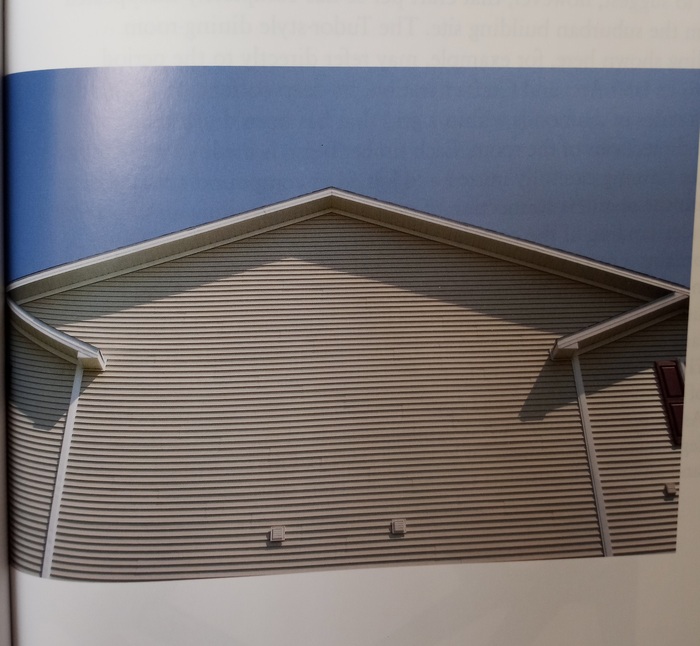
My favorite chapter was a photograph a blank wall of vinyl siding with the fascia boards and rain gutters angled to suggest a bay or projection, the accompanying text expounding upon the curious compression of formerly distinct architectural elements. "It appears that detail is slowly being absorbed into the homogenous surfaces - gradually reduced to pure gestures and flattened into little more than a two-dimensional graphic. As detail recedes, the primary forms seem to swell with a boisterous confidence in their sheer size. At times, suburban houses have the intimidating quality of an object that has grown too quickly and wants to dominate everything around."
Profile Image for Tim Belonax.
147 reviews13 followers
November 17, 2024
A book like this could have easily been twice or three times in length. As a child of the Western suburbs that found his way out and into art school, American housing developments like those observed in this book are rich with inspiration, curiosities, and stories. I’m glad this was made. I hope there’s a follow up to it some day.

And kudos to the AA for excellent book design.
Profile Image for Pam.
68 reviews
December 15, 2012
I found the opening essay as nebulous as Lars Lerup's entire book, 1 Million Acres and No Zoning, but the bulk of the book is a series of photos with short essays about what we are looking at. Many of them made me laugh out loud, but most were a little depressing to look at. All of them made me wonder what kinds of people the architects responsible for these houses are. Or are architects not typically employed to design suburban housing any more, and perhaps that is the problem?
Displaying 1 - 3 of 3 reviews

Can't find what you're looking for?

Get help and learn more about the design.