

What do you think?

Inspector Nergui #1
The Shadow Walker
As winter falls upon the streets of Ulan Bataar, Mongolia, a serial killer is just getting warmed up. When the mutilated body of a fourth victim is found in one of the city's most expensive hotels, Nergui, the former head of the Serious Crimes squad, is no closer to catching the killer and will accept any help he can get.
Drew McLeish, a senior British CID officer and no stranger to the savage side of human nature, is sent out to lend his expertise to the investigation. From the abandoned factories of the city's decaying suburbs to the icy expanse of the barren steppes, Nergui and McLeish follow a trail of the dead.
Drew McLeish, a senior British CID officer and no stranger to the savage side of human nature, is sent out to lend his expertise to the investigation. From the abandoned factories of the city's decaying suburbs to the icy expanse of the barren steppes, Nergui and McLeish follow a trail of the dead.
320 pages, Paperback
First published July 1, 2007
About the author
Michael Walters
65 books10 followersLibrarian Note: There is more than one author in the GoodReads database with this name. See this thread for more information.
Aka Alex Walters
Michael Walters has worked in the oil industry, broadcasting and banking. Over the last decade, he has worked as a management consultant across the world, in environments ranging from parliaments to prisons. When not travelling, he lives in Manchester with his wife and three children.
Series:
* Inspector Nergui
Aka Alex Walters
Michael Walters has worked in the oil industry, broadcasting and banking. Over the last decade, he has worked as a management consultant across the world, in environments ranging from parliaments to prisons. When not travelling, he lives in Manchester with his wife and three children.
Series:
* Inspector Nergui
Ratings & Reviews
Friends & Following
Create a free account to discover what your friends think of this book!
Community Reviews
Displaying 1 - 30 of 72 reviews

February 13, 2019
The Shadow Walker by Michael Walters and Alex Walters is a dark police thriller that is the first book of the Inspector Nergui series. This one is a bit different to me as it's set in Mongolia so of course for one that loves to virtually travel through stories I was curious about the setting right away. In the story Inspector Nergui is part of the Mongolian Serious Crime squad and gets the call to come help find a serial killer when mutilated bodies start turning up. Not too bad overall but I did find it could get slow with talking instead of doing in parts leaving this one just one of those so-so Ok reads to me.
For more reviews please visit https://carriesbookreviews.com/
For more reviews please visit https://carriesbookreviews.com/

August 8, 2021
"I don't understand. What is it you find so disturbing about this place? I mean, it's a desolate enough spot, but--"
"Desolate," Nergui repeated. "Yes, certainly. But it is the emptiness that disturbs me."
This was all becoming a little too philosophical for Drew's tastes. He would not have imagined that Nergui was a man prone to these kinds of imaginative fancies, but then he did not understand this culture.
Nergui smiled. "You think I am a superstitious fool?"
"No," Drew protested. "It's just--"
"I am expressing myself badly, trying to capture a feeling I have." He shrugged. "The famous detective's intuition. You have that?"
Drew smiled. "I think it's usually just a polite word for blind guesswork when I haven't a clue what's going on."
"That could well be the case," Nergui agreed. " But it is not entirely fanciful, I think, not in this case. We Mongolians are accustomed to the open air, to emptiness. It is our heritage. But today it feels to me as if we are surrounded by forces that are threatening that birthright."
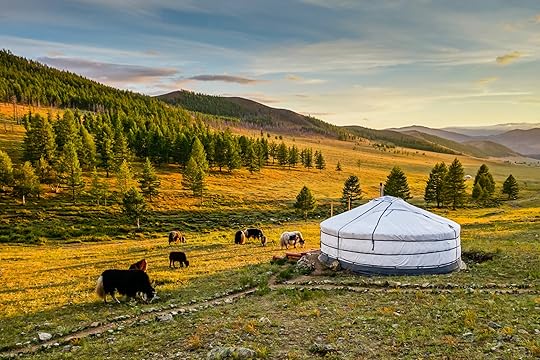
~~A beautiful picture of the open, mostly empty, Mongolian countryside that is referenced in the above quote. In the foreground is pictured a ger , a portable, round tent covered with skins or felt still heavily used by Mongolian nomads, as well as some city-dwellers who prefer to live on the outskirts of the city within which they work. Walters takes us into this often overlooked world with his mystery novel.
First two sentences: It was like one of the gates of hell. They drove at speed away from the airport, northeast towards the city, as the setting sun cast crimson shadows along the road ahead.
Meet Nergui. He's a detective by trade, formally employed by the Serious Crimes Team (think Mongolia's rough equivalent to the FBI), but now working for the ambiguous Ministry. He often pines for the days when his job duties were more clear-cut...and less political. His wish is unexpectedly granted when a presumed psychopath has the audacity to commit murder in Ulan Baatar. And this is not just any murder. The victim is a British national, the scene of the crime is one of the most upscale hotels in the city, and the crime itself is horribly brutal.
The minister fears that this crime will tarnish Mongolia's reputation, right as the country is attempting to emerge from the shadows of the previous Soviet Union, and establish itself as a member of the international community. The murders are starting to stack up, and the minister sends Nergui back to Serious Crimes in an attempt to quickly apprehend what is beginning to look like a serial killer. Great Britain sends their own detective--Drew McLeish, to assist in the investigation. One of their own citizens is a victim after all.
But nothing is turning out to be simple in this case. And Nergui and Drew start to feel like they are in over their heads, caught deep in the mire of a political stew that they can't quite understand. Mongolia has valuable mineral resources underground out in those open spaces. And certain private and governmental groups will go to great lengths to secure those resources. Will they go as far as murder? Read to find out.
My two cents:
"Desolate," Nergui repeated. "Yes, certainly. But it is the emptiness that disturbs me."
This was all becoming a little too philosophical for Drew's tastes. He would not have imagined that Nergui was a man prone to these kinds of imaginative fancies, but then he did not understand this culture.
Nergui smiled. "You think I am a superstitious fool?"
"No," Drew protested. "It's just--"
"I am expressing myself badly, trying to capture a feeling I have." He shrugged. "The famous detective's intuition. You have that?"
Drew smiled. "I think it's usually just a polite word for blind guesswork when I haven't a clue what's going on."
"That could well be the case," Nergui agreed. " But it is not entirely fanciful, I think, not in this case. We Mongolians are accustomed to the open air, to emptiness. It is our heritage. But today it feels to me as if we are surrounded by forces that are threatening that birthright."
~~A beautiful picture of the open, mostly empty, Mongolian countryside that is referenced in the above quote. In the foreground is pictured a ger , a portable, round tent covered with skins or felt still heavily used by Mongolian nomads, as well as some city-dwellers who prefer to live on the outskirts of the city within which they work. Walters takes us into this often overlooked world with his mystery novel.
First two sentences: It was like one of the gates of hell. They drove at speed away from the airport, northeast towards the city, as the setting sun cast crimson shadows along the road ahead.
Meet Nergui. He's a detective by trade, formally employed by the Serious Crimes Team (think Mongolia's rough equivalent to the FBI), but now working for the ambiguous Ministry. He often pines for the days when his job duties were more clear-cut...and less political. His wish is unexpectedly granted when a presumed psychopath has the audacity to commit murder in Ulan Baatar. And this is not just any murder. The victim is a British national, the scene of the crime is one of the most upscale hotels in the city, and the crime itself is horribly brutal.
The minister fears that this crime will tarnish Mongolia's reputation, right as the country is attempting to emerge from the shadows of the previous Soviet Union, and establish itself as a member of the international community. The murders are starting to stack up, and the minister sends Nergui back to Serious Crimes in an attempt to quickly apprehend what is beginning to look like a serial killer. Great Britain sends their own detective--Drew McLeish, to assist in the investigation. One of their own citizens is a victim after all.
But nothing is turning out to be simple in this case. And Nergui and Drew start to feel like they are in over their heads, caught deep in the mire of a political stew that they can't quite understand. Mongolia has valuable mineral resources underground out in those open spaces. And certain private and governmental groups will go to great lengths to secure those resources. Will they go as far as murder? Read to find out.
My two cents:
April 22, 2009
To remember about this I'm going to quote some - the look into the life and place of Mongolia was really one of the best parts -tho I kept very intrigued by the story for sure up until the very en - got a little too predicable.
pg 44 Nergui smiled. "This is not like your country. A quarter of our population is nomadic. Of course, there are close family ties in many cases, and these days most people are formally registered with the state for voting and social security purposes. It's easier than it used to be. But with all the troubles we've had over the last decade, there has been a lot of movement. In both directions. Nomadic people coming to the cities seeking work. And unemployed city dwellers moving out to try their hands at herding or farming - usually without much success. Some of those have lost touch with their families or friends. Some have drifted into crime or more marginal ways of surviving."...
and pg 134-135 (Nergui speaking again - with Drew).."We Mongolians are accustomed to the open air, to emptiness. It is our heritage. But today it feels to me as if we are surrounded by forces that are threatening that birthright. Do you know what lies that way?"..."Close to the Chinese border, down there, you will find one of our country's largest deposits of gold and copper, ready for exploitation."..."Mining is a risky and expensive business-we are talking about investment in the billions. I think, until the scale of the deposits was known, there was a nervousness about becoming involved. Perhaps there still is, but there is beginning to be a jockeying for position. Everyone wants to get in on the act. I am no geologist, but I believe there is much more out there." He paused. "This could transform our country. That is also cause for nervousness. We are talking about a level of investment that is more than our gross national product-maybe several times more. If China or Russia were to make that level of investment-"..."What do you think they might do?"..."Maybe nothing. But it is not an altruistic state. We have spent many decades being a puppet of the Soviet Union, and before that centuries as a satellite of China. I would not like those days to return."
This is from the Berkely edition!
pg 44 Nergui smiled. "This is not like your country. A quarter of our population is nomadic. Of course, there are close family ties in many cases, and these days most people are formally registered with the state for voting and social security purposes. It's easier than it used to be. But with all the troubles we've had over the last decade, there has been a lot of movement. In both directions. Nomadic people coming to the cities seeking work. And unemployed city dwellers moving out to try their hands at herding or farming - usually without much success. Some of those have lost touch with their families or friends. Some have drifted into crime or more marginal ways of surviving."...
and pg 134-135 (Nergui speaking again - with Drew).."We Mongolians are accustomed to the open air, to emptiness. It is our heritage. But today it feels to me as if we are surrounded by forces that are threatening that birthright. Do you know what lies that way?"..."Close to the Chinese border, down there, you will find one of our country's largest deposits of gold and copper, ready for exploitation."..."Mining is a risky and expensive business-we are talking about investment in the billions. I think, until the scale of the deposits was known, there was a nervousness about becoming involved. Perhaps there still is, but there is beginning to be a jockeying for position. Everyone wants to get in on the act. I am no geologist, but I believe there is much more out there." He paused. "This could transform our country. That is also cause for nervousness. We are talking about a level of investment that is more than our gross national product-maybe several times more. If China or Russia were to make that level of investment-"..."What do you think they might do?"..."Maybe nothing. But it is not an altruistic state. We have spent many decades being a puppet of the Soviet Union, and before that centuries as a satellite of China. I would not like those days to return."
This is from the Berkely edition!
February 3, 2010
This book was a slog, just aweful. Story was unimaginative, plot was overly descriptive and methodical in a bad way, characters were unmemorable, protaganist wasn't proactive enough, plus there wasn't a single female in the whole book. It was doubly bad because it took no advantage of Mongolia as a unique setting. I found nothing memorable about the sense of place. I lived there for 2 years with the Peace Corps, and I know Mongolians don't talk the way this book depicts them. Yet, I felt obligated to read it because no other modern thrillers are set here. What a waste of time. I could have had more suspense reading the latest edition of Lonely Planet.

August 13, 2007
THE SHADOW WALKER (Police Proc-Mongolia-Cont) – G+
Walker, Michael – 1st book
Quercus, 2006- UK Hardcover
***Although there is crime in Ulan Baatar, the capital of Mongolia, finding a corpse missing it’s head and hands is far from normal. Negrui, ex-head of the Serious Crime Squad is ordered back to his former role with instructions to clear the case immediately. When the fourth victim is a British geologist, senior British CID officer Drew McLeish is sent to work with Negrui and his successor, Doripalam. The trail leads them through the capital city, to the steppes and into the Gobi desert trying to learn the connection between the killings when Drew is kidnapped.
*** Walker does a wonderful job of bringing the reader to present day Mongolia. His descriptions of the country, the contrasts in cultures and the winter season are so well done. It was fascinating to read a story set in a country about which I’d never given much thought. The characters of Negrui and Drew balanced well; neither was overbearing and I liked that both seemed a bit out of their depth. It was interesting to have Negrui be the lead character. The story flowed well; I certainly read it straight through, but the plot didn’t completely hold together. There were incidents not really explained, the end felt very abrupt and the motive behind the crimes detracted from the suspense of the story. I found this a very credible first book, well worth reading for the setting alone, and look forward to Walker’s second book.
Walker, Michael – 1st book
Quercus, 2006- UK Hardcover
***Although there is crime in Ulan Baatar, the capital of Mongolia, finding a corpse missing it’s head and hands is far from normal. Negrui, ex-head of the Serious Crime Squad is ordered back to his former role with instructions to clear the case immediately. When the fourth victim is a British geologist, senior British CID officer Drew McLeish is sent to work with Negrui and his successor, Doripalam. The trail leads them through the capital city, to the steppes and into the Gobi desert trying to learn the connection between the killings when Drew is kidnapped.
*** Walker does a wonderful job of bringing the reader to present day Mongolia. His descriptions of the country, the contrasts in cultures and the winter season are so well done. It was fascinating to read a story set in a country about which I’d never given much thought. The characters of Negrui and Drew balanced well; neither was overbearing and I liked that both seemed a bit out of their depth. It was interesting to have Negrui be the lead character. The story flowed well; I certainly read it straight through, but the plot didn’t completely hold together. There were incidents not really explained, the end felt very abrupt and the motive behind the crimes detracted from the suspense of the story. I found this a very credible first book, well worth reading for the setting alone, and look forward to Walker’s second book.

October 20, 2010
Let's see. Our hero inspector laments the lack of money to have a real police office as he sits in a green office with one desk and one chair. So, money is tight in Ulan Bator. I get it. But then where does the money come from to support a crime lab and a forensic team? Really. Mind you they just show up at every murder, but do nothing. The author can't be bothered to actually study police procedures in Mongolia. This is a new kind of touristic exoticism:'I'll learn just enough to write some books and make some cash. The truth be damned!
August 28, 2014
good and entertaining. Different setting than I am used to. Looking forward to the second installment.

December 30, 2019
Good Crime novel, intriguing & keeps the reader guessing till the end.

October 25, 2019
Who wouldn’t want to read a mystery that takes place in Mongolia? The setting was the drawing card for me, since this part of the world is rarely written about in mysteries. The plot, a hunt for a serial killer committing bizarre murders, grows more complex with every chapter, which makes the story quite intriguing.
The unique setting is deftly described by the author. I can’t say it’s a place I’d want to visit, though, given the capital city’s drab, abandoned factories and buildings from the Soviet area, however descriptions of the Gobi desert are terrific. It was interesting to learn a little about the different lifestyles between city workers and the nomadic Mongolians who still live in gerts. At least this is how the setting was portrayed when the book was published in 2006. I would have liked to have learned more, but local workers aren’t really emphasized in this book.
Inspector Nergui, a former police officer who is now with the Ministry, is an intriguing character. We learn a fair bit about his shrewdness and lonely lifestyle, and there are still enough secrets to make him an enigmatic individual. The character of British Chief Inspector Drew McLeish isn’t as colorful, but certain serves an important role in the story.
The author does a great job of combining political intrigue and espionage with a socio-economic portrayal of Mongolia, all woven throughout a police procedural. No easy task, given that there isn’t a long list of suspects. The story is beautifully done. Highly recommended.
The unique setting is deftly described by the author. I can’t say it’s a place I’d want to visit, though, given the capital city’s drab, abandoned factories and buildings from the Soviet area, however descriptions of the Gobi desert are terrific. It was interesting to learn a little about the different lifestyles between city workers and the nomadic Mongolians who still live in gerts. At least this is how the setting was portrayed when the book was published in 2006. I would have liked to have learned more, but local workers aren’t really emphasized in this book.
Inspector Nergui, a former police officer who is now with the Ministry, is an intriguing character. We learn a fair bit about his shrewdness and lonely lifestyle, and there are still enough secrets to make him an enigmatic individual. The character of British Chief Inspector Drew McLeish isn’t as colorful, but certain serves an important role in the story.
The author does a great job of combining political intrigue and espionage with a socio-economic portrayal of Mongolia, all woven throughout a police procedural. No easy task, given that there isn’t a long list of suspects. The story is beautifully done. Highly recommended.

July 4, 2017
A gripping, clever tale of shadows, corruption and murder
When a mutilated body is discovered in Mongolia dressed in the clothes of a westener it is pushed under the carpet ..until a week later when another body is found..Nergui who works for the ministry is asked to head up the investigation. This is no ordinary case therefore they ask assistance from the British government and McLeish is sent out to assist on the case.All the bodies are left in open places ..one of them a British scientist.. Doripalam a capable ,hardworking detective ,is pushed aside a little as Nerugi leads the case ..This case will lead them to the desert ,to dark places in their hunt for a killer .Just as they are on the verge of turning a corner. A monster changes his gameplay leading one in fear of his life and one to find answers before it is too late.Double dealings ,twists, murder .Nerugi is a clever ,brilliant detective with a sharp nerve of steel.McLeish when he takes on this job could never in a million years imagine how the story could unfold..Alex Walters has written a clever tale of greed ,corruption and murder.... .A read that took me into the early morning ...
When a mutilated body is discovered in Mongolia dressed in the clothes of a westener it is pushed under the carpet ..until a week later when another body is found..Nergui who works for the ministry is asked to head up the investigation. This is no ordinary case therefore they ask assistance from the British government and McLeish is sent out to assist on the case.All the bodies are left in open places ..one of them a British scientist.. Doripalam a capable ,hardworking detective ,is pushed aside a little as Nerugi leads the case ..This case will lead them to the desert ,to dark places in their hunt for a killer .Just as they are on the verge of turning a corner. A monster changes his gameplay leading one in fear of his life and one to find answers before it is too late.Double dealings ,twists, murder .Nerugi is a clever ,brilliant detective with a sharp nerve of steel.McLeish when he takes on this job could never in a million years imagine how the story could unfold..Alex Walters has written a clever tale of greed ,corruption and murder.... .A read that took me into the early morning ...

August 2, 2021
As a huge fan of Alex Walters, I had no doubt that I would enjoy this, although with the book being set in Mongolia, I did wonder how I would relate to it. As it happens, I found this book absolutely fascinating and extremely captivating. The storyline was brilliant, albeit highly complex and it took me a while to get my head around it. The characters were perfect – Neguri, Doripalam and Drew McLeish were very well crafted and totally believable. It certainly gave me an insight into how politics and policing is handled in Mongolia – it would appear that they are handled in the same fashion by the same people! Once I got to grips with the plot, I found it fast paced and gripping – especially towards the end where the action ramps up and lives are at stake. There is plenty of depth to the story and it kept me involved and captivated throughout. Much more so than I had expected. Although I know that this is an older book that has been republished, I found that it was exciting and new and will most definitely be reading the next in the series.

November 28, 2018
One of the things I like best in mystery-action books and series is getting to learn about a new place. So I picked this one up because of its setting: Mongolia, with a Mongolian detective. I was a bit disappointed in the mystery story itself, which was less about solving a string of garish murders than about the political and economic intrigue within which they are set. And oddly, we learn less about the Mongolian characters than about the visiting English policeman. However, it looks like there are others in this series, and I'll be happy to read on, hoping the author gets a better grip on storytelling, because I'm still interested in the place and in the characters.

August 27, 2018
An enjoyable work of fiction set in the world were communism (post-Soviet) and capitalism (globalisation) meet. From my perspective, I enjoyed the short sections that explain life in Mongolia (a former Soviet republic) after the fall of the Communist Party in 1991. I felt that the author tried to explain the legacy of the Soviet mindset and the sense of loss and opportunity that the citizens of Mongolia and Central Asia feel and experience today. I think this work of fiction would appeal to students and scholars of (post-Soviet) Asian societies.

February 5, 2021
This police-procedural, set in a convincing Mongolia moving towards “democracy”, develops towards a thriller-type ending and it’s always gripping even if there are some bland characters, fortuitous appearances and clichéd situations. Western-educated Mongolian, Inspector Nergui, investigates with a fairly useless British CI seconded because of the killing of a UK geologist; one of a series of gruesome murders ultimately connected to multi-national mining. It hums along but lacks the subtlety of the best.
April 18, 2024
Some mystery books are really travelogues. I read them to get a peek into another place, another culture. A book set in Mongolia shortly after the break up of the USSR seemed a good candidate. It did a passable job in that respect. Unfortunately the place descriptors weren’t good enough and the pacing was so glacial. The earliest part of the book showed promise. But then pretty much nothing happened until about halfway through. Honestly , the description of the plane ride there was the best part of the whole book.
June 29, 2020
Unusual Venue
It took me a while to get into the story, I think because I could not put a face to the main characters. The author writes several times that Negui has difficulty reading them too, so I was not alone in this. The plot was interesting but again it was hard to hold a picture in my min because I do not know what a steppe looks like. This is something I am going to have to Google.
It took me a while to get into the story, I think because I could not put a face to the main characters. The author writes several times that Negui has difficulty reading them too, so I was not alone in this. The plot was interesting but again it was hard to hold a picture in my min because I do not know what a steppe looks like. This is something I am going to have to Google.

May 12, 2021
My first mystery set in Ulan Baator. I found this a fascinating read with interesting characters and a good twisting and turning storyline. It was a little slow at times, but in a way, it lent itself to the country and its people and their way of life. Not the toughest mystery to figure out the culprit, but it did keep me caught up in the movement of the plot. I gave it a 5 because of the place and its people.
January 22, 2024
I picked this up in a hostel library on my travels. Set in Mongolia, I assumed this crime novel would also offer insight and description of a country I know little about.
But it was, imho, very dull and rambling. Still not really sure why a detective from Manchester had to be flown to Ulan Bator to help with the case. Lots of violence, wooden male characters, and just not what I'd hoped for. Skimmed through it.
But it was, imho, very dull and rambling. Still not really sure why a detective from Manchester had to be flown to Ulan Bator to help with the case. Lots of violence, wooden male characters, and just not what I'd hoped for. Skimmed through it.

April 21, 2025
3.25 Mongolia
Easy police procedural. Nice gruesome murders but plot lacked momentum and no real mystery to work through. Enjoyed the Mongolian details … was a good pick for my country book.
The ending was anticlimactic in that the detective didn’t figure out anything. He got a phone call from the mastermind and went to hear his story. Case closed.
Easy police procedural. Nice gruesome murders but plot lacked momentum and no real mystery to work through. Enjoyed the Mongolian details … was a good pick for my country book.
The ending was anticlimactic in that the detective didn’t figure out anything. He got a phone call from the mastermind and went to hear his story. Case closed.
This entire review has been hidden because of spoilers.

November 9, 2017
Decent read
Lacking in suspense, but the mystery was fairly inscrutable for the first half of the book. Exotic locale, characters a bit wooden, but as a procedural it was interesting.
Lacking in suspense, but the mystery was fairly inscrutable for the first half of the book. Exotic locale, characters a bit wooden, but as a procedural it was interesting.
June 8, 2020
I thought this book was interesting as it was set in Mongolia so has different aspects to most crime novels I have read. However I wasn’t convinced by the ending and was left with a lot of questions. It wasn’t very satisfactory and was disappointing.
August 3, 2018
great book
country 27 : Mongolia
country 27 : Mongolia

April 29, 2023
A great tale of murder and mystery in the cities and deserts of Mongolia.
November 24, 2025
a good read - about Mongolia
July 12, 2026
Really enjoyed this detective book about a serial killer but I loved learning about Mongolia.

March 25, 2017
It starts really fine, but in the end it feels to miss some things, the end is a bit disappointing.
May 15, 2025
Excellent. Love Inspector Nergui

September 3, 2016
This debut crime thriller is intriguing because it’s set entirely in Mongolia, a country about which most of us in the West know little.
The capital Ulan Baatar has its fair share of crime, but not too many murders. And certainly no previous murdered corpses missing the head and hands. And alarmingly the bodies start to mount up… It’s winter so citizens have to wrap up or they might freeze to death. These temperatures play havoc with identifying the time of death, too. Nergui was transferred from the police to the Ministry of the Justice, but these murders suggested he was needed back in the Serious Crimes team to help his relief Inspector Doripalam solve the case.
Alas, the clues are few. Until one corpse doesn’t resemble the others – it’s identifiable as an English geologist. Detective Inspector Drew McLeish is flown in from the Manchester force as he’s an experienced murder investigator. Politics seem of greater concern than the risk of more citizens dying a ghastly death. Alas, McLeish doesn’t seem to contribute much to the investigation, nor to the story, save that he becomes a reason for the ‘ticking bomb’ finale.
Nergui is an interesting character, and after initial resentment Doripalam works well with him. We also learn a bit about McLeish and see aspects of Mongolia through his fresh eyes.
Mongolia is a resource-rich country where various outside mining and business consortiums vie for access. Inevitably, there’s corruption and complicity.
I was expecting more description and feel for the Gobi, but the visit here was spare and even sparse. The descriptions of the city in the freeze put the reader there, but there was no feel that the culture was particularly alien. Sure, Nergui tells McLeish (and the reader) some Mongolian idiosyncrasies, but we are not shown much.
There seems to be a cunning mastermind behind the murders, though I felt it was a bit contrived, and the final confrontation where it was all explained over several pages by the perpetrator was stretching credibility. The villain was a bit of a nonentity, even a shadow, though whether he was the shadow of the title is debatable.
I enjoyed the first half, mainly concerning Nergui, but then for me the story seemed to deteriorate. The resolution owed little to either McLeish or Nergui, in fact, and was therefore a disappointment. Readers want the main protagonist to resolve the case, not a minor character. I’m not sure why the book is called The Shadow Walker, which is an over-used title, also found in the fantasy genre.
The author also writes as Alex Walters.
The capital Ulan Baatar has its fair share of crime, but not too many murders. And certainly no previous murdered corpses missing the head and hands. And alarmingly the bodies start to mount up… It’s winter so citizens have to wrap up or they might freeze to death. These temperatures play havoc with identifying the time of death, too. Nergui was transferred from the police to the Ministry of the Justice, but these murders suggested he was needed back in the Serious Crimes team to help his relief Inspector Doripalam solve the case.
Alas, the clues are few. Until one corpse doesn’t resemble the others – it’s identifiable as an English geologist. Detective Inspector Drew McLeish is flown in from the Manchester force as he’s an experienced murder investigator. Politics seem of greater concern than the risk of more citizens dying a ghastly death. Alas, McLeish doesn’t seem to contribute much to the investigation, nor to the story, save that he becomes a reason for the ‘ticking bomb’ finale.
Nergui is an interesting character, and after initial resentment Doripalam works well with him. We also learn a bit about McLeish and see aspects of Mongolia through his fresh eyes.
Mongolia is a resource-rich country where various outside mining and business consortiums vie for access. Inevitably, there’s corruption and complicity.
I was expecting more description and feel for the Gobi, but the visit here was spare and even sparse. The descriptions of the city in the freeze put the reader there, but there was no feel that the culture was particularly alien. Sure, Nergui tells McLeish (and the reader) some Mongolian idiosyncrasies, but we are not shown much.
There seems to be a cunning mastermind behind the murders, though I felt it was a bit contrived, and the final confrontation where it was all explained over several pages by the perpetrator was stretching credibility. The villain was a bit of a nonentity, even a shadow, though whether he was the shadow of the title is debatable.
I enjoyed the first half, mainly concerning Nergui, but then for me the story seemed to deteriorate. The resolution owed little to either McLeish or Nergui, in fact, and was therefore a disappointment. Readers want the main protagonist to resolve the case, not a minor character. I’m not sure why the book is called The Shadow Walker, which is an over-used title, also found in the fantasy genre.
The author also writes as Alex Walters.

May 31, 2016
Review: The Shadow Walker by Michael Walters.
The book is set in Mongolia where the people scuffle to find a place in the post-global world. I thought the story was written with ease and the characters were well created for their place in the story. At first it was hard to get into the story because the author stacked up murders one after another. As I read on I finally was able to understand the complex situation and follow the story. However, the story seems to lack hard core descriptions for the brutal crimes committed. As many murder scenario’s the book prevailed it needed more captivating language to keep the pages turning. Most of the action took place in the Capital City of Ulan Bator. Yet, I will be fair as this was the British author’s first book.
The story begins with the first of many murders and the city police, Chief Dorlpalam feels he needs someone with experience to handle the case because the body showed signs that they have a serial killer in the making. They call in former Crimes Chief Nergui to handle the investigation and British CID Inspector Drew McLeish to assist in finding the murderer before someone else dies. They worked as a team with no hesitation at all and besides being co-workers they became friends. Before they had time to investigate one murder another body is found, mutilated as the first. So that did reveal that they were looking for one person. By the time a forth body was found, a British geologist, the trail begins to lead them through the capital city, to the steppes and the Gobi desert where they learn of a connection between the killings that kept them at the Gobi desert area for some days.
They went on working as a team with Chief Nergui providing the insight to the city, the suburbs and the Gobi desert while Inspector McLeish brings the profiling up to date as the body count mounts and one of the bodies was a police officer. While in the Gobi desert area they stop at a tourist camp during the investigation to get more background information on the murdered policeman. As the story goes on political and business motivations gets introduced into the story and Inspector McLeish is kidnapped….The kidnapping gets the clock ticking faster and Chief Negrui is making complex connections that leads him to an area of haunting abandoned factory’s to conclude the suspenseful crime story to an end. I thought the ending was abrupt and not completed.
However, the plot is what kept me reading….
The book is set in Mongolia where the people scuffle to find a place in the post-global world. I thought the story was written with ease and the characters were well created for their place in the story. At first it was hard to get into the story because the author stacked up murders one after another. As I read on I finally was able to understand the complex situation and follow the story. However, the story seems to lack hard core descriptions for the brutal crimes committed. As many murder scenario’s the book prevailed it needed more captivating language to keep the pages turning. Most of the action took place in the Capital City of Ulan Bator. Yet, I will be fair as this was the British author’s first book.
The story begins with the first of many murders and the city police, Chief Dorlpalam feels he needs someone with experience to handle the case because the body showed signs that they have a serial killer in the making. They call in former Crimes Chief Nergui to handle the investigation and British CID Inspector Drew McLeish to assist in finding the murderer before someone else dies. They worked as a team with no hesitation at all and besides being co-workers they became friends. Before they had time to investigate one murder another body is found, mutilated as the first. So that did reveal that they were looking for one person. By the time a forth body was found, a British geologist, the trail begins to lead them through the capital city, to the steppes and the Gobi desert where they learn of a connection between the killings that kept them at the Gobi desert area for some days.
They went on working as a team with Chief Nergui providing the insight to the city, the suburbs and the Gobi desert while Inspector McLeish brings the profiling up to date as the body count mounts and one of the bodies was a police officer. While in the Gobi desert area they stop at a tourist camp during the investigation to get more background information on the murdered policeman. As the story goes on political and business motivations gets introduced into the story and Inspector McLeish is kidnapped….The kidnapping gets the clock ticking faster and Chief Negrui is making complex connections that leads him to an area of haunting abandoned factory’s to conclude the suspenseful crime story to an end. I thought the ending was abrupt and not completed.
However, the plot is what kept me reading….

July 28, 2008
I'm having a hard time deciding exactly how to review this book. My opinion of it is EXTREMELY colored by the fact that I lived in Mongolia so I am perhaps judging some of the pieces too much and not focusing on other parts as equally. I guess to start I will say that I think the story is good overall, but suffers from the fact that this is the first book by Walters. I think (and hope) the next in the series will be better.
I think Walters did an incredible job of capturing some of details of Mongolian culture, especially how things are changing with the influx of western influence and capitalism. This leads me to believe he spent a good deal of time there and did some extensive research. However, I also think he missed some details, or perhaps decided to add/change things because it is a fictional book. For example, towards the end of the book it starts snowing and he describes how dangerous the streets were getting but that the snowplows and gravel (snow ploughs and gritters as he calls them) would be around soon. Unless I completely missed something, I never once saw a snow plow and it tended to be street sweepers that brushed the snow from the streets the few times it did snow. I swear he also changed around some of the geography of the city. But, does this really matter to the story? Do these small details really impact the quality of the narrative? For the majority of people who read this book, probably not, but for my fellow "lived in Mongolia" people, it might distract from the story at times. I hope you enjoy the book regardless.
I think Walters did an incredible job of capturing some of details of Mongolian culture, especially how things are changing with the influx of western influence and capitalism. This leads me to believe he spent a good deal of time there and did some extensive research. However, I also think he missed some details, or perhaps decided to add/change things because it is a fictional book. For example, towards the end of the book it starts snowing and he describes how dangerous the streets were getting but that the snowplows and gravel (snow ploughs and gritters as he calls them) would be around soon. Unless I completely missed something, I never once saw a snow plow and it tended to be street sweepers that brushed the snow from the streets the few times it did snow. I swear he also changed around some of the geography of the city. But, does this really matter to the story? Do these small details really impact the quality of the narrative? For the majority of people who read this book, probably not, but for my fellow "lived in Mongolia" people, it might distract from the story at times. I hope you enjoy the book regardless.
Displaying 1 - 30 of 72 reviews