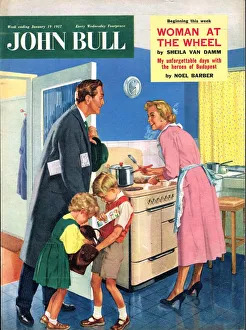
Writer and director Jordan Peele’s searing Get Out deliberately builds on two earlier films based on work by Ira Levin, the 1960s adaptation of Rosemary’s Baby and the 1970s version of The Stepford Wives. Peele was exploring the alienation and racism underpinning upscale American commuter communities, Levin was interested in similar issues but for racism substitute misogyny – Levin’s novel alludes to race but when it comes to social bonds, for Levin, gender’s the ultimate dividing line. At its centre is up-and-coming photographer Joanna Eberhardt whose career’s been disrupted by marriage and motherhood. Joanna and her husband Walter, a lawyer, have a young son and daughter. On the surface they’re the image of the ‘desired’ American nuclear family. In search of space and a better environment for raising their children, the Eberhardts exchange their cramped New York apartment for an airy house in picturesque Stepford; a semi-rural town notable for its historic buildings and manicured lawns. Once there, Walter travels into the city by train with the rest of Stepford’s male professionals, leaving Joanna to parent and keep house.
It’s a pretty conventional setup but for Joanna, and new friend Bobby, it’s one that chafes. Both are attracted to the growing feminist movement and opportunities it might offer to reclaim a sense of self beyond their familial roles. But when they try to stir up interest in a local women’s group the more established Stepford wives are oddly resistant, uniformly clad in flowery, flowing dresses, they’d rather talk about baking and the best products for waxing floors. The local library’s deserted, even the cinema only seems to attract teens and older children. Meanwhile Walter joins the booming men’s association headed up by sinister Dis, soon he’s there every night, along with the other husbands in their circle. Joanna starts to realise something strange is happening to Stepford’s women, even recent arrivals suddenly change to fit the profile of vacant but picture-perfect mother and obsessively devoted wife. And Joanna begins to see that if she doesn’t work out what’s happening to them, and soon, she may be next.
Levin’s story combines chilling, domestic horror with social satire. Couched in workaday prose, his fast-paced, narrative is an inventive depiction of the rise of second-wave feminism and a rapidly-emerging backlash. Kate and Bobby are reading authors like Kate Millet on women’s rights but the Stepford husbands are absorbed in the theories of sociologist Lionel Tiger whose controversial bestseller Men in Groups became the bible of a conservative, men’s rights movement. Tiger believed women should be confined to the home otherwise they threatened and undermined male identity, upsetting the balance of nature itself. Levin’s definitely siding with the women here, he was strongly influenced by Betty Friedan and Simone de Beauvoir when he wrote this. Although his take on patriarchal power suggests he was less than convinced that women could prevail; and even his most rebellious female characters remain overly invested in orthodox family structures.
Levin’s approach is less than subtle, and plot takes precedence over sophisticated worldbuilding – I have so many questions about how Stepford actually worked. However, its prescient representations of gaslighting, coercive control, growing demands placed on women, combined with concerns about the impact of developing technologies on culture and society, gave this a curiously modern feel. Even more so in the context of a rampant resurgence of conservative family values and trad wife influencers promoting cradle-and-ladle lifestyles. For anyone tempted, or horrified, by their vision of everyday life, this remains a timely, cautionary tale. Although, for me, the 1975 film with its arresting visuals and Katherine Ross’s memorable performance, still wins out – stir clear of the Nicole Kidman remake.
Edit: If you don't already know the plot skip the Chuck Palahniuk intro in this edition, he gives everything away - plus his comments on women, imo, not the most enlightened.
Rating: 3/3.5