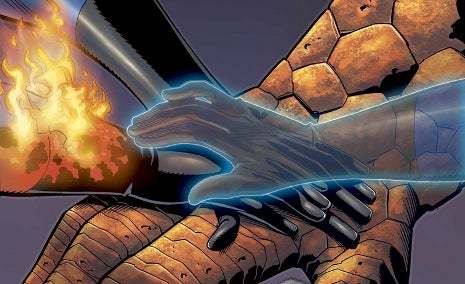
Manhattan is cut off from the rest of the world by a fleet of miles-high alien spacecraft -and that's just the beginning With the Avengers in disarray, New York reluctantly turns to the disenfranchised Fantastic Four, the only heroes in town, to save them - but where to even start? And which member of the team will make a decision that will radically change the Fantastic Four for some time to come? Plus: Witness the genesis of an all-new, all-twisted Frightful Four Collects Fantastic Four #514-519.
Mark Waid is an American comic book writer widely known for shaping modern superhero storytelling through influential runs on major characters at both DC Comics and Marvel Comics. Raised in Alabama, he developed an early fascination with comic books, particularly classic stories featuring the Legion of Super-Heroes, whose imaginative scope and sense of legacy would later inform his own writing. He first entered the comics industry during the mid 1980s as an editor and writer for the fan magazine Amazing Heroes, before publishing his first professional comic story in Action Comics. Soon afterward he joined DC Comics as an editor, contributing to numerous titles and helping shape projects across the company. After leaving editorial work to focus on writing, Waid gained widespread recognition with his long run on The Flash, where he expanded the mythology of the character and co-created the youthful speedster Impulse. His reputation grew further with the celebrated graphic novel Kingdom Come, created with artist Alex Ross, which imagined a future DC Universe shaped by generational conflict among superheroes. Over the years he has written many prominent series, including Captain America, Fantastic Four, Daredevil, and Superman: Birthright, bringing a balance of optimism, character depth, and respect for comic book history to each project. Waid has also collaborated with notable artists and writers on major ensemble titles such as Justice League and Avengers, while contributing ideas that helped clarify complex continuity within shared superhero universes. Beyond mainstream superhero work, he has supported creator owned projects and experimental publishing models, including the acclaimed series Irredeemable and Incorruptible, which explored moral ambiguity within the superhero genre. He later took on editorial leadership roles at Boom Studios, guiding creative direction while continuing to write extensively. In subsequent years he expanded his involvement in publishing and digital storytelling, helping launch online comics initiatives and advocating for new distribution methods for creators. His work has earned numerous industry awards, including Eisner and Harvey honors, reflecting both critical acclaim and enduring popularity among readers. Throughout his career Waid has remained a passionate student of comic book history, drawing on decades of storytelling tradition while continually encouraging innovation within the medium. His influence extends across generations of readers and creators, and his stories continue to shape the evolving language of superhero comics around the world today through enduring characters imaginative narratives and thoughtful reinventions of familiar myths within popular culture and modern graphic storytelling traditions.
The first half of this volume has absolutely nothing to do with Avengers: Disassembled, and concerns the Frightful Four, a new member, and The Wizard family issues causing troubles for all; with some awful blocky artwork by Karl Kesel over an average story. The second half is actual set in the post-Avengers Disassembled world and sees an alien threat come to Manhattan with the Fantastic Four alone are left to combat it. This story has better art by Mike Wieringo and a more driven plotline but has a huge cliff-hanger of an ending which will have you dashing out to buy the next volume, if you care. From an Avengers Disassembled point of view - you can skip this entire volume! 5.5 out of 12.
Two separate story arcs were mashed together in this collection and branded under disassembled tag.
The very average first story arc which has nothing to do with disassembled arc deals with sinister four...uh, no horrible fo..um.. some thoroughly unmemorable villain team going against fantastic four.
Second story arc was much better. It takes place after the whole disassembled story. When New York is attacked by aliens, apparently FF is the only team who can take them on (which is actually dumb when you think about it.) But the ending of the story was really cool!
The first arc in this is truly awful. A stock superhero plot with basically nothing good going for it outside of fleeting moments of fun and cleverness that are immediately overshadowed by mediocrity. To say nothing of the tastelessly handled SA plot with Salamandra's pregnancy. (Who herself is a weird Ambiguously Brown Hot Foreign Lady who talks in the third person. It makes sense she never appeared again, if ComicVine is to be believed.) I have nothing good to say about the Wizard story plot that's worth mentioning.
The titular Disassembled arc doesn't quite save this volume, but it does prevent it from getting a 3/5 which was my original thought after reading the first arc. I think it's a little interesting the Four doesn't even consider the utilitarian calculus of saving those trillions of civilizations when Sue's life is at stake - that Sue herself is the only one willing to go through with it. I like it, but I'm surprised it's never brought up that Reed is one of the few men alive who can even *comprehend* what trillions of civilizations would look like, and he *still* chooses to sacrifice them for the sake for his wife.
The scale of the sacrifice involved could have used a closer look, but I was relieved that the quality of the series, while not as great as prior arcs, had returned - the Four finally felt like themselves again and the ending of the arc where they regain their reputation felt great. ... okay
This is the Disassembled subplot that has the least to do with the actual event, but that maybe helps it out? Well, that and the fact that Mark Waid just nails these characters. It's a lot of fun, this Waid FF run is among my favorite things from this era of Marvel.
That being said, it's odd to include the previous storyline "Dysfunctional" in the trade rather than "Rising Storm" which immediately follows the events in this book. It's also pretty good, you should check it out.
How much fun was that! Waid is really good when it comes penning big scale threats and action. And with Wieringo art. That was so much fun. Sadly, other half was not so much. It was just talktive boringness with the new Frightfull Four and way too manga influenced art.
The Wingless Wizard story really sucks, very messy and difficult to buy into, but the Disassembled stuff with Manhattan isolated from the world is really good, with a nice moral quandary and cool solution
Spider-Man story was fun, evil fantastic four story was whatever with a kinda forced romance, galactus story is just getting started and also has nothing to do with the avengers disassembled name but I’m interested to see where it goes. Probably the low point of the run for me so far.
This book was a lot of fun. People give this one bad reviews but that’s because it doesn’t have anything to do with disassembled. The first arc is a fun but kinda forgettable bought against a new frightful four. The highlight of this is seeing how Johnny has grown but his core is still the same; he keeps getting mixed up with girls that cause him trouble. However it seemed to lack Mark Waids amazing dialogue, probably due to Karl Kesel being a co-writer on it. The second arc does take place after Avengers Disassembled and that’s only relevant because the Avengers aren’t around to help when Manhattan gets lifted into the sky. Some crazy aliens think killing Sue is the only way to save countless worlds from Galactus. It’s a fun story and very widescreen. What we get is Reed outsmarting then at the last second with a plan that no one saw coming. It ends with a slightly changed status quo being set up for the final arc, which is signaled by Galactus arriving. On art we have Paco Medina in the first half who does a good job but it feels like he’s trying too hard to be Mike Wieringo. The art is very Wieringo but the faces art different which is what throws me off and makes it not seem as good. Then in the second half it actually is Wieringo back with his wonderful style. Wieringo is always a treat on the Fantastic Four. Solid book.
Anyone Else Feel Like Thinker is a Cheapened Version of Doom? OVERALL RATING: 3 stars Art: 3 stars Prose: 3.5 stars Plot: 2.75 stars Pacing: 2.75 stars Character Development: 3.5 stars World Building: 2.75 stars This was in the middle of a weird period of this run in which Waid, Wieringo and a few others including the chief editor were forced off and then came back for issue 517 and following. Was funny to see a 'Gone Fishing' billboard as they were signing off got through editing but it was a funny exchange at least to me. Overall though this was a rather boring installment. The Mad Thinker is like Doom's cheap cousin. Similar hubris and intellect just not as ruthless. It's a meh score though. After issue 511 my expectations are probably too high. All the same the last two issues saved this trade for me. No spoilers but something big is brewing.
The first story felt a little dated, and having not read the main "Disassembled" comics, perhaps I was just missing some context that would have added more enjoyment to the start of this arc. Interested to see where it goes in the following volume(s?), though.
This was part of the Avengers Disassembled story. Now that the Avengers are gone-NYC is under attack from a huge alien spacecraft and the only ones to turn too are the Fantastic Four. The problem with this volume was I am not sure why the Mayor of NYC was so reluctant to call the FF. Had they done something wrong? But once they were called out- they board the massive ship to find that the aliens seek only to hide from Galactus. They have technology that allows them to cloak worlds but it seems that Sue Richards has "something" to make it be seen by Galactus. Reed switches Sue and Johnny's powers and problem solved. Until Galactus shows up and the comic ends. Thats all I know. So, I ended up giving it 3/5 since the story was good and the art quite decent. It might have gotten higher if it Knew how it ended but alas.
This volume contains two story arcs. The first, "Dysfunctional," appears to be part of a larger set of Disassembled stories across other Marvel titles. It stands perfectly well on its own. However, in terms of an FF story it isn't great and is pretty skippable. The internet-speak references are dated and I really wasn't a fan of the art.
The second story, "Fourtitude," starts the Glactacus arc (which continues in Vol 6) and is much better (back to Wieringo's art, yay!), though it functions largely as a vehicle for the FF to win back public support. That's all well and good, but after pages and pages of the FF being in the doghouse this rapid PR redemption gave me whiplash.
A fine collection of disconnected stories. No real arc, just a bunch of randomness. Good enough art and writing but I really want more. And none of the Four are all that worth knowing, oh Sue perhaps. And I've always been a Franklin Richards fan. But the kids were basically non-entities here. And there was definitely too much Johnny and Ben was his cardboard self.
Johnny falls in love, only problem being she's the Wizard's daughter. This is a very good volume and touches on the Fantastic Four not bein very popular, even Spiderman is more popular! It also looks at an alien invasion of a different sort. Some nice character moments make this worth reading.
Just barely a Disassembled tie in. More or less explains why New York could be in trouble and the Avengers aren't helping. Serviceable, but not great story.