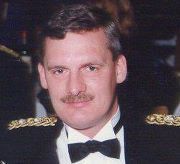
Jochen Peiper was one of the most colourful and ruthless of the unconventional type of leader thrown up by the SS in the Second World War. Notorious for his participation in the massacre of American soldiers at Malmedy in December 1944, he might have felt he had paid the price when he was released from prison in 1957. But as Charles Whiting vividly demonstrates, a grisly end still awaited him.
Born in the Bootham area of York, England, he was a pupil at the prestigious Nunthorpe Grammar School, leaving at the age of 16 to join the British Army by lying about his age. Keen to be in on the wartime action, Whiting was attached to the 52nd Reconnaissance Regiment and by the age of 18 saw duty as a sergeant in France, Holland, Belgium and Germany in the latter stages of World War II. While still a soldier, he observed conflicts between the highest-ranking British and American generals which he would write about extensively in later years.
After the war, he stayed on in Germany completing his A-levels via correspondence course and teaching English before being enrolled at Leeds University reading History and German Language. As an undergraduate he was afforded opportunities for study at several European universities and, after gaining his degree, would go on to become an assistant professor of history. Elsewhere, Whiting held a variety of jobs which included working as a translator for a German chemical factory and spells as a publicist, a correspondent for The Times and feature writer for such diverse magazines as International Review of Linguistics, Soldier and Playboy.
His first novel was written while still an undergraduate, was published in 1954 and by 1958 had been followed by three wartime thrillers. Between 1960 and 2007 Charles went on to write over 350 titles, including 70 non-fiction titles covering varied topics from the Nazi intelligence service to British Regiments during World War II.
One of his publishers, Easingwold-based Rupert Smith of GH Smith & Son said he was a quiet man and prolific writer.
"He's one of a band of forgotten authors because he sold millions of copies and still, up to his death was doing publishing deals.He was the kind of man who was very self-effacing, one of Britain's forgotten authors, still working at 80 years of age, with his nose down and kicking out books."
Charles Henry Whiting, author and military historian died on July 24 2007, leaving his wife and son.
Anyone who read this book may see that it is very poorly researched. Apparently the author believes all the lies told to him by SS war criminals. One is well advised in stead to consult Jens Westemeiers excellent book "Himmlers Krieger" from 2015 or Steven Remy's "The Malmedy Massacre" from 2017.
I'm a historian buff (yeah, one of those). I've read numerous books by Charles Whiting and kept most of them.
Joachim Peiper was a fascinating person so much I've read 3 books about him, and several others with his actions in the war mentioned. I learned about him at first in Time Life Books about WWII, a series I managed to collect and still have. Later, I learned he was portrayed by Robert Shaw in the movie classic 'Battle of the Bulge.'
What I found most interesting about Peiper was how an intelligent, capable man who proved to be a highly-adept soldier could be so cruel and warped into believing the Nazi cause. Whiting's book brings to light how before he became a battle-hardened soldier, he was Himmler's personal adjutant, thus making him privy to what was going on in the Nazi death camps. An American soldier captured during the Battle of the Bulge recalled Peiper as being fluent in English (I believe he also spoke French and Russian), telling the American prisoner how he believed in the Nazi cause and was sure they would whip the Allies. This, after the defeat in Stalingrad, North Africa, and Normandy. I found that amazing how an educated man could lie to himself so.
At one point in Russia his unit was referred to as the 'Blowtorch Battalion,' for having burned 2 Russian villages to the ground with its inhabitants inside. Then he received the Knight's Cross, Germany's highest award for bravery, for having rescued 1,500 German soldiers encircled by Russian troops.
The man was so dedicated a Nazi that Hitler appointed him the point-man for the attack during the Battle of the Bulge, known as the largest battle on the Western Front during the war, and the largest battle ever fought by the American Army. Peiper's advance was so swift and brutal that had they crossed the bridge at La Gleize it's possible the war could've been extended throughout 1945. I've been led to believe in recent history books that it's unlikely the Allies would've sued for peace, because their resources would've allowed them to counter-attack at one point and recapture the strategic port of Antwerp (had the Germans managed to actually capture it, which they didn't). Even German history books quote German generals skeptical about the attack and verifying how they would be unable to hold for long any captured territory.
In Whiting's book you learn about Peiper's career from beginning, through peace, war, and the trail itself. Members of the SS killed nearly 100 American prisoners at Malmedy, eventually known as the Malmedy Massacre. When it was learned what happened, ironically morale in the American offer stiffened. This was contrary to what Hitler thought would happen, for he believed a swift and brutal campaign would cause American soldiers to crumble. In the end, the Allies won the battle and the war.
Peiper was arrested and put to trial for the actions of his men, despite he wasn't at the massacre at Malmedy, nor was there proof of any kind he issued the order to kill prisoners of war. As commander he was convicted and sentenced to death, but America needed support from Germany now that the Cold War was heating up. His sentence was commuted to life, he served around 20 years. Whiting follows Peiper's career after the war and there are pictures detailing his accounts. I enjoyed this book so much I kept it in my personal collection and plan on reading it again. I highly recommend this book. You will enjoy it whether you like history or not.
Whiting seems a capable story teller. His stuff is an easy read but there's something annoying about the style - a purported biography that reads glibly, like a novel, an arrogance. It's not aided by an utter lack of referencing, bizarre pro nazi conclusions and propositions nor the clearly one sided, bombastic sanitization or even glorification of a war mongering man-child. At least his attempt to glorify the foolish SS Colonel is only clumsily veiled. There's an almost antisemitic agenda as far as I'm concerned, too, irrelevant in any case in its content. His portrayal is lop sided, all essentially drawn from no more than self reports of SS degenerates seeking exoneration in the public mind. There's too much untranslated German, like it's venerated as the tongue of the Angels. Thanks for showing your true colours, Whiting. A writer I would never wish to meet
The British historian who wrote this book pointed out irregularities in the investigation and trial againt Peiper for war crimes after the war. His stance is that Peiper was probably innocent of personally committing any wrongdoing or ordering others to murder surrendered troops or civilians. He spent a good amount of time telling the story of the trial and of those who stood trial with him.
Clearly there was some wrongdoing during combat operations in Beligum that they accused Peiper of being responsible for. However, there was also similar issues with US troops killing surrendered troops and their leadership were not held responsible.
The book covers the career of Peiper. Noting that while a member of the SS armed forces (actual military battle troops not police or prison guards) Peiper never actually joined the Nazi party. Peiper was sentenced to death. Then as some of the details of the trial came out and because of how the trial was based on information gotten by torture and threats his sentence was commuted to life and then after 13 years in jail he was released. His defense attorney never forgot how unfair the trial was and spent years in the US trying to overturn the verdict against him including spending a great deal of his own money on Peiper's behalf.
The things written about him as a murderer however reamained firmly in the public. The other side of the story as this author points out was not published. Peiper got several jobs and was a good worker but several times ended up being hounded out of his job because people would figure out his background and the accusations against him and complain to the company he worked for. He finally retired to a small villiage in France working on translating English books into German when he was attacked one night, killed, and had his house burned down on top of him. Fortunately he had sent his wife away because of threats he had recieved prior to the incident. The author complained that his killers were never brought to justice and that the French authorities didn't try very hard to figure out who was responsible.