

What do you think?
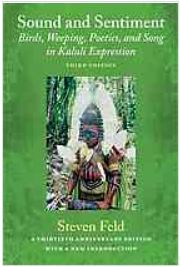
Sound and Sentiment: Birds, Weeping, Poetics, and Song in Kaluli Expression
This thirtieth anniversary edition of "Sound and Sentiment" makes Steven Feld's landmark, field-defining book available to a new generation of scholars and students. A sensory ethnography set in the rain forest of Papua New Guinea, among the Kaluli people of Bosavi, "Sound and Sentiment "introduced the anthropology of sound, or the cultural study of sound. After it was first published in 1982, a second edition, incorporating additional field research and a new postscript, was released in 1990. The third edition includes all of the material from the first two editions, along with a substantial new introduction in which Feld discusses Bosavi's recent history and reflects on the challenges it poses for contemporary theory and representation.
348 pages, ebook
First published June 1, 1982
Ratings & Reviews
Friends & Following
Create a free account to discover what your friends think of this book!
Community Reviews
Displaying 1 - 7 of 7 reviews

July 27, 2013
I read this in 1999, when I was doing an independent study class on world music as an undergrad. It focuses on the Kaluli people and the idea of birdsong and water flow forming the background concepts of their musical themes and life. Pretty much an ethnomusicology classic.

Read
July 25, 2014If I had stuck with anthropology and ethnomusicology, this is the kind of book I would have wanted to write.

February 19, 2026
i think the best way of categorizing anthropology is as applied philosophy
the epistemological value of this book is absurd, i grow more and more jealous of postcolonial ethnographers every day, the idea of introducing grandmaster blaster to a people who communicate through music is so incredibly peak
the epistemological value of this book is absurd, i grow more and more jealous of postcolonial ethnographers every day, the idea of introducing grandmaster blaster to a people who communicate through music is so incredibly peak

April 10, 2021
Impressive piece of fieldwork.
February 19, 2026
A classical master work which merges both ethnomusicology and anthropology and that, unlike the brillant "How musical is man?" by John Blacking, also attempts to focus on the methodological issues in such interdisciplinary approach.
It also shows how sorrow, sadness, meaning and music are the intertwined basic grounds of humankind.
It also shows how sorrow, sadness, meaning and music are the intertwined basic grounds of humankind.

February 1, 2016
Dense and very specific, but that's to be expected. This book came to me by way of a music major friend who thought I'd enjoy it (I love birds & play piano so understand music theory enough I wasn't lost during the technical stuff), and I did. Music/syntax/symbolism in bird songs and water(falling-movement quality). Not a casual read; it took concentration and I reread some parts. But I liked what I got out of it in the end, and Feld's approach to subject v-v culture then -ism avoidance in explicating both.

December 31, 2022
In Sound and Sentiment, Steven Feld presents an ethnographic study of the cultural significance of sound among the Kaluli people of Papua New Guinea. He argues that the limited visibility of the rainforest environment has led Kaluli culture, communication, and aesthetics to be shaped around the spiritual words and natural sounds of their surroundings. Feld begins by examining a Kaluli myth about a boy who transforms into a bird after his sister refuses to share her food with him, and demonstrates how this myth serves as a metaphoric foundation for Kaluli aesthetics, with bird sounds representing the voices of the deceased. He then discusses the classification and symbolism of different bird sounds, the role of women in funeral "melodic-sung-weeping," and the connection between Kaluli poetry and bird sounds. In the final chapter, Feld synthesizes his arguments, arguing that Kaluli aesthetics are centered on the concept of "being a bird" and that birds and their songs serve as mediators for audible social sentiments such as singing, weeping, and communication. Feld employs a range of structuralist, anthropological, linguistic, semiotic, ethnographic, and musicological methods and techniques in his study, and raises questions about the relationship between environment, culture, and the meanings of sounds.
Displaying 1 - 7 of 7 reviews