

What do you think?

Voodoo in New Orleans
"Interesting investigation and straightforward handling of sensational times and tricksters, of the cult of voodooism in all its manifestations. From its first known appearances in New Orleans of 200 years ago, here are the fetishes and formulae, the rites and dances, the cures, charms and gris-gris. Here were the witch-doctors and queens, and in particular Doctor John, who acquired fame and fortune, and Marie Laveau, who with her daughter dominated the weird underworld of voodoo for nearly a century." Kirkus Reviews "Robert Tallant speaks with authority . . . ." New York Times "Much nonsense has been written about voodoo in New Orleans. . .here is a truthful and definitive picture." Lyle Saxton Both of Robert Tallant's highly praised books about the practice of voodoo in New Orleans have been re-issued in paperback. Originally published in 1946, Voodoo in New Orleans examines the origins of the cult voodooism. The lives of New Orleans's most infamous witch doctors and voodoo queens have been re-created in this well-researched account of New Orleans's dark underworld.
247 pages, Paperback
First published January 1, 1946
About the author
Robert Tallant
28 books18 followersRobert Tallant was one of Louisiana’s best-known authors. Born in New Orleans in 1909, he attended the city’s local public schools. Before “drifting” into writing, Tallant worked as an advertising copywriter, a bank teller, and a clerk. It was his friendship with Lyle Saxon that led Tallant to his position as editor on the Louisiana WPA Writers Project during the 1930s and 1940s. In that position, he coauthored Gumbo Ya-Ya: Folk Tales of Louisiana (pb) with Lyle Saxon and Edward Dreyer.
By 1948, Tallant’s career had launched, and over the next eleven years, he produced eight novels, six full-length works of nonfiction, and numerous short stories and articles on subjects of local interest. He is also known to have corresponded with, as well as applied to, the Julius Rosenwald Fund for a fellowship in creative writing. During the last years of his life, he was a lecturer in English at Newcomb College as well as a reporter for the New Orleans Item. Robert Tallant died in 1957.
http://pelicanpub.com/products.asp?ca...
By 1948, Tallant’s career had launched, and over the next eleven years, he produced eight novels, six full-length works of nonfiction, and numerous short stories and articles on subjects of local interest. He is also known to have corresponded with, as well as applied to, the Julius Rosenwald Fund for a fellowship in creative writing. During the last years of his life, he was a lecturer in English at Newcomb College as well as a reporter for the New Orleans Item. Robert Tallant died in 1957.
http://pelicanpub.com/products.asp?ca...
Ratings & Reviews
Friends & Following
Create a free account to discover what your friends think of this book!
Community Reviews
Displaying 1 - 30 of 52 reviews

June 17, 2017
Wait until midnight. Saint John’s Eve. Light some candles. Maybe a bit of incense. Put Gris-Gris on the stereo. Listen to the Night Tripper. His gravelly voice, slow and swampy.
Moonglow over the Vieux Carré. Wherever you are, the Doctor is in.
♫ I got medicine to cure all yall’s ills. ♫
Listen to the chant. The call and response. The spooky seductive music. Dance to it. Sway to the drum beat. Drink your liquor and shed your clothing. Abandon yourself to le Grand Zombi.
That’s my recommendation.
Or you could read Voodoo in New Orleans. But you’d rather listen to Dr. John. You’d rather go into a trance. Feel the heart of Voodoo. Take it in with all your senses. Robert Tallant has written a valuable book, but you want more.
Tallant’s history is comprised of local newspaper reports and anecdotes recounted by elderly Orleanians. He includes a Voodoo song given to a reporter and printed in the New Orleans Times-Picayune on March 16, 1924. Sung by the Voodoo Queen in Creole, it boasts of her power (20-21). But you can hear Dr. John’s version in “I Walk On Gilded Splinters.”
Tallant also includes a lengthy passage from C. D. Warner’s Studies in the South and West where Warner describes a Voodoo ritual. Offerings were made before an altar, with the celebrants wildly chanting the “Calinda” (30).
“Danse Calinda, boudoum, boudoum!
Danse Calinda, boudoum, boudoum!”
But you can hear this for yourself in Dr. John’s “Danse Kalinda Ba Doom.”
The longest of the three parts of Voodoo in New Orleans is devoted to Marie Laveau. As it should be. She was the Queen of the Voodoos ~ beautiful, powerful, cunning. People stepped aside when she walked by. A chapter is also devoted to Queen Julia Jackson. But you can hear Dr. John tell of the Voodoo Queens in “Mama Roux” and “Jump Sturdy.”
Tallant’s book is valuable because it compiles so many oral and ephemeral sources. The oral history would surely have been lost had it not been gathered by Tallant and others. Local newspaper articles and other such ephemera would have been forgotten. So it is a book that should be read. But to truly experience Voodoo in New Orleans, you’ll want to get your gris-gris from the Doctor.
Moonglow over the Vieux Carré. Wherever you are, the Doctor is in.
♫ I got medicine to cure all yall’s ills. ♫
Listen to the chant. The call and response. The spooky seductive music. Dance to it. Sway to the drum beat. Drink your liquor and shed your clothing. Abandon yourself to le Grand Zombi.
That’s my recommendation.
Or you could read Voodoo in New Orleans. But you’d rather listen to Dr. John. You’d rather go into a trance. Feel the heart of Voodoo. Take it in with all your senses. Robert Tallant has written a valuable book, but you want more.
Tallant’s history is comprised of local newspaper reports and anecdotes recounted by elderly Orleanians. He includes a Voodoo song given to a reporter and printed in the New Orleans Times-Picayune on March 16, 1924. Sung by the Voodoo Queen in Creole, it boasts of her power (20-21). But you can hear Dr. John’s version in “I Walk On Gilded Splinters.”
Tallant also includes a lengthy passage from C. D. Warner’s Studies in the South and West where Warner describes a Voodoo ritual. Offerings were made before an altar, with the celebrants wildly chanting the “Calinda” (30).
“Danse Calinda, boudoum, boudoum!
Danse Calinda, boudoum, boudoum!”
But you can hear this for yourself in Dr. John’s “Danse Kalinda Ba Doom.”
The longest of the three parts of Voodoo in New Orleans is devoted to Marie Laveau. As it should be. She was the Queen of the Voodoos ~ beautiful, powerful, cunning. People stepped aside when she walked by. A chapter is also devoted to Queen Julia Jackson. But you can hear Dr. John tell of the Voodoo Queens in “Mama Roux” and “Jump Sturdy.”
Tallant’s book is valuable because it compiles so many oral and ephemeral sources. The oral history would surely have been lost had it not been gathered by Tallant and others. Local newspaper articles and other such ephemera would have been forgotten. So it is a book that should be read. But to truly experience Voodoo in New Orleans, you’ll want to get your gris-gris from the Doctor.

December 2, 2018
I stopped halfway through because the Voodoo rituals described in this book by the witnesses and participants Tallant interviewed were distressing to me. Some reviewers claim this book is just white men's ideas about voodoo as practised in Louisiana at the time, but it's not so simple as that. Robert Tallant was a respected researcher and interviewer. He interviewed a wide variety of local folks (both black and white) who knew about and participated in these rituals. I won't get into arguments with people about how much of this book is true or not, because we cannot be sure about that. Perhaps all those he interviewed were lying? If so, I would not be one to accuse them of that. They sound sincere enough.
What I do know is that animal sacrifice was then, and is now, still a part of religious ritual in many cultures and certainly is a valid aspect of Voodoo, whether or not modern practitioners choose to make use of it. (You can easily find information about this written by people defending the practice.) While most civilised religions stopped ritual sacrifice centuries ago and began using oblations instead, others have retained the blood rites of their ancestors. So, I knew the use of animals, both as objects of sacrifice and worship, would come up, but there was more description about this aspect of things than I expected.
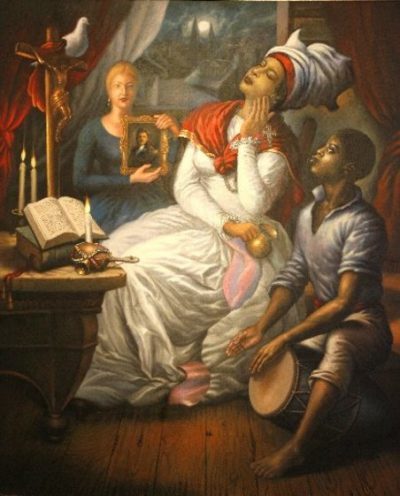
Marie Laveaux I and II seem like captivating women, and I liked learning about them. Marie I was especially well thought of, having worked as a healer in her own community during the Yellow Fever outbreak. Here's my favourite painting of her (below). You will see lots of Catholic iconography that she is using during her ritual. This was not unusual, since the strange gumbo that is New Orleans Voodoo combines elements of Roman Catholic iconography and ritual, with traditional African magical and religious rites involving sorcery and spirit possession.
"Spirit possession" in this context has nothing to do with the Holy Trinity or Pentecost (Whitsunday): Voodoo is neither an Abrahamic nor a monotheistic religion and, in practice, it has little to do with Christianity. The gods, saints, and spirits invoked and worshiped in Voodoo were (and are) many and varied. Despite Voodooists claiming to be Catholic, one does not have to look far into Voodoo (then or now) to see that the religions are fundamentally incompatible, and that Voodoo would be a sacrilege to any true Catholic (or any other Christian, for that matter). Voodoo is an animistic worldview, with its roots deeply buried in the pagan folk religion from which it springs, so its weird syncretism with Catholicism seems an unholy alliance, at best. Voodoo wears Catholicism like a veil, a lightly-worn disguise that is easily discarded.
It's easy to feel sympathy for the plight of those who, through no choice of their own, were taken captive and sold into slavery by their own people, and brought in chains to foreign lands, as the property of other men. Those who survived the rough and merciless sea voyages had their homes, their families, their identities, and their cultures stripped away from them. It is under such circumstances that these slaves came to take on the surface rituals of Catholicism, which were forced upon them, whilst maintaining their own faith and culture beneath the disguise. I cannot say I blame them! Here's one example of how this happened in Brazil:
If you don't mind reading repeatedly about animals (especially black cats, black cocks, snakes, etc.) being mutilated, skinned alive, or bound and boiled alive to satisfy the appetites of dark and hungry gods, then you might enjoy this book.
* From historian Roger Bastide's Contribuição ao Estudo do Sincretismo Católico-Fetichista.
What I do know is that animal sacrifice was then, and is now, still a part of religious ritual in many cultures and certainly is a valid aspect of Voodoo, whether or not modern practitioners choose to make use of it. (You can easily find information about this written by people defending the practice.) While most civilised religions stopped ritual sacrifice centuries ago and began using oblations instead, others have retained the blood rites of their ancestors. So, I knew the use of animals, both as objects of sacrifice and worship, would come up, but there was more description about this aspect of things than I expected.
Marie Laveaux I and II seem like captivating women, and I liked learning about them. Marie I was especially well thought of, having worked as a healer in her own community during the Yellow Fever outbreak. Here's my favourite painting of her (below). You will see lots of Catholic iconography that she is using during her ritual. This was not unusual, since the strange gumbo that is New Orleans Voodoo combines elements of Roman Catholic iconography and ritual, with traditional African magical and religious rites involving sorcery and spirit possession.
"Spirit possession" in this context has nothing to do with the Holy Trinity or Pentecost (Whitsunday): Voodoo is neither an Abrahamic nor a monotheistic religion and, in practice, it has little to do with Christianity. The gods, saints, and spirits invoked and worshiped in Voodoo were (and are) many and varied. Despite Voodooists claiming to be Catholic, one does not have to look far into Voodoo (then or now) to see that the religions are fundamentally incompatible, and that Voodoo would be a sacrilege to any true Catholic (or any other Christian, for that matter). Voodoo is an animistic worldview, with its roots deeply buried in the pagan folk religion from which it springs, so its weird syncretism with Catholicism seems an unholy alliance, at best. Voodoo wears Catholicism like a veil, a lightly-worn disguise that is easily discarded.
It's easy to feel sympathy for the plight of those who, through no choice of their own, were taken captive and sold into slavery by their own people, and brought in chains to foreign lands, as the property of other men. Those who survived the rough and merciless sea voyages had their homes, their families, their identities, and their cultures stripped away from them. It is under such circumstances that these slaves came to take on the surface rituals of Catholicism, which were forced upon them, whilst maintaining their own faith and culture beneath the disguise. I cannot say I blame them! Here's one example of how this happened in Brazil:
“In Brazil, syncretism is an old phenomenon, for from the beginning of colonization we find it in the quilombo dos Palmares (hiding place of fugitive slaves) . . . We find it in Cuba, in Haiti, in the same form as in Brazil.”
“Arriving in Brazil, the blacks were catechized in a vague way, were, at least, baptized. However, they understood nothing of that religion which was forcibly taught to them.”
“Catholicism changed into . . . a way of disguising traditional beliefs: in reality, the Catholic saint was not worshiped, but rather the corresponding orixá [African deity] behind it. Catholicism became merely a front to hide a secret ritual. . . . In the syncretism, Christianity furnishes only the Portuguese words; all else is fetishism." *
If you don't mind reading repeatedly about animals (especially black cats, black cocks, snakes, etc.) being mutilated, skinned alive, or bound and boiled alive to satisfy the appetites of dark and hungry gods, then you might enjoy this book.
* From historian Roger Bastide's Contribuição ao Estudo do Sincretismo Católico-Fetichista.

June 10, 2015
Well...
It took me a while to get though this if I'm honest. But it was a really interesting read. I got this at hex Shop while in New Orleans This was the other book I picked up along with Queen of voodoo. while I was travelling around USA.
I found this book to be really interesting.. loads of little spells You can pick up in this book.if that's your thing. The author wrote this book in 1940's. Whether Some of this history is true or not, It was a interesting read. It's almost like he tracked the People who he writes about down and interviewed them. So this is about new Orleans voodoo from inside new Orleans it's self. I personally loved how Voodoo is not about how expensive Items are and how raw and tribal it is they have so many gods and goddess's and saints.
all in all a really interesting read and i book i shall treasure with memories of the good old Nola <3
It took me a while to get though this if I'm honest. But it was a really interesting read. I got this at hex Shop while in New Orleans This was the other book I picked up along with Queen of voodoo. while I was travelling around USA.
I found this book to be really interesting.. loads of little spells You can pick up in this book.if that's your thing. The author wrote this book in 1940's. Whether Some of this history is true or not, It was a interesting read. It's almost like he tracked the People who he writes about down and interviewed them. So this is about new Orleans voodoo from inside new Orleans it's self. I personally loved how Voodoo is not about how expensive Items are and how raw and tribal it is they have so many gods and goddess's and saints.
all in all a really interesting read and i book i shall treasure with memories of the good old Nola <3

August 1, 2014
A strange, charmingly racist little book (she says with sarcasm). It's very much a product of the time - all the (poor, black) characters sound the same, and the author handles the subject not from journalistic remove but from a 'look what these silly savage folks get up to!' mindset.
That being said, it's fascinating, even just as a primer into What White People Thought Voodoo Was Like. Lists of curses, depictions of ceremonies, details on voodoo queens and their various rivalries and scandals. A deep expose into voodoo's history it ain't - but it's colorful and full of character.
That being said, it's fascinating, even just as a primer into What White People Thought Voodoo Was Like. Lists of curses, depictions of ceremonies, details on voodoo queens and their various rivalries and scandals. A deep expose into voodoo's history it ain't - but it's colorful and full of character.

May 18, 2013
An interesting read, but he's no Zora.

July 13, 2019
This was such an awesome read! If you want to learn about this kind of stuff, this is definitely the book for you! There’s a lot of stuff about Marie Laveau, the voodoo queen of New Orleans. There is also in depth description of some of the Gris-Gris that are used in the curses and charms. It’s all together super interesting and I totally recommend this.

May 19, 2022
An interesting book of local history. It seems to be sold in a lot of the tourist shops around the French Quarter, which is how I came across it.
First of all, it was published in 1944. The way it talks about race will probably bother a lot of modern readers who don’t take that into consideration. On the other hand, by writing it at that time, the author was able to interview a lot of the residents of New Orleans with first-hand knowledge (at least as kids) of the people and events who contributed to the growth of Voodoo there in the mid- to late-1800s. It’s a good oral history. And while the attitude can sometimes be dismissive or patronizing, he does let people speak in their own words, and so there’s a lot of humanity that comes through.
One thing I think the book was missing was more detail about the belief system itself. It’s written more of an anthropological study of how believers behaved and of prominent figures in the community, but doesn’t go into much depth about what it is they believed and why it manifests in these different ways. Additionally, it probably could have shown more empathy - what might be the reasons that some people believed in it?
Overall, I was glad to have read the book, particularly while visiting New Orleans. I feel like I learned a lot about voodoo in America, like how it was brought over by slaves from certain regions of Africa and how it evolved, often in secret, and even grew to include elements of Catholicism in New Orleans.
Despite its flaws, the book helped me appreciate the cultural history more, definitely beyond the campy way “voodoo” is often used now. Now I realize how ridiculous it is to use it as an aesthetic, like a business such as Voodoo Doughnuts does.
Reading it in a year like 2022 was also interesting. Voodoo at first might seem like an irrelevant artifact of history, but I noticed a lot of parallels to the quack remedies and other types of pseudoscience that get peddled in certain spheres of media today. In a way, you may feel more understanding for those early believers than you would otherwise. Reading about people trying to fight pandemics like the great influenza of 1918 with voodoo remedies gave me a lot of perspective. It’s not all that different from the kind of nonsense many people were trying in order to combat COVID-19, over 100 years later. Some things stay the same.
The book also includes a great quote about America by one of the people he interviews:
“America is just like a turkey. It’s got white meat and it’s got dark meat. They is different, but they is both important to the turkey.”
First of all, it was published in 1944. The way it talks about race will probably bother a lot of modern readers who don’t take that into consideration. On the other hand, by writing it at that time, the author was able to interview a lot of the residents of New Orleans with first-hand knowledge (at least as kids) of the people and events who contributed to the growth of Voodoo there in the mid- to late-1800s. It’s a good oral history. And while the attitude can sometimes be dismissive or patronizing, he does let people speak in their own words, and so there’s a lot of humanity that comes through.
One thing I think the book was missing was more detail about the belief system itself. It’s written more of an anthropological study of how believers behaved and of prominent figures in the community, but doesn’t go into much depth about what it is they believed and why it manifests in these different ways. Additionally, it probably could have shown more empathy - what might be the reasons that some people believed in it?
Overall, I was glad to have read the book, particularly while visiting New Orleans. I feel like I learned a lot about voodoo in America, like how it was brought over by slaves from certain regions of Africa and how it evolved, often in secret, and even grew to include elements of Catholicism in New Orleans.
Despite its flaws, the book helped me appreciate the cultural history more, definitely beyond the campy way “voodoo” is often used now. Now I realize how ridiculous it is to use it as an aesthetic, like a business such as Voodoo Doughnuts does.
Reading it in a year like 2022 was also interesting. Voodoo at first might seem like an irrelevant artifact of history, but I noticed a lot of parallels to the quack remedies and other types of pseudoscience that get peddled in certain spheres of media today. In a way, you may feel more understanding for those early believers than you would otherwise. Reading about people trying to fight pandemics like the great influenza of 1918 with voodoo remedies gave me a lot of perspective. It’s not all that different from the kind of nonsense many people were trying in order to combat COVID-19, over 100 years later. Some things stay the same.
The book also includes a great quote about America by one of the people he interviews:
“America is just like a turkey. It’s got white meat and it’s got dark meat. They is different, but they is both important to the turkey.”

July 9, 2022
I was surprised that a book written in the 1940s so fully captured my attention. I was swept away from page 1! What a delight to have to peer into the mists of the past and gain a deeper insight into the Voodoo of Marie Laveau's time and beyond. The best thing about this book is that the author is primarily passing along the tales and opinions of others... who either were practitioners, experienced certain happenings themselves, or were told by relatives living at the time.
There are things within this book that modern readers will find jarring, namely the use of the "n" word, which seems to have been common place back when it was written. I also felt moments of distain from the author in the last section of the book, when some of his own opinions peak through the work. For these reasons the book lost a star.
Overall, forgiving the sins of the era, it was a book that I found I couldn't put down. I especially enjoyed the exploration of Marie Laveau I and II.
There are things within this book that modern readers will find jarring, namely the use of the "n" word, which seems to have been common place back when it was written. I also felt moments of distain from the author in the last section of the book, when some of his own opinions peak through the work. For these reasons the book lost a star.
Overall, forgiving the sins of the era, it was a book that I found I couldn't put down. I especially enjoyed the exploration of Marie Laveau I and II.

January 24, 2021
A very interesting book on the history of Voodooism in New Orleans, but also on the peoples who inhabited New Orleans prior to the Louisiana Purchase and created a vastly different cultural world from the rest of the United States. I learned quite a bit of New Orleans history from this book. As famous as Marie Laveau is, I was surprised to find out that there were actually two Marie Laveaus (mother and daughter) and that the first Marie Laveau was actually born way back in 1801. Even though voodoo is still practiced today, it is vastly different from the way it was practiced in the 1800s.
I read this book to fulfill a challenge at my local library. I'm glad I picked this book.
I read this book to fulfill a challenge at my local library. I'm glad I picked this book.
October 13, 2018
I purchased this book looking for a quick read that explains the various beliefs and customs of New Orleans Voodoo. I was curious to compare and contrast it with Hatian Voodoo. However, this book is more a picture of what white men in the 1940s believed voodoo to be. Multiple unverified and unreferenced anecdotes, misuse of some very basic voodoo concepts, downright fabrications about basic beliefs (for example, multiple references to voodoo being a form of devil worship, naked orgies, black magic, curses, witch doctors, conflation of hoodoo with voodoo, bewilderment at voodooists practicing catholicism, and absolutely zero references to the loa, their veves, etc).
In the end, I gave it two stars because the book was somewhat interesting in the way of understanding how voodoo was (and likely still is) perceived amongst outsiders. I think it sits today as a case example for why voodoo tends to be a very secretive belief structure. However, don't expect to gain any understanding of their actual beliefs, customs, or history through this book.
In the end, I gave it two stars because the book was somewhat interesting in the way of understanding how voodoo was (and likely still is) perceived amongst outsiders. I think it sits today as a case example for why voodoo tends to be a very secretive belief structure. However, don't expect to gain any understanding of their actual beliefs, customs, or history through this book.
January 7, 2024
It's a 1940s book on New Orleans Voodoo. It's racist and it's factually inaccurate. It is good for providing a historiographical viewpoint (what I used it for). Don't go in expecting anything helpful on the practice of voodoo. Thankfully, it's a pretty easy read.

February 9, 2020
My friend got a copy of this book for me as a souvenir as he was in New Orleans himself for a wedding. He saw the book and thought of my interests in local folklore and magick. This was actually a very interesting read, although definitely a product of its time. Still, it was one of the first serious books to be written on the subject of New Orleans Voodoo, being published in the 1940s. A lot of research went into the book involving looking at historical city archives and interviewing locals of the area. The book is divided into three parts. The first part "This is the way it was," looks at how Voodoo first arrived to New Orleans and tries to trace the roots. It doesn't go as deep as I would have liked and mainly looks at the first incidences of practice in New Orleans, but still contained some unexpected insight. The second part is the longest and it is devoted to Marie Leveau. She is the central figure in New Orleans Voodoo folklore, so this is very appropriate. This section postulates that there were mainly two people who went by this name, very likely related, who purposely tried to merge their identities together to give the illusion of immortality. Tallant tries to sketch out a character using the scraps of historical and local anecdotes. The final third part "This is the way it is" looks at Voodoo as it was then at the time the book was first released. He interviews locals, and practitioners, and even writes of some of his own experiences in Voodoo ceremonies. Robert Tallant's own interest in Voodoo is apparent, but ultimately so is his status as an outsider taking a peek at something exclusive to him. Although he treats his subjects with respect, there is still a sense of exotification from the fact that they are "coloured," which he often clumsily tries to render in their speaking style in accordance to their level of education. Still there are solid facts and history contained in the book, along with a modern (for its time anyway) contextualisation of Voodoo in the city. The book even contains the seeds of genuine spells and tips for spellcrafting for those of a more practical pursuit and those who are able to read between the lines. The fact that the book is still in print and on sale in New Orleans shows to me that the city still recognises itself within its pages. But given the time between it's first publication and now, I wonder how much has changed, and how much has stayed the same? Perhaps a trip to New Orleans is in order?
May 31, 2025
Voodoo in New Orleans is a fascinating study of what happened there. It is by no means a full history nor is it a study of Voodoo itself. Those to of us who live elsewhere we get to know a lot of mainly the 1800's and and the commercialization in the early half of the 1900's. Some facts can be found historically while the others will make your spin round and round like a top. Almost like you've been fixed. You get the practical matters of being a voodoo queen and what it takes to be there on top. The legends like a lot of religions are highly important with the reputations they had to maintain. The reader can look at the material as a bunch of superstitious nonsense. Good ahead. This book is a window into the life of those times and worth the reading of it. Not saying it's all gonna be as pretty as Marie Laveau, in fact, some of this stuff you don't want to know, yet it is legend and part of the pride of New Orleans. Well worth the reading of it.

July 25, 2020
This is an odd little book. I’ve always been interested in the history of New Orleans, voodoo, and how it all came together due to an influence of cultures from Europe and Africa. I purchased this book from the Voodoo Museum in New Orleans on my last visit there hoping to learn a little history.
I did learn some history and hear some supposed first hand accounts of ceremonies or fixing done and so that was fulfilled.
However, this book was squeamish to read in 2020. It was originally published in 1946 so pre-Civil Rights movement South....you can imagine from there the kind of language used describing a culture and religion predominantly practiced by Black people or African people enslaved in America. While I wouldn’t say the tone felt particularly violently racist it was still overtly racist in how it would refer to “colored folk of a lower strata.” Yikes.
I did learn some history and hear some supposed first hand accounts of ceremonies or fixing done and so that was fulfilled.
However, this book was squeamish to read in 2020. It was originally published in 1946 so pre-Civil Rights movement South....you can imagine from there the kind of language used describing a culture and religion predominantly practiced by Black people or African people enslaved in America. While I wouldn’t say the tone felt particularly violently racist it was still overtly racist in how it would refer to “colored folk of a lower strata.” Yikes.

May 25, 2020
Voodoo in New Orleans
Growing up in New Orleans when I was young I remember when Voodoo was mentioned my grandmother didn't want to discuss it or hear anything about it. I don't know the reason why but I do know that people in New Orleans either believe in it and are afraid of it or they don't believe and don't know much about it. I find this a very informative book and very interesting. I believe some of what is written and some it it is just passed down stories. Voodoo is a very real thing here in New Orleans.
Growing up in New Orleans when I was young I remember when Voodoo was mentioned my grandmother didn't want to discuss it or hear anything about it. I don't know the reason why but I do know that people in New Orleans either believe in it and are afraid of it or they don't believe and don't know much about it. I find this a very informative book and very interesting. I believe some of what is written and some it it is just passed down stories. Voodoo is a very real thing here in New Orleans.

July 20, 2023
I found this at a library book sale, and my car was stolen the very same night I took it home. Maybe I got voodooed. This is essentially a mid 20th century sociological text by a white author researching black New Orleans residents and their customs. Some of the language is wholesale racist, but I feel like this is kind of an essential New Orleans book. I swear I remember seeing a copy in my sister's room when I was a kid. Lots of great creepy pastas if nothing else. I'm gonna hand this book off to some unsuspecting rube and see how long it takes bad luck to befall them.

March 24, 2019
Despite the author's racist mentality, and acknowledging this was still an era fueled by this mentality, Tallant features intriguing insight into voodoo in New Orleans. Filled with vignettes of interesting details that one has to question if the author was completely fabricating, or simply taking creative liberty to increase profits while oppressing others. Certainly a book that will require a lot of fact checking as if you were reading a novel straight off of Wikipedia.

January 14, 2023
Having a lifelong interest and family history in the occult, especially of the African traditions i find these books so close to the source of the American traditions really enthralling. I'm currently on a mission to try and pull out the superstition and store brought fluff from real traditions and this certainly has a very interest take on what was real and what was in the mind and overblown ideas and fantasies of Voodoo in the USA.
The Outro to the book is brilliant an analogy of America being a chicken, made up of dark and light meat and that voodoo is the veins that connect them..
The Outro to the book is brilliant an analogy of America being a chicken, made up of dark and light meat and that voodoo is the veins that connect them..
This entire review has been hidden because of spoilers.

September 11, 2023
A relic of its time, really, and interesting in a time capsule way. It definitely shows the stereotypes and racism of the 1940s while the author, in a strange way, manages to avoid seeming to cast full judgement or condemnation. You almost get a feeling that some of his word choices are just because that is what everyone else uses. It's kinda weird like that. I'm still pleased to have found a copy for my historic NOLA collection.

June 15, 2025
OK, yes, it's written by an "outsider" to the world of voodoo and terribly outdated, but it's a very interesting introduction to the New Orleans scene, with an especially interesting section on Marie Laveau and her daughter Marie Laveau II. The best parts are the interviews with the "current day" (the book was written in the 1940s) practitioners. Oh, and I got my copy from a prominent display at the New Orleans Voodoo Museum - which, trust me, is staffed by true believers. Worth a read.
June 8, 2025
I picked this up in New Orleans and I am SO glad I did. Fun, interesting, and actually extremely well-written. I’ve always been so interested in Voodoo because it has a lot of Catholic elements, and this book totally scratched that itch for me. Lol also I almost finished reading this book an Easter but then I decided that would be inappropriate so I waited until the day after Easter.

November 5, 2017
This was the first book I read about Voodoo, and it was a wonderful introduction. Most of it is fiction, and many serious writers love to point out the myths in this book, and they well should. But this is still fun.
March 16, 2018
It was a fun and campy read. Previous books on the topics indicate that you should take it with a rather large grain of salt, but I enjoyed it none the less. Interesting to find out it was a works-progress book, same as some stuff that Zora Neale Hurston did.

March 4, 2019
Mostly a sort of disjointed collection of hearsay and personal stories. Did not read as if it was well researched, there was no substantiating facts. Very dated!
March 17, 2019
Very thorough...quite interesting, especially if your headed to Nawlins 😈

July 25, 2019
Really good historical resource. If not for accuracy on the reality of voodoo it is good to read from a primary source of a residents observations in 1940s New Orleans.
January 18, 2021
Pretty informative about more famous New Orleans practitioners and how it has changed over the last few hundred years

January 25, 2022
Excellent book. Learned some new things.

March 25, 2022
Loosey goosey as all get out with sources
January 31, 2023
Informative, but also pretty racist most of the time. I don't know how much of it is accurate or simply author conjecture.
Displaying 1 - 30 of 52 reviews