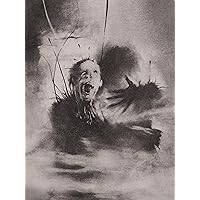
I never would have guessed that the man who famously wrote ‘The Jungle Book’ could have had such a macabre imagination. ‘Strange Tales,’ however, is nothing if not a strong testimony that Rudyard Kipling was indeed a very creepy – and very talented – writer of weird fiction.
And while he isn’t quite up there with Bierce - or Poe, I guess - there are some stories in this anthology that work exceedingly well at getting right under your skin.
They are terrifically written, and with the exception of ‘The Wish House’, they are easy to understand as well.
Unfortunately, the excellent first bunch of stories aren’t quite lived up to, as the second half contains tales of a mostly mediocre quality. But all in all, they each serve to entertain and engage the reader. There is not one story here that is boring.
Bierce was a consistently satisfying storyteller, whilst Poe was more likely, now and then, to drag his story into tedium – except when he got it right, he got it better than right.
That places Kipling a little below these two iconic writers.
But something that he does have, which the other two – and most writers – lack, is the firsthand experience in Indian culture, which lends his stories of a more average value the welcome sense of color, fantasy, and intrigue.
Many of his India-based stories – which were my favorites – are about the sheer contrast between modernized Britain and its futile attempts to manage a country so far influenced by religion and superstition. The story, ‘The Tomb of his Ancestors,’ cleverly has the British protagonist manipulate the tribes into following the government's rules by assuming the notion that he is his great-grandfather – whom they worshipped – reincarnated.
Where as on the other end of the spectrum, ‘The Strange Ride of Morrowbie Jukes,’ tells a nightmarish tale about a British colonel falling into a desert pit, where those cast as “living dead” by their native tribes are thrown into without a chance of escaping. Thenceforth he finds himself stripped of his superiority, and has to resort to the same brutality that the other captives live by every day of their remaining lives.
We also have various stories set in England, which personally I found to be a little less remarkable. Although I should point out that ‘They’, and the chillingly hostile ‘Mary Postgate’, were very good ones.
And then there are about three stories set amongst The Great War, which affected Rudyard Kipling greatly – seen especially in the just-mentioned ‘Mary Postgate’, in which an innocent housemaid comes across a parachuted German in her backyard, injured by the fall, and merely leaves him to die like a poisoned rat as she tends to everything else.
These ones were quite good, and you really get the sense that Kipling was very personally taken by the global tragedy, as they really convey a strong emotional impact.
There were a few that I didn’t like at all. ‘The Dog Hervey’, for instance - because I just didn’t understand what was meant to be going on. It calls itself a dog love-story, but I just didn’t get it. And also ‘The Dream of Duncan Parrenness’, which perhaps I was just too dumb to interpret. There was nothing wrong with ‘By Word of Mouth’; it just felt a little too simple to have it right at the end of the book. It might have been more effective placing it near the beginning, so that it wouldn’t have to compete against those that were much better. Because as it is, the best stories do mostly occur in the first half, with the occasional return to form scattered about the rest of the book.
The best one, by far, was ‘The Return of Imray’ (sequel to the also excellent ‘Mark Of The Beast’) in which we are not just treated to a spine-tingling account of snakes and rats living inside the thatch-roof of an Indian hut, but something even more horrifying as well.
‘Morrowbie Jukes’ was a terrific story, and I would have even considered it equal to ‘The Return of Imray’ – except the ending was unfortunately a big disappointment. Without giving too much away, let’s just say that the protagonist finds an idea for escaping the pit, which will, however, take him years and years of working out – and then it all just suddenly blows away when something much simpler comes into the mix.
‘Swept And Garnished’ was quite sad – especially as I had just recently seen the film, ‘War Horse’, in which that beautiful French girl gets killed by the Germans.
‘A Madonna of the Trenches’ was another provokingly creepy one. And ‘The Phantom Rickshaw’ told a good story that was quietly unsettling, as well as rather funny, as the selfish protagonist is haunted by the woman he once loved and then threw away.
Overall, this was a very enjoyable book by yet another fantastic author from the times when horror-fiction was not the bland, formulaic genre that it is now. It’s only small, and so I would easily recommend anyone who likes the good old-fashioned ghost stories to give this one a go, if ever they come across it. It was always fun and engaging, and most of the time it was also very creepy.