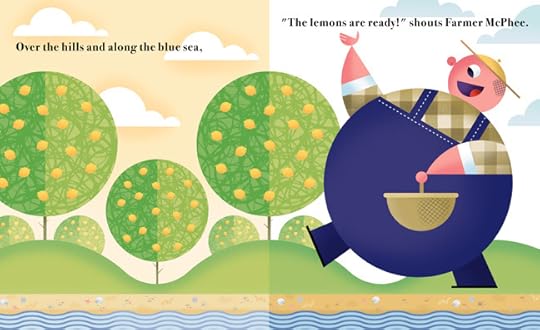
In this thought-provoking tale reminiscent of Seuss, Farmer McPhee finds a red lemon in his orchard and cries, "It's red as a stop sign! It's red as a rose! I can't have red lemons where yellow fruit grows! Imagine a world where lemonade's red? Where once-yellow cupcakes are crimson instead?" As he tosses the red lemon across the water, he can't imagine that it will land on a small island, sprout a seed, and someday bring forth an orchard of lemon trees...where people will travel to from all over, to try the red lemons that are "six times as sweet!"
Bob Staake has authored and/or illustrated more than forty-two books, including The Red Lemon, a New York Times Book Review Best Illustrated Children’s Book of the Year. His work has graced the cover of The New Yorker a dozen times, and his November 17, 2008 Barack Obama victory cover was named Best Magazine Cover of the Year by Time magazine. He lives on Cape Cod, in Massachusetts.
This book is done in vivid colors and uses lots of yellow for the lemon color. There are a lot of geometric shapes and different proportions for the farmer and other things in the book. It follows a steady rhyme scheme throughout the pages which makes it an easy to follow and cohesive read. The beginning and end pages are covered in the stamp that is used on the front of the farmer's wood crate that he puts the lemons in, and it reads "100% Yellow Perfection Lemons," which further contrasts when the farmer finds a red lemon, to his shock, on one of his trees. The page after he finds this red lemon is covered in different shades of red, and also provides readers with good words to use in place of red (crimson), and color (hue). The farmer is shocked by the red lemon and wonders "who would buy a red lemon from Farmer Mcfee?" Because the lemon was so different, the farmer throws it far away onto an island, but little did he know, two hundred years later, that a patch of red lemon trees would grow, that were sweeter than the yellow ones and were put in their foods. Now, the red lemon that Farmer McFee worried so much about, was bringing people from all around to test the red kind and to taste it in their food too. This book teaches a great lesson to children that being different is okay, and that even though you may not be popular with everyone, you will still have people that like you and that think you aren't so different, but that you're something great. This also teaches students that things, views, and attitudes change over time, just just because it is new, doesn't mean it is bad.
Written and illustrated by Bob Staake, "The Red Lemon" was named by the The New York Times as one of the 10 Best Illustrated Books of 2006. It tells a story about Farmer McPhee and his famous yellow lemons. His passion for yellow lemons comes to a halt when he realizes a red lemon grew among his perfect lemons. He is devastated by the red lemon that he tosses it to a remote island to grow by itself. Years later, the story of the red lemon takes a complete turn and the lemon prevails.
The brilliant illustrations remind me of the cartoons from the early 2000's. There is a central message that can be used in the classroom and discussed with students after the read-aloud.
Cute book. I really like the illustrations with the circle-trees and the circle-farmer. I liked the yellow lemon box label "100% Yellow Perfection Lemons...Could they be any tastier?" with a very smiley circle-farmer. Then comes along a defective lemon, which is not at all yellow. It's red. It's wrong. It's not perfection. For those of us who don't fit the mold (and I believe there are many of us), it's quite satisfying to see that the farmer-hurled-red-lemon begets (many years later, when the yellow lemon Grove is in shambles) a grove on an island where it's landed. Not only are all the lemons red, but they prove to be far sweeter than ordinary yellow lemons and are sought after by people worldwide.
My three year old really liked this one (I think the red lemon and the freaking out and throwing part). I didn't love it, it felt like there wasn't really a lot of There there, and the idea that it takes 200 years for the lemon grove to establish felt like a weird detail. But it was bright and funny and had a good rhythm and engaging so worth a read. But also it just kept reminding me throughout of all these public health posters about bladder cancer with one red lemon in a sea of yellow lemons so I may have been biased.
A favorite new book! Having read thousands upon thousands of picture books to 3 kids over 14 years it isn't often we come across a new one that we love but this one has been added to our favorites list. It's the perfect package of rhyming lyrical text that's not annoying or forced with fun vibrant pictures that are easy to grasp for a toddler. The story is unique and surprising. This will be one of our keepers for the grandchildren as I don't mind reading it over and over.
My son and I absolutely love books that rhyme. This one is a wonderful rhyme book with a nice moral at the end, "don't judge a book by its cover," or better yet "don't judge a fruit by its color!" I would recommend this to everybody.
From the "read to the six month old" pile: This one has a nice theme about good things coming from unexpected places. It's got a wonderful rhythm to it that makes it fun for the person reading it out loud to their little one.
Beautifully illustrated and imaginative story. The farmer discovers a unique lemon and tosses it away. Events unfold that showed how uniqueness might need time and a different perspective to appreciate. A great story for young readers. Clever, enjoyable read with much room for discussion.
I really loved this book! It’s a god read aloud book for k-2. It also has a great lesson that you shouldn’t just throw things away before you see the value it has. Along with that it shows that other people might have a use for something you don’t want, so overall I think it’s a really good book!
I had to wait so long for this book at the library I had forgotten why I wanted to read it. Nevertheless, It is a delightful book--both the story and the illustrations. Bob Staake is both the author and illustrator.
I really liked this book! The overall lesson that I thought it gives, is that it's ok to be different and sometimes it's even better to be different! In the end the red lemon ended up being much sweeter than the yellow lemons were.