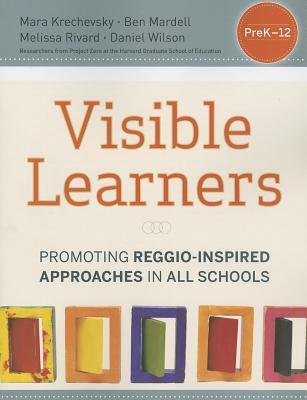
A progressive, research-based approach for making learning visible Based on the Reggio Emilia approach to learning, Visible Learners highlights learning through interpreting objects and artifacts, group learning, and documentation to make students' learning evident to teachers. Visible classrooms are committed to five key that learning is purposeful, social, emotional, empowering, and representational. The book includes visual essays, key practices, classroom and examples. Visible Learners asks that teachers look beyond surface-level to understand who students are, what they come to know, and how they come to know it.
This book is divided into two parts, in the first, you will read about several projects from a different school and, in the second, you will get deeper into the theory of behind this way of conceiving learning and education.
For me, it was quite useful to see practical examples of making learning visible. The theory part was enough to understand some of the principles behind this pedagogy and with many ready-to-use tools.
The book is not very long and very accessible. I recommend it to anyone who wants to get inspired by the Reggio-Emila approach
Great to read a book written by the colleagues at Project Zero who I’m working with on the LEGO foundation’s playful schools initiative. The book is a helpful guide to thinking about why and how to use the documentation of learning that Reggio use so brilliantly to capture the 100 languages of children, in other settings, and specifically k-12 education. A humane and useful text, that manages the balance between things like standards and the child and learning centred approaches of Reggio, and finds a helpful interrelationship between them.
Mara Krechevsky’s Visible Learners: Promoting Reggio-Inspired Approaches in All Schools reads less like a conventional how-to manual and more like a practiced ethnography of classrooms — an ars poetica for teachers who want to see what learning looks like when it is taken seriously as an object of attention. The book’s clear, capacious argument is deceptively simple: when teachers adopt practices that make thinking and knowing visible — documentation, collaborative inquiry, careful attention to artifacts and conversation — the shape of both teaching and learning changes. Krechevsky and her coauthors do not merely describe Reggio-inspired techniques; they dramatize their epistemic consequences. Formally, the book is modest and clever. It is arranged in three parts: six richly told “learning portraits” that read like short case studies, a section of principles and practical moves, and a toolkit of classroom and staffroom strategies. The portraits alone are worth the price of admission — a kindergarteners’ project about “The Yellow Door,” a seventh-grade vernal-pool investigation, an AP literature seminar negotiating interpretive difference, even a high-school math classroom where problem-solving is staged in plain sight. These episodes demonstrate the book’s central claim: making learning visible is both a method and an ethic that works across ages and disciplines. The prose is at its best when she slows down and describes: the artifacts children leave behind, the tentative teacher questions, the small acts of re-presentation that turn a play activity into a collective inquiry. That attention to material and moment is what gives the book its literary air — the reader feels summoned into intimate rooms of attention. Yet the book never lapses into mere aesthetics. Each portrait is followed by analytic commentary that draws out implications for curriculum design, assessment, and professional learning. In this sense the book performs a rare double move: it preserves the experiential fidelity of ethnography while translating that fidelity into usable practices. Two features of the argument deserve emphasis. First, Krechevsky frames documentation — careful records of children’s talk, drawings, and projects — not as a bureaucratic artifact but as a cognitive tool. Documentation externalizes thought, enabling learners and teachers to revisit, interrogate, and build upon nascent ideas. Second, the book insists on the social nature of knowing: learning is shown to be purposeful, social, emotional, empowering, and representational — principles that reorient assessment from individual performance to communal sense-making. These are not platitudes; she shows how classrooms reorganize themselves around them. If the book has a theoretical lineage, it is Project Zero — the Harvard research lab that has long studied visible thinking, thinking routines, and the pedagogies of interpretation. That connection is a strength: The author’s arguments are empirically anchored and dialogic with a broader research program. It is also why the book is unusually useful for teacher educators and school leaders: it supplies both conceptual frames and a roster of concrete tools for professional inquiry. No book is without limits. Visible Learners occasionally leans toward an idealizing register, offering classroom portraits that risk appearing more exemplary than representative. Readers in resource-strained contexts may wonder how to scale these practices when class sizes, curriculum mandates, and standardized assessments press in opposing directions. The book gestures at systemic change — it treats documentation as a democratic practice — but is less interested in the political economy of school reform than in the micro-politics of classroom life. A future companion volume that tracks whole-school adoption over time, or that traces the tensions between visible learning and accountability regimes, would be a welcome complement. Still, those caveats do not detract from the book’s core virtue: it trains educators to look. In a moment when teaching is often reduced to scripted procedures or metric-driven outputs, Krechevsky recuperates patience, curiosity, and interpretive labor as the central technologies of instruction. The result is both humane and practical — a manifesto for educators who want to cultivate classrooms in which children’s thinking is treated as public, provisional, and worth revisiting. For teacher-researchers, school leaders, and curriculum scholars, Visible Learners is essential reading; for practicing teachers it is quietly transformational. Read it as you would a finely observed portrait — for its narrative intelligence — and as you would a toolkit — for the practices it makes available. Either way, the book stakes a persuasive claim: to teach well is to make learning visible, and to make learning visible is to take seriously the work children do when they think together.
I loved this book as it is applicable to all grade levels and all subjects. It also encourages teachers to include students in documenting their learning, seeking the opinions and questions of others to deepen their understanding. I wish all teachers would read this book and use it to guide them instructing students.
I read this book for a class I took with my colleagues. While I enjoyed many of the methods, I don't think I would recommend this book unless you took the course. Good pedagogical practices though.
Required reading for Sci/SS. Interesting concept (I had never heard of Reggio-inspired learning) and interesting cases, but I felt the book drug on and had a lot of repetitive information