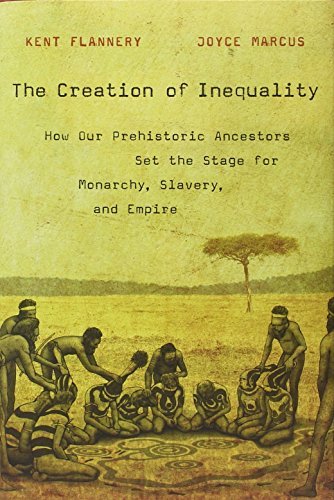
I am somewhat ambivalent about The Creation of Inequality. How Our Prehistoric Ancestors Set the Stage for Monarchy, Slavery and Empire.
I am not entirely sure the contents reflected what the label on the tin said, even allowing for its advertising hyperbole. And the folksy Americentric approach irritated me at times: “Converted to a more militaristic society by the Tongan invasion, the Samoans became legendary warriors. No one who follows American professional football will be surprised by this fact. Picture a war canoe paddled by Manu Tuiasosopo (6’3” and 255 pounds), Tiaina “Junior” Seau (6’3” and 250 pounds), Edwin Mulitalo (6’3” and 340 pounds),” etc etc. I am not sure that this contributes to the scholarly credentials of the book. My concern with the scholarship was extended when the authors offered a foolishly simplistic comparison between England’s Catholic Queen Mary I following Protestant King Edward VI, with the Egyptian religious volte face over Amun and Aten when Akhenaten died.
Then again, there was a vast amount of archaeological and anthropological information in the book and, by and large, the information did lead to a reasonably coherent picture.
Flannery and Marcus tout their methodology which combines archaeology (the discipline with which they are both connected) which does not allow direct observation of human behaviour, with anthropology which allows that direct observation but is hugely displaced from pre-historic times. It remains, I think, an open question as to whether the combination really allows us to see into pre-historic societies.
In a sense, the story begins with the acknowledgement that “Humans share 98% of their DNA with chimpanzees, and chimpanzees are anything but egalitarian. They have alpha males who physically abuse their rivals and beta males who bully everyone but the alphas.” Which rather suggests that we are genetically pre-destined to be hierarchical in social structure. However, it is proposed that “by giving humans the capacity for language and culture, natural selection enabled them” to take a more nuanced course. The higher reasoning powers allowed, or even encouraged something we might see as more altruistic.
It seems that there is general agreement that the broad change from equality to inequality took place at the end of the neolithic hunter-gatherer phase. That concept, itself is, however, an over-simplification, in that the change from hunter-gatherer to sedentary farmer was gradual. The authors mention that, as far back as 75,000 to 55,000 years ago, some bulbs were being cultivated and left, for harvest on the party’s return; grasses were being saved and kept. Fences were being constructed for management of wildlife. And fish were probably being smoked, so that subsistence was not entirely reliant on immediate and fortuitous hunting and gathering. (In fact, good fishing presumably often obviated the need for moving far from a base settlement.)
“The headmen of foraging groups were not bullies. They were generous, modest, and diplomatic, because their constituents were too skilled at alliance-building to put up with bullies”. Yet there is evidently some dispute as to whether such altruism would have worked. The stability of chimpanzee groups derives from their hierarchy. On the other hand, it has apparently been suggested that in early human societies, deities occupied the role of the alpha-chimp.
Elements of agricultural practices were introduced in phases, obviously without perceiving them as moves into a different lifestyle paradigm.
Considerable attention is dedicated in the book to Inuit societies and it seems that they quite commonly actively discourage any trend towards inequality. An assumption is made that, on the basis of similarities between ancient, and recent, observed, Inuit societies, it can be concluded that features identified in recent societies will also have been present in original hunter gatherer communities. On this basis, it is averred that “So crucial was food sharing that the Eskimo used ridicule to prevent hoarding and greed…A skilled hunter and good provider might be universally respected, but even he was expected to be generous and unassuming.” If the skilled hunter boasted of his prowess, he was ridiculed. Thus, the group’s survival was reliant on selfless sharing so there was deliberate repression of individually-focused behaviour. “Generosity is a wide-spread principle among hunters and gatherers, yet constant social pressure must be applied to ensure that individuals continue to be generous.”
This is taken to mean that early transitional societies are likely to have tended towards stable non-hierarchical structures of basic equity. And Inuit behaviours are used to propose that humour could have been a vital tool in the strategy to suppress any individuals who were seeking to move into leadership positions on the basis of their higher skills.
Nevertheless, at some point, inequality appeared – such that it is now ubiquitous.
The authors suggest that one form of transition into hierarchies might have resulted from developments out of gift-giving processes. Apparently, in many circumstances, societies had strict rules preventing the giving of gifts which would make repayment difficult. Honour would require repayment so the original gift had to make repayment a practicable possibility. However, in time, these rules dissolved and some recipients accumulated debt which made them beholden to the original donor. These donors acquired the right to wear differentiating clothing and to have specific privileges such as additional wives. “Because of the desire to be thought of as superior, some hunter-gatherers manipulated cosmologies, reciprocal exchange, social obligations, wealth transfer and the subservience of junior lineages to create societies based on hereditary rank.”
“Many economic historians see in the temple estates the germ of a capitalist society. Early Dynastic temples were profit-making, surplus-accumulating, money-lending, interest-charging corporations, and foreclosure on loans may have driven thousands of needy farmers into servitude.”
This reminds us that leadership could arise in several different dimensions. First, there is the social, whereby the leader effects prominence in the society and is possibly able to order people to take on certain tasks; secondly, in times when conflict, or imperial ambition for additional territory arose, leadership would take what we would see as a military form. Finally, ritual leadership would also become important. We need to remember that there is, contrary to the simple model, some evidence of leadership in hunter-gatherer communities. The extraordinary site of Gobekli Tepe has no evidence of village farming and yet the remarkable ritual structures must have had large work-forces coordinated by some form of leadership. This site also defies the paradigm that foragers had random places and times for ritual practice, compared with the scheduled rituals in specific places for agriculturalists.
Flannery and Marcus argue that “achievement-based leadership” probably arose about 10,000 years ago in the Near East. This, the end of the Ice Age, was also the time of transition to early sedentary farming practices: “Glaciers melted, sea levels rose, and the amount of carbon dioxide in the world’s atmosphere increased from 180 to 280 ppm, a 50 percent increase in just a few thousand years. Since plants grow better at this higher carbon dioxide level, it was a good time to experiment with agriculture.” There was a spread of mutant domestic races of wheat and barley; long-term camps became permanent mutigenerational villages; and fences were erected to corral herd animals, goats, sheep, pigs, and smaller cattle.
The book draws a distinction between hierarchies where leadership is entirely a consequence of an individual’s merit, and those where leadership is inherited. By and large, the former seem to precede the latter, and the book contends that there was commonly some resistance to the subsequent adoption of hereditary leadership. There was, they say, “a long-standing desire” for equality. “The balance they struck between personal ambition and the public good allowed their way of life to endure for centuries.” It is argued that there would need to be an alteration to “the social logic to allow for hereditary privilege”. “Hereditary inequality does not occur without active manipulation of social logic”. (And yet I can not help thinking there would also be an evolutionary pressure towards hereditary privilege. Given that part of the evolutionary model involves transmission of benefit through to later generations, would not those benefits have included social exclusivity providing for guaranteed food supplies and security from personal attack, as well as freer access to a parenting partner?)
Archaeology provides convincing evidence of early inherited rank. Grave goods including such ritualistic items as statuettes, weapons and jewellery are seen as reflecting the high rank of the incumbent. There is nothing in such an adult burial, however, to indicate the source of the rank: notable achievement and leadership, or inheritance. Burials from 7,500 years ago in Mesopotamia show the remains of young children with similar grave goods. The interpretation has been that these are also indicative of rank and that the child would have been too young to have demonstrated hierarchical skills, so their privilege must have been inherited.
Once hereditary inequality took hold, it provided its own justification for increased disparities in wealth and authority. There was an increased separation between settlements and increased conflict, and the conflict led to further potential for inequity. “the ‘us versus them’ mentality of clans justified raiding. The principal of social substitutability meant anyone from another group was fair game. Some raiding parties returned with trophy heads. Others returned with captive women and children, turning them into slaves.” The book refers to a group in Assam where “A man who had be-headed no one was considered such a wimp that he had trouble getting a wife.”
It was an interesting point that the most extreme inequality was where there was a direct relationship between the earthly leader and deities, such as in Egypt. In early Sumer, “Hundreds of rules of social behaviour had allegedly been established by the gods; human priests, judges, and bailiffs were there to make sure that they were followed. The state decided what men were allowed to do, what women were allowed to do, who could marry, who could divorce, who could strike whom, and so on”. And “The rest of human society obeyed the ruler. Only a ruler was powerful enough to have a direct relationship with his city’s patron deity. A commoner interacted only with his tutelary God, a lesser deity who had taken an interest in him.” The authors present, in a slight digression, the interesting hypothesis that “It is probably from the Sumerians that later Near Eastern societies, including the Aramaic-speaking authors of the Old Testament, got the notion that marriage should be restricted to one man and one woman.”
They also argue that “The aborigines also show us that, contrary to popular belief, cosmology and religion are not eternal and unchanging. When societies and their situations change, cosmologies get revised as well.” Several of the world’s great monotheistic religions preserve, largely unaltered, the ultimate sacred propositions of Aramaic-speaking societies that lived too long ago to have heard of Copernicus, Galileo, Newton, Darwin, Krick, and Watson. Had those sacred propositions being passed on by word-of-mouth instead of imprinted texts, religious cosmology might very well have changed slowly over the centuries to keep pace with scientific cosmology.” 60. “What no one could have foreseen was the invention of the printing press and the fossilisation of a pre-Copernican view of the world. So if today’s multinational religions sometimes seem resistant to social and scientific breakthroughs, Gutenberg will have to share some of the blame.”
I found the definition of some concepts in The Creation of Inequality a little confusing. So, just what made some leaders “kings” was, I felt, unclearly presented, and when I sought a clarification through the index, that was decidedly unhelpful.
The inconsistency of the book was demonstrated when, after five hundred plus pages of interesting accounts of forms of inequality and leadership in many areas of the world, all academically sound, it concluded with some decidedly unscholarly silliness “So the next time a pampered star tells you that his last film made him $20 million, tell him which charity to give to./Then explain that you have not actually seen the film, but that you and your dog have discovered that the DVD makes a great Frisbee.”
As an Australian, I was interested in what the book had to say about the Australian aborigines. I was surprised to find that, despite aborigines inhabiting discreet environments across a vast area, the book periodically treats these peoples as though they and their societies are homogeneous. It does note that there are differences (He reports, for example, that the early pre-colonial Tasmanians had no boomerangs, spear throwers, circumcision, or tree-platform burial). And yet “From the moment they reached Australia, the aborigines began creating new ways to organise society, some of which were still spreading when Europeans arrived.” And “To the Australian aborigines, for example, there was no such thing as inevitable natural death. Death resulted either from homicide or witchcraft.”
Sadly, having made these all-inclusive generalisations, the book then fatuously moralises that the Australian aboriginal woman, Yvonne Goolagong, became an international tennis star, highly regarded by Australians generally for her success. This was an oddly misplaced excursion, apparently to remind us not to be racist.
So, overall, I enjoyed the descriptions and explanations of forms of leadership and inequality (which is different from the title’s “creation of inequality”) but was disappointed with the all too regular discursions into jokiness and moralizing.