

What do you think?
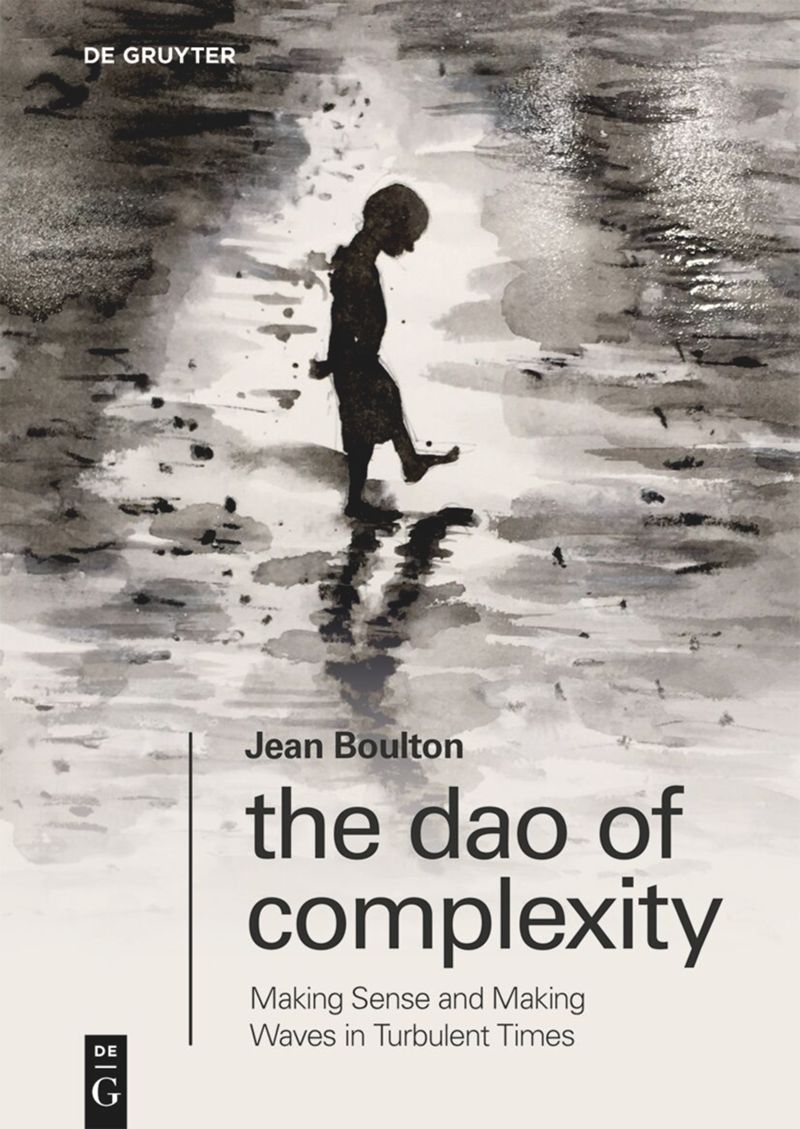
The Dao of Complexity: Making Sense and Making Waves in Turbulent Times
Finalist in the Leadership - Think Differently category of the Goody Business Book Awards 2024
The pandemic, climate change, rising populism, geo-political unrest – just a few of the issues causing turbulence in today’s world. We are living and working in times that are complex and fast changing.
The Dao of Complexity is a book about challenging and deepening worldviews. It explores the remarkable resonance between complexity and Daoism, engaging with the processual, contextual and emergent nature both of ourselves and of the world of which we are a part. It connects to ideas from such diverse fields as quantum physics, brain science, political theory and economics.
Jean asks what ‘making sense’ of the world means in these turbulent times and how that can galvanise action for those of us trying to make a difference, trying to ‘make waves’ in a world of increasing connectivity, polarisation and fragility.
Taking its lead from Daoist texts, the design encourages readers to open at any page and use the short, stand-alone, yet networked pieces as reflective starting points.
This book will be of interest to scholars and those striving for social change, as well as managers and policy makers looking for inspiration. The general reader interested in science, philosophy and ancient wisdom will find relatable material to explore how to engage effectively in this complex world.
The pandemic, climate change, rising populism, geo-political unrest – just a few of the issues causing turbulence in today’s world. We are living and working in times that are complex and fast changing.
The Dao of Complexity is a book about challenging and deepening worldviews. It explores the remarkable resonance between complexity and Daoism, engaging with the processual, contextual and emergent nature both of ourselves and of the world of which we are a part. It connects to ideas from such diverse fields as quantum physics, brain science, political theory and economics.
Jean asks what ‘making sense’ of the world means in these turbulent times and how that can galvanise action for those of us trying to make a difference, trying to ‘make waves’ in a world of increasing connectivity, polarisation and fragility.
Taking its lead from Daoist texts, the design encourages readers to open at any page and use the short, stand-alone, yet networked pieces as reflective starting points.
This book will be of interest to scholars and those striving for social change, as well as managers and policy makers looking for inspiration. The general reader interested in science, philosophy and ancient wisdom will find relatable material to explore how to engage effectively in this complex world.
430 pages, Paperback
First published January 1, 1961
Ratings & Reviews
Friends & Following
Create a free account to discover what your friends think of this book!
Community Reviews
Displaying 1 - 8 of 8 reviews
October 14, 2024
The Dao of Complexity is one of those books that will get dog-eared - on and off the bookshelf for years. Understanding and appreciating complexity is a lifetime pursuit and Jean has condensed her lifetime of exploration into a remarkable book. It is in two parts, the first is about complexity itself – what it is, what it means, what do we know about it, and why we need to embrace it (see Jean’s previous book!). The second part takes us into the world where we can apply that understanding. What is the practice of someone who sees everything as a process, everything connected, and realises that therefore new things emerge? That practice is what Jean calls ‘making waves’ – an apt water metaphor for action in complexity. This book will make waves for you. (PS and that is from someone who loves sitting motionless in a kayak on a wave in a river in full spate).
October 15, 2024
This is a hugely interesting and practical take on living and working in a complex world. I loved it! The style of short pieces means that the reader can dip in and out and the the content makes you reflect deeply on the connections between complexity and Daoism. If writing is Jean Boulton's form of activism, this is persuasive prose indeed! Beautifully written and illustrated, I can't recommend this book more highly to readers curious to learn more about the nature of complexity and how we show up in it.

July 11, 2026
I came across this book by accident, and honestly? I didn't expect a book about complexity science and ancient philosophy to feel so deeply personal. But The Dao of Complexity turned out to be exactly what I needed in a world that feels increasingly chaotic and overwhelming.
Jean Boulton has done something remarkable here. She takes big, intimidating ideas from quantum physics, brain science, and Daoist wisdom and makes them feel like they're talking directly to you. But this isn't one of those books that just throws complex concepts at you and walks away. It holds your hand through the confusion and gently says, "It's okay not to have all the answers."
Here's the part that really hit me, and I think it's a detail many readers might miss. The book isn't structured as a linear argument. It's designed as short, standalone pieces that you can open to any page and just start reading. At first, I thought this was just a quirky format choice. But the more I read, the more I realized this is actually the whole point.
The structure itself is a lesson. You don't read this book in a straight line because life doesn't happen in a straight line. You dip in, you reflect, you connect dots between seemingly unrelated chapters, and suddenly, patterns start to emerge. That's not just a reading experience; that's a demonstration of how complexity actually works. Boulton didn't just write about complexity; she built it into the very DNA of the book.
And that little design choice? That's what made the whole thing click for me in a way no other book on this subject has.
I'm recommending this book because it doesn't pretend the world is simple. It doesn't offer quick fixes or easy formulas. Instead, it gives you something far more valuable: a way of seeing that helps you navigate uncertainty with a bit more grace, a bit more wisdom, and a lot less fear.
Jean, if you ever read this, thank you for trusting your readers enough to lead by example rather than just by explanation. You didn't just teach me about complexity; you showed me how to live with it. And that's a gift I won't forget.
If you're feeling lost in today's noise, pick this up. It won't give you all the answers, but it might just help you ask better questions.
Jean Boulton has done something remarkable here. She takes big, intimidating ideas from quantum physics, brain science, and Daoist wisdom and makes them feel like they're talking directly to you. But this isn't one of those books that just throws complex concepts at you and walks away. It holds your hand through the confusion and gently says, "It's okay not to have all the answers."
Here's the part that really hit me, and I think it's a detail many readers might miss. The book isn't structured as a linear argument. It's designed as short, standalone pieces that you can open to any page and just start reading. At first, I thought this was just a quirky format choice. But the more I read, the more I realized this is actually the whole point.
The structure itself is a lesson. You don't read this book in a straight line because life doesn't happen in a straight line. You dip in, you reflect, you connect dots between seemingly unrelated chapters, and suddenly, patterns start to emerge. That's not just a reading experience; that's a demonstration of how complexity actually works. Boulton didn't just write about complexity; she built it into the very DNA of the book.
And that little design choice? That's what made the whole thing click for me in a way no other book on this subject has.
I'm recommending this book because it doesn't pretend the world is simple. It doesn't offer quick fixes or easy formulas. Instead, it gives you something far more valuable: a way of seeing that helps you navigate uncertainty with a bit more grace, a bit more wisdom, and a lot less fear.
Jean, if you ever read this, thank you for trusting your readers enough to lead by example rather than just by explanation. You didn't just teach me about complexity; you showed me how to live with it. And that's a gift I won't forget.
If you're feeling lost in today's noise, pick this up. It won't give you all the answers, but it might just help you ask better questions.
October 22, 2024
This is a fascinating read that covers many of the big issues of our time and uses what modern science has to say about how the world REALLY works to help us decide how to act to create the changes we want to see. Jean Boulton's exploration of the Dao and its focus on process and change underlines how the ancient philosophy coincides with what complexity theory has to say about how the world works. Incredibly, Boulton manages to make the difficult topics of complexity theory and the Dao accessible, in part by choosing to write about them in short pieces that can be visited and revisited.
The author makes no attempt to tell the reader what the solution is but rather emphasises the importance of showing up and acting in accordance with your deepest values. This is fundamentally a hopeful book, because it shows that choosing what waves to make in these turbulent times will influence the direction of change and this may make all the difference.
The author makes no attempt to tell the reader what the solution is but rather emphasises the importance of showing up and acting in accordance with your deepest values. This is fundamentally a hopeful book, because it shows that choosing what waves to make in these turbulent times will influence the direction of change and this may make all the difference.

January 16, 2025
A much needed interweaving of several strands of thought, all of which amount to the same insight, which is the absolute centrality of complexity theory as a still inadequate, but less inadequate, way into the situation we find ourselves in.
Full of original insight blended with well-chosen quotation from other thinkers, I was especially struck by an excerpt from Mary Parker Follett's Creative Experience:
"I never react to you, but to you-plus-me or, to be more accurate, it is I-plus-you reacting to you-plus-me… that is in the very process of meeting, by the very process of meeting, we both become something different. It begins even before we meet, in the anticipation of meeting." That's beautiful, true, and almost never enters our thinking.
Full of original insight blended with well-chosen quotation from other thinkers, I was especially struck by an excerpt from Mary Parker Follett's Creative Experience:
"I never react to you, but to you-plus-me or, to be more accurate, it is I-plus-you reacting to you-plus-me… that is in the very process of meeting, by the very process of meeting, we both become something different. It begins even before we meet, in the anticipation of meeting." That's beautiful, true, and almost never enters our thinking.
September 26, 2024
For years I've known that complexity is important, and has an alignment with Eastern traditions. With this book I was able to not just learn about both but experience them too, through style of many essays, which are connected to each other in different ways.
I hope to be able to put it all into practice, being complexity-literate in all I do.
Thank you Jean!
I hope to be able to put it all into practice, being complexity-literate in all I do.
Thank you Jean!
November 1, 2024
I love the premise and the ideas presented in the book, but I really struggled with the format. Short chapters and paragraphs interspersed with quotes and the constant referencing to other chapters made it hard for me to get into the flow and retain my focus.

January 22, 2026
The book collects lots of different sources but it's also quite patchy. It also spends a lot of time by referring to other passages of itself. It's approach is rather vague.
Displaying 1 - 8 of 8 reviews