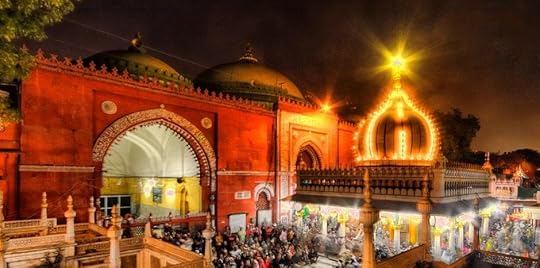
'As the soldier picked up his sword to slaughter, the Sufi stood up to confront the politics of the day with a song.' The Book of Nizamuddin Aulia reveals the life and teachings of the most beloved and revered of medieval Sufi saints. Nizamuddin Aulia was born in 1236, in great poverty. He grew up in a tumultuous world and saw three dynasties and seven sultans wreak havoc over an entire nation in the name of religion. Staying away from the corridors of power, the mystic chose instead to dedicate his life to the Sufi vision of love and spiritual enlightenment and to serving the needs of the poor. If Muinuddin Chishti introduced Sufism to India, Nizamuddin helped spread his message across the country as the head of the Chishti Sufi order. Even today, his shrine in New Delhi, the Nizamuddin Dargah, draws countless devotees and visitors. In this rich, colourful book, Mehru Jaffer tells the story of Nizamuddin Aulia from man to saint, vividly bringing alive the history of the period.
The title had triggered a warning, but I still went for it, because the cover art was beautiful.
It's a motley collection of stories and anecdotes from the life and times of Nizamuddin Auliya (1238-1325), one of the most important Sufi mystics in the Indian subcontinent from the Sultanate Period, a mentor of the legendary Amir Khusrau and a friend of the poor who embraced all without discrimination. He earned the title of Ghareeb Nawaz, the bestower or the benefactor of the poor.
Among the more striking was his struggle against the social inequality of the Hindu caste system at one hand and the informal social-political hierarchy which had developed among Muslims on the other, whereby the Turkic-Afghan tribe (which comprised the ruling class) were considered superior to Muslims from other countries and especially local converts who were treated with contempt.
Nizamuddin's almost anarchist-like views on power and authority made him a persona non grata with the sultans in Delhi, some of whom kept him close and showered him with gifts to gain public approval for their rule; others tried to confront him with force, unsuccessfully. He outlived over half a dozen sultans and lived all his life in a hermitage outside the city where he was involved in large-scale charity work for the poor aside from holding large gathering for prayer and meditation. There still exist a cult-like following who still visit his mausoleum in Delhi, which to this day is an important landmark in the city.
The book, however, fails to deliver in that it is neither arranged thematically nor chronologically to be of any use to the reader. It's a big jumble of basic writing which forced me to draw pattern and fill in the gaps. I'd have liked some critical commentary on the religio-philosophical outlook of the sufi saint and how it influenced his peers and devotees. I didn't get it. Most of which I know about the subject I knew already so in the end it wasn't of much value to me.
The mausoleum or dargah of Nizamuddin Auliya in Delhi, India.
Good intro for starters on the life of the great Muslim Saint. It’s an easy read but lacks chronological order or some definite sequence and ends up in repetition.
The social and political conditions when Nizamuddin grew into the spiritual teacher is explained beautifully. Every important aspect of his life is brought out in a detailed manner. This brings in layers to his life and the difference in each layer in colour. I really learnt a lot and enjoyed the book. The language is simple and there are lots of citations that inform how deep the research has been.
The book recounts how Sufi saints were and how they lived their lives in times of reigning cruel monarchs and in an era of foreign attacks, pillage, loot and plunder.
Although mostly focused on Nizamuddin the book traces the early Sufi movements beginning with Bakhtiyar Kaki and Farid of Ajodhan. Nizamuddin became Farid's disciple and impressed by his stoic and austere life helping the poor was soon to become his spiritual successor. Then, he moved to Delhi and settled in the locality now known by his name. Nizamuddin followed his master Farid and opened his doors and his kitchen for the poor and the hungry. Soon his renown spread and all sought his blessings, be it paupers or kings. The book devotes much time on how Amir Khusro became inspired by Nizamuddin and became his disciple and friend. Much of Khusro's music and lyrics derived spiritual inspiration from the angelic Nizamuddin and dance and music became an integral part of the Sufi seats. The book also tells how even Jalaluddin Feroze Khilji failed to get an audience with Nizamuddin despite asking Amir Khusro.
Nizamuddin was succeeded by Nasiruddin Chirag Dilli and he carried forward Nizam's love. The book recounts how Chirag refused to leave Dilli in 1327 when the capital was shifted to Daulatabad by Mohammad Bin Tughlaq. Overall the book shows how Nizamuddin and Sufis before and after him interpreted Islam as a liberal religion of love and a poetic and sublime experience of life. The book is a beautiful rendition of the Sufi way of life and gives a good comprehensive historical understanding of the Sufi movement. It also successfully captures the great Sufi philosophy of love and compassion.
A very fine and delicate rendition in the times of terrorism and the ugly side of Islam getting prominence over the real Sufi spirit of the religion.
I never read anything about Sufism before and hence I felt, it is a good beginner book. With the profound impact that he had on the lives of people, irrespective of the religion and status, and, having that during the times of such uncertainty and shaping of the Delhi Sultanate, my heart is overwhelmed and at peace. Another beautiful contrast I liked is, the lives of Nizamuddin and Amir Khusro were very different, yet the deep love for his mentor and to the divine! I would recommend this beautiful book a must read.
A brief rather disappointing biography of his life just laden with facts from other sources not exactly arranged in a particularly helpful/useful manner.
I picked up the book seeing the beautiful coverpage. I had never heard of this Sufi saint & I least expected it to be from the city I recently moved to, Delhi. The book captures rise & clashes of the auli which people dearly called him.
It reveals various life teachings, and depiction of life staying away from power & money, serving the poor.
As I read this book it was a lot to take in. A lot of rulers and people who come & go. If you are keen to learn about spread of Sufism in South Asia, this book is for you. I wouldn't call it a light read! It's a book heavy on information..
In this book, the author presents a thorough and easy reading account of the life and times of a sage who continues to evoke inspiration even today. The reader is offered glimpses from the life and philosophy of the sage in a very simple narrative style.