Jump to ratings and reviews
Rate this book

No Joke: Making Jewish Humor

Rate this book
Why the genius of Jewish humor runs risks as well as rewards

Humor is the most celebrated of all Jewish responses to modernity. In this book, Ruth Wisse evokes and applauds the genius of spontaneous Jewish joking--as well as the brilliance of comic masterworks by writers like Heinrich Heine, Sholem Aleichem, Isaac Babel, S. Y. Agnon, Isaac Bashevis Singer, and Philip Roth. At the same time, Wisse draws attention to the precarious conditions that call Jewish humor into being--and the price it may exact from its practitioners and audience.

Wisse broadly traces modern Jewish humor around the world, teasing out its implications as she explores memorable and telling examples from German, Yiddish, English, Russian, and Hebrew. Among other topics, the book looks at how Jewish humor channeled Jewish learning and wordsmanship into new avenues of creativity, brought relief to liberal non-Jews in repressive societies, and enriched popular culture in the United States.

Even as it invites readers to consider the pleasures and profits of Jewish humor, the book asks difficult but fascinating questions: Can the excess and extreme self-ridicule of Jewish humor go too far and backfire in the process? And is leave 'em laughing the wisest motto for a people that others have intended to sweep off the stage of history?

296 pages, Hardcover

First published January 1, 2013

22 people are currently reading
395 people want to read

About the author

Ruth R. Wisse

22 books30 followers

Ratings & Reviews

What do you think?
Rate this book

Friends & Following

Create a free account to discover what your friends think of this book!

Community Reviews

5 stars
15 (17%)
4 stars
29 (32%)
3 stars
25 (28%)
2 stars
13 (14%)
1 star
6 (6%)
Displaying 1 - 18 of 18 reviews
Profile Image for Jan Rice.
586 reviews517 followers
February 15, 2021
Remember the Charlie Hebdo murders? Seemingly, half the literary world mourned them as martyrs, while the other half thought they were so Islamophobic as to deserve what they got. The two sides argued about the Charlie Hebdo product: defiant and inspired humor versus vile, hateful product.

I think Ruth Wisse would say the difference is in the perspective, not in the cartoons themselves.


She begins with a joke she had heard recently and told her Harvard Jewish Studies colleagues:
Four Europeans go hiking together and get terribly lost. First they run out of food, then out of water.
"I'm so thirsty," says the Englishman. "I must have tea."
"I'm so thirsty," says the Frenchman. "I must have wine."
"I'm so thirsty," says the German. "I must have beer."
"I'm so thirsty," says the Jew. "I must have diabetes."

The joke was new at the time, and hilarity ensued.
But a secretary in the department, not Jewish although engaged to a Jewish grad student, said if she hadn't known the teller and audience, she would have thought the joke was antisemitic.

In Prague, after the war, a Christian survivor collected the jokes of Jewish comedians who never returned.
Why did the Jewishness of Jewish joking gain ecumenical appeal under repressive regimes?

It seems that as long as Jews experienced intimidation, repression, and terror aimed at them specifically, their humor held little attraction for onlookers who wanted to stay clear of the fray. Once fascism and Communism routed and regimented the rest of the population as well, though, Jewish humor resonated with citizens under similar attack, and became emblematic of...freedom....


She quoted Howard Jacobson as saying he feels more threatened by those who would wipe out ethnic joking than by those who make such jokes.

People who have gone through the American civil rights movement condemn stereotyping. But under other circumstances, those same "offensive" jokes stand for defiance and freedom.

Now maybe you begin to see how it is people have those different reactions, and how humor may not transfer well from one culture to another.

When you think of Jewish humor, do you think of Billy Crystal and Don Rickles? Well, don't forget about Jerry Seinfeld and Jon Stewart. By some counts, Jewish comedians represent 80% (or 75%) of professional comics in America. Jews haven't always been considered funny, though. It came with modernity, and it came to the West: no history of medieval Jewish comics from the Iberian peninsula; no records of saved collections of Jewish jokes from the Arab countries.

In the nineteenth century in the German-speaking countries, it was the baptized Jews who let loose with comic barbs in all directions. Think Heine. Maybe too dangerous for those who hadn't traipsed by the baptismal font?

According to Wisse, Freud's love of Jewish jokes was based on his understanding of civilization and its discontents, so to speak. He believed the attitude toward Jews was unchangeable and that humor was a way to deal with it. Of course, he generalized from Jews to citizens in general. Nevertheless I'm glad I chose Wisse instead of Freud this time. Depression already abounds!

Theodor Herzl, who wrote the books that began the Zionist movement, envisioned a country where the populace could dispense with self-deprecating humor, but joking has survived the creation of the state of Israel.

Looking at modern Jewish history in the West through the lens of humor isn't intuitive, and this book isn't always an easy read. For me the smoothest part was about America and comedians familiar to me. I learned a lot, though!

Jews in the diaspora traditionally adapted by making themselves needed. Whence the market for Jewish humor? Her answer: it came from the discomfort created when legal enfranchisement had exceeded social acceptance.

Jokes are a way to talk about what can't be said. If you're laughing at something, you're at least talking about it -- a way to speak truth to power without getting in someone's face.

I love her view of zany stand-up comedians as the true descendants of early hasidic mystics, each of whom is waging a battle against overpowering forces. On joining the Facebook "Jewish Humor" group, I noticed their cover photo calls humor a "defense against the universe." Instead, Ruth Wisse would say it's an attack on the universe.
Stand-up comedy is all about nerve--a battle between aggressor and victims with wit as the weapon and laughter as the prize. Different from prizefights that pit people against one another in the presence of paying spectators, comedy pits the fighter against the paying customers, with silence as the killer, and the detonation of laughter as the victory.


The detonation depends on tension. Without the tension the joke can't work.

I'm still thinking about her idea that if laughter is the best medicine, one must watch out for overdosing. The part about Stalin's purges and the execution of Jewish comics -- that I get, but she's saying something broader. She puts her overdose warning into various contexts throughout the book, and I haven't put it all together. Heine broke out of humor into anger, and Kafka into grief.

As Wisse observes, laughter isn't very far from tears.

But, as they say, leave 'em laughing:
(Thanks to the Facebook group Jewish Humor)


It’s Shabbat and the family is ready to say the traditional blessing over wine. The youngest boy has forgotten to wear a kippah and as he begins to recite the blessing, his father places his brothers’ hand over the younger boy’s head. The older boy pulls it back. The father places it over the younger boy’s head again. Again, the older boy pulls his hand away. Finally, his father asked why he would not help out. His son responded, “Am I my brother’s kippah?”

Last, bad puns, but appropriate to Tzadic Valentine's Day:


Leave 'em thinking too: why might those sorts of jokes be predominant in that Facebook group?

Another point is that Ruth Wisse doesn't identify essential differences between Jewish and other humor; says at one point she thought to hold up Jewish humor as verbal, but eventually physical humor also emerged. It's all good!

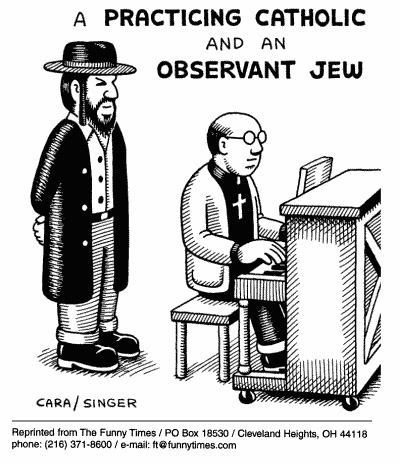
Here's one more I just love that I found today on Facebook: a No Exit cartoon I couldn't find online last night. 😄


I will consider not amending this review time and time again with more jokes and cartoons....
Profile Image for David.
1,702 reviews16 followers
June 13, 2013
A scholarly examination of Jewish humor: origins, nature, evolution. Drier than I had anticipated but the jokes used as examples makes it worth reading. Jewish humor, according Wisse is to Jews as jazz is to African Americans. Interesting that Jewish humor is not as robust in Israel as it was and is elsewhere. Wisse suggests this is because in Israel Jews run the place, elsewhere not so much.

A good joke starts the book...
Four Europeans go hiking together and get terribly lost. First they run out of food, then water.
"I'm so thirsty," says the Englishman, "I must have tea!"
"I'm so thirsty," says the Frenchman, "I must have wine!"
"I'm so thirsty," says the German, "I must have beer!"
"I'm so thirsty," says the Jew, "I must have diabetes!"
Profile Image for Jim Leffert.
179 reviews9 followers
August 24, 2014
What to make of a scholarly (although aimed at a general audience), analytic treatise on Jewish humor? It’s not a joke book but it does contain a number of quite funny jokes. Between the jokes, Wisse presents analysis, interpretation, history—for example, Wisse cites Freud’s and others’ theories of the psychological mechanisms underlying humor, and applies these theoretical perspectives to explain how certain jokes work and how they affect different groups of listeners. Wisse, agreeing with other authorities, argues that Jewish humor is a phenomenon worth studying—an important aspect of Jewish culture that has also had a major impact on the society at large. At the same time, she does not believe that there is anything unique in the features of Jewish humor—it’s just that the impulse for humor finds prominent expression in our community.

Humor, she points out, springs from motivations such as 1) to cope with the painful gap between wished for (and for Jews, divinely promised) positive outcomes, on one hand, and undesirable circumstances in reality, on the other; 2) to cope with being different from the majority of surrounding people, either as a persecuted group of outsiders, or as a minority striving to fit in (each of these conditions gives rise to its own style of humor); and 3) to provide a psychological mechanism for managing our fear of death, disease, and other circumstances of personal vulnerability.

Wisse believes that humor was there all along in the Jewish community., but only to a modest extent. Wisse may actually be underreporting the humor quotient in ancient and medieval Jewry. I see great humor in a few places in the Bible--in Numbers in the story of Balak, Balaam and the Ass, and in the Book of Esther. Wisse mentions that Rabbinic sages’ strong appreciation of wordplay, but the Talmud and Midrash also includes some charming humorous tales: the heathen who asks Hillel to teach him all of Judaism while standing on one foot; the Roman noblewoman who, in imitatio dei, pairs up her hundreds of servants in matrimony, with disastrous results. Moreover, medieval Jews used humor to poke fun at their persecutors— the book Sefer Toldot Yeshu is a wicked satire of the Gospels. According to Wisse and others, though, it wasn’t until the onset of the Enlightenment in Europe that Jewish humor as we know it developed in its full flowering.

Wisse provides a history of this post-Enlightenment humorous outpouring. She describes the contribution of seminal figures—I didn’t realize that Heinrich Heine was the original progenitor of European Jewish humor, with an influence that spanned the continent and the Atlantic, writing already a half-century before Sholem Aleichem (and in German, no less). She compares the humor of different communities—Enlightenment figures, Hasidim, misnagdim, and of Jews in different historical and social circumstances—those who used humor to express solidarity against their persecutors and those who used it to disarm the surrounding community by poking fun at stereotypes about themselves.

Wisse offers examples of black humor from the Holocaust and from the Soviet Union under Stalin, and presents humor from the supposedly humor-challenged Israelis who, according to some theories, shouldn’t need to cultivate humor since with the establishment of the Jewish state, they are no longer powerless. This view is short-sighted because the conditions that give rise to humor are universal and to some degree, so is the Jewish condition.

So, what to make of this treatise on Jewish humor? This question brings to mind how Saul Leiberman, the distinguished Talmudic scholar, is said to have once introduced Gershon Scholem, the renowned scholar of Jewish mysticism: He said ”Narishkeit (the Yiddish word for foolishness) is narishkeit; but the history of narishkeit? This is scholarship!” We can echo Leiberman in praising Ruth Wisse’s new book.
Profile Image for Philip Mann.
Author 3 books10 followers
February 3, 2017
For a scholarly book, No Joke by Ruth R. Wisse was surprisingly easy to read, and even enjoyable. The author traces Jewish humour from the Torah, when Sarah laughs at God for predicting that she will have a child. Jews never lacked for chutzpah, it seems. And we needed it.
Very often humour was a means of defying an enemy, usually a hostile government. The jokes were told in Yiddish, so that any Gentile listener would not be privy to his being skewered. God Himself is often the butt of the joke. Jews knew all too well how perilous their situation was as His chosen people.
Wisse brings in Kafka and Freund, among others who alternately mock their co-religionists and those who crossed the floor and became Christians. For the latter, the joke was on them, as their own, native people sneered at them, while their new cohort looked askance at them. \you can run but you can't hide, it seems.
The book takes off when it enters the Russian phase, and the humour is more familiar, and easier to understand. Jews make sly remarks about the Czar, then the communists, and always about their fate. The jokes are a mixed bag, some more easily understood than others. Again, this is a book written by a learned person, so caveat emptor.
Once in America, the humour takes on a new tack, with the borscht belt comics making a living by slicing and dicing their wives ( no female comics back then), the Gentiles among which they lived, and their own religion. It also became far raunchier, with Lennie Bruce and Philip Roth attracting criticism for raising obscenity to new heights. Roth took on both his own people and the Gentile world, holding back not a bit. Bruce had legal problems. Both were forerunners in their field.
The book concludes with a warning at today`s world, with traditional Jewish observance declining, and the state of Israel itself besieged by the politically correct crowd. Wisse sees the convergence of these two flows and sees a world in which Jewish humour ceases to defend its own and tends, more and more, to mock and bring down its own history, and to side with what is considered the correct view. She notes how there are no trends of Arabs mocking the Jihadi, of the politically astute ridiculing its own, or anybody but Jews mocking themselves. For this conclusion alone the book is worth reading.
743 reviews5 followers
August 10, 2013
This is a scholarly book that traces the history of Jewish humor. In her delightful, erudite new book No Joke: Making Jewish Humor, Harvard professor of Yiddish Literature Ruth Wisse evokes and applauds the genius of Jewish joking—as well as the brilliance of writers like Heinrich Heine, Sholem Aleichem, Isaac Babel, S. Y. Agnon, Isaac Bashevis Singer, and Philip Roth. At the same time, Wisse draws attention to the precarious conditions that call Jewish humor into being—and the price it may exact from its practitioners and audience.
While many of the jokes are familiar Wisse interprets the joke's context into the culture of the time. Jews who were repressed found outlets in jokes and used witticisms to signal that they are alive. Holocaust gallows humor is prevalent as a way of coping. A book to be read more than once.
68 reviews1 follower
July 31, 2014
I found this book informative, thoughtful and with some laugh out loud examples. It was largely an analysis of how humor serves the Jews and Jewish culture with excellent descriptions of Jewish humor in different aspects of Jewish history and culture. I also liked the few personal tidbits that Ruth Wisse added. The book was fine with me.
Profile Image for R.J. Gilmour.
Author 2 books26 followers
August 5, 2016
A disjointed book that would appeal only to academics interested in Yiddish culture and its relationship to humour.
27 reviews11 followers
February 7, 2015
Way more scholarly than I was expecting and not as many examples of jokes, but a wonderful overview of Jewish comic literature.
121 reviews
June 23, 2022
Initially, I was somewhat surprised that this was a slim book, of 250 pages, when one considers the size of the subject matter. It is, in many ways, an overview, albeit a scholarly one rather than an intense study of this interesting and fascinating aspect of Jewish heritage.
The author, Ruth R. Wisse provides a very readable time frame for both the origins and development
of the specific stylistic humor, most readily through European Yiddish, within the social restrictions
that the humor often expressed.
An excellent primer, beautifully written with sensitivity, and appropriate examples throughout, as the fundamental Yiddish base expands in later years to incorporate more recent Hebrew jokes and sayings.
Enjoyable and interesting - but could have been a much larger book - Oy !!
Profile Image for Virginprune.
305 reviews5 followers
November 28, 2014
... so I'm perplexed.
this should be a really interesting and enjoyable book. but it just wasn't.

now, we know it's not just a collection of Jewish jokes (which, in retrospect, would have been a better call) - the author's an academic (a Harvard professor, no less) and the title warns us.

yet this book doesn't really seem to be much of anything. as an academic work it just doesn't make the grade; it feels like what you get when you send a lot of grad students out to the library to generate the ballast, then stitch it together with a couple of simple ideas and some personal insights and anecdotes - in itself a time-tested formula, and one that could even work, if the insights were profound enough, the anecdotes interesting, and the research deep and broad enough.

this feels like a set of essays, which have yet to be coherently strung together with a powerful unifying theme and flow of logic. it feels like you're sitting at a dinner table, next to someone who doesn't stop talking.
but not only is the big picture missing the mark - even the details are infuriating. perfectly wonderfully simple jokes are explained and dissected in ways that add no value. (we got it the first time!) in other places, sweeping assumptions are made, with no justification or explanation. even the grammar/spelling is shoddy (look up "acronym" and "cache" before using them!)

the sad fact is, the author doesn't seem to have a sense of humour. or maybe she just has to work on her delivery.

i was also a little thrown by her early reduction of the scope possibilities to: either Jews are essentially funny, and have always been so; or Jews are basically really boring, but started cracking jokes a little over 100 years ago.
she went for the latter, which i assumed was a way of limiting the research workload... but there may have been another agenda: if there is a theme here, it's that Jews may be funny, but it's been done under duress, and Jews should not be branded as god-given comedic talents (least of all by Jews themselves.)

or maybe i just didn't get it. i mean, apart from the above, this is a really good book. and the subject matter is, of course, ripe, fruity and delicious. and bitter. and so on.
however, as the author states, there is already plenty of literature already published on the subject. perhaps try another book instead?
Profile Image for Ben.
427 reviews44 followers
November 24, 2014
Jewish beggars, or schnorrers, endorsed by a religion that requires high levels of giving, generated a brand of comic insolence by demanding gratitude from their benefactors.... In Yiddish joking, a beggar turned away because the master of the house has suffered a financial reversal retorts, "So because he's had a bad week, why should my family go hungry?" Asked to return the following day because of a lack of money at hand, the schnorrer objects, "If only you knew what a fortune I've lost by extending credit."
Profile Image for Avi.
559 reviews7 followers
December 31, 2014
Some interesting bits. I frequently disagreed with its author's perspective. Sometimes even on basic joke analysis.

I found one joke hilarious but it was on the first page... Nothing in the rest of the book made me laugh like this:

Four Europeans go hiking together and get terribly lost. First they run out of food, then out of water.

"I'm so thirsty," says the Englishman. "I must have tea!"

"I'm so thirsty," says the Frenchman. "I must have wine!"

"I'm so thirsty," says the German. "I must have beer!"

"I'm so thirsty," says the Jew. "I must have diabetes!"
Profile Image for Andy Oram.
622 reviews30 followers
September 25, 2015
No astonishments in this book, but a welcome focus on some little-known sides of Jewish culture and related European and American history. Ranging from 19th-century Germany through the Eastern European pale, the United States, the Soviet Union, and Israel, this book can only hit the high points. There are many fascinating historical details (such as the alarm with which Jewish reviewers greeted Portnoy’s Complaint) but the analysis and conclusions don’t stray far, in my opinion, from well-understood precepts that others have stated.
Profile Image for Kathy.
353 reviews13 followers
August 21, 2013
very interesting. It is always good to see how experience shapes a group's thinking and try to understand a viewpoint different from your own.
Profile Image for Leora Wenger.
119 reviews28 followers
January 5, 2015
I wouldn't recommend this book for the jokes. On the other hand, if you like history, especially Jewish cultural history, you may enjoy it. Quite of the jokes are dark humor.
54 reviews1 follower
December 30, 2014
a little detailed at times but really insightful and enjoyable--a great historical/cultural perspective from an academic who really has a sense of humor
Profile Image for Dan.
42 reviews1 follower
January 29, 2018
Couldn't finish it. Just not for me.
This entire review has been hidden because of spoilers.
Displaying 1 - 18 of 18 reviews

Can't find what you're looking for?

Get help and learn more about the design.