The oversized Hellboy hardcover series continues, collecting the climatic "Death of Hellboy" storyline from Mike Mignola and Duncan Fegredo, and one-shots by some of the greatest talents in comics! Hellboy has racked up multiple awards, numerous spinoffs, a novel line, video games, cartoons, and two feature films. Hellboy Library Edition Volume 6 collects two complete trade-paperbacks: The Storm and The Fury and The Bride of Hell and Others, as well as an extensive selection of previously unreleased art.
Mike Mignola was born September 16, 1960 in Berkeley, California and grew up in nearby Oakland. His fascination with ghosts and monsters began at an early age (he doesn't remember why) and reading Dracula at age 13 introduced him to Victorian literature and folklore from which he has never recovered.
In 1982, hoping to find a way to draw monsters for a living, he moved to New York City and began working for Marvel Comics, first as a (very terrible) inker and then as an artist on comics like Rocket Raccoon, Alpha Flight and The Hulk. By the late 80s he had begun to develop his signature style (thin lines, clunky shapes and lots of black) and moved onto higher profile commercial projects like Cosmic Odyssey (1988) and Gotham by Gaslight (1989) for DC Comics, and the not-so-commercial Fafhrd and the Grey Mouser (1990) for Marvel. In 1992, he drew the comic book adaptation of the film Bram Stoker's Dracula for Topps Comics.
In 1993, Mike moved to Dark Horse comics and created Hellboy, a half-demon occult detective who may or may not be the Beast of the Apocalypse. While the first story line (Seed of Destruction, 1994) was co-written by John Byrne, Mike has continued writing the series himself. There are, at this moment, 13 Hellboy graphic novel collections (with more on the way), several spin-off titles (B.P.R.D., Lobster Johnson, Abe Sapien and Witchfinder), three anthologies of prose stories, several novels, two animated films and two live-action films staring Ron Perlman. Hellboy has earned numerous comic industry awards and is published in a great many countries.
Mike also created the award-winning comic book The Amazing Screw-on Head and has co-written two novels (Baltimore, or, the Steadfast Tin Soldier and the Vampire and Joe Golem and the Drowning City) with best-selling author Christopher Golden.
Mike worked (very briefly) with Francis Ford Coppola on his film Bram Stoker's Dracula (1992), was a production designer on the Disney film Atlantis: The Lost Empire (2001) and was visual consultant to director Guillermo del Toro on Blade II (2002), Hellboy (2004) and Hellboy II: The Golden Army (2008). He lives somewhere in Southern California with his wife, daughter, a lot of books and a cat.
Шосте бібліотечне видання «Геллбой: Шторм і лють. Наречена з пекла» закриває основну сюжетну лінію про Червоного диявола, який знайомий усім за ім’ям Геллбой. Далі мене уже чекає тільки фінал усього, який є у бібліотечному виданні «У пеклі» та різних серіях разом із ваншотнимм історіями, які розповідають про Б.П.Р.О, Ейба Сапіенса, Лобстера, Відьмолова та багато інших персонажів.
Перша частина цього бібліотечного видання є цілісною сюжетною аркою «Шторм і лють», яка є природним продовженням коміксу «Дике полювання». Відчувається, що Майк Міньйола та Дункан Феґредо перебувають у найкращій формі та створюють прекрасний кінець основної серії, який водночас трагічний і сповнений надії. Тут Міньйола зв’язав докупи багато незавершених кінцівок з основними сюжетними лініями. Також вирішуться питання щодо претензії Геллбоя на трон Англії та армію Демонів. Але ця арка, насправді, торкається всіх тем, які проходять через сагу про Геллбоя. Життєвий вибір, доля, самопожертва та надія — усе це знову з’являється на першому плані, поки Геллбой стикається з найбільшим і останнім випробуванням.
Дункан Феґредо, чий малюнок уже з’являвся в деяких попередніх коміксах серії, тепер чітко показує своє майстерне виконання художньої сторони. Якщо спочатку здавалося, що він буде просто гідним «імітатором», щоби замінити Майка Міньйолу за столом художника, то тут можна сказати, що перехід від одного вишуканого стилю до іншого точно відбувся. І світ від цього не те, що нічого не втратив, а навпаки, у багатьох моментах, навіть виграв у художньому плані.
«Шторм і лють» є апогеєм усього, що заклав у цей світ Майк Міньйола. Якщо ви любите скандинавську міфологію, чи кельтську міфологію, чи легенди про Артура, чи єврейські та християнські мотиви, чи слов’янську міфологію, чи творчість Говарда Філіпса Лавкрафта, чи легенди, чи казки — то все це присутнє в цьому томі одночасно, гармонійно перемішане, гарно продумане та атмосферне. Якщо ж узяти усю серію загалом, то Майк Міньйола помало вводив ці різні пласти зі світової культури та історії, щоб не перевантажувати читача. А в цій арці маємо все навпаки, бо це вже данина всім попереднім історіям. І це було прекрасно!
Решта цього бібліотечного видання, яка має назву «Наречена з пекла», насправді, збірка раніше опублікованих коротких коміксів Майка Міньйоли, які намальовані чотирма різними художниками — Майком Міньйолою, Річардом Корбеном, Скоттом Ґемптоном та Кевіном Ноуланом. Хоча ці історії не такі цікаві і красиві, як у першій половині, вони, беззаперечно доповнюють загальну картину подорожей Геллбоя світом.
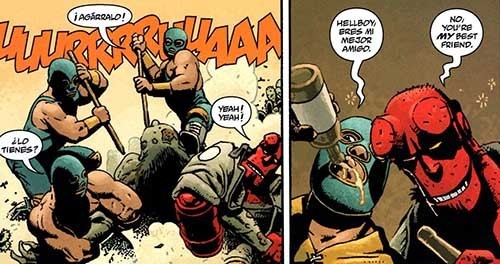
Особисто я не дуже люблю художній стиль Річарда Корбена, але сама історія «Геллбой в Мексиці» про про трьох борців луча лібре (мексиканський національний стиль професійної боротьби), які, випиваючи й бешкетуючи разом із Геллбоєм, подорожують усією Мексикою, мені дуже сподобалася. Також вартує згадати комікс «Сплячі та мертві», який малював Скотт Гемптон, де Геллбоя заведе дорога до стародавнього вампіра, який ув’язнив двох сестер та використовував дівчат задля власних цілей. Вийшла досить містична й атмосферна історія. Ще повеселив комікс «Бастер Оуклі виконує своє бажання», де Геллбой відвідав фермера, який скаржиться на своїх зниклих корів. Блукаючи фермою, його засмоктує гігантський космічний іншопланетний корабель, повний мутованої худоби. Дуже дивна та весела історія.
Якщо спробувати підсумувати це бібліотечне видання чи серію загалом, то окрмі того, що Майк Міньйола показав свій талант на повну силу, важко ще щось додати. Він точно стоїть поміж найславетнішими сценаристами мальованих істоірй минулого й теперішнього, а глибокий, продуманий та атмосферний світ, затягує безповоротно. Усім раджу. Це геніально!
Hellboy Library Edition, Volume 6: The Storm and The Fury and The Bride of Hell is without a doubt one of my favorites of the 6 Hellboy library editions published to date. The Storm and The Fury kicks ass and is certainly the better portion of this collection. Storylines that started all the way back in the beginning ( Hellboy: Seed of Destruction) finally come to fruition here and it pays off big. This is definitely not a good starting point for someone who is trying out Hellboy for the first time. Mignola continues to blend action, Lovecraftian elements, and classic monster horror with great success. This story sets the stage for what is a huge turning point in the series that I won’t spoil for those of you who don’t know. Duncan Fegredo does such a great job with the art in this story. Initially, I really was sad to see Mignola stop illustrating his title, however, Duncan has maintained and in some ways surpassed Mike’s previous artwork in Hellboy. His level of detail and similar, but unique style quickly won me over.
The remainder of the title is a collection of several previously published short stories by Mike illustrated by four separate artists (Mignola, Richard Corben, Scott Hampton, and Kevin Nowlan). While these stories are not as good at the first portion of the book, they are certainly enjoyable and fill in more of Hellboy’s history while working with the BPRD and traveling the world. I really got a kick out of the Corben illustrated story of the three Lucha libre wrestlers and their time spent boozing and brawling throughout Mexico with Hellboy in tow. There is also a substantial section of sketches drawn by the various artists included at the end of the book with some really nice stuff thrown in.
I have no doubt fans of Hellboy will enjoy this collection. I would recommend starting Hellboy’s story at the beginning and working your way up to this volume. Mignola has really created some wonderful characters along the way and it’s great to see Hellboy evolve and grow from Seed of Destruction through to this collection. I would also recommend the Library Editions if you can afford or find them due to the overall quality of the books themselves and the oversized pages. These pages really showcase the artwork so well and added to my overall enjoyment of all the stories.
(4,6 of 5 for yet another amazing Hellboy's adventures) The ominous finale of the very long Hellboy's arc. And it's great. The mysterious atmosphere, the legends the smoke and the mirrors. I always got really sucked into those kinds of mysterious stories. And Mike Mignola and all guys he gravitated in to participate in those stories are really great. And it shows. And there are those all short stories in the second half. Good old short horror stories. Sometimes with the "old" Garry Giani feel, which I like. The Bride of Hell is a great story, with that made-up lore of Knights of st. Hagan. It's shame the recent limited series about them was swept from production thanks to me too/cancel culture wave coming towards Allie. And the last story feels like a little easter egg. Something kind of funny, light, I felt some Goon-ish vibe from that and it was just the digestif to the great lunch I just had. I'm a sucker for Hellboy, but still, the Stories collected in Hellboy Library Editions are one of the best things in comics media. I truly believe so.
Поки остання частина офіційної бібліотечки Хелбоя, далі вже Hellboy in Hell. Якщо підсумувати, це була прекрасна, таємнича й містична пригода, сповнена захоплення і міркувань. Щодо цього тому, то перша частина є фінальним крещендо попереднього тому із блискучим малюнком Дункана Ферґедо, який, як вже згадував, місцями перевершує самого маестро. Вже друга частина є солянкою різних оповідань, спін-оффів, якість яких середня. Мене найбільш бентежить наявність жахливого й примітивного стилю малюнку Річарда Корбена. От не сприймаю його ніяк! Він мене ще раніше дратував, а тут знову з'явився. Звісно, що концепти оповідань конструював Міньйола, тому тут без питань, але візуальна реалізація дуже сумнівна
Тому й виходить такий баланс між п'ятіркою та трійкою, де остання за короткі історії. Зловив себе на думці, що мені взагалі вкрай важко заходять короткі історії за окремими винятками. Загалом, це звісно культова класика, яку треба читати й вивчати. Те, що зробив Міньйола з міфами, казаками й легендами може рівнятись хіба до Ніла Ґеймана, який також деконструював усю культурну спадщину світу в своїй творчості, а особливо у "Пісочному чоловікові". Міньйола - геній. Додати більше нема чого.
While I liked the conclusion of the arc, it’s also somewhat of a rehash of what’s happened in previous volumes too. It’s at its best when it’s not just a physical conflict imo. Panels of punching and stuff, especially with the new artist who is more detailed but also more generic, just feels like a quick read with little actual value. The older ones are very wordy and focus on telling an excellent story. As soon as we learn he is more-or-less invulnerable, it becomes way less interesting and the short stories sing far more than the larger arcs.
The later part with many short stories, ironically, is still uneven though, but this was because each story has a different artist. Some hit and some miss. A vampire story is particularly excellent. The art there was fantastic and it was a bit different than expected. Then, there’s some bland stuff too. Always enjoyable, but does exceed expectations overall.
Another fantastic Hellboy book with beautifull art and story, the ending is coming, but i dont want it to end. Hellboy in Mexico, and the sleeping and the dead two short stories are worth the book alone, so freaking good !!!
That was a great and epic finale, as it should be with hellboy. The short stories at the second part were just meh, but didn't bother me. I really look forward to "Hellboy in Hell".
This is really more of a 4.5 star collection but it packs a superb 5-star tale at its onset before closing on a mix of stories that are more hit-and-miss. The story, as always, is a lot of fun. A combination of real-world mythology and Hellboy mythos make for some fun action, but this volume constitutes an immense turning point in the story of Hellboy proper. Eschewing the typical short-story approach to Hellboy, this volume brings home to roost many of the chickens laid in earlier short stories. While I can't talk too much about the story, this is the resolution of the beast of apocalypse prophecy that has plagued our unenthusiastic hero throughout his adventures. Though Mignola is off art duties for this story, which comprises the first half of the sixth collection, Ducan Fegredo pulls some seriously heavy weight in this chapter and brings a chapter of the Hellboy tale to a powerful close.
As the saga begins to close out, we’re treated to more bombastic monster horror, witches and demons, zombie armies, explosions, romance (!!!), and Hellboy’s inevitable death. But don’t worry, he’s not really dead.
This is probably closer to a 4.5 as I think a lot of the Bride of Hell stories are kinda duds, but I'll round up for Storm and the Fury, which really nails that implacable, tragic, "this was always going to happen this way" feeling. I don't know if I can recommend this for new readers, as I read Volume 5 7 years (D: D: D:) ago and then tried to pick this back up late last year and was totally lost as to when Hellboy got a girlfriend and why he had a little Russian ghost girl following him around. I have to give credit to Duncan Fegredo who's absolutely crushing it the whole way through. I distinctly remember reading the first couple collections of Hellboy a long time ago, kind of losing interest, and then years later seeing that panel of the dead guys outside the country inn and thinking, "man, I GOTTA get back into Hellboy", and I was right.
Half of this volume is finishing a very large story arc, with the other half being short vignettes and random stories. The various artists keep a certain Hellboy style, but show their own techniques through it.
What a hell of a ride. Duncan Fegredo's run on Hellboy was a truly remarkable thing, a spellbinding blend of Lovecraftian horror and high fantasy, grounded in Fegredo's incredible knack for characterization through his art. Hellboy, Vol. 12: The Storm and the Fury is action-packed, but Mignola and Fegredo leave enough space for some really great character beats, maybe some of the best in the entire series. And when it ended--even though I knew what was coming--I was left breathless.
I was a little worried that after such a stunning conclusion, I'd be a little let down by the self-contained stories collected in the latter half of this volume (originally published as Hellboy, Vol. 11: The Bride of Hell and Others), but this wasn't the case. "Buster Oakley Gets His Wish" was a little too campy for me, and the idea of , while not outside the realm of possibility in the Mignolaverse, felt tonally incorrect. Oh well. It's no matter, because the other stories were all great. If I had to pick a favorite, it'd probably be "The Sleeping and the Dead," in part because I appreciate the elaboration of the role of vampires in the Hellboy mythos, but also because Scott Hampton's painterly style is absolutely gorgeous. Not that Corben is a slouch--he's my favorite Hellboy artist after Mignola and Fegredo, and his style perfectly suits these standalone stories that expertly mix action and horror.
As always with the library editions, this thing is beautiful to look at and hold in your hands, and it's packed full of bonus features such as sketchbook stuff from all four artists, a snippet of original script, and, best of all, a whole bunch of Fegredo's line and wash pieces. Great, great stuff, and well worth the cost of admission.
I feel torn writing an objective review for this volume, but the reason it’s difficult is the reason why I have to rate it low. This is the final giant volume, the penultimate, before Mignola retakes the reigns for Hellboy in Hell. It builds from the continuous line of plot established in the previous volume, and promises the grand finale. And then, while an epic and fully satisfying conclusion, it’s...only the first 1/4 to 1/3 of the volume? I mean, Vol 5 was bloated as well, with the final 1/4 of the pages being Fegredo’s “sketchbook,” but I expected more of this tome to be a giant conclusion to the story. Instead it’s like a footnote they chose to put at the beginning of the volume instead of the end. Vol 6 is just Vol 4 all over again - a collection of Hellboy Bsides - and it makes the ending of this particular sequence feel extremely lackluster. The editing of this Hellboy Library, when viewed as a whole, is extremely sloppy and frankly money-grabbing. As I’ve stated before, Vol 4 - and now the majority of Vol 6 by extension - needed to be a giant end volume of “Bsides” or “Appendicies,” not stories by guest artists and guest writers that are shoehorned in, break up the flow of the main story, and essentially just pad volumes to ensure all of them are sold. I personally don’t care for any of the guest efforts, so it’s very discordant. Hellboy, that is to say the core story established by Mignola and not just the character, is really a story told in just 4 volumes. Read 1-3, then 5, and then treat the very beginning of 6 as a dumb placement of the grand finale. 4 is fluff. The final 1/3 of 5 is fluff. The vast majority of 6 is fluff. And it honestly only cheapens, not deepens, the depth of the core material. It’s a shame to say, but if you have an interest in Hellboy and aren’t already a huge fan of the series in some regard, it’d be better to find and read the original trade paperbacks. These initial 6 library editions are just a cash grab with poor editing. It needed to be 4 volumes with one big volume at the end for all the fluff, and as a reader, it’s discordant to have to parse through all of it when the goal of a library edition, to me, is to assist with that.
I don't read many new comics anymore but I try never to miss an issue of Mike Mignola's universe of titles. Hellboy is, of course, the flagship behind which all the others sail and often feels like the strip that best captures its creator's wonderful, dark vision. This volume contains the last Hellboy strips before the character is cast into Hell, where he currently struggles as part of the world-destroying story line that spans Mignola's multi-title epic, and a number of one-off horror stories with Hellboy as protagonist. I had read all of these comics individually but reading them in the library edition, the continued story is more coherent and satisfying. If there is a negative side to reading them in this format, it is that the formula (Hellboy encounters something awful and fights it) becomes a little more naked. Still, these library editions present one of the great joys of modern comic book reading. The books themselves are a pleasure, from the texture of the binding to the heft of the over sized pages, I know of no other collected editions as lovingly assembled. Beyond this volume, the current story line, which has taken years to unfold, promises to be an ending of some sort to the Earth where Hellboy and the BPRD live, but I will happily read whatever comes after.
I'd give this 10 stars if I could. I wasn't sure about about the story line when I first read the Storm and the Fury as comics but reading them as a collection I really like them. In the early days of Hellboy I always thought it would never be as good if Mike Mignola ever stopped drawing it but Duncan Fegrado is fantastic and in some ways maybe even better! As for Richard Corben I could look at his stuff all day, his Crooked Man (not in this collection) Hellboy story is maybe my favourite of all time. In this collection Bride of Hell and Hellboy in Mexico are great. The stories drawn by Scott Hampton and Kevin Nowlan come a very close third and fourth for me but that's just personal taste as they are both great artists. Hugely recommended to all Hellboy fans and anyone who likes great comics of the darker variety.
Kulminacja całej historii prowadzonej przez Mignola'ę zachwyca. Spięto większość wątków, czasami mocno mnie zaskakując w kierunku jakim autor prowadzi całość, kończąc starcie w dosyć satysfakcjonujący sposób. Burza i pasja to wszystko to co najlepsze w tym tytule, jednocześnie pozostawia czytelnika z pytaniem" "Co, u licha, dalej?"
Szlachetni lordowie wstają ze swoich grobów, aby ostatni raz stanąć pod wodzą swojego króla do walki z siłami zła. Nimue pozbyła się wszystkich przeszkód i nic nie przeszkodzi jej w wytępieniu ludzkości oraz zaprowadzeniu swoich krwawych rządów. Tylko, że ona, jak i sam Hellboy są pionkami. Ważnymi, ale jednak figurami szachowymi w grze, którą prowadzą siły znacznie wyższe niż cały też Wąż Niszczyciel, który rozpaczliwie szuka drogi do naszego świata. Aby po wszystkim został tylko popiół i kości. Hellboy po raz pierwszy wydaje się zdawać sobie sprawę, że aby uratować sytuację musi grać tak jak podpowiada mu jego intuicja, a nie gromada różnorodnych indywiduów, które mają w całym zamieszaniu własne interesy.
Do pierwszej historii nie mam zastrzeżeń. Na to czekałem i to dostałem. Zakończenie tego wątku i zarysowanie kolejnego, równie ciekawego. Potem dostajemy kilka mniejszych opowiadań, które jednak cechują się różnym poziomem. Hellboy w Meksyku jest co prawda niezły, ale to nic czego bym nie widział. Ponownie wampiry. Hellboy dołącza do grupki Luchadores, którzy polują na nocne stwory. Jedyną nowalijką jest tu miejsce, gdzie odbywają się same walki. Meksyk to w wizji Mignoli, Corbena i spółki bardzo obskurne miejsce.
Podwójny seans zła jest krótką i świetną historyjką, która potwierdza że siła autora tkwi mocno w niezbyt obszernych opowiadaniach. Mamy dom, który zmusza właściciela do składania mu ofiar, a za które zrzuca niewolnikowi parę złotych monet. Dom Sobek jest nieco za chaotyczny, ale to tylko dlatego że te kilka stron dzieję się pod koniec jakiejś fabuły.
Śpiący i martwi to kolejna zamknięta historia o wampirach. O pewnej rodzinie, która padła ofiarą pradawnego zła i musi temu złu usługiwać, choć pod sam koniec sprawiedliwości staje się za dość.
Piekielna narzeczona to też zacna historia, w której rolę tych złych i dobrych są mocno niejednoznaczne. Zło tu potrafi być dobre dla ludzi, bo demon Asmodeusz potrafi brać na małżonki "chętne" kobiety, a Ci dobrzy są tak ślepo nastawieni na swoje wartości wiary, że nie potrafią pojąć, iż ktoś może chcieć dokonać takiego, a nie innego wyboru. To mocna strona wyobraźni Mignoli. Tu często nie ma podziału na białe i czarne, bo dobre też potrafi być naprawdę paskudne...
Dziedzictwo Whittierów oraz Spełnione życzenie Bustera Oakleya to najsłabsze elementy szóstego tomu przygód Czerwonego Chłopca. Mają odpowiednio ponury wydźwięk, ale nie mają tej mocy, jak to co czytałem przed nimi. Inną sprawą jest to, że Mike nie ma miernych historyjek. Tu mamy jakiś okultystyczny rytuał, który idzie nie tak jak potrzeba, bo przywołujący nie ma pewnego medalionu oraz sprawę powiązaną z uprowadzeniami przez UFO i zamianą ludzi w krowy... Na plus zaliczam całą masę szkiców, które zajmują jak zwykle dobrze powyżej pięćdziesięciu stron...
Świetny tom, który gdyby składał się z trzech czy czterech najlepszych opowiadań to dostałby piąteczkę. Tak niestety występuję tu kilka średniaków, które zarysowują tą idealną szklaną powierzchnię, za którą mamy bramę do niezwykle ciekawego i ponurego świata, gdzie zło nie śpi, a ludzi są tylko mięsem, które kończy w taki, albo inny sposób. Niemniej cała seria jest warta uwagi. Zwłaszcza te tomy w ślicznej czarnej oprawie ze złotymi napisami, które dumnie prezentuję na swojej półce.
'The Storm and the Fury' follows the main storyline; the rest of this volume is sides stories.
In 'The Storm and the Fury' Hellboy, now the rightful King of England, chooses to fight Nimue without Excalibur. Instead, Alice gives the sword to a man who might be King Arthur reborn who takes the army of resurrected knights to fight Nimue's forces. King Arthur and his knights are killed, and Hellboy defeats Nimue only for her to rip out his heart and she is being dragged to her doom.
There is a log going on here - The pig fae Gruagach is cursed by Merlin and then freed by Morgan, there's a log of Arthurian imagery, Morgan Le Fay reveals the battle the knights are waging is Ragnorak, Hellboy gives Baba Yaga one of his eyes, and the Wild Hunt rides through. The story does a good job of keeping everything moving without being too confusing, and I can't wait to see what happens next.
The short stories are fun as usual; Mignola has always been good at those. I've read 'Hellboy in Mexico' before, in the collection with all his Mexican adventures. 'Sullivan's Reward' is a very creepy, Twilight Zone type story about a not exactly haunted house. 'The House of Sebek' had a nice twist at the end. (Always know what god you are invoking!) 'The Sleeping and the Dead' was creepy vampire story, touching on the idea that all vampires went into hiding until people forgot how to fight them. 'The Bride of Hell', 'The Whittier Legacy' and 'Buster Oakly Gets His Wish' didn't stand out as much.
This entire review has been hidden because of spoilers.
Storm and the fury is amazing and expectional in its telling of the story. Those initial chapters were pure forbodance, the calm before the storm if you will. You can sense the coming of the impending danger, Mike Mignola in full flow people and its a force to be reckoned with. That sequence with Washbrook coming down those stairs and doing you know what was probably the most bad ass epic scene yet, it was a moment of goosebumps. Duncan definitely delivered with his art in this story. We all knew at some level about the sad ending but eventually everything must come to and end, for its not just an end but also a new beginning.
The rest of the book is a collection of shorts and there are some good ones in it. A noteworthy contribution would be by Kevin Nowlan in 'Buster Oakley gets his wish', his art style is something I haven't come across in the library editions thus far. It's color pallets and inking are refreshing and I throughly enjoyed it. The rest of them are good as usual a lot of folklore and myth.
I'll put the review of the series on this volume. For me, Hellboy is a series I really loved reading. It's been a while, and I honestly don't remember much. To me, the main Hellboy series slots inside my head more like a dream or closer to a feeling. With its art and protagonist who I love dearly.
Although the series had a meh start, and most of the side stories I don't care much about except for a few, to me Hellboy as a character remained its best part together with the artwork.
It's a bleak and oddly hopeful view of the future to come in its ending. One panel specifically in 'The Storm and The Fury' makes me cry rivers. I've looked at that panel and got wet eyes a few times just from looking at it months later. Shit is an actual magic spell.
For me, it's a vibe. I love this series based on vibes. I can't recommend it. I have no deep insights on its actual narrative, I have no smart things to say. I just know I fuck with it.
I have defended Hellboy a lot ever since I began reading it and found it rather thematically lacking, and while I think the action, the character of Hellboy and the art is, as always, great, I think the ending of Hellboy was more annoying than anything else.
All of this buildup spread throughout five collections, only to end with something as weak as a last-ditch attempt at bringing the thematic significance of choice into the series by clumsily adding it. Yes, there was build-up to it, but Hellboy has never been half as smart as it seems despite knowing a lot of myth, legend, and folklore.
It's more fitting to end this series with Hellboy going out in a blaze of glory to save humanity rather than develop apathy to the point that it's hard to tell if he cares enough to save everyone. I still like it, but that ending is more frustrating than anything.
The story comes to an end or so it seems. What I like about Hellboy is that the story keeps developing never stopping and even when its near its end, there are still flashbacks that connects the dots and tells a new intriguing story amid the clash of the titans; hellboy obviously being one of them. The 2nd part of this volume has multiple short stories and I remembered when reading the 1st volume I wasn't that excited and wanted more of the main story lore and here I am now at Volume 6 craving more short stories because you love Hellboy and want anything more with him in it mixed with monsters and legendary folklore. Its not about the action scenes anymore its more about the interactions and story plots that keeps me reading....on to Volume 7 I guess.
"And I like that the proof of my being king is, at the moment, wrapped in a stolen hotel towel in the back seat of your crappy rental car...you'd think a king would travel in more style."
That is Hellboy's style...that and a trench coat. He doesn't need anything flashy to get by. No fancy technology. He just finds ways to win. He fights and fights and fights right up to the end...and you get to find out if it was worth it. It may not wind up like you think. He has been destined to bring on the apocalypse all along right...?
The mythopoeia is epic, and Mike Mignola is as much a genius as anyone in comics. The Hellboy story is one of the all-time best.
English (but not so good) / Italiano I don’t know, I’m not so sure that this final I liked. Many good ideas but little of the old Hellboy that I know and appreciate. A chaotic turning of events… and now, the Hell.
Italiano Non lo so, non sono così convinto che questo finale mi sia piaciuto. Molte buone idee ma poco del vecchio Hellboy che conosco e apprezzo. Una caotica girandola di eventi… e ora, l’Inferno.
Would have gotten 5 stars if it were not for the inconsistent stories that follow the main Hellboy narrative. One thing that is frustrating with the Hellboy Library edition series is the lack of consequence from some of the other stories that are collected. Sometimes it feels like they just throw in whatever else Hellboy has shown up in. Mignola's art is always awesome when he gets a chance to draw Hellboy. Looking forward to the next volume if only to see where the core story goes next.
The first four-star in the Hellboy Library Edition collection, which -- this is the first time the format frustrated me at all. I think the material was split up poorly between Volumes 5-6, where I think a lot of the stories in this volume should've instead been in 5, with book 6 being the Duncan saga, and ending on that ending.
That quibble aside, the continuity-half of this one, that "completes" the Hellboy story, is elite. The short stories are largely very good. It's more great Hellboy.
This one finishes vol.5's storyline and finishes it in spectacular fashion. I was glad that the ending of one story wasn't the end of the volume, as I really enjoyed "The Bride of Hell" as a kind of flashback to Hellboy's earlier days. After reading six volumes of Hellboy I don't mind taking a break, but when I come across the last collection "Hellboy in Hell" I will definitely pick it up to see how Hellboy's story continues.
Za pricu koja zavrsava olujom i bijesom necu vise pisat hvale, sve sam reko u prethodnom svesku. Mogu samo dodat da koliko je vazno umjece pricanja i pratece slike pokazuje zadnji Hellboy film koji ovu pricu pretvori u dosadan fantasy. Price koje su skupljene u nevjesti pakla izvsno sluze ko zona za usporavanje od epski velike price u “normalne” vode.
"Burza i pasja" to trzecia część cyklu zapoczątkowanego w Tomie 5, która domykając go, tworzy świetną (może nawet najlepszą w serii) całość. Reszta to kilka historii w różnych konwencjach i z udziałem różnych artystów. Dobry hellboyowy standard utrzymany
Some of the panel layouts in this book are the best examples of what the medium can provide for emotion and action. What a mood. A great lead-in to Hellboy in Hell, one of the most enjoyable conclusions in comics.