

What do you think?
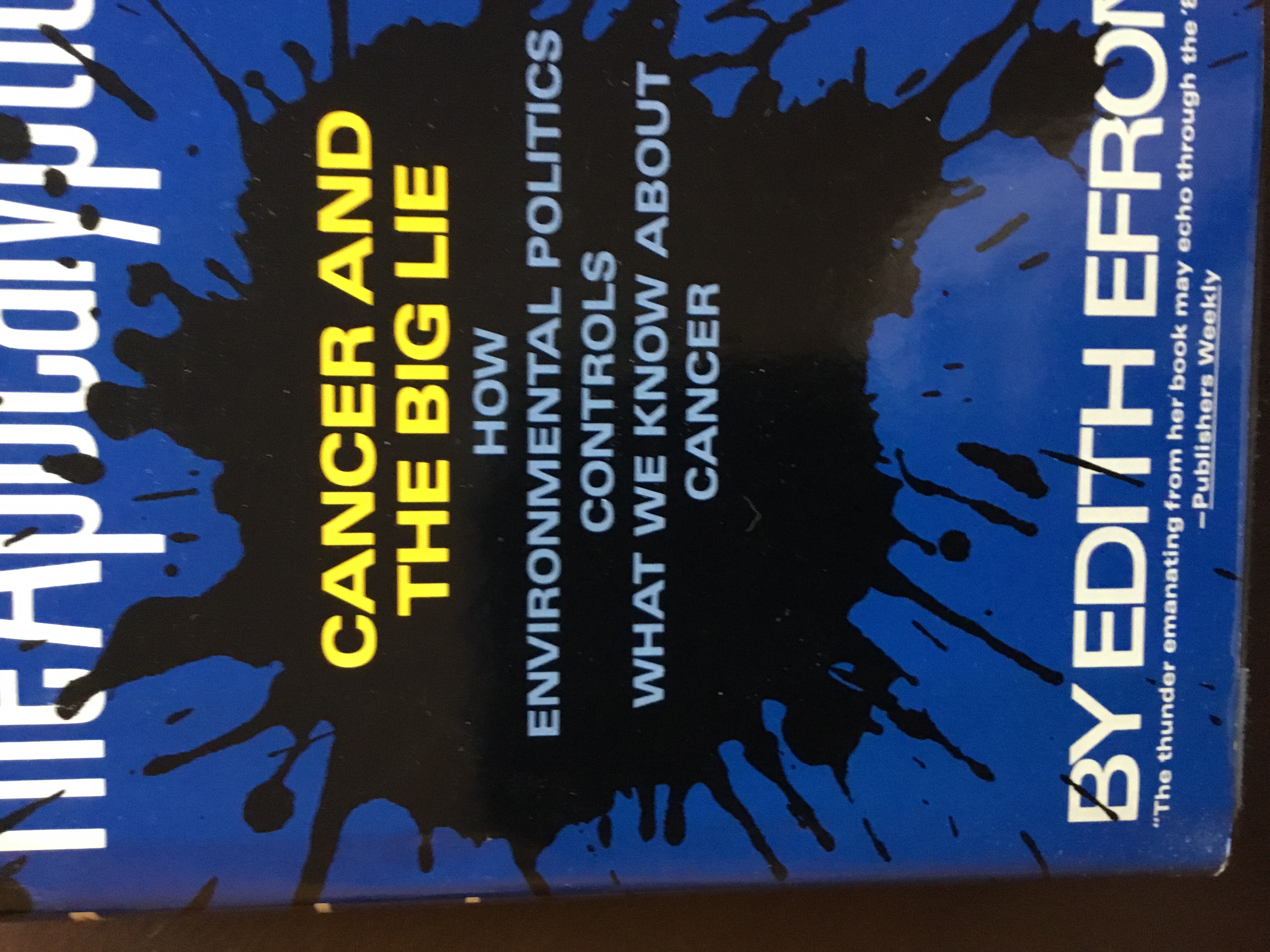
Apocalyptics: Cancer and the Big Lie : How Environmental Politics Controls What We Know About Cancer
This comprehensive study examines the truth about carcinogens and life-threatening substances in the environment and reveals the political manipulation of scientific data and methodology for ideological ends
Hardcover
First published December 31, 1984
Ratings & Reviews
Friends & Following
Create a free account to discover what your friends think of this book!
Community Reviews
Displaying 1 - 3 of 3 reviews

January 19, 2008
Edith Efron, The Apocalyptics: Cancer and the Big Lie—How Environmental Politics Controls What We Know of Cancer (Simon and Schuster, 1984)
Have you ever opened a book, started reading, and within five pages realized that it was going to be one of those books that changes your worldview completely? Let me introduce you to The Apocalyptics, a now-obscure exposé of the cancer industry that should have been a game-changer in this country. But it wasn't. In fact, it's been out of print for over a quarter-century (to the best of my knowledge, the last printing was in September 1985). We'll be talking about this later. But first, an introduction.
This is a doorstop-sized piece of nonfiction, very thick language, covered with so much superscript (there are over a hundred pages of endnotes) that it almost looks as if it has the measles. Efron did her research, and she did it very thoroughly. Make no mistake, this book is not an easy read. But it is a necessary one. This is even more true now than it was in 1984, because it shows the genesis of policy-as-science—the ludicrous idea that has given rise to the ever-wider streak of anti-intellectualism in the American populace. It was the policymakers Efron turns her eye on in this book who are ultimately responsible (though in their defense they could never have foreseen this at the time) for the clarion calls we've been hearing to get intelligent design taught in schools. They're responsible for what is now known, thanks to Chris Mooney's book, as the Republican War on Science. Hell, they're responsible for the state of Kansas as we know it today. (viz. Thomas Frank's What's the Matter with Kansas?: How Conservatives Won the Heart of America.) All this because of one Federal policy decision spurred on by the scientists Efron terms the Apocalyptics: the idea that the danger of cancer caused by industrial chemicals was so great that the possible danger to the public outweighed the need to prove that the possible danger to the public even existed. Efron goes into exhaustive detail first on the basic science behind cancer research and then switches to the regulatory science promulgated by the policymakers, comparing and contrasting. She offers possible reasons why otherwise scientifically-minded people might jump on the regulatory bandwagon (here's a hint: follow the money), and then shows us, as of 1984, how governmental policy was changing based on the Apocalyptics' pronouncements. Reading this book in the waning years of the first decade of the following century (I started it in 2009), it was pretty easy to extrapolate. Were she still alive (she died in 2001), Efron wouldn't be able to write a new edition now; it demands a sequel showing how the cancer that is regulatory science has permeated the very fabric of American culture.
Ever since Woodward and Bernstein, the exposé has been a popular genre. And they all come with blurbs about how important the book is and its possible far-reaching consequences. The Apocalyptics is no exception. And the blurbers were right to hope that when the general public got ahold of this information, there would be the kind of hue and cry that would shake the cancer industry to its foundations, maybe even causing the dismantling of the National Cancer Institute altogether. (If this sounds like overkill, please, for the love of Cod and His son Haddock, read this book. Now.) The scientists may have been self-interested, but it does make sense that the good of the country would have been served with a return to a governmental policy of only trusting hard science when hard science was called for. Instead, we have the FDA pulling drugs off the market that help hundreds of thousands of people because of a half-dozen adverse reactions. Brilliant.
Now, I could offer you a dozen hypotheses about why the public never did anything with this information. They'd have to stay hypotheses given that I am not privy to the book's sales figures, but I'm guessing that most of the general public never got wind of the information contained in this book. Like many exposés, it came, went, and faded into obscurity. It demands rediscovery now more than ever. There's also the general slide into apathy the American people have experienced since the end of the Vietnam war, but with the Occupy movements popping up, that, too, seems to have changed; another reason this book needs to be brought back. For that matter, with the advent of the e-reader, you don't have to cart around a five-pound hardback tome, and maybe even that would be a deciding factor for some folks. (Me, I consider it exercise.) One way or the other, and knowing that it's never going to happen, I'm still going to tell you: read this book as soon as you can get your hands on a copy. Buy as many as you can at used bookstores or through Amazon Marketplace or what have you and give them to every friend you have who has expressed even a passing interest in the scientific method or worried aloud about the state of intellectualism in America. Disseminate this information. It was important in 1984. It's critical in 2011. **** ½
Have you ever opened a book, started reading, and within five pages realized that it was going to be one of those books that changes your worldview completely? Let me introduce you to The Apocalyptics, a now-obscure exposé of the cancer industry that should have been a game-changer in this country. But it wasn't. In fact, it's been out of print for over a quarter-century (to the best of my knowledge, the last printing was in September 1985). We'll be talking about this later. But first, an introduction.
This is a doorstop-sized piece of nonfiction, very thick language, covered with so much superscript (there are over a hundred pages of endnotes) that it almost looks as if it has the measles. Efron did her research, and she did it very thoroughly. Make no mistake, this book is not an easy read. But it is a necessary one. This is even more true now than it was in 1984, because it shows the genesis of policy-as-science—the ludicrous idea that has given rise to the ever-wider streak of anti-intellectualism in the American populace. It was the policymakers Efron turns her eye on in this book who are ultimately responsible (though in their defense they could never have foreseen this at the time) for the clarion calls we've been hearing to get intelligent design taught in schools. They're responsible for what is now known, thanks to Chris Mooney's book, as the Republican War on Science. Hell, they're responsible for the state of Kansas as we know it today. (viz. Thomas Frank's What's the Matter with Kansas?: How Conservatives Won the Heart of America.) All this because of one Federal policy decision spurred on by the scientists Efron terms the Apocalyptics: the idea that the danger of cancer caused by industrial chemicals was so great that the possible danger to the public outweighed the need to prove that the possible danger to the public even existed. Efron goes into exhaustive detail first on the basic science behind cancer research and then switches to the regulatory science promulgated by the policymakers, comparing and contrasting. She offers possible reasons why otherwise scientifically-minded people might jump on the regulatory bandwagon (here's a hint: follow the money), and then shows us, as of 1984, how governmental policy was changing based on the Apocalyptics' pronouncements. Reading this book in the waning years of the first decade of the following century (I started it in 2009), it was pretty easy to extrapolate. Were she still alive (she died in 2001), Efron wouldn't be able to write a new edition now; it demands a sequel showing how the cancer that is regulatory science has permeated the very fabric of American culture.
Ever since Woodward and Bernstein, the exposé has been a popular genre. And they all come with blurbs about how important the book is and its possible far-reaching consequences. The Apocalyptics is no exception. And the blurbers were right to hope that when the general public got ahold of this information, there would be the kind of hue and cry that would shake the cancer industry to its foundations, maybe even causing the dismantling of the National Cancer Institute altogether. (If this sounds like overkill, please, for the love of Cod and His son Haddock, read this book. Now.) The scientists may have been self-interested, but it does make sense that the good of the country would have been served with a return to a governmental policy of only trusting hard science when hard science was called for. Instead, we have the FDA pulling drugs off the market that help hundreds of thousands of people because of a half-dozen adverse reactions. Brilliant.
Now, I could offer you a dozen hypotheses about why the public never did anything with this information. They'd have to stay hypotheses given that I am not privy to the book's sales figures, but I'm guessing that most of the general public never got wind of the information contained in this book. Like many exposés, it came, went, and faded into obscurity. It demands rediscovery now more than ever. There's also the general slide into apathy the American people have experienced since the end of the Vietnam war, but with the Occupy movements popping up, that, too, seems to have changed; another reason this book needs to be brought back. For that matter, with the advent of the e-reader, you don't have to cart around a five-pound hardback tome, and maybe even that would be a deciding factor for some folks. (Me, I consider it exercise.) One way or the other, and knowing that it's never going to happen, I'm still going to tell you: read this book as soon as you can get your hands on a copy. Buy as many as you can at used bookstores or through Amazon Marketplace or what have you and give them to every friend you have who has expressed even a passing interest in the scientific method or worried aloud about the state of intellectualism in America. Disseminate this information. It was important in 1984. It's critical in 2011. **** ½

December 27, 2023
If one is puzzled by how the emergence of "scientist as policymaking excuse" his emerged and how it inevitably corrupts the scientific process. This older but still relevant book will walk you through the process. Today we have many more examples of course - nuclear regulation, dietary advice, climate catastrophism. All partake of the apocalyptic mindset described here, and only the details differ. The disappearance of the phrase that should be commonplace in science, "I don't know", can be traced to these roots.

April 21, 2025
The best popular science book I've read. Thoroughly detailed but not monotonous. If you want to understand the environmental ideology, and it's hostility to reality, start here.
Displaying 1 - 3 of 3 reviews