Librarian Note: There is more than one author by this name in the Goodreads database.
Richard Murphy was one of Ireland’s most distinguished poets. He is particularly known for poems that draw on the landscape and history of the west of Ireland. His Collected Poems (Gallery Press) was published in 2000, his acclaimed autobiography The Kick (Granta Books) in 2003. His awards include the Cheltenham Award and the American-Irish Foundation Award.
‘Richard Murphy’s verse is classical in a way that demonstrates what the classical strengths really are. It combines a high music with simplicity, force and directness in dealing with the world of action. He has the gift of epic objectivity: behind his poems we feel not the assertion of his personality, but the actuality of events, the facts and sufferings of history’ (Ted Hughes).
Richard Murphy, who died in Sri Lanka in 2018 at the age of 90, is one of Ireland’s most important contemporary poets. He is best known for his four major collections, from 1963, 1968, 1974 and 1985, although there are others too, totalling around a dozen in all.
Although Richard Murphy was born in 1927 to an Anglo-Irish family in County Mayo in the West of Ireland, he spent much of his early childhood in Sri Lanka, (then called Ceylon) where his father worked in the British colonial service, and was the last British mayor of Colombo, the capital city. Richard Murphy was sent back to England to be educated at private schools in Canterbury and Berkshire, and read English at Magdalen College, Oxford, where one of his tutors was C.S. Lewis. He met Stephen Spender there, and thought of becoming a poet.
Richard Murphy later studied at the Sorbonne in Paris, and went on to establish a school in Crete. His first poetry collection, “The Archaeology of Love” was published in 1955, and the poems in that collection reflect Richard Murphy’s experiences in England and Continental Europe.
However in the early Fifties he returned to the West of Ireland, and settled in the erstwhile fishing village of Cleggan, in Connemara. Richard Murphy believed that poetry and other writing about the sea was often too metaphorical. He wanted to write about the sea in a realistic way, so decided that the best way would be to experience the sea at first hand before writing about it. As a consequence, he bought a couple of boats and started a modest fishing business.
Restoring a boat himself, can in a way be seen as a concrete example of his aim to recover and reveal the Irish past, which is so much a feature of his verse. By the time of his second collection of poetry, Sailing to an Island, Richard Murphy had found his voice, and his concerns. Faber and Faber, who published the collection, were also publishing poetry by Philip Larkin, Ted Hughes and Thom Gunn. Sailing to an Island is thus a major work of poetry dating from 1963.
Much of Richard Murphy’s poetry is about Ireland, and particularly about the places he knew well. Most of those which have lasted from this time, were inspired by the landscape, or rather the seascape, and the oral history of the West of Ireland.
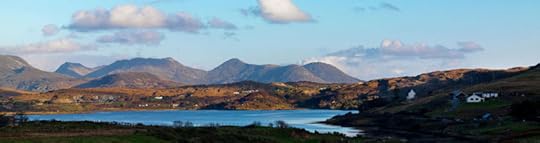
Connemara, County Galway, West of Ireland
Nearly all the poems in Sailing to an Island are about a particular part of Connemara, in the West of Ireland, and the peoples who lived there. Cleggan, where he lived, was a village where fishing had been abandoned, after a famous sailing disaster. On 28th October 1927, 25 fishermen, who were out in rowing boats at night were tragically lost in a tumultuous storm. Richard Murphy used first-hand accounts of survivors, and with great mastery and skill wove the material into a long poem called “The Cleggan Disaster”. It is perhaps his signature poem; certainly it is one of his most famous long poems. It begins:
“Five boats were shooting their nets in the bay After dark. It was cold and late October. The hulls hissed and rolled on the sea’s black hearth In the shadow of stacks close to the island. Rain drenched the rowers, with no drying wind. From the strokes of the oars a green fire flaked And briskly quenched. The shore-lights were markers Easterly shining across the Blind Sound.”
Allied with the rolling rhythm, and evocative language, we have precise details:
“Down in the deep where the storm could not go The strong ebb-tide was drawing to windward Their cork-buoyed ninety-six fathom of nets With thousands of mackerel thickly meshed …”
And by halfway, the tension has mounted; the rhythm and line lengths have changed and the sentences are shorter. We are gripped in the moment, sharing the terror of these men fighting for their lives:
“The men began to pray. The stack-funnelled hail Crackled in volleys, with blasts on the bows Where Concannon stood to fend with his body The slash of seas. Then sickness surged, And against their will they were gripped with terror. He told them to bail. When they lost the bailer They bailed with their boots. Then they cast overboard Their costly nets and a thousand mackerel.”
The poem is narrative, with documentary details, but the language can swell and change into a surreal and horrific lyricism:
“What were those lights that seemed to blaze like red Fires in the pits of the waves, lifted and hurled At the aching sockets of his eyes?”
and yet some of the horror is literal and down-to-earth:
“In the dark before the moon rose, he could smell Fish-oil and blood oozing from the nets Where a shark was gorging on the tails of mackerel.”
And after the tale is told, many stanzas later, the poem transforms into a song-like memory. Gone is the breathtaking dramatic depiction of the destructive power of the sea. This part is written in a completely different style and voice, mourning and reflecting on those events long ago:
“Whose is that hulk on the shingle? The boatwright’s son repairs Though she has not been fishing For thirty-four years Since she rode the disaster?”
The ending has a different form: a different rhythm and metre. There are 5 verses of 8 lines, each with a strict rhyming scheme. Each begins a memory, “Where are the red-haired women?”, “Where are the barefoot children”, “Where are the dances in houses”, and finally:
“Why does she stand at the curtains Combing her seal-grey hair … When will her son say 'Forget about the disaster We’re mounting nets today!’”
As Ted Hughes said:
“He has the gift of epic objectivity: behind his poems we feel not the assertion of his personality, but the actuality of events, the facts and sufferings of history.”
Ted Hughes was to become a great friend of Richard Murphy, but not before his wife Sylvia Plath had made a pass at Richard Murphy, and tried to seduce him while staying in his house in Connemara …
“The Cleggan Disaster” had won the Cheltenham Poetry Prize in 1962, and one of the judges had been Sylvia Plath. Falling in love with the west of Ireland through that poem, and others by him, she had written to tell Richard Murphy that his poem had won, and to ask if there was “any chance of Ted and me coming to Bofin … I have always desired, above many things, a friend with a boat.”
A couple of months later Sylvia Plath and Ted Hughes visited Richard Murphy in his home. Sexually ambivalent, although he managed to marry happily, for a short while, before a painful separation (he had later written bittersweet poems to his ex-wife), Richard Murphy was (by other accounts) an imposing figure. One critic wrote of his:
“impeccable English-accented voice with its inflections of the west of Ireland ... also his posture, the tall, seemingly aloof, intense yet ambling figure”.
So Richard Murphy put them up, sailed them both to Inishbofin Island on his boat, took them to both to Lady Augusta Gregory (an Irish dramatist)’s home “Coole Park” and to Yeats’s castle “Thoor Ballylee”, which are both in County Galway. He generally played the attentive and courteous host, until one dinner-time Sylvia gave him a playful kick under the table. Ted Hughes left the next day, going to fish with the painter Barrie Cooke in Clare, without saying goodbye to his host. Sylvia Plath also left abruptly shortly afterwards, for England.
Years later, Richard Murphy spoke about their visit to author Anne Stevenson, who was writing what proved to be a controversial biography of Sylvia Plath called “Bitter Fame”. He said:
“Ted asked me to write it. I wrote it as if I had my hands tied behind my back, giving evidence to the jury …What disturbed me about the incident was the violation of hospitality - one of my guests was asking me to betray my other guest, her husband.”
“The Cleggan Disaster” is a grand elegy: an intensely powerful, almost electric poem, which commemorates an event which feels peculiarly personal to the poet. Such nautical narratives top and tail Sailing to an Island. The title poem, which begins this collection, describes another perilous sea trip, although in this case the disaster was averted.
Richard Murphy and his brother had set sail for the legendary island of “Gráinne Mhaol”, (or “Clare Island”), home of the legendary pirate queen. But instead they are driven back into the harbour of Inishboffin, where he meets men in the real world and exchanges romance for reality. It changed his life. Richard Murphy had revelled in novels about the sea, but now he had direct experience of its attractions and dangers. LINK TO THE POEM HERE
Richard Murphy was to live in Cleggan throughout the 1960s and 1970s. His poetry from that time is both general and personal, dealing both with the working fishing community, who are usually Catholic and poor, and the more wealthy Anglo-Irish Protestants, to which Richard Murphy and his family belonged:
“The Woman of the House” is an affectionate portrait of his grandmother, Lucy May Ormsby. It evokes the lost world of the *Ascendancy and is intensely personal, being predominantly a narrative created from his own memory:
“Her mind was a vague and logwarmed yarn Spun between sleep and acts of kindliness: She fed our feelings as dew feed the grass On April nights; and our mornings were green.”
These stresses and rhythms, the formal style, the use of half-rhyme, all combine to a feeling of warmth and comfort. In 26 quatrains, it describes how despite a formerly grand family background, her existence has become pitiable, and almost futile. I love the rich details in the poem, especially about the house which is fixed in a time long past:
“Hers were the fruits of a family tree: A china clock, the Church’s calendar Gardeners polite, governesses plenty, And incomes waiting to be married for.”
The poem depicts his grandmother’s decline into dementia; a pointed parallel to the decline of the Protestant Ascendancy itself.
I very much like these lyrical poems. One, “Epitaph on a Fir Tree” is, again, rather an epitaph on the Anglo-Irish Ascendancy with all its wealth and society weddings, now long gone. The literary conceit is that the tree is a witness to everything which has happened and changed:
“Except for daffodils, the ground is bare: We two are left. They walked through pergolas And planted well, so that we might do better.”
Other short poems I enjoyed are “Droit de Seigneur: 1820”, “Connemara Marble”, “Auction”, “Girl at the Seaside”, and especially “The Philosopher and the Birds”. This poem was written in 1951 after Richard Murphy had won an award which enabled him to rent a cottage: “Quay House” at Rosroe on Killary Fjord, in Connemara, for two years. The previous tenant had been the philosopher Ludwig Wittgenstein, some of whose letters he found in the turf shed (serving as draught excluders, according to his memoir). The poem is a tribute, in memory of Wittgenstein at Rosroe. It includes the memorable words:
“He clipped with February shears the dead Metaphysical foliage”
Wittgenstein apparently loved birds, and had left money with the caretaker to feed them after his departure. Here is the final stanza of the poem:
“His wisdom widens: he becomes worlds Where thoughts are wings. But at Roscoe hordes Of village cats have massacred his birds.”
Richard Murphy said that “he had made them so tame, the cats ate them … When the great man is gone, the disciples get gobbled up.”
“The Poet on the Island”LINK HERE, but please turn the page for the final three stanzas!, is another tribute, this time a portrait of the poet Theodore Roethke. These lovely lyrical pieces sit beside the big narratives, though both display his concern with storytelling.
Other poems about seafarers in this collection are “The Last Galway Hooker”: a poem inspired by his experience of buying and restoring a sailing boat of traditional design, and “Pat Cloherty’s Version of The Maisie”. They too describe a distinctive region, and are about those who manned the boats. This Irish seafaring world, was a world that Richard Murphy had made his own.
Richard Murphy had a strong urge to explore his Irish inheritance. His early influences were John Milton, William Wordsworth and Dylan Thomas. He was firmly committed to accuracy in his historical narratives, but brought up as part of the British-oriented Protestant Ascendancy, he struggled to find an identity.
Perhaps this is in part why his poems combine intimacy with a measure of detachment. Like his predecessors such as W.B. Yeats and J.M. Synge, he was forced to accept that finding a place in a largely Catholic Ireland, which was dedicated to firmly shedding any British identity, was not easy. Many would tend to reject him as not truly Irish.
His was a writing career which spanned many years, and he has left us a great legacy. His writing about Connemara is beautiful, classical, and can give you a shiver down the spine.
“I wrote poetry all my life to try to make something last ... I wrote about people I loved. Poetry is the best way of remembering through words people we love.”
“I searched for grounds of pleasure that excluded nobody, till I found them by living with friends I loved among people on or near the sea. There I tried to write poetry true to that life in words put together to last.”
* NOTE: The Anglo-Irish Protestant Ascendancy, known simply as the Ascendancy, was the political, economic, and social domination of Ireland between the 17th century and the early 20th century by a minority of landowners, Protestant clergy, and members of the professions, all members of the Established Church.
A small volume (63 pages) by a poet who lived in Galway. Published 1963 by Faber and Faber, London with a second printing the same year. My wife's father was a friend of the poet. Our copy, slightly smoke-damaged in a house fire, is inscribed to another mutual friend.
The poems are mostly about Galway life and death. The longest is a very short epic about a marine disaster in 1927, reads very well. There are two short poems in here that are great favorites of mine, warrant four stars to the book. These are "Epitaph on a Fir Tree" "The Philosopher and the Birds," which is about L. Wittgenstein, who lived near Cleggan. The latter poem is followed by a good one one dedicated to Theodore Roethke.
This book is well worth seeking out for everyone who likes poetry written in 20th C. Ireland in English.
‘Sailing to an Island’ by Richard Murphy At one of the bookshops in Hay-on-Wye, when at the Hay Literary Festival, I bought this used copy of a Faber ‘paper covered’ 1968 edition, sent out for review with the original note from Faber still intact. Telling of storms and fishing hardship, Irish island life, this is an entertaining collection for anyone enjoying tales of the sea. Scattered imagery like flotsam in the poems is treasure to collect, such as: in an elegy to his grandmother Lucy, he says: “in the lake of her heart we were islands”; and, in a poem offered ‘For Wittgenstein’, he says: “His wisdom widens: he becomes worlds/Where thoughts are wings …”