It is the night of September 5th, 1907, and the Moscow train is approaching St Petersburg. Traveling first class appears to be a young Russian princess and her fiancé. They are impostors. In the luggage carriage are the spoils of the Yerevan Square Expropriation, the greatest bank heist in history. The money is intended for Finland, and the hands of a man known to the Tsarist authorities as The Mountain Eagle--Vladimir Ilyich Lenin.
I'm a university lecturer and researcher based in Canterbury, UK.
For the most part, I write thoughtful, character-based science fiction thrillers with a philosophical edge, like 'Deja Vu', which has been republished by Unsung Stories.
Déjà Vu won the Red Adept Science Fiction Award.
Otherwise, I have been known to write comedy fiction.
Drop me an email if you like: ihocking@gmail.com. I also maintain a mailing list for those interested in keeping up with my work.
“Quit messing with my mind!” are words that I mumbled a number of times as I was reading Ian Hocking’s The Amber Rooms. Time travel, alternate universes, brain-nanotechnology interface and quantum entanglement are all components of this novel, which to say is nothing less than mind bending. Of all the Saskia Brandt novels, The Amber Rooms, is undoubtedly the most complex which says a lot, as this series is one challenging read.
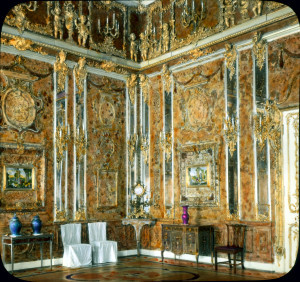
The Amber Rooms begins not long after the second novel, Flashback, ends. (Minor spoiler alert for Flashback) At the ending of Flashback, Saskia Brandt had left the year 2003 expecting to be transported into the future, but instead, arrived in Russia in the year 1907 at a pivotal point in its history. Russia was in turmoil and it was a time when it was difficult to trust anyone. Saskia’s goal was to arrive at a set time in the Amber Room located in the Catherine Palace of the Tsar’s Village. (Historically, the Amber Room is a real place which was disassembled by the Nazi’s during World War II.) The Amber Room is significant because it is the launching point for Saskia to travel back to the future. But getting there would be a challenge, as Saskia had to take on many roles and barely escape death to get there. Once she reaches the Amber Room, things turned weird.
The Amber Room in Catherine Palace in 1931
Hocking’s style of writing has an artistic flair, along with the complex subject matter of time travel, parallel universes, and sophisticated technology, makes for a very challenging read. Hocking states in the beginning of the book that The Amber Rooms can be read as a standalone, but I would disagree, as I really feel that reading Déjà vu and Flashback will make reading The Amber Rooms much easier. In this addition of The Amber Rooms, Hocking has combined it with the novella Red Star Falling, which is a wise move, as it really gives a better ending to The Amber Rooms.
Besides the technological aspect of the novel, The Amber Rooms, gives a glimpse into Russian history at a time before the Russian revolution of 1917 takes place. Saskia gets to encounter the likes of Stalin and Lenin, as well as the brutalities that existed during that time period which makes for an educational and interesting read.
The Amber Rooms may mess up your mind, but it’s worth it.
This book was given to me as part of a series in exchange for an honest review. Although I had the Omnibus I opted to review each book individually, keeping in mind the fact that it was related to other books that expanded the story. This is not a summary - for that read the description. For a review, read on (no promises it will be good though)!
More confusing than first two books, the Amber Rooms still focuses on the same main character, adding a few new ones to help carry a fair portion of the story, and returning to one character who has been present throughout all of the books, yet remained a mystery. In this third book that mystery finally begins to unravel.
As with the first two, this book has the story moving in a semi non-linear fashion, and if anything is more confusing with its hopscotching through time than both books before it combined. I say semi non-linear because I feel at heart it struggles to be linear, yet never achieves that goal, at least not in a manner we can see.
Russia, 1908, seems to be the time for this book, as we return to it time and again. Of course there is a logic there, tied to the title of the book. For those who know world history well, they will make the connection early on; for those not as well versed in Russian history enough will be explained to make the connection clear. Given the prominence of that era, it interesting to view that part of history through the lens of the characters and their individual and shared stories.
As individual books I think I'd rank this lowest due to the confusion, and also because some would make no sense without information from the prior books. It also left some loose ends, which normally is acceptable since that grants the author access to continue the story should they elect to, and gives the reader a chance to creatively add their own mark in the world inside the story.
The three books taken as a whole are terrific and get 5 stars from me. This is a stunning work that blends fact and fiction together to create something refreshingly new and completely enjoyable. With these books you aren't just along for the ride, you are actively engaged, and at times laboring right alongside the character(s) to figure out what is going on before time runs out.
When Saskia Brandt vanished from 2003 at the end of Flashback she probably did not expect to end up in 1907 among Georgian communist bank robbers.
Most of this book is a well-researched (in an interview included the author tells he even learned Russian to write the book) historical novel told from the perspective of a time traveler. At first I was a bit put off by the fact that the time travel aspect was kept a mystery. The story opens right in the middle of things, and the pieces come together rather slowly and not always in the most obvious order.
Not being a history buff I missed some authentic historical characters like Kamo, until I looked things up on Wikipedia and learned a lot. (Also felt a little stupid.)
The time travel aspect gets more mysterious by each book. I have thought there are two ways to deal with time travel into the past:
1. The actions of the time traveler split off a different future universe and she can never go back to the one she came from. This avoids paradoxes (except for the traveler coming from "nowhere") but isn't really that much fun for storytelling purposes (no time loops, for instance, for if a time traveler goes back to meet her past self, that past self will never become that particular future self).
2. Whatevet the time traveler does will turn out to be part of the immutable past. (This series seemed to be following this school of thought, but this latest book raises some questions.) This idea has beem used in fun ways at least since Heinlein's "By His Bootstraps". Of course, we can think of someone going back in time with the explicit purpose of changing things. How do events always so conveniently conspire to thwart such intentions?
There is of course a third option: 3. The past can be changed, but some kind of "Time Police" protects the "official" version of it.
Anyway, I don't really know where this series is going with this. Which is kind of fun.
The Amber Rooms is the third book in the Saskia Brandt series. It continues with what happens to Saskia in Flashback (the second book). Although a person could get away with reading this book as a standalone, I would suggest reading the first and second book. It has references to both. [I have a review for each of these books.]
Characters: The main character of this third person narrative is Saskia who adopts many names along the course of the book. She still is a strong likeable character as she was in the other books. This time her adventures take her to Russia – picture Bolsheviks, Lenin, etc. She is yet again involved with crimes and ninja-type maneuvers. The other characters, like the other books in the series, where complex and drawn out. (And yes, Ego does make a guest appearance in this book as well. I’ll let you read how.)
Plot: In The Amber Rooms, Saskia is trying to gain access to the Amber Room at the Summer Palace where she believes at certain points of time she can go home to the future. However, this is not an easy task. She is running out of time and she is involved with some unsavory characters from a heist. The plot for me really took off just after the halfway point of the book. This is where things start coming together and the back story of what happened prior is explained. There are some surprises and the reader wonders how this might affect the future (that we know from the prior books.)
Overall, it was a good read. I finished reading it in about two days. There is room for another book at the end after the reader is left wondering what will happen to Saskia.
Dr. Ian Hocking brings a refreshing aspect to time travel. The books are an embodiment of the terminology "technothriller". Though the Saskia Brandt Omnibus may be placed under the sci-fi category, it is most definitely in a class of it's own. I most enjoyed the fact that being a "sci-fi" book, the entire story stayed rooted on planet Earth. These three books are an obvious culmination of the time and study the author dedicated to the idea of travelling through time and addressing well-known historical data.
The last book of the omnibus is THE AMBER ROOMS. The author's vast researching skills are evident in this last book of the series. This book brings together some of the gaps from the other two books. I quite enjoyed the interesting facts about pre-revolutionary Russia placed into the story. Saskia Brandt is transported back to the last crumbling days of Tsarist Russia. Unlike the other two predecessors, this book only relies on technology to supplement the story, not to make it the main attention grabber.
First of all I've to admit that it's worth reading the first and second book of this sequel to get an idea of the time travelling. Ian Hocking provided the copy I've got with a short summary of both earlier books and I'm glad for that also he remarked that this book could stand as an own story.
The story takes place in the early 20th century mostly in St. Petersburg but also in some places in the south of Russia and in Switzerland. Saskia is travelling with some dubious characters which are partly related to real historical persons. Whereas she is trying to bring the money of the heist securely to the right party she is struggling with different groups and moreover is fighting for her survival. With the help of a special band and the Amber Room she should be able to find her way back to her real life in 2023. In the middle of the book this time transfer gets started but instead of landing in 2023 she is passing different Amber Rooms and is still in the early 20th century where the explanations for the first half of the story starts. (3 1/2 stars)
This book was quite a bit darker in tone than the previous two, and gorier too. though it doesn't feel gratuitous. But Saskia continues to be one of the most engaging characters I've had the pleasure of reading. Her memory issues felt very, very realistic. The technology and timelines was more complex this time around but still followable. One thing that really stands out to me about this series is the way it bucks, without making a big deal of it, heteronormativity. As a queer woman, that means a whole lot to me. I love where the story ended up. If this was all we were getting it would be enough to leave me hopeful for the characters. But Mr. Hocking has said that there will be more and that makes me VERY happy!
I'm not sure that I liked this book as well as Ian Hocking's previous 2 books in this series. While the epilogue superbly wraps everything up, you have to read the entire book (about [SPOILER ALERT!] expanding from time travel to parallel universes and Stalin and Lenin in late Tsarist Russia (early 1900's)) to get there.