Revolting Subjects is a ground-breaking account of social abjection in contemporary Britain. Focusing on citizenship, social class and migrant illegality and utilizing a number of high-profile case studies, it details the abject forms of injustice which neoliberal social and economic policies effect. Throughout, Revolting Subjects reveals the pivotal role of media systems in procuring public consent for forms of government that corrode democracy. Tyler argues for a deeper psycho-social understanding of the impact of stereotyping and scapegoating whilst also revealing how counter-representational strategies can be a creative resource for resistance.
Imaginative and original, Revolting Subjects introduces a range of new insights into neoliberal societies, and will be essential reading for those concerned about widening inequalities and social justice in the wider global context.
[Through my ratings, reviews and edits I'm providing intellectual property and labor to Amazon.com Inc., listed on Nasdaq, which fully owns Goodreads.com and in 2014 posted revenues for $90 billion and a $271 million loss. Intellectual property and labor require compensation. Amazon.com Inc. is also requested to provide assurance that its employees and contractors' work conditions meet the highest health and safety standards at all the company's sites].
Extremely serious book, allegedely in the "political and critical tradition of British cultural studies best exemplified by the work of Stuart Hall" (p.215), but actually drawing heavily on Rancière's aesthetics of politics and Agamben's philosophy of law, and also paying tributes to Klein, Federici and Graeber. The resulting analysis is therefore a bit halting and too deferential to its diverse cultural authorities to make a strong, coherent case, but the evidence collected along the way is arresting.
The core thesis is that the manufacturing of a "politics of disgust" is instrumental to state-crafting in neoliberal societies. The author analyses the mediatic campaigns against asylum seekers, Irish Travellers, 'chavs', and disabled people in the UK and identifies a common thread in the creation of consensus in the governed over the contaminating threat of despicable 'others', which explodes in dissent when the despicable others disagree to agree and revolt.
Why is this politics of disgust particularly relevant to the neoliberal state? If we follow Foucault, Agamben and Rancière, we do not get an answer, because they posit that racism (a particularly severe form of politics of disgust?) is inherent to sovereignty per se, over the centuries.
Beyond the scope of cultural studies, we should probably distinguish between democracies and authoritarian states, and between class-divided and single-class societies, in the Marxian meaning of class. Neoliberal states are single-class, democratic societies - having deproletarianized the economy through delocalization and off-shoring of production. Whereas racism in authoritarian and class-divided Nazi Germany was used for nation building purposes to distract from a class war that was dangerously economically grounded (peasants, workers, bourgeoisie and rentiers having clearly diverging interests), in the neoliberal democratic state a politics of disgust is used to underpin the ideology of meritocracy. Where everyone is fundamentally a rentier - Buckingham Palace to council estate - the problem you have is one of wealth distribution. The neoliberal ideology of meritocracy states that your share in the pie has to be deserved and is by definition deserved.
Look at the 'chavs' (essentialist label designating workless people living on council estates): they have nothing because they are worth nothing (watch on Youtube "Little Britain", a revolting spoof of this British brand of "white trash" - to use the equivalent American term from the segregated South of the Sixties). The middle income earners have what they have because they are polite. The rich deserve their wealth because they 'aspired' to it, etc.
It has to be clear that only members of the national society can claim a share (in consideration of their worth) in the national rent. So non-members (asylum seekers, immigrants) have either to be excluded or to earn every penny they get through hard work.
The neoliberal state therefore squanders inordinate amounts of money on the maintenance of boundaries separating the haves from the have-nots and the haves from the have-mores, to ensure that no contamination take place, to the point that ‘the council estate’ would come to mark the moral boundaries of the nation-state." (p. 160).
Asserting - as was the case in the 2011 riots - that the have-nots can aspire to the same share in the pie as the bright young things (that selfrighteously helped to clean up the mess after the revolt) just because they exist, and not for any specific merits, is totally unacceptable, the taboo par excellence, as the hysteria in the aftermath of the revolt showed. The boundaries have to be protected physically but also ideologically, and any breach in the "Because I'm worth it/because you're worth it" discourse is to be staved off as an attack even more dangerous than physical looting.
In this context, the Occupy movement (not covered in this book) can be understood as perfectly aligned to the neoliberal ideology: what it said was, "we, the 99%, the single-class society, want a bigger share of the national rent, because we are so nice and well educated". It's like when an employee asks for a pay rise because they are worth it. The employer smiles.
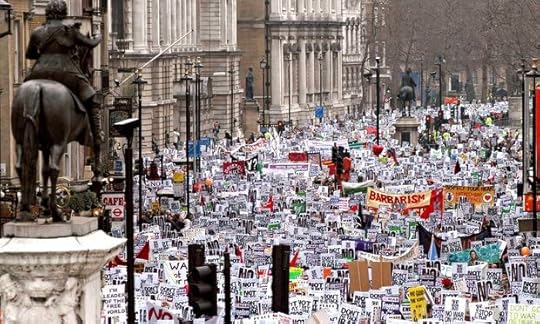
The most melacholic, because totally useless, of all the revolts captured in the book are however the massive 2003 anti Iraq war protests. The indifference of power to this huge single-class display of dissent is revealing of the impotence of democracy when decoupled from class struggle (everyone protesting is no one protesting).
But the author, loyal to cultural studies to the end, does not take the point: "The task of political action, therefore, is aesthetic in that it requires a reconfiguration of the conditions of sense perception so that the reigning configuration between perception and meaning is disrupted by those elements, groups or individuals in society that demand not only to exist but indeed to be perceived." (p. 149)
Revolting Subjects is a brilliant book about the ways in which various people, from asylum seekers to the ‘chav’, are depicted as the ‘underclass’ in contemporary Britain. Imogen Tyler weaves together academic theories and original research studies to provide an insightful, succinct, and beautifully written picture of Britain as we know it, in all its inequality. I found the case studies particularly compelling- they give the theories depth, context, originality, and are also incredibly moving, particularly ‘Abas Amini’s’ story. The contemporary take on, and new framing of, abjection theories are original and fascinating, bringing new life to old academic material, making it more relevant for modern readers. I thoroughly enjoyed reading this book, and was continually moved and inspired. A must for anyone interested in theories on class, disgust, revolt and neoliberalism.
This is pretty good, mixes academic sources with popular culture, political rhetoric and mass media discourse. It's fairly well written too and skirts away from too many of those portmanteau words that trendy social scientists like to coin, and is all the better for it: abstruse prose and lack of clarity often spoil books of this kind.
The notion of the revolting subject is developed coherently and the case studies are relevant and to the point. Good references too, quite a few of which I have followed up, or will be, including several of Imogen Tyler's articles. Very promising writer.
I have recently read a number of books in this genre which were full of interesting facts and comments, but this was not one of them. It was reminiscent of my university text books as it was just mainly extracts and comments from other academics and Journalists.
Decent read exploring how the social insecurity generated by neoliberal government has given rise to novel modes of (re)classification - refugees transformed into bogus asylum seekers, unemployed young people into feckless chavs, people with disabilities into welfare cheats
This is a powerful book that demonstrates how neoliberal policies objectify and demonize particular groups. These groups are dehumanized by politicians and policy makers. Whether women, citizens of colour, the unemployed, men and women with impairments or the young, these groups are excluded and blamed for social, economic and political problems.
Tyler diagnoses the causes and consequences for this demonization. The impact on individuals and communities is vast. How this culture of blame and demonization can be transformed is reliant on the trajectory of neoliberalism. This is the moment we will decide on this economic and social future.