

What do you think?

Jadąc do Babadag
„Jadąc do Babadag” to książka o podróży przez zapomnianą Europę. Polska, Słowacja, Węgry, Rumunia, Słowenia, Albania, Mołdawia – przez te kraje podróżuje autor. Samochodem, autostopem, pociągiem. Ale jednocześnie jest to podróż w głąb świadomości mieszkańca tej części Europy, która zawsze była uważana za gorszą, zapóźnioną, prymitywną i zacofaną.
Jednak autor ogląda te kraje w sposób pozbawiony kompleksów. Czasami ma się nawet wrażenie, że to jedyne kraje na ziemi, co pozwala uniknąć nudnych i jałowych porównań z Zachodem bądź Wschodem. „Jadąc...” to książka przygodowa i podróżnicza. Nie tylko w sensie geograficznym, ale także – a może przede wszystkim – duchowym.
Jednak autor ogląda te kraje w sposób pozbawiony kompleksów. Czasami ma się nawet wrażenie, że to jedyne kraje na ziemi, co pozwala uniknąć nudnych i jałowych porównań z Zachodem bądź Wschodem. „Jadąc...” to książka przygodowa i podróżnicza. Nie tylko w sensie geograficznym, ale także – a może przede wszystkim – duchowym.
321 pages, Paperback
First published January 1, 2004
About the author
Andrzej Stasiuk
68 books328 followersAndrzej Stasiuk is one of the most successful and internationally acclaimed contemporary Polish writers, journalists and literary critics. He is best known for his travel literature and essays that describe the reality of Eastern Europe and its relationship with the West.
After being dismissed from secondary school, Stasiuk dropped out also from a vocational school and drifted aimlessly, became active in the Polish pacifist movement and spent one and a half years in prison for deserting the army - as legend has it, in a tank. His experiences in prison provided him with the material for the stories in his literary debut in 1992. Titled Mury Hebronu ("The Walls of Hebron"), it instantly established him as a premier literary talent. After a collection of poems Wiersze miłosne i nie, 1994 ("Love and non-love poems"), Stasiuk's bestselling first full-length novel Biały kruk (English translation as "White Raven" in 2000) appeared in 1995 and consolidated his position among the most successful authors in post-communist Poland.
Long before his literary breakthrough, in 1986, Stasiuk had left his native Warsaw and withdrew to the seclusion of the small hamlet of Czarne in the Beskids, a secluded part of the Carpathian mountain range in the south of Poland. Outside writing, he spends his time breeding sheep. Together with his wife, he also runs his own tiny but, by now, prestigious publishing business Wydawnictwo Czarne, named after its seat. Apart from his own books, Czarne also publishes other East European authors. Czarne also re-published works by the émigré Polish author Zygmunt Haupt, thus initiating Haupt's rediscovery in Poland.
While White Raven had a straight adventure plot, Stasiuk's subsequent writing has become increasingly impressionistic and concentrated on atmospheric descriptions of his adopted mental home, the provincial south-east of Poland and Europe, and the lives of its inhabitants. Opowieści Galicyjskie ("Tales of Galicia"), one of several works available in English (among the others are "White Raven", "Nine", "Dukla," "Fado," and "On the Road to Babadag") conveys a good impression of the specific style developed by Stasiuk. A similar text is Dukla (1997), named after a small town near his home. Dukla achieved Stasiuk's breakthrough in Germany and helped built him the most appreciative reader-base outside of Poland, although a number of Stasiuk's books have been translated into several other languages.
After being dismissed from secondary school, Stasiuk dropped out also from a vocational school and drifted aimlessly, became active in the Polish pacifist movement and spent one and a half years in prison for deserting the army - as legend has it, in a tank. His experiences in prison provided him with the material for the stories in his literary debut in 1992. Titled Mury Hebronu ("The Walls of Hebron"), it instantly established him as a premier literary talent. After a collection of poems Wiersze miłosne i nie, 1994 ("Love and non-love poems"), Stasiuk's bestselling first full-length novel Biały kruk (English translation as "White Raven" in 2000) appeared in 1995 and consolidated his position among the most successful authors in post-communist Poland.
Long before his literary breakthrough, in 1986, Stasiuk had left his native Warsaw and withdrew to the seclusion of the small hamlet of Czarne in the Beskids, a secluded part of the Carpathian mountain range in the south of Poland. Outside writing, he spends his time breeding sheep. Together with his wife, he also runs his own tiny but, by now, prestigious publishing business Wydawnictwo Czarne, named after its seat. Apart from his own books, Czarne also publishes other East European authors. Czarne also re-published works by the émigré Polish author Zygmunt Haupt, thus initiating Haupt's rediscovery in Poland.
While White Raven had a straight adventure plot, Stasiuk's subsequent writing has become increasingly impressionistic and concentrated on atmospheric descriptions of his adopted mental home, the provincial south-east of Poland and Europe, and the lives of its inhabitants. Opowieści Galicyjskie ("Tales of Galicia"), one of several works available in English (among the others are "White Raven", "Nine", "Dukla," "Fado," and "On the Road to Babadag") conveys a good impression of the specific style developed by Stasiuk. A similar text is Dukla (1997), named after a small town near his home. Dukla achieved Stasiuk's breakthrough in Germany and helped built him the most appreciative reader-base outside of Poland, although a number of Stasiuk's books have been translated into several other languages.
Ratings & Reviews
Friends & Following
Create a free account to discover what your friends think of this book!
Community Reviews
Displaying 1 - 30 of 144 reviews

August 23, 2012
'On the Road to Babadag' won all possible awards in Poland and for a while it was all everybody was reading and talking about. So imagine my disappointment when I started reading it and all I wanted to do was to hurl it against the wall. It’s because I thought this would be a travel book. I thought Stasiuk would leave some small town in Poland and go through Slovakia, Hungary, Ukraine, Moldova, Serbia, Albania, Bulgaria etc. until finally he would reach Babadag, Romania where the book would end. It is called On the Road to Babadag: Travels in the Other Europe, after all. So what else should I expect? I thought Stasiuk would tell me some funny anecdotes. I expected some musing over the cultural differences between here and there. I thought it would be like Michael Palin’s New Europe only written from a perspective of someone actually from that ‘New Europe’.
It is not really like that at all. This book is just pure poetry and you have to accept that to be able to read it. As soon as you do, you will embark on a journey that’s one of a kind. Stasiuk’s accounts of his travels are non-linear, context-free, often confusing, full of ‘maybes’ and ‘perhaps’ but what they never lack of is beauty. Even if he is fixated on the subject of animal excrement, he produces the most lyrical description of cow’s shit. Travelling for Stasiuk is not caused by the typical wanderlust. It’s more of a strong urge to be in the ‘here and now’. He writes when describing a trip he took in Poland before the borders opened:
“I had no passport then, of course, but it never entered my head to try to get one. The connection between those two words, freedom and passport, sounded grand enough but was completely unconvincing. The nuts and bolts of passport didn’t fit freedom at all. It’s possible that there, outside Gorzów, my mind had fixed on the formula: There’s freedom or there isn’t, period. My country suited me just fine, because its borders didn’t concern me. I lived inside it, in the centre, and that centre went where I went.”
This obsession with here and now is obvious throughout the book because Stasiuk’s descriptions are often careless when it comes to detail and context. He disarmingly admits he doesn’t remember where this happened or when, or whether it happened at all. He can only offer a collection of impressions, smells, sounds and sights, maybe a nameless person here and there, some sliver of a dialogue.
He stays clear of big cities and famous landmarks. He explores the backwater and laments its disappearance. He does get high on poverty and destitution. You almost get the impression he is offended by every new ATM or internet café which sprouts up in the villages he so fondly remembered to be completely free of any 21st century influence. He wouldn’t be the first and won’t be the last travel writer to fetishise backwardness. We have to forgive him for that because he writes it all so beauitifully:
“At the same hour, in that same dying light, cattle were coming home: from Kiev, say, to Split, from my Rozpucie to Skopje, and the same in Stara Zagora. Scenery and architecture may change, and the breed, and the curve of horn or the colour of mane, but the picture remains untouched: between two rows of houses moved a herd sated cattle. They were accompanied by women in kerchiefs and worn boots, or by children. No isolated island of industrialization, no sleepless metropolis, no spiderweb of roads or railroad lines, could block out this image as old as the world. The human joined with the bestial to wait out the night together.”
'On the Road to Babadag' is a lyrical journey through the provinces of Europe and through its subconscious. To Stasiuk that Europe is all that there is, that’s the centre of his universe, it’s where the heart of Europe beats. Thanks to that we are spared witty jibes and superfluous comparisons between East and West.
It is not really like that at all. This book is just pure poetry and you have to accept that to be able to read it. As soon as you do, you will embark on a journey that’s one of a kind. Stasiuk’s accounts of his travels are non-linear, context-free, often confusing, full of ‘maybes’ and ‘perhaps’ but what they never lack of is beauty. Even if he is fixated on the subject of animal excrement, he produces the most lyrical description of cow’s shit. Travelling for Stasiuk is not caused by the typical wanderlust. It’s more of a strong urge to be in the ‘here and now’. He writes when describing a trip he took in Poland before the borders opened:
“I had no passport then, of course, but it never entered my head to try to get one. The connection between those two words, freedom and passport, sounded grand enough but was completely unconvincing. The nuts and bolts of passport didn’t fit freedom at all. It’s possible that there, outside Gorzów, my mind had fixed on the formula: There’s freedom or there isn’t, period. My country suited me just fine, because its borders didn’t concern me. I lived inside it, in the centre, and that centre went where I went.”
This obsession with here and now is obvious throughout the book because Stasiuk’s descriptions are often careless when it comes to detail and context. He disarmingly admits he doesn’t remember where this happened or when, or whether it happened at all. He can only offer a collection of impressions, smells, sounds and sights, maybe a nameless person here and there, some sliver of a dialogue.
He stays clear of big cities and famous landmarks. He explores the backwater and laments its disappearance. He does get high on poverty and destitution. You almost get the impression he is offended by every new ATM or internet café which sprouts up in the villages he so fondly remembered to be completely free of any 21st century influence. He wouldn’t be the first and won’t be the last travel writer to fetishise backwardness. We have to forgive him for that because he writes it all so beauitifully:
“At the same hour, in that same dying light, cattle were coming home: from Kiev, say, to Split, from my Rozpucie to Skopje, and the same in Stara Zagora. Scenery and architecture may change, and the breed, and the curve of horn or the colour of mane, but the picture remains untouched: between two rows of houses moved a herd sated cattle. They were accompanied by women in kerchiefs and worn boots, or by children. No isolated island of industrialization, no sleepless metropolis, no spiderweb of roads or railroad lines, could block out this image as old as the world. The human joined with the bestial to wait out the night together.”
'On the Road to Babadag' is a lyrical journey through the provinces of Europe and through its subconscious. To Stasiuk that Europe is all that there is, that’s the centre of his universe, it’s where the heart of Europe beats. Thanks to that we are spared witty jibes and superfluous comparisons between East and West.

December 4, 2011

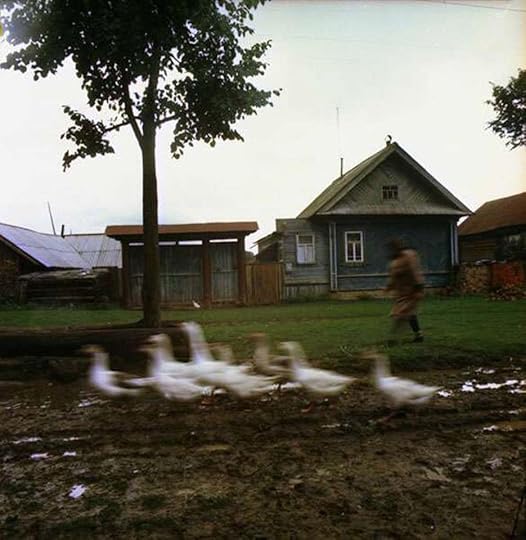
If this photograph by André Kertész takes hold of your thoughts and your imagination, you might understand why Andrzej Stasiuk writes: "It's possible that everything I've written so far began with this photograph...The space of this photograph hypnotizes me, and all my travelling has had only one purpose: to find, at long last, the secret passage into its interior" The strange aspect of this for me is that I, who have never been in Eastern Europe [since I wrote this I have been to Romania, and loved it], long to be there too, and not just in that street where a blind violin player is led across a dusty road by his young son, but in so many of the other photos Kertész took. This one for example

I long to be there, following on along that shadowy street as the old man returns to his home after, perhaps, a visit to the nearby bar; a drink and cards with other old men who have lived there all their lives.
That longing and that searching pervades every page of this wonderful book. Stasiuk has no interest in events or spectacles or cities with all their aspirations and anxieties. In a small Hungarian town called Gonc he watches a Slovak family emerge, with some hesitation, from a Skoda Octavia and reflects: " This was the sort of thing we wanted to see, not the Hussite House with its "curious wooden bed that pulls out like a drawer", as the guidebook said. What happened on the main street in Gonc was more interesting than what had become mere history. It drew us, because life is made of bits of the present that stay in the mind. The world itself, really, is made of that".
Of course what he sees, and how he sees it, is highly subjective. He needs to see those elements of rural societies that seem eternal, fixed, repeated through the generations. "All as it had been for a thousand years". If he finds evidence of change, modernity, the new universal mediocrity, he isn't telling. For him it isn't worth noticing. What makes Stasiuk's point of view special is that it always emerges by engaging with the ordinary: ordinary people, ordinary events. Nowhere in the book is there the slightest sense of his being patronising, of seeing any division between what he is and what anyone else is. This is travel writing by someone who wants to be, as much as to see. Again and again he enters bars that brought the film of Satantango to mind. Lonely, hopeless places where they've never heard about the present. "Clearly I am drawn to decline, decay, to everything that is not as it could or should be". I though too of Bela Tarr's most recent and final film, 'The Turin Horse', when I read about "The odour of monotonous labour chained for centuries to matter...this changing that changes nothing, this movement that expends itself. Some spring, not only will the snow melt, everything else will melt too". Does any of this make sense? Stasiuk prefers to dream the landscape into words than to describe exactly what is there. For him it is more important to evoke the essence of a place than to laboriously describe it in detail. History impinges (there is, for example, a visit to the grave of Nicolae Ceausescu) but it is what remains despite history that sends him on another journey - always on the smaller roads - through Slovakia, Romania, Hungary or Albania, trying to find the secret passage, into their interiors.

November 12, 2014
I would like to be buried in all those places where I've been before and will be again. My head among the green hills of Zemplén, my heart somewhere in Transylvania, my right hand in Chornohora, my left in Spišská Belá, my sight in Bukovina, my sense of smell in Răşinari, my thoughts perhaps in this neighborhood ... This is how I imagine the night when the current roars in the dark and the thaw wipes away the white stains of snow.This is the colorful, often poetic prose of a seasoned traveler who loves to bypass the tourist hype and seek the unknown.
Busses, trucks, trains and walking, take him on the more than 200 trips into the countries of his soul. In a bleak landscape filled with debris of war and wasteland, he finds the colorful people in their picturesque environment, writing the history of the geographical wonderland he comes across. Different languages reside next to each other,and in between Russian is still a nostalgic remnant of a recent past. Horse-carts with number plates share roads with rustic old cars. The people are as ignorant of happiness as they are of the future.
I tried to follow the author by Googling his route, which resulted in a longer read than actually planned. It nevertheless opened a world to me that was previously just a blur of possibilities, initiatated by images portrayed in travel programs and limited information provided in news programs.
We are spurred by the desire to return to the world of dreams, which relieves us of our freedom of will and gives in its place the freedom, absolute, of the unexpected. This happens in places rarely touched by the traveler's eye. Observation irons out objects and landscapes. Destruction and decline follow. The world gets used up, like an old abraded map, from being seen too much...The Balkan States of Eastern Europe are the author's playground, which he visits as often as possible. The small villages on the map disappears as the ink fades, but in reality they also vanish as fast as the political landscape changes. "That's why I rush to make these trips, why I'm so avid for details that will soon vanish and need to be re-created out of words."
...The old looks bedraggled, cast off, impotent; the new struts and challenges, wanting to overcome both the shame of the past and the fear of the future. Everything is temporary, ad hoc, a verb whose action is never completed...
...Clearly I am drawn to decline, decay, to everything that is not as it could or should be. Whatever stops in half stride because it lacks the strength or will or imagination to continue. Whatever gives in, gives up, does not last, and leaves no trace. Whatever in its passing stirs no regret or reminiscence. The present imperfect. Histories that live no longer than the relating of them, objects that are only when someone regards them. This is what haunts me—this extra being that everyone can do without, this superfluity that is not wealth, this hiddenness that no one explores, secrets that, ignored, are lost forever, memory that consumes itself.
Unpronouncable, exotic, names are scattered over his journey: Nagykálló, Mátészalka, Nagykálló, Gönc , Kamenice, Vidice, Selenice, Borove, Chişinău...
Nobody believes in tomorrow. The here and now simply do not show any signs that it will be different from yesterday.
In the square, an air of indifferent symbiosis. Everyone was connected by a time that had to be waited through. Seconds and minutes grew, swelled, and burst open, but there was nothing inside.
The book is a confusing read if you try to track his route. The author recalls his past experiences of places when he visited them in different seasons, some of them many years previously and that confuses the reader a bit.
Yet, his memories are colorful, often satirical and generously covered by irony. He shares his philosophies and anecdotes and although he finds little reason for optimism he is still infatuated with a region that he deeply loves. He does not hesitate to call a spade a spade, and does not try to hide his observations of the villages he visits.
Parody and delirium. One must be born in Huşi to smell the poison of melancholy that eats into mind and soul. One must be born in Huşi, where even the crows turn back, to grasp this dream of glory of the native land, to understand this nightmare...It is not an exciting, fast-paced read, but it sure is entertaining. Apart from having proper guide books visiting these areas, a book like this one, will relieve the boredom of long train rides or futile hours waiting at a border crossing. It might even make you smile. But just reading the book on its own merit guarantees a refreshing look on a world we hardly know.
So that was Chişinău. I spent many hours under an umbrella in Green Hills Nistru on the Boulevard of Stephen the Great and Holy, at the corner of Eminescu. In the pub sat a more international gathering, speaking in English and German. Probably office workers who had chosen to throw away their European and American money in this particular spot. Besides them was the growing Moldovan middle class, the men wearing gold, sporting sunglasses, in the common style that combines hood, pimp, and gigolo, the women like the women you see on television, practically all with cell phones on silver chains around their necks.
I certainly enjoyed this introduction by this author to his region, where ancient cultures, hundreds of years old, still prevailed, where man and beast never lost their bond, and an industrial revolution ended in rust heaps as man-made as its dark history.
At times it was too much, but most of the time I was amazed.

May 4, 2020
I really don't know how to rate this book. Some parts are insanely delightful and poetic (this man can write a sentence!) but in other parts, my mind drifted away during some unnecessary ongoing descriptions (don't know if that is due to my lack of focus and concentration, I did work a lot these days). But parts that were good, were so original and amazing that this book deserves a high rating after all.
I don’t usually read travel journals, but due to the current situation, I wanted an armchair journey. The author travels through Eastern Europe, but he does not go to capitals, big, well-known cities. In his journey, he explores small and nearly abandoned places, with few or no people, and I adored that his traveling is really non-commercial and unique. He takes local people to drive him and guide him through their country. I was always more interested in that kind of traveling through the wilderness and rural areas than visiting big cities. Sometimes when I drive past these kinds of places, I imagine what kind of life people live there. This book provides that answer, as a lot of scenes of everyday life or ordinary people are described. There is also something interesting that the author does in describing the panorama. He doesn’t just describe a material landscape, he tries to portray the soul of the whole country. He paints a picture in which you learn about lands' historical context, psychological characteristics of people who live or lived there, politics (especially interesting due to the fact many countries where communist countries in near history), mixing mythology and philosophy with his inner dialogue. Those were the best parts for me when the author was going deep in the inner state of consciousness and explored how different landscapes and countries affect his state of mind. That is something that really interests me - a connection between external and internal and how one affects the other. I think there is a lot more to be said about that - author himself said that he has to travel due to the inner restlessness. I think that people sometimes gravitate to traveling in pursuit of a deeper exploration of outer but also the inner world. Physical travel can compensate for the psychological journey, or as this book showed, one can be parallel to other.
When I think more deeply about this, this author is fascinating (as is his life, I suggest you read about it) and I love the way his mind works in giving verbal structure to pictures of lands mixed with his own stream of consciousness. I have a feeling he is a type of person that looks at everything in search of the deeper layer beneath the surface. I will check out his fiction work for sure.
If you are interested in travel journeys, the never-seen face of Eastern Europe, and a very original way of using language, this book is for you.
I don’t usually read travel journals, but due to the current situation, I wanted an armchair journey. The author travels through Eastern Europe, but he does not go to capitals, big, well-known cities. In his journey, he explores small and nearly abandoned places, with few or no people, and I adored that his traveling is really non-commercial and unique. He takes local people to drive him and guide him through their country. I was always more interested in that kind of traveling through the wilderness and rural areas than visiting big cities. Sometimes when I drive past these kinds of places, I imagine what kind of life people live there. This book provides that answer, as a lot of scenes of everyday life or ordinary people are described. There is also something interesting that the author does in describing the panorama. He doesn’t just describe a material landscape, he tries to portray the soul of the whole country. He paints a picture in which you learn about lands' historical context, psychological characteristics of people who live or lived there, politics (especially interesting due to the fact many countries where communist countries in near history), mixing mythology and philosophy with his inner dialogue. Those were the best parts for me when the author was going deep in the inner state of consciousness and explored how different landscapes and countries affect his state of mind. That is something that really interests me - a connection between external and internal and how one affects the other. I think there is a lot more to be said about that - author himself said that he has to travel due to the inner restlessness. I think that people sometimes gravitate to traveling in pursuit of a deeper exploration of outer but also the inner world. Physical travel can compensate for the psychological journey, or as this book showed, one can be parallel to other.
When I think more deeply about this, this author is fascinating (as is his life, I suggest you read about it) and I love the way his mind works in giving verbal structure to pictures of lands mixed with his own stream of consciousness. I have a feeling he is a type of person that looks at everything in search of the deeper layer beneath the surface. I will check out his fiction work for sure.
If you are interested in travel journeys, the never-seen face of Eastern Europe, and a very original way of using language, this book is for you.

October 26, 2020
Two stars: Not completely without merit, but poorer than average books of this type.
The late David Rakoff once described the lobby of his super-chic Parisian hotel as filled with "beautiful people of both sexes draped bonelessly over the furniture." This phrase came back to me while reading Babadag, because this struck me as a travel memoir cast bonelessly over the pages. (Babodag, by the way, is a small town in Romania hard up against the Black Sea. In his book, it had no particular significance -- I guess he just liked the name.)
I gave it a fair shot. For the first hundred pages or so, I was just confused. Stasiuk seemed to be engaged in an interesting experiment: What if all the normal structural elements of a travel memoir were simply stripped out? --Elements such as why the author decided to make the trip, placing the trip in a certain time period and following a coherent itinerary, and occasionally checking in to make some sort of broader point about the differences or similarities between the place being explored and home.
So instead, we get something like astronaut.io. For those of you unfamiliar with this, Google has website in which they randomly pull some of the millions of videos uploaded each week and stream them to the astronaut.io website. The only criteria are that the video needs to be less than a week old and viewed by fewer than eight people so far. This means you get a series of very personal videos -- lots of kids playing sports, wedding videos, lectures on soybean production, people dancing goofily and the like. There is no plot, no progression towards a goal, simply a collection of what individuals around the world found interesting enough to upload that week.
After a while, I started to understand Stasius' technique -- bit by bit, like dabs of paint on an enormous canvas, an overall portrait of life in Eastern Europe starts to emerge. It is a land in which hard liquor is a not-uncommon breakfast accoutrement. It is easy to lose control of your vehicle when sliding over slicks of cow shit. Smoking is an essential social activity. Older folks bemoan the loss of dictatorships.
Stasius himself describes his approach this way:
And a few pages later:
I was willing to play along, but this book went on and on and on and on, completely formless. What caused me to drop it to a two-star review was the final twenty percent, in which he felt compelled to share his philosophy. Or at least, fill about 100 pages of incoherent babbling of the "dreams are more real than reality" type, or "places are not real until I see them" variety. I have no patience for this sort of nonsense, expecially when presented as a first draft with no attempts to tighten it up or make it in any way coherent.
The late David Rakoff once described the lobby of his super-chic Parisian hotel as filled with "beautiful people of both sexes draped bonelessly over the furniture." This phrase came back to me while reading Babadag, because this struck me as a travel memoir cast bonelessly over the pages. (Babodag, by the way, is a small town in Romania hard up against the Black Sea. In his book, it had no particular significance -- I guess he just liked the name.)
I gave it a fair shot. For the first hundred pages or so, I was just confused. Stasiuk seemed to be engaged in an interesting experiment: What if all the normal structural elements of a travel memoir were simply stripped out? --Elements such as why the author decided to make the trip, placing the trip in a certain time period and following a coherent itinerary, and occasionally checking in to make some sort of broader point about the differences or similarities between the place being explored and home.
So instead, we get something like astronaut.io. For those of you unfamiliar with this, Google has website in which they randomly pull some of the millions of videos uploaded each week and stream them to the astronaut.io website. The only criteria are that the video needs to be less than a week old and viewed by fewer than eight people so far. This means you get a series of very personal videos -- lots of kids playing sports, wedding videos, lectures on soybean production, people dancing goofily and the like. There is no plot, no progression towards a goal, simply a collection of what individuals around the world found interesting enough to upload that week.
After a while, I started to understand Stasius' technique -- bit by bit, like dabs of paint on an enormous canvas, an overall portrait of life in Eastern Europe starts to emerge. It is a land in which hard liquor is a not-uncommon breakfast accoutrement. It is easy to lose control of your vehicle when sliding over slicks of cow shit. Smoking is an essential social activity. Older folks bemoan the loss of dictatorships.
Stasius himself describes his approach this way:
With events that have passed there is no problem, provided we don't attempt to be wiser than they are, provided we don't use them to further our own ends. If we let them be, they turn into a marvelous solution, a magical acid that dissolves time and space, eats calendars and atlases, and turns the coordinates of action into sweet nothingness. What is the meaning of the riddle? What is the use to anyone of chronology, sister of death?
And a few pages later:
So I repeat my hopeless mantra of names and landscapes, because space dies more slowly than I do and assumes an aspect of immortality. I mutter my geographic prayer, my topographic Hail Marys, chant my litany of the map, to make this carnival of wonders, this Ferris wheel, this kaleidoscope, freeze, stop for a second, with me at the center.
I was willing to play along, but this book went on and on and on and on, completely formless. What caused me to drop it to a two-star review was the final twenty percent, in which he felt compelled to share his philosophy. Or at least, fill about 100 pages of incoherent babbling of the "dreams are more real than reality" type, or "places are not real until I see them" variety. I have no patience for this sort of nonsense, expecially when presented as a first draft with no attempts to tighten it up or make it in any way coherent.
October 4, 2024
Taking the reader to some of the more obscure places in Central and Eastern Europe - including the village where Romanian philosopher Emil Cioran spent his childhood, this was a really interesting piece of evocative and mysterious travel writing; to experience something off the beaten track for a change. Stasiuk isn't bothered about famous landmarks and large gatherings so avoids cities and busy roads, and is enraptured by folklore and legend more than actual history. With no clear route in mind on his journey, Stasiuk simply takes a chance or follows his gut instinct if something in the scenery intrigues him; whether a winding river, a crumbling old building or some woodland - being pulled by his love for the peripheral rust and ruin; the declining and the decaying; giving off a feeling of something apocalyptic, soaked deep in a beautiful melancholy. Certainly, with the landscapes as they are described, and the fact he isn't exactly the joyous type, he wouldn't look out of place in a László Krasznahorkai novel, nor would some of the locals he encounters.

November 9, 2018
"Das ist das wahre Gesicht meiner Gegend, meines Teils des Kontinents – die Veränderung, die nichts verändert, die Bewegung, die sich in sich selbst erschöpft.""Unterwegs nach Babadag" ist eine weitere Station auf Andrzej Stasiuks endloser literarischer Reise durch die Terra incognita des europäischen Ostens. Die Orte und Gegenden die er durchstreift liegen meist unterhalb der Wahrnehmungsschwelle der durchschnittlichen Mitteleuropäer. Gegenden in denen die Zeit scheinbar stehengeblieben ist, geprägt von Stagnation und allmählichem Verfall. Lőkösháza, Baia Mare, Răşinari, Sokołów, Podlaski, Huşi, Gönc, Sulina – Orte mit Namen die in der Fantasie des Fremden der sie hört, einen Raum voller Verheißungen eröffnen, weil sich in der konkreten Vorstellung so rein gar nichts mit ihnen verbinden lässt. Orte deren Bewohner in ewiger Wartestellung ausharren, auf eine Zukunft hoffend, die niemals kommen wird. Stasiuk erweist sich bei seiner rastlosen Suche als unheilbarer Romantiker, angetrieben von einer unstillbaren Sehnsucht ohne rechtes Ziel. Seine Berichte sind Sammlungen von Bruchstücken, Erinnerungsfetzen, Fieberphantasien, aus denen er sich in der Rückschau seine Welt zusammensetzt. Der Ausdruck "Meditation in Bewegung" fällt an einer Stelle – besser lässt sich nicht benennen, wovon dieses Buch handelt. Gleichsam einem sich stetig wiederholenden Ritual folgend, bricht der Autor immer wieder aufs Neue in das europäische Niemandsland zwischen polnischer Ostseeküste und albanischen Bergen auf. Daraus ergeben sich unvermeidlich einige Redundanzen in seinen Erzählungen. So kommt es vor, dass Orte und Begebenheiten mehrmals in veränderter Form in den Texten auftauchen. Bei manchen Lesern wird sich vermutlich dadurch ein Eindruck von Langeweile aufdrängen, was nachvollziehbar wäre. Allerdings macht für mich genau dieser meditative Stil den besonderen Reiz an Stasiuks Reiseberichten aus. Sie versetzen in eine Stimmungslage, in der man nur allzu gern bereit wäre, sich dem Autor anzuschließen, um sich in der Tiefe der Provinz zu verlieren.

August 31, 2024
"Hát igen, nem titkolhatom: az eltűnés érdekel, a bomlás, és minden, ami nem olyan, amilyen lehetett vagy amilyennek lennie kellene. Minden, ami félúton megtorpant, és hiányzik az energia, a kedv vagy az ötlet a folytatáshoz, minden, amiről lemondtak, amit alább adtak és feladtak, minden, ami nem marad fenn, nem hagy nyomot, minden, ami önmagáért valósult meg, és nem indít sajnálatra, gyászra vagy emlékezésre. Befejezett jelenidő. Történetek, amelyek addig tartanak, amíg elmondják őket, és tárgyak, amelyek csak addig léteznek, amíg valaki nézi őket."
Amit Stasiuk megvalósít, az tulajdonképpen egy paradoxon: folyamatosan mozgásban lenni azért, hogy megtaláljuk a tökéletes mozdulatlanságot. Kutatás az élet moccanatlan magja után, amit még nem formált át a civilizáció, ahol az ember még nem tudatos lény, nincsenek szelektív kukák és gluténmentes pizza, ahol a tér és az idő egyfajta nullpontban olvad össze, ahol a semmi partja van, na, oda megy Stasiuk, és belelógatja a lábát. Ez a hely ott lelhető fel, ahová a turista sosem vetődik: egy abonyi akácfa poros árnyékában, egy prelaskói söntés olcsó sörszagában, egy kupac dinnyében Cahul piacterén, vagy épp Babadagban, ahová amúgy csak véletlen vetődtünk. Ha pedig megtaláltuk, meg kell ragadnunk, szavakba kell öntenünk, csodás, csillogó képekre kell váltanunk a pillanat aprópénzét, mert ez a hely olyan, hogy ma még ott van, de holnap már nyoma sincs - felfalja a fejlődés vagy a felejtés. Stasiuk pedig megragadja, és a lehető legméltóbb lakásba költözteti: a stasiuki mondatokba.
Máshogy közép-kelet-európai az ember, miután elolvasta ezt a könyvet.
Amit Stasiuk megvalósít, az tulajdonképpen egy paradoxon: folyamatosan mozgásban lenni azért, hogy megtaláljuk a tökéletes mozdulatlanságot. Kutatás az élet moccanatlan magja után, amit még nem formált át a civilizáció, ahol az ember még nem tudatos lény, nincsenek szelektív kukák és gluténmentes pizza, ahol a tér és az idő egyfajta nullpontban olvad össze, ahol a semmi partja van, na, oda megy Stasiuk, és belelógatja a lábát. Ez a hely ott lelhető fel, ahová a turista sosem vetődik: egy abonyi akácfa poros árnyékában, egy prelaskói söntés olcsó sörszagában, egy kupac dinnyében Cahul piacterén, vagy épp Babadagban, ahová amúgy csak véletlen vetődtünk. Ha pedig megtaláltuk, meg kell ragadnunk, szavakba kell öntenünk, csodás, csillogó képekre kell váltanunk a pillanat aprópénzét, mert ez a hely olyan, hogy ma még ott van, de holnap már nyoma sincs - felfalja a fejlődés vagy a felejtés. Stasiuk pedig megragadja, és a lehető legméltóbb lakásba költözteti: a stasiuki mondatokba.
Máshogy közép-kelet-európai az ember, miután elolvasta ezt a könyvet.

February 7, 2025
This is a strange and delightful travelog of places that tourists avoid like the plague. As Andrzej Stasiuk says halfway through On The Road To Babadag: Travels in the Other Europe, "Whatever is new here is bogus; only when it ages and becomes a ruin does it take on meaning."
Consequently, his travels are mostly in run-down parts of Eastern Europe such as Albania, Moldova, Transnistria, Romania, Hungary (but not Budapest or Lake Balaton), Slovakia, and Ukraine. There is even a little bit of his native Poland.
In the process, Stasiuk tells us a great deal about Eastern Europe that does not appear in the Western literature. And yet all of it is utterly fascinating.
Consequently, his travels are mostly in run-down parts of Eastern Europe such as Albania, Moldova, Transnistria, Romania, Hungary (but not Budapest or Lake Balaton), Slovakia, and Ukraine. There is even a little bit of his native Poland.
In the process, Stasiuk tells us a great deal about Eastern Europe that does not appear in the Western literature. And yet all of it is utterly fascinating.
September 6, 2025
Perskaičiau antrą kartą. Labai, labai melancholiška knyga. Viena to priežasčių (spėtina) - autoriaus (knygoje jis tampa protagonistu) prigimtis. Antroji - tai, ką jisai lanko, mato, stebi, aprašo. Sujungdamas abi priežastis į vieną, S. sako: "Na, taip, negaliu slėpti, man įdomus nykimas, irimas ir viskas, kas yra ne taip, kaip galėtų ar turėtų būti. Visa, kas sustojo pusiaukelėje ir neturi nei jėgų, nei noro eiti toliau, nei žino, kaip eiti, visa, kas apleista, išklydo iš dermės ir kapituliavo /.../".
Protagonistas klajoja (netrukus po 2000) po Vengriją, Rumuniją, Slovakiją, Albaniją, Moldovą... Žodžiu, po amžinąją Europos provinciją. Ne, ne. Jis nelanko sostinių. Jam rūpi paribiai, užkampiai, jį traukia pabuvoti "visose tose vietose, apie kurias niekas nieko nežino, bet iš kurių sudarytas pasaulis." O čia - daug dulkių, šiukšlių, purvo, karvių mėšlo, visokių visokiausio laužo. Čia vyksta dūlėjimas, irsmas, trūnijimas. Čia dominuoja sąstingis, apatija, mieguistumas, vangumas, lėtapėdystė: "Kintamumas, kuris nieko nekeičia, judėjimas, kuris pats save išvargina, ir yra tikrasis manųjų kraštų, manosios žemyno dalies veidas." Beje, protagonisto kelionių tikslas ir nėra pamatyti ką nors "reikšminga". Dažniausiai keliaujama tiesiog pasižiūrėti, kaip vyksta gyvenimas. O kartais, kai tikslai formuluojami, jie skamba taip, kad pradžiugintų labai nedaugelį: "O aš užsispyriau važiuoti į Erindą, nes žemėlapyje pamačiau, kad ten baigiasi kelias /.../".
Vis dėlto... Čia gali išvysti tai, ko jau nebeišvysi (turiu galvoje Europą) kitur. Būtent: senąsias, šimtmečius tvėrusias gyvenimo formas, fenomenus, nuo kurių dar nenugremžta laiko "patina". Antai - žmonių ir naminių gyvulių bendrabūvio variantas: "Kaimo aikštė priminė jauną parką /.../. Tai šen, tai ten švietėsi baltos sienos, bet žmonių nesimatė. Tik sunkios rusvos kiaulės vaikštinėjo po šią scenografiją." Antai - kone archetipinis žemdirbystės vaizdelis: "Molėtu šlaitu į viršų kopė arklys, įkinkytas į plūgą, kurį laikė susilenkęs vyras. Įkandin ėjo dvilinka moteris ir mėtė į šalis iškilusius akmenis. Tai buvo didi scena su trupučiu biblinio patoso." Antai - senovinė senučių "siesta": "Norėjome stebėti senutes, sėdinčias prie namų pagrindinėje gatvėje. Jos priminė saulėje besikaitinančius driežus." O kur dar tradiciniai būstai, tradiciniai žmonių "judesiai", tradicinės veiklos... O kur dar "tradicinė", nesužalota gamta... Beje, ją aprašinėdamas, autorius nešykšti tikrai pasigėrėtinų palyginimų: "saulė ritosi į vakarus tarsi nukirsta gaidžio galva"; "Žemynas čia smilko tarsi audinio pakraštys."
Žinoma, sintetinė dabartis braunasi ir čionai. Nuo jos - neišsisuksi. Bet protagonistui tai kelia ne džiugesį, o dar labiau gramzdina jį melancholijon: "Viskas, kas nauja, primena filmą ir neturi nieko bendra su tuo, kas buvo. /.../ Pagrindinėje Elbasano gatvėje mačiau didžiules skudurų krūvas. /.../ Moterys kapstėsi po daugelį metrų besitęsiančius skudurų kalnus, suverstus tiesiog ant betono. Atrodė lyg ieškotų katastrofoje žuvusių artimųjų kūnų. /.../ Idėjos ir mintys čia atkeliauja taip pat nudėvėtos, jo labiau kad ir sukurtos buvo kaip vienkartinės. Tai - antrinių žaliavų šalis, ir ji pati galų gale bus perdirbta."
Protagonistas klajoja (netrukus po 2000) po Vengriją, Rumuniją, Slovakiją, Albaniją, Moldovą... Žodžiu, po amžinąją Europos provinciją. Ne, ne. Jis nelanko sostinių. Jam rūpi paribiai, užkampiai, jį traukia pabuvoti "visose tose vietose, apie kurias niekas nieko nežino, bet iš kurių sudarytas pasaulis." O čia - daug dulkių, šiukšlių, purvo, karvių mėšlo, visokių visokiausio laužo. Čia vyksta dūlėjimas, irsmas, trūnijimas. Čia dominuoja sąstingis, apatija, mieguistumas, vangumas, lėtapėdystė: "Kintamumas, kuris nieko nekeičia, judėjimas, kuris pats save išvargina, ir yra tikrasis manųjų kraštų, manosios žemyno dalies veidas." Beje, protagonisto kelionių tikslas ir nėra pamatyti ką nors "reikšminga". Dažniausiai keliaujama tiesiog pasižiūrėti, kaip vyksta gyvenimas. O kartais, kai tikslai formuluojami, jie skamba taip, kad pradžiugintų labai nedaugelį: "O aš užsispyriau važiuoti į Erindą, nes žemėlapyje pamačiau, kad ten baigiasi kelias /.../".
Vis dėlto... Čia gali išvysti tai, ko jau nebeišvysi (turiu galvoje Europą) kitur. Būtent: senąsias, šimtmečius tvėrusias gyvenimo formas, fenomenus, nuo kurių dar nenugremžta laiko "patina". Antai - žmonių ir naminių gyvulių bendrabūvio variantas: "Kaimo aikštė priminė jauną parką /.../. Tai šen, tai ten švietėsi baltos sienos, bet žmonių nesimatė. Tik sunkios rusvos kiaulės vaikštinėjo po šią scenografiją." Antai - kone archetipinis žemdirbystės vaizdelis: "Molėtu šlaitu į viršų kopė arklys, įkinkytas į plūgą, kurį laikė susilenkęs vyras. Įkandin ėjo dvilinka moteris ir mėtė į šalis iškilusius akmenis. Tai buvo didi scena su trupučiu biblinio patoso." Antai - senovinė senučių "siesta": "Norėjome stebėti senutes, sėdinčias prie namų pagrindinėje gatvėje. Jos priminė saulėje besikaitinančius driežus." O kur dar tradiciniai būstai, tradiciniai žmonių "judesiai", tradicinės veiklos... O kur dar "tradicinė", nesužalota gamta... Beje, ją aprašinėdamas, autorius nešykšti tikrai pasigėrėtinų palyginimų: "saulė ritosi į vakarus tarsi nukirsta gaidžio galva"; "Žemynas čia smilko tarsi audinio pakraštys."
Žinoma, sintetinė dabartis braunasi ir čionai. Nuo jos - neišsisuksi. Bet protagonistui tai kelia ne džiugesį, o dar labiau gramzdina jį melancholijon: "Viskas, kas nauja, primena filmą ir neturi nieko bendra su tuo, kas buvo. /.../ Pagrindinėje Elbasano gatvėje mačiau didžiules skudurų krūvas. /.../ Moterys kapstėsi po daugelį metrų besitęsiančius skudurų kalnus, suverstus tiesiog ant betono. Atrodė lyg ieškotų katastrofoje žuvusių artimųjų kūnų. /.../ Idėjos ir mintys čia atkeliauja taip pat nudėvėtos, jo labiau kad ir sukurtos buvo kaip vienkartinės. Tai - antrinių žaliavų šalis, ir ji pati galų gale bus perdirbta."

November 19, 2011
Seemed like a 10 page essay that became a 250 page book through repetition repetition and repetition. This is a po-mo travel book -- travel without identifying context, just an endless list of Eastern European place names obscure enough to make you feel at first ashamed of your own ignorance and finally simply annoyed at the repeated refusal to communicate anything that would help us place these places. Travel that loses any purpose bc all the places are the same, simply names. The sense of poverty, decay and stasis comes through loud and clear, but little else does -- the narrator fetishizes his own imprecision and inability to remember, which on the page becomes frustrating vagueness and for me at least, an inability to care about what he's saying. The occasional hallucinatorily brilliant vignette (the pool party for Romania's jeunesse doree as seen through the eyes of the local filthy feral pig farmer) tells you that there was a more conventionally fascinating travel book to be had here, if only Stasiuk weren't far too cool to write it. As it was, I forced myself, barely, to finish.

November 11, 2014
A strange little book. Since the author jumped around a lot, I gave myself permission to read it randomly. I was mostly interested in what he experienced in Hungary, so I searched out those sections first, came across a passage, which I will quote in full, because it gets to the quirky loveliness of Stasiuk's writing:
The entire book is like this, from what I can tell (not sure I read it all since I approached it so unsystematically), and it made me want to travel the way he does. Whimsical, receptive, his romantic tendencies are leavened with a dark Eastern European sensibility that I found irresistible.
Nothing in Talkibánya, a village that hadn’t changed in a hundred years. Wide, scattered houses under fruit trees. The walls a sulfurous, bilious yellow, the wood carving deep brown, the door frames sculpted, the shutters and verandas enduring in perfect symbiosis with the heavy, Baroque abundance of the gardens. The metaphor of settling and taking root appeared to have taken shape here in an ideal way. Not one new house, yet also not one old house in need of repair or renovation. Although we were the only foreigners, we drew no stares. From the stop, in the course of the day, four buses departed. Time melted in the sunlight; around noon, it grew still. In the inn, men sat from the morning on and without haste sipped their palinka and beer in turn. The bartender immediately knew I was a Slav and said, pouring, “dobre” and “na zdorovye.” It was one of those places where you feel the need to stay but have no reason to. Everything exactly as it should be and no one raising a voice or making an unnecessarily abrupt movement. On a slope above the village, the white of a cemetery. From windows of homes, the smell of stewing onions. In market stalls, mounds of melons, paprikas. A woman emerged from a cellar with a glass jug filled with wine. But we left Telkibánya eventually, because nothing ends a utopia quicker than the desire to hold on to it.
The entire book is like this, from what I can tell (not sure I read it all since I approached it so unsystematically), and it made me want to travel the way he does. Whimsical, receptive, his romantic tendencies are leavened with a dark Eastern European sensibility that I found irresistible.

November 15, 2017
Volim, dakle, taj balkanski kupleraj, madjarski, slovacki i poljski, tu cudesnu tezu materije, tu prekrasnu snenost, tu iskuliranost cinjenica, to mirno, doslijedno pijanstvo tacno u podne i te maglovite poglede koji bez muke krstare kroz stvarnost, da bi, liseni straha, pustili nistavilu da pukne pred ocima. Nista tu ne mogu. Srce moje Evrope kuca u Sokolovu Podlaskom i u Husiju. Ni pod razno ne kuca ono u Becu. Ko drugacije misli obicna je budala. Pa ni u Budimpresti. Ponajvise ne kuca u Krakovu. Sve su to neuspjeli pokusaji transplantacije. Lifting i ogledalo neceg sto je negdje drugdje. Sokolov i Husi nista ne oponasaju. Ostvaruju se sopstvenom sudbinom.
Meni je ovo bilo carobno! Jedan tako lirski putopis i prvi tog tipa koji citam. Definitivno bih mogla da zamislim nekog da ovo cita i uzdise od dosade, ali isto tako ima i nas koji valjda dosta slicno Stasjuku poimamo svijet oko sebe, pa se tu negdje i pronalazimo.
Stasjuk je putnik koji je svjestan svog nagona prema provinciji i svoje perverzne ljubavi prema svemu sto iscezava i propada. Zaintresovan samo za zemlje o kojima se malo zna ili u koje malo ko zalazi, od skoro 200 pecata koliko ima u pasosu za samo nekoliko godina, mnogi pripadaju Poljskoj, Slovackoj, Madjarskoj, Rumuniji, Moldaviji, Albaniji.
Mnoge stvari po ovim zabacenim predjelima ujedno i postoje i ne postoje. Niti su sasvim mrtve, niti bas zive. Kao da materija oponasa svijet duhova.
Ima vise opisa koji lirski nadasve savrseno prikazuju stanje stvari, i ne mogu da izdrzim a da ih ne podjelim.
Jer Albainija je stara. Njena ljepota priziva u sjecanje davno izumrle vrste i epohe koje za sobom nisu ostavile nikakve sile. Pejzaz opstojava, ali se i neprestano kruni, raspada se, kao da nebo i vazduh hoce da ga razdrobe medju prstima. To su naprsline, linije, pukotine i neprekidno gravitiranje materije koja zeli da je ostave na miru, da se ratosilja forme, da doceka odmor i vrati se u vrijeme kad oblici nisu ni postojali.
(Gagauzija)
Tesko je opisati Komrat, jer je slabo uocljiv. Putujes kroz grad koji jedva vidis. Postoje kuce, postoje ulice, ali to su samo projekti, jedva oblikovan provizorijum, tuga materije koja se stvrdla na pola puta do ostvarenja, iscrpla se upola oblika. Lenjinov spomeniik bio je prevucen zlatnom farbom.
To je bila moja Rumunija – to trenutno bratstvo mercedesa, zlata, svinjskog smrada i tragicnog industrijalstva cija se zapustenost mogla ravnati samo s njenom golemijom.
U Sfantu George sve je moglo da se desi. Postoje mjesta u kojima ne postoji nista vise od potencijala. A ovdje je doista jedini izlaz moglo da bude cudo, znak, iznenadno otkrivenje. Vakuum, nepomicnost, horor nestajanja, tuga stihija obikovanih u geometriju ravni, nebo i zemlja koji melju medju sobom napaceno i tromo covjecanstvo – sve to samo po sebi bilo je cudo i znak, posto je zaustavljalo mastu napola koraka, stavljajuci na njeno mjesto neumoljivu stvarnost.
Meni je ovo bilo carobno! Jedan tako lirski putopis i prvi tog tipa koji citam. Definitivno bih mogla da zamislim nekog da ovo cita i uzdise od dosade, ali isto tako ima i nas koji valjda dosta slicno Stasjuku poimamo svijet oko sebe, pa se tu negdje i pronalazimo.
Stasjuk je putnik koji je svjestan svog nagona prema provinciji i svoje perverzne ljubavi prema svemu sto iscezava i propada. Zaintresovan samo za zemlje o kojima se malo zna ili u koje malo ko zalazi, od skoro 200 pecata koliko ima u pasosu za samo nekoliko godina, mnogi pripadaju Poljskoj, Slovackoj, Madjarskoj, Rumuniji, Moldaviji, Albaniji.
Mnoge stvari po ovim zabacenim predjelima ujedno i postoje i ne postoje. Niti su sasvim mrtve, niti bas zive. Kao da materija oponasa svijet duhova.
Ima vise opisa koji lirski nadasve savrseno prikazuju stanje stvari, i ne mogu da izdrzim a da ih ne podjelim.
Jer Albainija je stara. Njena ljepota priziva u sjecanje davno izumrle vrste i epohe koje za sobom nisu ostavile nikakve sile. Pejzaz opstojava, ali se i neprestano kruni, raspada se, kao da nebo i vazduh hoce da ga razdrobe medju prstima. To su naprsline, linije, pukotine i neprekidno gravitiranje materije koja zeli da je ostave na miru, da se ratosilja forme, da doceka odmor i vrati se u vrijeme kad oblici nisu ni postojali.
(Gagauzija)
Tesko je opisati Komrat, jer je slabo uocljiv. Putujes kroz grad koji jedva vidis. Postoje kuce, postoje ulice, ali to su samo projekti, jedva oblikovan provizorijum, tuga materije koja se stvrdla na pola puta do ostvarenja, iscrpla se upola oblika. Lenjinov spomeniik bio je prevucen zlatnom farbom.
To je bila moja Rumunija – to trenutno bratstvo mercedesa, zlata, svinjskog smrada i tragicnog industrijalstva cija se zapustenost mogla ravnati samo s njenom golemijom.
U Sfantu George sve je moglo da se desi. Postoje mjesta u kojima ne postoji nista vise od potencijala. A ovdje je doista jedini izlaz moglo da bude cudo, znak, iznenadno otkrivenje. Vakuum, nepomicnost, horor nestajanja, tuga stihija obikovanih u geometriju ravni, nebo i zemlja koji melju medju sobom napaceno i tromo covjecanstvo – sve to samo po sebi bilo je cudo i znak, posto je zaustavljalo mastu napola koraka, stavljajuci na njeno mjesto neumoljivu stvarnost.

February 9, 2015
Местата и стилът на Анджей Сташук:
„Октомври е, вали студен нощен дъжд и мога да си представя как мократа тъма удавя села и градове. Лежат на дъното на водите и още нямат имена. Напомнят големи спящи риби с къщи, хора и пътища в коремите. Хората шепнат в мрака, съсредоточени, сгушени един в друг, чакат да мине потопът и се опитват да отгатнат съдбата си. Времето още не е напълно започнало, няма светлина и трябва да се чака зората. Мълвите приличат на обещания и легенди. Светът е толкова далечен, че преди разказът да достигне до него, самият той може да престане да съществува.“
Книга за нетрадиционните пътешествия – без график, без група, без граници (на мислите и перото). Земи, които могат да бъдат объркани и с нашите – по мизерията, соц-наследството, циганите (няма роми в книгата на Сташук); по изоставените западнали села, по застиналите градчета. За първи път обаче срещам отношение на разбиране, дори привличане. Сташук описва този останал в миналото 21-ви век без капка отвращение.
„Така че, обичам този балкански бардак, а също и унгарския, словашкия и полския, това чудно притегляне на материята, тази красива съненост, това презрение към фактите, това спокойно, последователно пиянство посред бял ден и тези замъглени погледи, които без усилие пробягват през действителността, за да се отворят без тревога към небитието. Нищо не мога да направя. Сърцето на моята Европа бие в Соколув Подласки и в Хуши. Изобщо не бие във Виена. Който мисли по друг начин, е обикновен глупак. Нито в Будапеща. Най-вече не бие в Краков. Всички те са отхвърлени опити за трансплантация. Лифтинг и огледало на нещо, което е някъде другаде. Соколув и Хуши нищо не имитират. Осъществяват се в собственото си предопределение. Моето сърце е в Соколув, макар че там съм прекарал всичко на всичко десетина часа.“
Очаквах романтичен привличащ разказ за неизвестни недалечни места. Така е - местата са непопулярни, но и книгата е необикновена. Катунарски разпиляна, неспокойно-лежерна, написана сякаш от автора за автора, не толкова за читателите, не толкова като диалог, по-скоро вътрешен монолог на пътешественика.
Очаквах и повече срещи с местните хора. Има и такива, но към края разбрах защо те не са акцентът на книгата.
„Възможно е обаче просто да става дума за безлюдност на пейзажа, за моя собствена самота. Защото е хубаво да пристигнеш наготово в страна, в която не заварваш никого. Можеш всичко да започнеш отначало. Тогава историята се превръща в легенда, а действителността в собствени видения. Ами че не е възможно да разберем, да кажем, Воскопойе, Воскопойе може най-много да си го представим. На снимките във Воскопойе няма жива душа, само две магарета, пасящи сред магарешки тръни и камъни. Знам, че на тях трябва да го има шофьорът Яни, редуващ бренди и бира, и гъркинята, собственичка на кръчмата, и нейният мълчалив мъж, и пияния като талпа приятел на Яни със славянски черти, и недоразвитото момче, което взехме по пътя, но тогава разказът би потънал в мястото завинаги и вече никога не бих се измъкнал от плетеницата на съдбите им. Така че – само две магарета, камънак и сиво-синьо небе над разрушения манастир.“
Разбира се в подобни страни няма как циганите да не са в обектива на пътешественика. И тях не ненавижда, но и не ги „обгрижва“ по новия европейски начин.
„Винаги се връщам пак толкова глупав, колкото невеж заминавам. Навсякъде по ъглите на улиците стоят мъже и чакат нещо да се случи, навсякъде седалките във влака имат дупки от цигари и хората просто прекарват времето си и гледат спокойно как историята натиска газта до дупка. Губя си времето и парите. Същото би било да не мърдам от вкъщи, защото всичко това тук го имам. Където и да отида, издирвам циганите. В Прекмурие изхарчих един резервоар бензин, за да ги открия, защото ме хванаха бесните от тази подредена страна и от словенците, от тези предатели на славянския хаос, но не намерих нито един, макар че прочетох, че със сигурност са там. […] където и да отида, веднага се оглеждам за тях, за тази жива обида за средиземноморската и християнската цивилизация, за този народ без земя, който, дори ако построи нещо, то го прави така, сякаш веднага ще го напусне, ще го подпали за развлечение или от отчаяние и ще пренесе своята подвижна държава някъде по-нататък, където бялата европейска сган по-малко ги ненавижда. “
Често странникът преминава през местата съвсем за кратко. Но всички детайли му говорят и се запечатват в съзнанието му като съществени.
„Едноетажни дървени къщи в центъра на града, люляци, буренак, дървени капаци на прозорците, кучета, спящи на асфалта, наклонени стълбове на спирките с жълти кръгли табели, кафяв и зелен цвят на рамките на прозорците, на вратите и външната ламперия, пясък във фугите на тротоарните плочки, сладкарница за сладолед, миришеща вътре като селска къщурка, захарни топченца в стъклени тръбички, всичко едва надигнало се от земята, едва започнало, да, точно така, разпадане, шумолене и дрямка, живот без претенции, за да стигне за по-дълго, скърцане на дървен, изтрит под, смешен героизъм на ежедневието, крехък като вафлена фунийка за сладолед. Помня всичко и мога да изброявам безкрайно. Защото това е в кръвта ми. По същата причина сърцето ми е в Хуши, което прекосих за пет минути, защото там няма за какво да се спира.“
Запитах се какво е отношението ми към подобни тихи забравени места. Зная, че не съм дорасла примерно за нощуване в миризливи селски къщурки с дървеници. Преди дни описах с неприязън претъпкаността на многомилионните градове на Япония и може да се предположи, че харесвам малките градчета. Но май само на книга и в интернет съм способна засега да харесвам такива места. Както в „Галицийски истории“ обиколих чрез google street view полските селца от книгата, и сега се поразходих из Бабадаг, Саколув, Хуши (в един момент имах отворени 6 прозореца на google maps). В описания в книгата Тирасполь съм ходила през 1978 г., но google street view все още не е стигнал дотам, за да „видя“ пак селото - дали нещо се е променило. В „По пътя за Бабадаг“ има места, застинали в 70-те – не само със сградите, а с носталгията към миналия живот, дори с преклонението към диктаторите…
Имам все пак едно наум, че книгата е писана около 2000 г. и дори само 15 години не са никак кратък период (особено след влизането на повечето описани страни в Европейския съюз, колкото и оплюван да е той от незапознатите). Възможно е за тези години да са настъпили някои промени, макар и повърхностни, външни, не толкова промени в духа на местата. Неотдавна четох книга на българин за Япония също от 2000 г. и се изненадах как нещата (материални, „напредничави“), впечатлили автора в Япония, вече са се настанили и по нашите земи за хубаво или лошо (само отсъствието на кражби в Япония май още не пристигнало при нас). Все пак се почувствах точно като в книгата на Сташук, когато в полет за Истанбул кацнахме в Констанца да вземем пътници и… такова летище(нце) като от началото на 20-и век не бях виждала досега. И пак се люшкам в колебанията си – напредък, но какво ни дава и какво ни отнема. А без него има ли смисъл просто да си живуркаме. В крайна сметка - не може ли и двете: тихите, но напълно осигурени селца в Западна Европа (където пък е друг тип скука)…
Имам и едно наум, че авторът само преминава през тези места. Друго е да си за постоянно „на края на света“. Но пък знам, че самият той живее в изолирано полско селце. Преди 25 години ме стегна шапката в малкия стохиляден Добрич и избягах завинаги от него. Но за Сташук това е голям град.
„Опитайте се в час пик да прекосите например Будапеща. Отгоре на всичко не може да бъде заобиколена. Стои като паяк в центъра на паяжината от пътища. Опитайте се да преминете през Варшава или Букурещ. Когато си на път, градът е бедствие. Селяните не умеят да строят градове. Получават се тотеми на някакви чужди божества. Центърът горе-долу го докарват, но предградията винаги изглеждат като абортирани махали. Хипертрофия на пространство за складиране и тъга по изгубени илюзии. Колкото пъти си пътувам спокойно и внезапно в центъра на някой кучи гъз израства конгломерат, се вцепенявам, защото тази фата моргана не предсказва нищо и нищо не доказва. И само ако мога, заобикалям тази фантасмагория, търсейки обиколни шосета, едва забележими нишки на картата, прибавям пътища, само и само да избягам от дългите сенки на офис-сградите в центъра и от крайните квартали от блокове. Всичко, което наброява повече от сто хиляди жители, се зачерква, забавлявайте се сами и стройте с надеждата, че ще се скрие гледката на мястото, откъдето сте дошли.“
Книгата не съдържа само безпосочни описания на места в Източна Европа и Балканите. Пътуването често е фон за разсъжденията на автора.
„Малките държави трябва да бъдат освободени от уроците по история. Трябва да се издигат като острови някъде по краищата на течението на историята. Така си мислех два дни по-късно на магистралата за Любляна. Някъде около Постойна изведнъж стана студено и мъгливо. Разсъждавах над този приказен утопичен вариант и изпреварвах хърватските камиони. Малките държави трябва да бъдат пазени така, както се пази детството. Поданиците на хипертрофирали държави и империи трябва да ги посещават, за да поумняват. Вероятно това не би довело кой знае до какво, но на хората трябва да се дава шанс и възможност за размисъл над многоликостта на смисъла на този най-добър свят. Съществуването на малки държави с умерен темперамент е просто предизвикателство за просторечната оценка на експанзията, мощта, величието, значението и други неоспорими баналност. Що се отнася до мен, винаги съм искал; да живея в малко по-малка страна и никога, пази Боже, в по-голяма. В края на краищата нищожността значително по-трудно от величието се превръща в собствена карикатура. А във всеки случай по-малко вреди на обкръжението.“
Започнах книгата с лека дезориентация („къде съм, кога съм“), но към края Анджей Сташук все повече ме унасяше в мисли и картини, в сънища и словесни снимки.
„Якобени беше празно. В средата на голям площад растяха няколко стари дървета. Около затревения мегдан беше плътно застроено. Повечето къщи приличаха на изоставени. Впрочем, цялото село създаваше усещането за обезлюденост. Слънцето беше в зенита си, така че може да беше време за обедна почивка, но дори ако някой си почиваше, то той не беше кой знае колко изморен, защото и къщите, и площадът бяха оставени на произвола на съдбата. Обрастваха, рушаха се, килваха се, пропукваха се и потъваха в земята. Боята от дървото се изтриваше, мазилката от стените се излющваше. Оставената на произвола на съдбата материя се трошеше под собствения си товар.“
Сигурно ще прочета всички издадени на български книги на Анджей Сташук, независимо че започнах с ненадминатите според мен „Галицийски истории“. Дано преводач на всички е Диляна Денчева. Харесва ми.
„Воскопойе беше абсолютно едноетажно. В действителност не приличаше на построено, а само на струпано от камъни. Някои къщи се рушаха под собствената си тежест и това не беше в резултат на занемареност, изоставеност или старост, а поради свойствата на използвания материал. Просто нищо по-голямо или по-високо не е могло да се насипе или струпа от този строителен материал. Всичко приличаше по-скоро на геология, отколкото на архитектура. Сякаш един ден просто земята се е разтворила и е родила своя вариант на човешко строителство. И сега все по-трошливите зидове, ронещите се стени, изсъхналата глина, сипеща се на струйки от свръзките, напуканите керемиди, разцепеното от зноя дърво на портите и вратичките, подпомагани от ерозията и гравитацията, се опитваха да се върнат в земните недра.“
„Октомври е, вали студен нощен дъжд и мога да си представя как мократа тъма удавя села и градове. Лежат на дъното на водите и още нямат имена. Напомнят големи спящи риби с къщи, хора и пътища в коремите. Хората шепнат в мрака, съсредоточени, сгушени един в друг, чакат да мине потопът и се опитват да отгатнат съдбата си. Времето още не е напълно започнало, няма светлина и трябва да се чака зората. Мълвите приличат на обещания и легенди. Светът е толкова далечен, че преди разказът да достигне до него, самият той може да престане да съществува.“
Книга за нетрадиционните пътешествия – без график, без група, без граници (на мислите и перото). Земи, които могат да бъдат объркани и с нашите – по мизерията, соц-наследството, циганите (няма роми в книгата на Сташук); по изоставените западнали села, по застиналите градчета. За първи път обаче срещам отношение на разбиране, дори привличане. Сташук описва този останал в миналото 21-ви век без капка отвращение.
„Така че, обичам този балкански бардак, а също и унгарския, словашкия и полския, това чудно притегляне на материята, тази красива съненост, това презрение към фактите, това спокойно, последователно пиянство посред бял ден и тези замъглени погледи, които без усилие пробягват през действителността, за да се отворят без тревога към небитието. Нищо не мога да направя. Сърцето на моята Европа бие в Соколув Подласки и в Хуши. Изобщо не бие във Виена. Който мисли по друг начин, е обикновен глупак. Нито в Будапеща. Най-вече не бие в Краков. Всички те са отхвърлени опити за трансплантация. Лифтинг и огледало на нещо, което е някъде другаде. Соколув и Хуши нищо не имитират. Осъществяват се в собственото си предопределение. Моето сърце е в Соколув, макар че там съм прекарал всичко на всичко десетина часа.“
Очаквах романтичен привличащ разказ за неизвестни недалечни места. Така е - местата са непопулярни, но и книгата е необикновена. Катунарски разпиляна, неспокойно-лежерна, написана сякаш от автора за автора, не толкова за читателите, не толкова като диалог, по-скоро вътрешен монолог на пътешественика.
Очаквах и повече срещи с местните хора. Има и такива, но към края разбрах защо те не са акцентът на книгата.
„Възможно е обаче просто да става дума за безлюдност на пейзажа, за моя собствена самота. Защото е хубаво да пристигнеш наготово в страна, в която не заварваш никого. Можеш всичко да започнеш отначало. Тогава историята се превръща в легенда, а действителността в собствени видения. Ами че не е възможно да разберем, да кажем, Воскопойе, Воскопойе може най-много да си го представим. На снимките във Воскопойе няма жива душа, само две магарета, пасящи сред магарешки тръни и камъни. Знам, че на тях трябва да го има шофьорът Яни, редуващ бренди и бира, и гъркинята, собственичка на кръчмата, и нейният мълчалив мъж, и пияния като талпа приятел на Яни със славянски черти, и недоразвитото момче, което взехме по пътя, но тогава разказът би потънал в мястото завинаги и вече никога не бих се измъкнал от плетеницата на съдбите им. Така че – само две магарета, камънак и сиво-синьо небе над разрушения манастир.“
Разбира се в подобни страни няма как циганите да не са в обектива на пътешественика. И тях не ненавижда, но и не ги „обгрижва“ по новия европейски начин.
„Винаги се връщам пак толкова глупав, колкото невеж заминавам. Навсякъде по ъглите на улиците стоят мъже и чакат нещо да се случи, навсякъде седалките във влака имат дупки от цигари и хората просто прекарват времето си и гледат спокойно как историята натиска газта до дупка. Губя си времето и парите. Същото би било да не мърдам от вкъщи, защото всичко това тук го имам. Където и да отида, издирвам циганите. В Прекмурие изхарчих един резервоар бензин, за да ги открия, защото ме хванаха бесните от тази подредена страна и от словенците, от тези предатели на славянския хаос, но не намерих нито един, макар че прочетох, че със сигурност са там. […] където и да отида, веднага се оглеждам за тях, за тази жива обида за средиземноморската и християнската цивилизация, за този народ без земя, който, дори ако построи нещо, то го прави така, сякаш веднага ще го напусне, ще го подпали за развлечение или от отчаяние и ще пренесе своята подвижна държава някъде по-нататък, където бялата европейска сган по-малко ги ненавижда. “
Често странникът преминава през местата съвсем за кратко. Но всички детайли му говорят и се запечатват в съзнанието му като съществени.
„Едноетажни дървени къщи в центъра на града, люляци, буренак, дървени капаци на прозорците, кучета, спящи на асфалта, наклонени стълбове на спирките с жълти кръгли табели, кафяв и зелен цвят на рамките на прозорците, на вратите и външната ламперия, пясък във фугите на тротоарните плочки, сладкарница за сладолед, миришеща вътре като селска къщурка, захарни топченца в стъклени тръбички, всичко едва надигнало се от земята, едва започнало, да, точно така, разпадане, шумолене и дрямка, живот без претенции, за да стигне за по-дълго, скърцане на дървен, изтрит под, смешен героизъм на ежедневието, крехък като вафлена фунийка за сладолед. Помня всичко и мога да изброявам безкрайно. Защото това е в кръвта ми. По същата причина сърцето ми е в Хуши, което прекосих за пет минути, защото там няма за какво да се спира.“
Запитах се какво е отношението ми към подобни тихи забравени места. Зная, че не съм дорасла примерно за нощуване в миризливи селски къщурки с дървеници. Преди дни описах с неприязън претъпкаността на многомилионните градове на Япония и може да се предположи, че харесвам малките градчета. Но май само на книга и в интернет съм способна засега да харесвам такива места. Както в „Галицийски истории“ обиколих чрез google street view полските селца от книгата, и сега се поразходих из Бабадаг, Саколув, Хуши (в един момент имах отворени 6 прозореца на google maps). В описания в книгата Тирасполь съм ходила през 1978 г., но google street view все още не е стигнал дотам, за да „видя“ пак селото - дали нещо се е променило. В „По пътя за Бабадаг“ има места, застинали в 70-те – не само със сградите, а с носталгията към миналия живот, дори с преклонението към диктаторите…
Имам все пак едно наум, че книгата е писана около 2000 г. и дори само 15 години не са никак кратък период (особено след влизането на повечето описани страни в Европейския съюз, колкото и оплюван да е той от незапознатите). Възможно е за тези години да са настъпили някои промени, макар и повърхностни, външни, не толкова промени в духа на местата. Неотдавна четох книга на българин за Япония също от 2000 г. и се изненадах как нещата (материални, „напредничави“), впечатлили автора в Япония, вече са се настанили и по нашите земи за хубаво или лошо (само отсъствието на кражби в Япония май още не пристигнало при нас). Все пак се почувствах точно като в книгата на Сташук, когато в полет за Истанбул кацнахме в Констанца да вземем пътници и… такова летище(нце) като от началото на 20-и век не бях виждала досега. И пак се люшкам в колебанията си – напредък, но какво ни дава и какво ни отнема. А без него има ли смисъл просто да си живуркаме. В крайна сметка - не може ли и двете: тихите, но напълно осигурени селца в Западна Европа (където пък е друг тип скука)…
Имам и едно наум, че авторът само преминава през тези места. Друго е да си за постоянно „на края на света“. Но пък знам, че самият той живее в изолирано полско селце. Преди 25 години ме стегна шапката в малкия стохиляден Добрич и избягах завинаги от него. Но за Сташук това е голям град.
„Опитайте се в час пик да прекосите например Будапеща. Отгоре на всичко не може да бъде заобиколена. Стои като паяк в центъра на паяжината от пътища. Опитайте се да преминете през Варшава или Букурещ. Когато си на път, градът е бедствие. Селяните не умеят да строят градове. Получават се тотеми на някакви чужди божества. Центърът горе-долу го докарват, но предградията винаги изглеждат като абортирани махали. Хипертрофия на пространство за складиране и тъга по изгубени илюзии. Колкото пъти си пътувам спокойно и внезапно в центъра на някой кучи гъз израства конгломерат, се вцепенявам, защото тази фата моргана не предсказва нищо и нищо не доказва. И само ако мога, заобикалям тази фантасмагория, търсейки обиколни шосета, едва забележими нишки на картата, прибавям пътища, само и само да избягам от дългите сенки на офис-сградите в центъра и от крайните квартали от блокове. Всичко, което наброява повече от сто хиляди жители, се зачерква, забавлявайте се сами и стройте с надеждата, че ще се скрие гледката на мястото, откъдето сте дошли.“
Книгата не съдържа само безпосочни описания на места в Източна Европа и Балканите. Пътуването често е фон за разсъжденията на автора.
„Малките държави трябва да бъдат освободени от уроците по история. Трябва да се издигат като острови някъде по краищата на течението на историята. Така си мислех два дни по-късно на магистралата за Любляна. Някъде около Постойна изведнъж стана студено и мъгливо. Разсъждавах над този приказен утопичен вариант и изпреварвах хърватските камиони. Малките държави трябва да бъдат пазени така, както се пази детството. Поданиците на хипертрофирали държави и империи трябва да ги посещават, за да поумняват. Вероятно това не би довело кой знае до какво, но на хората трябва да се дава шанс и възможност за размисъл над многоликостта на смисъла на този най-добър свят. Съществуването на малки държави с умерен темперамент е просто предизвикателство за просторечната оценка на експанзията, мощта, величието, значението и други неоспорими баналност. Що се отнася до мен, винаги съм искал; да живея в малко по-малка страна и никога, пази Боже, в по-голяма. В края на краищата нищожността значително по-трудно от величието се превръща в собствена карикатура. А във всеки случай по-малко вреди на обкръжението.“
Започнах книгата с лека дезориентация („къде съм, кога съм“), но към края Анджей Сташук все повече ме унасяше в мисли и картини, в сънища и словесни снимки.
„Якобени беше празно. В средата на голям площад растяха няколко стари дървета. Около затревения мегдан беше плътно застроено. Повечето къщи приличаха на изоставени. Впрочем, цялото село създаваше усещането за обезлюденост. Слънцето беше в зенита си, така че може да беше време за обедна почивка, но дори ако някой си почиваше, то той не беше кой знае колко изморен, защото и къщите, и площадът бяха оставени на произвола на съдбата. Обрастваха, рушаха се, килваха се, пропукваха се и потъваха в земята. Боята от дървото се изтриваше, мазилката от стените се излющваше. Оставената на произвола на съдбата материя се трошеше под собствения си товар.“
Сигурно ще прочета всички издадени на български книги на Анджей Сташук, независимо че започнах с ненадминатите според мен „Галицийски истории“. Дано преводач на всички е Диляна Денчева. Харесва ми.
„Воскопойе беше абсолютно едноетажно. В действителност не приличаше на построено, а само на струпано от камъни. Някои къщи се рушаха под собствената си тежест и това не беше в резултат на занемареност, изоставеност или старост, а поради свойствата на използвания материал. Просто нищо по-голямо или по-високо не е могло да се насипе или струпа от този строителен материал. Всичко приличаше по-скоро на геология, отколкото на архитектура. Сякаш един ден просто земята се е разтворила и е родила своя вариант на човешко строителство. И сега все по-трошливите зидове, ронещите се стени, изсъхналата глина, сипеща се на струйки от свръзките, напуканите керемиди, разцепеното от зноя дърво на портите и вратичките, подпомагани от ерозията и гравитацията, се опитваха да се върнат в земните недра.“

November 24, 2018
Jestem tak zachwycona, że póki co nie wiem jak ubrać to w słowa.

April 10, 2025
[4.25]
May 23, 2023
Duch miesta, čaro krajiny a charakter ľudí je možné pri cestovaní dobre, ak nie najlepšie, spoznať na odľahlých perifériách, v skrytých mestečkách a dedinkách, a to mimo lesku turistických zón, kde vás nezavedie žiadny bedeker, ale iba túlavé topánky. Svedčí o tom aj táto krásna kniha vnímavého Andrzeja Stasiuka.
.
Jeho osobné cestovateľské zápisky naprieč juhovýchodnou Európou (počnúc Slovenskom) sú výrazne opisné, poetické a autentické. Navodenie atmosféry cez pachy, chute a najmä zrak Stasiukovho pozorného dokumentárno-fotografického oka, na mňa pôsobilo pri každom jeho kroku a zavše sa ma cez jeho slová dotkol genius loci.
.
Pri čítaní som mal stálu potrebu prezerať si mapy a vyhľadávať tak spomenuté miesta, ktoré som doteraz nepoznal. Najväčšiu zvedavosť vo mne vyvolávali potulky po Albánsku, Rumunsku a Moldavsku.
Hneď by som sa pobral obzrieť si albánske cestičky, ktoré stráži dvojhlavý orol tejto prehliadanej krajiny Balkánskeho polostrova, alebo by som zašiel pokochať sa krásou východno-južnej časti Karpatského oblúka, ktorý sa hadí k Starej planine, alebo by som sa neváhal stratiť v rozľahlej moldavskej nížine, tam, kde zdanlivo nič nie je, a potom sa nechal opäť zliať v delte Dunaja, ktorý od nepamäti starostlivo napája Čierne more.
.
Veľmi som rád za túto knihu. Cesta do Babadagu mi inšpiratívne rozcestovala dušu.
.
.
Jeho osobné cestovateľské zápisky naprieč juhovýchodnou Európou (počnúc Slovenskom) sú výrazne opisné, poetické a autentické. Navodenie atmosféry cez pachy, chute a najmä zrak Stasiukovho pozorného dokumentárno-fotografického oka, na mňa pôsobilo pri každom jeho kroku a zavše sa ma cez jeho slová dotkol genius loci.
.
Pri čítaní som mal stálu potrebu prezerať si mapy a vyhľadávať tak spomenuté miesta, ktoré som doteraz nepoznal. Najväčšiu zvedavosť vo mne vyvolávali potulky po Albánsku, Rumunsku a Moldavsku.
Hneď by som sa pobral obzrieť si albánske cestičky, ktoré stráži dvojhlavý orol tejto prehliadanej krajiny Balkánskeho polostrova, alebo by som zašiel pokochať sa krásou východno-južnej časti Karpatského oblúka, ktorý sa hadí k Starej planine, alebo by som sa neváhal stratiť v rozľahlej moldavskej nížine, tam, kde zdanlivo nič nie je, a potom sa nechal opäť zliať v delte Dunaja, ktorý od nepamäti starostlivo napája Čierne more.
.
Veľmi som rád za túto knihu. Cesta do Babadagu mi inšpiratívne rozcestovala dušu.
.
February 20, 2025
«De nuestro 𝘣𝘢𝘵'𝘬𝘰 no había ni rastro.
Y no podía haberlo, ya que durante los viajes la historia se convierte constantemente en leyenda. Sin duda demasiados acontecimientos en un espacio demasiado vasto. Y encima no había quien recordara todo aquello, por no hablar ya de escribirlo. No se puede prestar atención a acontecimientos que no se sabe de dónde vienen y cuyo objetivo y sentido no acaban de quedar claros. Nadie ensamblará esto en un todo, nadie confeccionará con estos retales una historia acabada. La dejadez es el meollo de estos lares. La historia, los acontecimientos, la congruencia, el pensamiento y el plan se diluyen una y otra vez en el paisaje, en algo mucho más antiguo y mayor que todas las tentativas juntas. El tiempo puede con la memoria. No es posible recordar nada con seguridad, puesto que los actos no se rigen por la ley de causa y consecuencia. Una larga narración sobre el espíritu de la Historia resulta aquí una idea igual de lamentable y pretenciosa que una novela escrita como Dios manda. El paroxismo y el hastío reinan por turnos en estos pagos; por eso son tan humanos. "¿Es algún 𝘣𝘢𝘵'𝘬𝘰 vuestro?". Por qué no, pensé. En cierto sentido tanto nuestro como vuestro. A fin de cuentas él fue la encarnación del ansia de un cambio súbito del propio destino, que con la misma rapidez se convirtió en conformidad con lo que el destino deparase».
Y no podía haberlo, ya que durante los viajes la historia se convierte constantemente en leyenda. Sin duda demasiados acontecimientos en un espacio demasiado vasto. Y encima no había quien recordara todo aquello, por no hablar ya de escribirlo. No se puede prestar atención a acontecimientos que no se sabe de dónde vienen y cuyo objetivo y sentido no acaban de quedar claros. Nadie ensamblará esto en un todo, nadie confeccionará con estos retales una historia acabada. La dejadez es el meollo de estos lares. La historia, los acontecimientos, la congruencia, el pensamiento y el plan se diluyen una y otra vez en el paisaje, en algo mucho más antiguo y mayor que todas las tentativas juntas. El tiempo puede con la memoria. No es posible recordar nada con seguridad, puesto que los actos no se rigen por la ley de causa y consecuencia. Una larga narración sobre el espíritu de la Historia resulta aquí una idea igual de lamentable y pretenciosa que una novela escrita como Dios manda. El paroxismo y el hastío reinan por turnos en estos pagos; por eso son tan humanos. "¿Es algún 𝘣𝘢𝘵'𝘬𝘰 vuestro?". Por qué no, pensé. En cierto sentido tanto nuestro como vuestro. A fin de cuentas él fue la encarnación del ansia de un cambio súbito del propio destino, que con la misma rapidez se convirtió en conformidad con lo que el destino deparase».

November 24, 2022
Meh. 80% grafomanii, 20% książki.

July 6, 2011
There are 167 stamps on Andrzej Stasiuk's passport. Or, at least, there were so many when this book was published. Probably Mr Stasiuk hit 200 stamps in the meantime. And I would be glad if he did, for each of these stamps has a story to tell and the author of "On the Road to Babadag" is the right person to do that.
What you will find here is the perfect combination of the celebrated "Danube" by Claudio Magris with the Eastern Europe travels of "Michael Palin's Europe" recently televised by the BBC.
And yet, in Michael Palin's words, Stasiuk is "less fucking pompous" than the Italian writer, while Claudio Magris would find Babadag more "Hapsburg influenced and quintessentially Central-European" than the ex-Python's travelogues.
What Stasiuk managed to accomplish here is stunning. This book is an act of love for those wide lands between the Carpathian mountains and the Black Sea spanning over 5 official countries (Slovakia, Ukraine, Hungary, Romania, Moldova) a self-proclaimed one (Transnistria) and a Gypsy stateless but very evident community.
There are also a couple of detours, when Stasiuk drove through Slovenia and visited Albania but in both cases they seem linked to the road which leads to Babadag as to prove a common Eastern ground made of dilapidated bunkers, rented rooms, watermelons and beer for chasing liquor.
Stasiuk managed to map a land where melancholy and initiative, bribing and altruism, alcoholics and essayist come with hands clasped sometimes being the right and back of the same hand.
A land which is crisscrossed by solemn rivers, bumpy roads and where half-dismantled borders pop up in the corn fields. There where the likes of Emil Cioran and Danilo Kiš were born.
What the author seeks for are places where time is "just a piece of eternity you cut out for your own consumption". As Stasiuk puts it, the heart of his Europe doesn't beat in Vienna, or Budapest, or Krakow. And this heartbeat cannot be found even in Ljubljana, Chisinau or Bratislava, but it rather pulses in Husi, Sulina, Szolnok. Or Dukla. Or Babadag.
Only driving to and through this immemorial and yet vaguely known cut-out Europe avoiding any large town on his sight, Andrzej Stasiuk can find what he is looking for.
"On the Road to Babadag" is the written proof of a world that will always be torn apart and yet somehow cohesive, with ferries travelling back and forth the Danube banks or connecting Constanța with Istanbul. I went aboard and let the time flow. For my own delighted consumption.
What you will find here is the perfect combination of the celebrated "Danube" by Claudio Magris with the Eastern Europe travels of "Michael Palin's Europe" recently televised by the BBC.
And yet, in Michael Palin's words, Stasiuk is "less fucking pompous" than the Italian writer, while Claudio Magris would find Babadag more "Hapsburg influenced and quintessentially Central-European" than the ex-Python's travelogues.
What Stasiuk managed to accomplish here is stunning. This book is an act of love for those wide lands between the Carpathian mountains and the Black Sea spanning over 5 official countries (Slovakia, Ukraine, Hungary, Romania, Moldova) a self-proclaimed one (Transnistria) and a Gypsy stateless but very evident community.
There are also a couple of detours, when Stasiuk drove through Slovenia and visited Albania but in both cases they seem linked to the road which leads to Babadag as to prove a common Eastern ground made of dilapidated bunkers, rented rooms, watermelons and beer for chasing liquor.
Stasiuk managed to map a land where melancholy and initiative, bribing and altruism, alcoholics and essayist come with hands clasped sometimes being the right and back of the same hand.
A land which is crisscrossed by solemn rivers, bumpy roads and where half-dismantled borders pop up in the corn fields. There where the likes of Emil Cioran and Danilo Kiš were born.
What the author seeks for are places where time is "just a piece of eternity you cut out for your own consumption". As Stasiuk puts it, the heart of his Europe doesn't beat in Vienna, or Budapest, or Krakow. And this heartbeat cannot be found even in Ljubljana, Chisinau or Bratislava, but it rather pulses in Husi, Sulina, Szolnok. Or Dukla. Or Babadag.
Only driving to and through this immemorial and yet vaguely known cut-out Europe avoiding any large town on his sight, Andrzej Stasiuk can find what he is looking for.
"On the Road to Babadag" is the written proof of a world that will always be torn apart and yet somehow cohesive, with ferries travelling back and forth the Danube banks or connecting Constanța with Istanbul. I went aboard and let the time flow. For my own delighted consumption.

September 10, 2013
If you enjoy reading about crumbling stucco, peeling paintwork, places forgotten by time and the outside world, the backwaters of Eastern Europe and the Balkans, byways hidden by mist, melancholia, ferries to nowhere, drinking in forlorn bars, decay, the detritus of post-communism, village squares overgrown with untended trees, and sleepy border crossings, then this might be the book for you. All of these things and others dealt with by the Stasiuk, the author, fascinate me, but somehow his book did not grab my attention as tightly as I hoped that it would.
Is Stasiuk’s writing poetry, or is it prose that is on the point of becoming poetry? Or, is it an almost meaningless ramble of words trying to evoke the meaning of memory? Whatever it is, one must take one’s hat off to the translator, whose task of bringing this text from Polish into English must have been difficult. And, what a ramble this is. Stasiuk’s memories drift from one place to another often without any discernible geographic logic. The exceptions are the chapters on Albania and Moldovar, which I enjoyed most.
Even if this book is not my favourite, it certainly captures the decaying atmosphere of the lesser visited corners of Eastern and South-Eastern Europe, places that time and the outside world almost neglect. Every now and then, Stasiuk makes reference to the Romanian writer Emil Cioran (1911-1995), whom I had never heard of before. According to an article in Wikipedia, many of his works express torment, pessimism, and a tragic sense of history. These are some of the aspects of the places that fascinate Stasiuk, although I felt that he conveys a far more optimistic appraisal of the forgotten corners of the fringes of Europe that he visited.
This book was recommended to me by a friend. Would I recommend it? I am not sure. If you can read fast, which I cannot, then give it a try. If you are a slow reader, then give it a miss.
I have rated this book 3 stars, but I would have liked to have been able to award it, say, 2.75! I almost liked it, but not quite. Maybe the geographic confusion was a little too much for me. I would have preferred a slightly more linear set of journeys. However, as a a literary evocation of the randomness of the memory process, the author has succeeded. If you enjoy the works of W.G. Sebald, then it is likely that this book by Stasiuk will be up your street.
Is Stasiuk’s writing poetry, or is it prose that is on the point of becoming poetry? Or, is it an almost meaningless ramble of words trying to evoke the meaning of memory? Whatever it is, one must take one’s hat off to the translator, whose task of bringing this text from Polish into English must have been difficult. And, what a ramble this is. Stasiuk’s memories drift from one place to another often without any discernible geographic logic. The exceptions are the chapters on Albania and Moldovar, which I enjoyed most.
Even if this book is not my favourite, it certainly captures the decaying atmosphere of the lesser visited corners of Eastern and South-Eastern Europe, places that time and the outside world almost neglect. Every now and then, Stasiuk makes reference to the Romanian writer Emil Cioran (1911-1995), whom I had never heard of before. According to an article in Wikipedia, many of his works express torment, pessimism, and a tragic sense of history. These are some of the aspects of the places that fascinate Stasiuk, although I felt that he conveys a far more optimistic appraisal of the forgotten corners of the fringes of Europe that he visited.
This book was recommended to me by a friend. Would I recommend it? I am not sure. If you can read fast, which I cannot, then give it a try. If you are a slow reader, then give it a miss.
I have rated this book 3 stars, but I would have liked to have been able to award it, say, 2.75! I almost liked it, but not quite. Maybe the geographic confusion was a little too much for me. I would have preferred a slightly more linear set of journeys. However, as a a literary evocation of the randomness of the memory process, the author has succeeded. If you enjoy the works of W.G. Sebald, then it is likely that this book by Stasiuk will be up your street.

July 23, 2021
3.5 gwiazdki
To nie tak, że nie mam żadnych zastrzeżeń do pisarstwa Andrzeja Stasiuka. Jednak każda jego książka mnie uwodzi i uwielbiam to jego gawędziarstwo. Nawet, kiedy jest lekko nabdzyczony, marudny, wciąż za nim przepadam. Za to na większość jego naśladowców mam uczulenie. Dlaczego?
1. Stasiuk jest przede wszystkim poetą. Potrafi malować słowem, chwycić za serce porównaniem i nawet pozornie błahe opisy mają coś w sobie. Na tym polega różnica, bo masa autorów próbując pisać poetycko, leci w straszny banał i kicz. Nie każdy umie pisać strumień świadomości o miejscach i ludziach spotykanych na swojej drodze.
2. Pod pozornie prostymi opowieściami o krajach tej mniej znanej, mniej kochanej Europy, kryją się naprawdę interesujące przemyślenia o tożsamości, czasie, metafizyce. To naprawdę coś więcej niż pijacki bełkot i anegdotki z podróży.
3. Stasiuk ma lat sześćdziesiąt i taka robotnicza poetyka mu pasuje. Chropawość, prostolinijność i przeszłość pozwalają mu o pewnych kwestiach pisać autentycznie. Takie same próby u wysoko wykształconych antropologów z kierunkowym wykształceniem rzadko się udają. Pasuje im inny ton,a nie naśladownictwo.
4. W pisaniu Stasiuka dużo jest ironii, ale jeszcze więcej czułości i ciepła dla ludzi, o których pisze. Nie wywyższa się, a nawet jeśli używa słownictwa, które mnie gniecie, to jest to zazwyczaj nomenklatura, której trzymają się opisywani ludzie.
5. Wreszcie nie czytałam jeszcze książki Stasiuka, w której nie byłoby zbilansowania między osobą autora a całą resztą świata. Oczywiście Stasiuk filtruje krajobraz przez swoją wrażliwość, zainteresowania, to, co go porusza. Ale ani na chwilę nie udaje, że jest inaczej, że „tak jest” i stanowi to jakąś prawdę objawioną. Nie, to są jego odczucia.
I właśnie dlatego „Jadąc do Babadag” tak mi się podobało.
To nie tak, że nie mam żadnych zastrzeżeń do pisarstwa Andrzeja Stasiuka. Jednak każda jego książka mnie uwodzi i uwielbiam to jego gawędziarstwo. Nawet, kiedy jest lekko nabdzyczony, marudny, wciąż za nim przepadam. Za to na większość jego naśladowców mam uczulenie. Dlaczego?
1. Stasiuk jest przede wszystkim poetą. Potrafi malować słowem, chwycić za serce porównaniem i nawet pozornie błahe opisy mają coś w sobie. Na tym polega różnica, bo masa autorów próbując pisać poetycko, leci w straszny banał i kicz. Nie każdy umie pisać strumień świadomości o miejscach i ludziach spotykanych na swojej drodze.
2. Pod pozornie prostymi opowieściami o krajach tej mniej znanej, mniej kochanej Europy, kryją się naprawdę interesujące przemyślenia o tożsamości, czasie, metafizyce. To naprawdę coś więcej niż pijacki bełkot i anegdotki z podróży.
3. Stasiuk ma lat sześćdziesiąt i taka robotnicza poetyka mu pasuje. Chropawość, prostolinijność i przeszłość pozwalają mu o pewnych kwestiach pisać autentycznie. Takie same próby u wysoko wykształconych antropologów z kierunkowym wykształceniem rzadko się udają. Pasuje im inny ton,a nie naśladownictwo.
4. W pisaniu Stasiuka dużo jest ironii, ale jeszcze więcej czułości i ciepła dla ludzi, o których pisze. Nie wywyższa się, a nawet jeśli używa słownictwa, które mnie gniecie, to jest to zazwyczaj nomenklatura, której trzymają się opisywani ludzie.
5. Wreszcie nie czytałam jeszcze książki Stasiuka, w której nie byłoby zbilansowania między osobą autora a całą resztą świata. Oczywiście Stasiuk filtruje krajobraz przez swoją wrażliwość, zainteresowania, to, co go porusza. Ale ani na chwilę nie udaje, że jest inaczej, że „tak jest” i stanowi to jakąś prawdę objawioną. Nie, to są jego odczucia.
I właśnie dlatego „Jadąc do Babadag” tak mi się podobało.

October 25, 2013
I would say I finish 95% of the books I start. BUt this one didn't make the cut. I picked it up because it was about the Balkans and Eastern Europe- my favourite places. Furthermore, the overarching theme, the second-hand europe, that is not really Europe; a land that frightens most, that is whispered by Westerners with a certain cautionary tone...as the place to travel.
I understand how the writer might have wanted to have written this book in such a confusing manner- because we, Eastern EUropeans, are as confused as this book. However, I believe that this book, at least according to its Romanian cover, does not deliver what it promises. On the road to Babadag does not make me want to just pick up my backpack and my tent and just set out to know the least traveled to destinations of this Europe, my part of Europe; but it makes me want to put out the book and if anything try and write one myself. Which in the end I guess it is also a productive feeling you can get from a book. Maybe the best of them all.
I understand how the writer might have wanted to have written this book in such a confusing manner- because we, Eastern EUropeans, are as confused as this book. However, I believe that this book, at least according to its Romanian cover, does not deliver what it promises. On the road to Babadag does not make me want to just pick up my backpack and my tent and just set out to know the least traveled to destinations of this Europe, my part of Europe; but it makes me want to put out the book and if anything try and write one myself. Which in the end I guess it is also a productive feeling you can get from a book. Maybe the best of them all.

January 30, 2024
4.5
En este libro (De camino a Badadag), el escritor polaco Andrzej Stasiuk relata sus múltiples viajes por Rumanía, Hungría, Eslovenia y Polonia.
Pero no habla de las grandes ciudades, de los lugares más conocidos, sino de aquellos rincones olvidados y muchas veces escondidos. Huye de las masificaciones y de los ruidos, y en su contra , va en busca de lo silencioso, de lo recóndito, de lo árido...
Su visión es casi fotográfica, como si describiera las imágenes desde un vehículo en movimiento.
No tiene demasiado trato con las personas, solo las ve desde la distancia. Y sus pensamientos, como si de un flujo de conciencia se tratara, se mezclan con las figuras humanas, con los pueblos perdidos y con los olores de los animales domésticos.
Cruza constantemente las fronteras de estos países europeos, y disfruta descubriendo la vida en sus límites.
Una lectura difícil, para la que hay que estar concentrada. Que no te permite relajarte ni despistarte.
A pesar de ello, la he disfrutado y me ha gustado conocer la prosa de este autor desconocido para mí hasta ahora.
En este libro (De camino a Badadag), el escritor polaco Andrzej Stasiuk relata sus múltiples viajes por Rumanía, Hungría, Eslovenia y Polonia.
Pero no habla de las grandes ciudades, de los lugares más conocidos, sino de aquellos rincones olvidados y muchas veces escondidos. Huye de las masificaciones y de los ruidos, y en su contra , va en busca de lo silencioso, de lo recóndito, de lo árido...
Su visión es casi fotográfica, como si describiera las imágenes desde un vehículo en movimiento.
No tiene demasiado trato con las personas, solo las ve desde la distancia. Y sus pensamientos, como si de un flujo de conciencia se tratara, se mezclan con las figuras humanas, con los pueblos perdidos y con los olores de los animales domésticos.
Cruza constantemente las fronteras de estos países europeos, y disfruta descubriendo la vida en sus límites.
Una lectura difícil, para la que hay que estar concentrada. Que no te permite relajarte ni despistarte.
A pesar de ello, la he disfrutado y me ha gustado conocer la prosa de este autor desconocido para mí hasta ahora.

May 13, 2014
In this postmodern travel book, the author ruts around eastern Europe, divvying out impressions of this and that in prose that is sometimes lyrical, but almost always opaque. I never could figure out what the point of this book was. There was no cohesion to it, and it seemed the author was on drugs most of the time. I suppose if you're a Joycean you may enjoy this, as it's stream of consciousness prose at its best. For the casual reader, however, it's like listening to a drunken old man with an addled brain recount the misadventures of his youth.

July 21, 2022
i found it difficult to follow perhaps cause i never had the chance to visit any of the places mentioned
even tho i have a lot of time until then, i do have to say that this book and "flights" gave me a sort of direction of what i would like my future thesis to explore
even tho i have a lot of time until then, i do have to say that this book and "flights" gave me a sort of direction of what i would like my future thesis to explore

May 6, 2024
Veľmi, veľmi som chcela, aby sa mi táto kniha páčila. Ale veľmi, veľmi ma unavovala nesúrodá záplava dojmov, repetitívnych a nevypointovaných. Chápem, že to bol zrejme zámer, zachytiť akési zvláštne bezčasie a elasticitu epizód, odohrávajúcich sa vždy na veľmi konkrétnom mieste a predsa zároveň kdekoľvek na rozsiahlej mape autorových ciest. Ale nesadlo mi to a knihou som sa vyslovene prehrýzala.

February 19, 2016
The work wanders the byways to the villages of the provincial, peripheral Eastern Europe region, giving the true experience of going there. An ode to “non-obvious lands, Stasiuk studiously avoided the great cities of Europe’s forgotten corner – Warsaw, Kiev, Belgrade, or Tirana.
Stasiuk is fascinated by legends and fables – the relationship between imagination and place than in plotting sequential events – than by history. And by the writers who helped to reinvent or subvert their national mythologies. In Hungary, he refers to contemporary writers such as Ádám Bodor and Péter Esterházy, and to the 19th-century national poet Sándor Petöfi. In Slovenia, it's the poet Edvard Kocbek; in Romania, the anti-philosophy philosopher, EM Cioran.
fantastical and unreal as Italo Calvino’s fabulist travel fiction "Invisible Cities", as lyrically meditative as Joseph Brodsky’s memoir of Venetian winter "Watermark", and nearly as eccentric in its descriptive details as Bruno Schulz’s "The Street of Crocodiles", the book won Poland's main literary prize, the Nike.
Với những ai hứng thú tìm hiểu về vùng Đông Âu ma mị, hoang tàn thì quyển này là kinh điển.
Stasiuk is fascinated by legends and fables – the relationship between imagination and place than in plotting sequential events – than by history. And by the writers who helped to reinvent or subvert their national mythologies. In Hungary, he refers to contemporary writers such as Ádám Bodor and Péter Esterházy, and to the 19th-century national poet Sándor Petöfi. In Slovenia, it's the poet Edvard Kocbek; in Romania, the anti-philosophy philosopher, EM Cioran.
fantastical and unreal as Italo Calvino’s fabulist travel fiction "Invisible Cities", as lyrically meditative as Joseph Brodsky’s memoir of Venetian winter "Watermark", and nearly as eccentric in its descriptive details as Bruno Schulz’s "The Street of Crocodiles", the book won Poland's main literary prize, the Nike.
Với những ai hứng thú tìm hiểu về vùng Đông Âu ma mị, hoang tàn thì quyển này là kinh điển.

September 30, 2018
Jadąc do Babadag okazała się być kolejną w tym miesiącu książką, której forma zupełnie nie jest kompatybilna z moją percepcją. W zasadzie miała wszystkie cechy lektury idealnej - podróże, wyprawy, przemyślenia im towarzyszące, stare fotografie. Tym bardziej cieszyłam się, że wreszcie ją przeczytam. Tymczasem jednak zupełnie nie nadaję na tych samych falach co Stasiuk.
Autor przemierza kraje, powiedzmy Europy Wschodniej. Porusza się, dość losowo po Słowacji, Węgrzech, Rumunii, Mołdawii, Bałkanach. Wsiada w przypadkowe pociągi i obserwuje. Absorbuje wszystkimi zmysłami, rozmawia, doświadcza. Niestety towarzyszące temu rozważania mnie nużyły. Stasiuk doświadcza odwiedzane kraje jako szare, zatrzymane w czasie, pełne marazmu, bezruchu. I taka jest jego proza. Stagnacja, rezygnacja, nuda. Przyznam, że ostatnie 50-60 stron już tylko przekartkowałam, bo nie byłam w stanie zmusić się do dalszej lektury.
Autor przemierza kraje, powiedzmy Europy Wschodniej. Porusza się, dość losowo po Słowacji, Węgrzech, Rumunii, Mołdawii, Bałkanach. Wsiada w przypadkowe pociągi i obserwuje. Absorbuje wszystkimi zmysłami, rozmawia, doświadcza. Niestety towarzyszące temu rozważania mnie nużyły. Stasiuk doświadcza odwiedzane kraje jako szare, zatrzymane w czasie, pełne marazmu, bezruchu. I taka jest jego proza. Stagnacja, rezygnacja, nuda. Przyznam, że ostatnie 50-60 stron już tylko przekartkowałam, bo nie byłam w stanie zmusić się do dalszej lektury.

Read
May 19, 20203/4*
Displaying 1 - 30 of 144 reviews