I am honestly not sure what to make of this book. I initially discovered this book (and author) through a random Amazon-crawl, where I assume it was recommended to me based on some of my other highly-rated books. I vaguely remember reading that Excellent Women was satirical, funny, biting, etc., and there were several comparisons to Jane Austen. I don't share the crush that virtually all well-educated white girls seem to have for Jane Austen (despite being a well-educated white girl myself), but I did enjoy Sense and Sensibility well enough for me to take a second look at any author who's compared to Austen.
The main character of Excellent Women is a single 30-year-old woman named Mildred who lives in London in the 1950s. This being the '50s, and Mildred being 30 already, she is considered to have entered the spinster stage and is treated very patronizingly by everyone around her, as though she had suddenly gone mad and started collecting vast amounts of cats. The plot of the book describes her very provincial and narrow life, which consists of making tea, eating really sad lunches of lettuce and cheese, and interfering with/getting dragged into other people's lives and helping to sort out their problems.
There are a few witty, clever lines in this book, but any pleasure they might have provided is withheld since they almost seem to be delivered unconsciously, as though Mildred could never imagine herself as someone who ever says anything funny. In fact, the moments that were supposed to be funny had a very sad quality to me, as though the author were rubbing it in our faces how miserable the main character was, but somehow also expecting us to be a sport and laugh anyway.
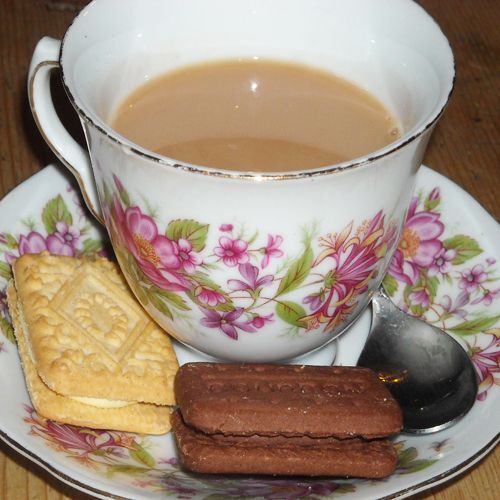
I kept thinking, 'Oh, Mildred seems unassuming, but this is where she's about to assert herself and become a real, three-dimensional person!' But it never happened. Instead of being redeemed, she just slipped slowly and sadly into her permanent role as a doormat and sounding-board for other people, and her individuality was lost in a bland mist of apathy and tea-making. There's one scene where Mildred is at a church committee meeting and one of the women leading the meeting starts making tea for everyone. Mildred, who has already consumed about four cups of tea that day, feebly suggests that perhaps they don't need tea for this meeting. Here's how that scene continues:
"...she looked at me with a hurt, almost angry look, 'Do we need tea?' she echoed. 'But Miss Lathbury...' She sounded puzzled and distressed and I began to realise that my question had struck at something deep and fundamental. It was the kind of question that starts a landslide in the mind. I mumbled something about making a joke and that of course one needed tea always, at every hour of the day or night."
I recognize that this scene has a big 'laugh here' sign on it, but I just found Mildred's complete acquiescence and sheepishness to be depressing. There is the seed of social commentary in this book – after all, Mildred does get weary of constantly meeting everyone's demands and expectations towards the end of the book, and seems on the verge of telling everyone off – but instead of taking that social commentary to its logical conclusion by having Mildred rebel, however mildly, Pym takes the alternate route of having Mildred sink into resignation and acceptance of her pathetic lot in life. In fact, the book ends with her getting roped into doing some clerical work for a pompous scholar who's a friend of hers – without pay, of course.
The presentation of women in this book is really unsettling (as it often is in Jane Austen's books, too). Mildred (who we're presumably meant to identify with?) is a fussy, boring, spineless drone, and the foil to Mildred is a woman named Helena, who is an anthropologist. Helena is described as being passionately interested in her work and committed to her field of study. She is also described as being an awful housewife who leaves dishes unwashed, rooms untidied, and meals unprepared. In the author's estimation, you can either be an intellectual or a good wife, but not both; smart or feminine, but not both; interesting or good, but not both. There are no other options.
There are also only two options in terms of virtue or goodness: attending church every single day or being an atheist. Mildred attends church every day (sometimes several times a day, it seems – she goes to church the way some people now watch TV), has an unquestioning obedience to tradition and authority, and has a simpering, saccharine view of spirituality, while Helena, the anthropologist, is not religious at all, and is portrayed as a crass philistine with no compassion or virtue. Again, Pym expects us to believe that these two stereotypes are the only options when choosing how to live a moral life. I realize that comedy as a genre trades in stereotypes all the time – it's the universal aspects of human experience that make us laugh in recognition and delight – but the stereotypes in this book seemed very confining, un-funny, and almost politically aggressive, as though Pym were daring any of her readers to be so arrogant as to claim that they fit into neither category.
It's possible that Pym was being more clever than I'm giving her credit for, and was calling attention to how the 1950s warped women's lives as a way of justifying and explaining the sexual revolution of the '60s and '70s. But her negative portrayal of Helena – who could have represented 'the smart, liberated woman of the future' in a positive way – indicates to me that Pym wasn't really thinking along those lines.
Overall, not nearly the snarky, witty romp I was promised.