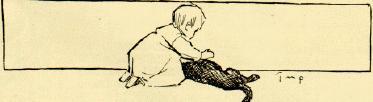
"A Child was standing on a street-corner. He leaned with one shoulder against a high board-fence and swayed the other to and fro, the while kicking carelessly at the gravel..."
A Dark Brown Dog, by Stephen Crane, was probably written in the summer of 1893, but not made public until it was published in Cosmopolitan, March 1901, after the author's death. The story is said to be an allegory about the Jim Crow South during Reconstruction, with the dog representing the newly emancipated slaves.
This a powerful and well written tale of sorrow. The story—whose interpretation may vary depending on one's perspective—can operate on at least two levels. On the one hand, as a straightforward story about a dog, a child and crushing cruelty. However, it may also be interpreted as an allegorical social criticism after the American Civil War. Either way, it's a powerful, poignant story that may reveal the nerves and sinews present underneath the skin of the human condition.
Stephen Crane (1871-1900) was an American novelist, poet, and journalist, best known for the novel 'The Red Badge of Courage' (1895). That work introduced the reading world to Crane's striking prose, a mix of impressionism, naturalism and symbolism. He died at age 28 in Badenweiler, Baden, Germany.
Stephen Crane (1871-1900) was an American novelist, poet and journalist, best known for the novel, The Red Badge of Courage. That work introduced the reading world to Crane's striking prose, a mix of impressionism, naturalism and symbolism. He died at age 28 in Badenweiler, Baden, Germany.
Librarian Note: There is more than one author by this name in the Goodreads database.
Published in Cosmopolitan in 1901, a dark brown dog, a boy, and his abusive family, (including a violent alcoholic father) all feature, and for someone like myself, who can’t bear animal or child abuse, I absolutely hated this short story!
Highly allegorical short story. I think the same point could be made without seeming so stark. By this account there are no good people in the world at all...even the children are cruel and heartless.
I read it once just for content, and then again to catch all the allegories, and it's sad and complicated both ways.
It's telling and meaningful to me that Crane, writing in the 1800's, was glaringly aware of the pain and displacement felt by African Americans during the Reconstruction Era, and that he was willing to bring it to light in this creative way.
This story is still relevant today in light of current racial tension throughout the world.
I’ve failed this year at reading classics like I planned so for the rest of the month I plan to read a classic short story around every other day. Short story #1 is A Dark Brown Dog by Stephen Crane. It was originally published in Cosmopolitian magazine in 1901 but was penned in 1893. It is described as an allegory for the Jim Crow South during Reconstruction. I’ll be honest I was not reading this for a class so my brain power did not go to dissecting the allegory. I gained access for free to it here: https://americanliterature.com/author...
Oh man… this is stark content. The Jim Crow South was never going to be a walk in the park. It is a sad and terrible story but very short. If you cannot stomach child or animal abuse and would struggle with an allegory that equates newly free slaves to dogs than I would pass on this.
The allegory is tough because Crane was using it in the 1800s to highlight the pain and displacement of African Americans after gaining their freedom from slavery. It was his way of subtly attempting to highlight injustice in the society he lived in without being so blatant as to have no one read his work.
I struggled with tone as there is literally nothing redeeming about anyone in this story. Every character lacks a depth of emotion beyond evil or cruelty. Crane obviously more aligned with the Enlightment ideals of Thomas Hobbes that people are always wicked, cruel and self serving. This is just too depressing an outlook for me… people can be terrible but there are good parts to humanity.
A dog will forever remain faithful to its master no matter how much it is beat upon. Drunkenness will always prove to be detrimental to a dog. Upon further review of the story, it is stated the dog represents emancipated slaves. "This powerful tale of cruelty and sorrow has at least two levels. The first is a sad story about a dog and a very young child, who administers both protection and cruelty, until the dog's tragic death at the hands of the child's father. It is also an allegory and social criticism of post-Civil War Reconstruction, in which the dog represents recently freed slaves who continue to be mistreated under the pretense of being free; the child is the new generation of white Southerners who have good intentions to attempt protecting African-Americans, but haven't matured enough to offer a safe and nurturing environment; and the father embodies Jim Crow Laws, which enforced segregation and suppression of African Americans, stripping their rights, even though they are supposedly freemen, protected by Federal civil rights."
Why was I not warned about how sad this story was. I don't think many people would be as touched as I was, but in my personal case it pulled at all the right strings and completely broke my tender heart. The short story was not badly written but the plot was incredibly mournful and despairing, evil to the innocent and naive. I cannot dwell on this any longer because I'd risk shedding more tears, I will now go search for cute puppy videos.
A brilliantly written work, told from the point-of-view of the dog and represents dog-like behaviour in narrative form with fanciful explanations of that behaviour; such as dog-prayers. This is deliberate use of empathic language to force the reader into a connection with the animal with its anthropomorphic guise, which plays right into the dark and harrowing ending. Many have, unjustly, awarded this short story a low star rating because it provoked an emotional response from them. I would argue, as that was the intent, it deserves full marks.
I think it should be commented that the age of the child is confusing. He seems to wander alone through the streets but must descend stairs backwards. It may be a case of neglect, given the circumstances within the household, that allows a small child to go out alone, but does seem odd. The child does sometimes act abrasively to the hound, but this may well be an indication of the low age of the child and therefore not be as abusive as you might initially think, since young children may hit an animal in thinking it the proper form of emotional response.
Personal response: I read the short story A Dark Brown Dog by Stephen Crane. It was a sad story and I really liked the authors descriptions throughout the book. Also, I liked how each character in the short story represented a group of people who took place at the time of the Jim Crow Laws. The dark brown dog represented the freed slaves, the little boy represented the Southerners trying to treat the freed slaves equally, and the father of the child represented the Jim Crow Laws.
Plot A young boy was leaning against a fence when a little brown dog walked by. The boy spotted the dog and played with the dog. After the boy got bored with the dog, the boy started to hit the dog. The boy later turned around and headed home and the dog followed. Every time the boy would turn around, the dog would be behind him. Everytime the boy looked back he also hit the dog with a stick, but the dog still kept on following him. The child finally accepted the dog following him and took him to his house. The family would later acknowledge the dog as part of the family. The child became a friend and a protector for the little brown dog. If a family member kicked the dog or threw things at him, the child would come in his defense. One day, the father of the family got drunk and came home to the dog. The father was in the mood to have fun and he took the dog and threw him out the window, causing a huge comotion. The child burst into tears and went to outside to sit by the body of his dead friend.
Characterization The boy was one of the main characters in the short story. Throughout the book the child changed his perspective of the dog and how he treated him. First, the child mistreated the dog and then later protected him. The dog was also another one of the main characters. The dog’s perspective of the boy didn’t change. The dog didn’t give up on the child and still followed him even though he always got hit.
The antagonist at the beginning of the story was the boy, who mistreated the dog. Later it became the father of the family, who killed the dog at the end. The dog was always the protagonist throughout the story.
Setting A Dark Brown Dog first took place on a street where the child and the dog first met. The book later transitioned to the child's house where the rest of the story would take place. Also, the story seemed to take place in a present day house and street. However, the meaning behind the story took place in the past.
Recommendation I recommend this book to anyone who can appreciate and understand the true meaning behind this short story. I would recommend this book to any high school student because it has some mature content that would not be suitable for an audience of a younger age. Also, high school students would be able to comprehend more of what the story refers to in history. This book can be read by any girl or boy.
This entire review has been hidden because of spoilers.
Personal response: I thought A Dark Brown Dog to be rather sad in nature. While the story progresses as you'd expect it to, it nonetheless invokes strong sympathy for the dog. I didn’t find it to be particularly enjoyable as a story, but one worth a read. The feeling the story brings forth makes the reader feel more human, despite the grim reality of the book.
Plot: A boy is sitting at a street corner when a dog waltzes up to him. The two spend awhile getting friendly, and playing. As the dog gets more and more excited, he eventually knocks over the small child. Afterwards, the boy strikes him on the head. The boy soon gets bored with the dog and returns home. As he does, the dog follows him. The boy beats the dog with a stick to deter it, but the dog is persistent in his faith in the boy. When they get to the boy’s house, the boy realizes how unique of a plaything the dog could be. He drags it inside and cares for the dog, despite its physical protests. After the family arrives chaos ensues as the father insists that the dog stay, while the rest of the family wants it to be gone. Over the months the dog and the boy become good friends while the family still despises it. However, the boy is still young and often abuses the dog. Soon the dog is caught during one of the father's drunken stupors and is beaten with a pot. Afterwards the dog is thrown out the window and falls 3 stories to his death. The boy runs down the stairs of his apartment and cradles the body of the dog in his arms as he sobs.
Characterization:
The dark brown dog: The dog is searching for a companion, and believes fervently that he's found one in the boy. Despite how often the boy abuses him, the dog still returns and loves him.
The boy: The boy commonly abuses the dog, while also expecting the dog to amuse and support him. He is naive and young.
Setting: The story is set in a street corner in a city. Apparently the city is large enough to contain stray dogs. The setting adds an air of observation that can be realized as the public, and how it appears to be acceptable in this city to beat stray dogs. In this way the family has done no wrong to the dog.
Recommendations: I would recommend this story to young male children and teenagers. The children could learn from this story how wrong it is to abuse animals, and teenagers can appreciate the gravity of the story. The reading level of the story might be difficult for children, but with an adult to read to them, it could serve as a valuable lesson.
I read “A Dark Brown Dog” by Stephen Crane. The time period is somewhere in the early 1890's. The story takes place during the summer or spring time because a women is watering and planting flowers in her yard and the family has all of their windows open in their house.
The main characters of the story are a little boy and a dog. The dog is brown in color and clumsy. He wants the little boy to like him and takes the beating that the little boy gives to him. The little boy doesn't know any better to not beat the dog, because that is all he knows. His father is an abusive alcoholic and takes his rage out on the boy. The little boy only knows to beat and hit because that is what he grew up with.
The little boy and the dog meet on the street and the dog is hesitant to go to the boy, but does anyways. The boy immediately hits the dog and the dog takes it and bows down to him. The dog apologizes for doing nothing and keeps on following the boy home, even after getting beaten repeatedly for following him. When they reach home, the boy grabs the rope attached to the dogs neck and drags the dog inside. The dog realizes what's happening and fights the boy. When they get inside the dog bows down to the boy and accepts the beating which was soon to come. When the family arrives home the father was drunk as usual and starts beating the dog. The father decided he wanted to have fun with the dog and threw him out the window. The dog flew and landed on the roof of a shed and fell to the ground, dead. The boy ran to the dog and lay there next to its dead body.
This story was difficult for me to read and confusing at times. It was hard for me to understand what the story really meant. At first I thought it was about slavery but when I read it again, I realized that it wasn't about slavery, it was about an alcoholic father who will takes his rage out on just bout anything. I rated this story two out of five stars because it didn't interest me at all. The story had a weird twist and I never expected for the dog to die. I wouldn't recommend this story because I found it very odd.
I thought this story was ok. I don't like short stories that much. It was sad on how the dog dies at the end. There are pictures in the story and there was on that showed the child crouching next to the dead dog which made it even sadder. Plot Summary This story is about the bond between a child and it's dog. The dog is a stray and follows the child home one day. The child's parents fight about whether or not they should let the child keep the dog. The father doesn't like the dog. It watches the father beat the child somedays. The child and the boy grow up with each other. The dog learns commands and what not to do when the child hits it. The father comes home one day, intoxicated, and beats the dog for fun. He ended up throwing the dog out the window onto the roof. He attracts the attention of all the nearby neighbors. The dog dies when it slides off the roof. Recommended Audience I would recommend this book to people of all ages. The words are easy to understand, along with what is happening. It is sad at the end, so people who cry a lot should be warned. It is also a quick story for someone who has to read for school.
This entire review has been hidden because of spoilers.
A deep dark symbolic short story. The language is eloquent, and every word adds something to the narrative.
A strange complicated bond between a child and a dog that symbolizes the relationship between a slave and a slave-master in the late 1800s. Superb writing.
I think a lot of folks are missing the fact that this story is an allegory about freed slaves in the Jim Crow/Reconstruction Period. The website americanliterature.com has a fantastic breakdown of the themes of the story and a character analysis. This is more than just a story about an abused dog.
Stephen Crane's description of the events made it seem like i was watching this story instead of reading it, which made it really hard for me to finish it.
A Dark Brown Dog kicked me in the gut. I am tearing up now thinking about the emotional impact of this story. A child and a dog... unless you are heartless you will be involved in the story. I have two puppies and I found myself picturing them as I read, which was probably a bad idea.
I read this one for enjoyment and didn't look at the allegorical elements so I won't do more than mention them here. This is a story about the Reconstruction: with the dog symbolizing the emancipated slaves and the father an emblem of Jim Crow. I will definitely read this one again, and try to pick up on all the important moments at that time.
I'm confused by the reviews of this short story. I searched for, and landed on the page for The Black Dog by Stephen Crane, but it seems most people have reviewed A Dark Brown Dog by the same author. Either a mistake on their part, or these two separate short stories have been mistakenly classified as different editions of a single story and those people have reviewed the other 'edition'. Either way, I give 3 stars to The Black Dog.
Um...is it just me or are most of these reviews missing, like, the entire symbolism and point of this story? It's literally not about animal abuse, it's about racism and the Jim Crow laws of the South during the reconstruction era following the Civil War and the dark aftermath of slavery. Sure, in a more literal sense, it also does share messages about animal abuse and abusive families, but that's really not the main message.
The story was haunting and got its point across succinctly and starkly, and I think it is still very relevant right now considering police brutality and the still underlying racism in our world today.
Yes, it's dark and sad and whatnot. It's SUPPOSED TO BE. It's supposed to make you feel sick to your stomach and feel disgusted at the actions of the father. That's the whole point.
If you think this story is too sad or depressing, imagine what the slaves felt. Imagine what any victim of racism or a hate crime or any other form of race-based prejudice or discrimination has felt. Maybe you don't have to imagine; maybe you know firsthand or know people who have.
Idk, I just feel like a lot of people rated this really low not for legitimate complaints about the writing or plot or whatever but rather because a story about racism and slavery was too "sad". Like um okay then. I just don't think being treated as inhuman and being forced to be a slave is supposed to be fun or upbeat, and it figures that a story about this experience would not be either, but to each their own.
“A Dark Brown Dog” by Stephen Crane, is definitely not what I had expected. This short story is very morbid; there is no happy ending. The story begins with a little dark brown dog waltzing up to a little boy. The story progresses and the dog and the boy’s relationship begins to grow, but only after a rocky beginning. The dog is taken to the little boy’s house and introduced to his family. The father of the little boy does not approve of the little boy, and the story takes a turn for the worst. I recommend this story to anyone that can stomach abuse. Many would not be as understanding with the point that Stephen Crane is trying to get across. This is not for anyone looking for a cheerful story about a little dark brown dog. The content yes is despairing and quite evil, but it is extremely well written and played with emotions. This story is very allegorical in its relevance to the jim crow south. It depicts what African Americans went through in that time of segregation. Anyone looking for a heart-tugging, well-written story should read “A Dark Brown Dog.” It resonates with you and makes a needed statement.