Jump to ratings and reviews
Rate this book

Rennefarre: Dott's Wonderful Travels and Adventures

Rate this book
Dott is a twelve-year old girl who lives in the countryside east of Berlin in a time between the two world wars. When Dott sneaks out to see the bonfire at the edge of her village on the evening of the midsummer night festival, the magical Rennefarre flower falls into her shoe. It not only makes her invisible, but also allows her to see things no one else could see. No longer able to stay with her parents and her young brother and sister, she begins her search to find a way out of her predicament.

Flying across the country on the backs of crows and herons, Dott finds herself seeing the country not only as it is, but also as it used to be. She lives through moments in history others can only read about. But, even with all of the excitement of her travels, she always has one goal in mind: returning home to her family.

Part coming-of-age story, part fantasy, and part social-cultural portrait of Eastern Germany in the early part of the 20th century, the book covers real ground.

298 pages, Kindle Edition

First published January 1, 1965

1 person is currently reading
33 people want to read

About the author

Tamara Ramsay

11 books2 followers
Tamara Ramsay was born in Kiew as one of three siblings to an industrialist of Baltic-Scottish descent and his wife, the daughter of a Russian-orthodox priest and his Danish-German wife. Her father died when she was six and the family moved from Russia to Hamburg in Germany. Her mother worked there as a translator and piano teacher.

Tamara received an education in the tradition of well-bred young girls of the time, with musical, literary and artistic education. She released her first book, called The Golden Ball (Die Goldene Kugel) and illustrated by herself, in 1931. In 1939 Eliwagar - the ice age book (Eliwagar - das Eiszeitbuch) came out.

Her most popular story, Die wunderbaren Fahrten und Abenteuer der kleinen Dott (The marvellous travels and aventures of little Dott) was released to critical acclaim in 1941 - at that time only the first volume of three was released. The original edition was illustrated by the author.

Tamara Ramsay died at the age of 89 on March 3rd, 1985 in Mühlacker near Stuttgart.

Sources: Wikipedia, Hörturm - translated from German

Ratings & Reviews

What do you think?
Rate this book

Friends & Following

Create a free account to discover what your friends think of this book!

Community Reviews

5 stars
6 (37%)
4 stars
5 (31%)
3 stars
3 (18%)
2 stars
2 (12%)
1 star
0 (0%)
Displaying 1 - 10 of 10 reviews
Profile Image for Estara.
799 reviews135 followers
February 14, 2013
Rennefarre is a true labour of love - which can be seen by the index with alphabetical information about people and places mentioned in the book and, before that, the time-line of the times that Dott visits in her adventure. These weren't in the original but created by the translator. She also adds a short overview about the author's history - I've linked to two German sources for that on the author's profile here at Goodreads.

There are books that personify a time in a country's children's literature and a style that you just don't see published anymore - like Edith Nesbit books or C.S. Lewis Narnia books or for the USians Laura Ingalls Wilder and Lucy Maud Montgomery and her books. These books, come to think of it are from a time around the date 1900, some date before and some date later and while I'm not sure how many children or middle graders read them, I know lots of adults who have read them and still love them and reread them.

This is a German classic of around that time (first released in 1941, but written around 1938), of a book style that isn't written any longer, based on a mix of folklore and history with a moral core at its adventure centre as experienced by one little girl from a region of Germany, specifically the Mark Brandenburg - of what was East Germany or the GDR when I grew up and therefore totally outside my experience as a kid.

My mother was born in East-Prussia and had to flee west as a ten-year-old child - I wouldn't be surprised if that was one of the reasons I picked the three volume edition from our church library's shelves - another were the amazing illustrations by Alfred Seidel in the edition I borrowed (and now own because they sold the edition, from 1956 or thereabouts, around 1985 for a few Deutsche Mark).

A lot of the books from the time between the two wars or after the second one have homeless children finding a new place to belong or deal with their experiences or waiting for father to return, etc. at their core. There are some truly moving ones that I loved to read and still own, like Cordula, Heiligenwald, Wohin mit Fritzi, Friedel Starmatz, Irene und ihre Tiere, Josi schafft es dennoch.

Dott's marvellous adventures aren't like that because while she goes on her travels after the Great War, the story totally centers on her and not on a family and country in the aftermath of war. That doesn't mean you won't meet war in this book - which is why I wonder if US readers will want to hand this book to their middle graders.

Disney has politically corrected Grimm's fairytales to an extent that people who have never read the original versions (or the even harsher Perrault versions for those fairytales that are French based, like Sleeping Beauty) seem to be repulsed by what German kids have no problem accepting as appropriate retaliation, etc. in a fairy tale setting.

You know your tastes best, so I say if you can handle the real fairy tales and you think your child can do so, and you're interested in a bit of German children's literary culture that you would usually not be able to read in another language - I can't remember anything of its ilk ever being translated - then you might enjoy this book.

For a fan of folklore and children's literature with a moral core from the beginning of the last century, this is a no-brainer purchase - just to compare to the equivalent in English literature.

And you know, I think I haven't read Dott, since I sent the German two volume edition from Prignitz Pur Verlag to Sherwood Smith - in 2010? - and I never read the one volume edition in German. I'm 46 now and the story still holds up for me, even without ever having visited Mark Brandenburg myself. In 1995 one of the big German newspapers - Die Zeit - did a feature on the book that pointed out that people could still follow Dott's travels if they wished.

What is it about?
Dott is around twelve years old. She's the oldest girl of a small farming family in the Prignitz in Mark Brandenburg. It's Midsummer Night and all the older children are allowed to join the parents at the big fire outside the village - but Dott isn't. Her youngest sister, Mummerle, is very weak and needs to be looked after and Dott drew the short straw. Her younger brother isn't old enough to be allowed to go anyway.

So Dott stews and can't sleep and wants to see juuuuuuuust a bit of the glow of the fire and thinks if she just goes there, or there, or even there, she'll be able to see bits of it better - until she suddenly runs off through the meadows up to the big fire where everyone is.

And when she gets there, the adults aren't celebrating but looking at two chilren - her brother holding her sister who is doing not well at all, having run directly here after not being able to find his big sister. Dott, ashamed, goes up to stand near to her brother and face the music - but no one talks to her. The adults all seem to shun her and the celebration stops as everyone goes home.

A devastated Dott can't believe that her parents and the village folk have this reaction and breaks out in tears, complaining to the wise shepherd of the village about her treatment - when the kind man makes her aware that he can't see her, only hear her - and none of the other people could see her either. After hearing how she came to the fire, he tells her she probably has the Rennefarre plant in her shoe, having run through the meadow and is now invisible to humans.

With this start and Dott's introduction to the fact that she can now see the fae folk and talk to animals the story is off - Dott wants to be able to rejoin her family and needs all the help she can get to find out what to do about the Rennefarre. In the course of her travels through the region, the Rennefarre lets her visit important historical situations far into the past and once even a possible future of war (interestingly enough not based on Nazi images, but possible religious war again - Dott visits the Thirty Years War and the Seven Years War and also the time when the Mark Brandenburg was being christianized and the troubles of that time). The Hörturm Verlag, who have done two audiobooks based on the novel, have a page with some pictures from the places Dott travels to. More information can also be found at the book's homepage.

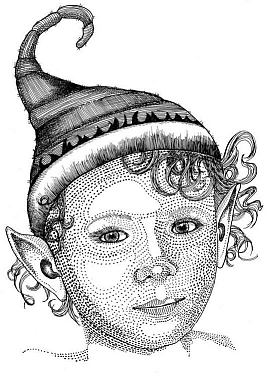
Instead of the Alfred Seidel illustrations, translator Malve von Hassel found a great replacement in Monica Minto's illustrations, to be found in the ebook as well as the print edition - there are quite a few of these. Here's the Red Boy, one of the fae:

Simple, Free Image and File Hosting at MediaFire

Tamara Ramsay had a strong Christian faith and this is something you need to be aware of, as one central theme of the book is the belief that humans may be the originators of the sadness in the world, but they will also be the ones who can carry the world and its animals and its fae creatures out of the darkness and into harmony with God in the end.

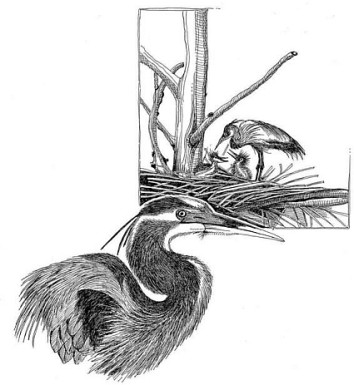
Here's Gurian, the heron, an important friend to Dott:
Simple, Free Image and File Hosting at MediaFire

So you have here a fascinating melding of a belief in folklore, in learning about responsibility, respect towards yourself and others and social contracts via history, and a deep faith that humans were put on this world to rule over it, but also to lift it up to the Lord.

Ramsay doesn't overpreach, I feel, she manages with the experiences of Dott and later her new and also enchanted friend Klaus from Berlin (a fascinating look at life in the poor quarters there), with the charm of the fae creatures and the animals that show Dott how to be noble and to take on responsibility for weaker cratures to make the experience a slow realisation and to be fascinated by the glimpses of the history of the whole regions as well - Dott's travels taking her into the Riesengebirge and to the town that is called Wroclaw these days and used to be Breslau.

As to the writing (the ebook edition has hardly any grammar mistakes, only occasionally some words that run into each other), I'd like to leave you with an excerpt of how Dott meets the ghost of Joseph von Eichendorff:

There was a castle up in the heights above the Oder. Quiet and lost in dreams, it sat in the middle of a large old park that seemed to be made for wandering around in and writing poetry. Indeed, a poet had once lived there. Some of the loveliest poems ever were created in that garden. The surrounding countryside was so beautiful that the poet never tired of singing its praises—he wrote about the gentle valley, the hillsides full of flowers, and the river rushing along between waving woods. His songs can make you feel odd and sad and full of longing—as if they come up from the depth of your own soul.

It was as if the sky
had gently kissed the earth
so, covered with blossoms,
she can but dream of him.
My soul
stretched wide her wings
and flew through the quiet lands,
as if she were flying home.


No one who has loved a little piece of land on this earth so much that it became a part of his soul would ever forget it. The poet wrote some of his most famous poems when he was away from home, his heart aching from homesickness. It would hardly be surprising to learn that he still walks along the same paths today, over one hundred years later, blessing them and loving them.

In fact, as Dott and her friends were flying by, there he was, walking through his park, tall, slender, and slightly hunched over just as he was in his own day, wearing his dark coat, with the vest closed all the way to the neck, crowned by a black scarf. He did not wear a hat. His silky soft white hair and his pale face were lit up by the morning sun.

Joseph Baron von Eichendorff walked through the park of his home, Castle Lubowitz, at Ratibor near the Oder. He stopped in front of an old pear tree and ran his hand over the gnarly bark. Why did he stop next to that frail old tree? As a boy, he used to climb up to the top of the tree and read. He read everything—legends, novels, and poems that opened his eyes to the marvelous secret behind all things, so that he, himself, came to wish to write himself. He turned and walked up the hill to an opening in the hedge of yew trees from where he could look down at the entire land below.

On just this morning, the two children and the flock of crows came from the church in Rosenberg in search of the Hodernyx. When the poet reached the opening in the hedge, he saw an odd assortment of beings on the other side. There were two children — a boy and a girl. Both looked exhausted as if they had been on a long hike through stormy mountains. They were surrounded by a flock of crows. Two of the birds stood out: one almost blind, old, and grey; and the other scruffy, but tough and strong looking. Being a poet, Eichendorff was not at all surprised to see the crows stand comfortably right alongside the children. It seemed that this was the way it should be everywhere between animals and human beings. Nor did he find it at all odd that the children and the crows talked to each — each in their own language but completely able to understand the other. A poet has to understand the language of all beings, and Eichendorff had been able to do that, too. Now that he had left his earthly life behind, he could perhaps do it even better.

"I think Schuschu the owl was already half asleep when he told us how we could recognize the Nöck," muttered the girl. "He said the Nöck Utoplotz appears as a leaf and as a grass blade, as a ball and as a ribbon, as a drop of water and as a fire brand, as a black horse and as gleaming gold. That means he could be practically anywhere and we would never even notice. We could be searching forever!" The girl looked sad and hopeless.

The tough-looking crow coughed a little and said: "True. The spirits can be anywhere without your noticing. That is why they are invisible. Or have you ever met one of the spirits if he did not want to show himself to you?"

The old grey crow intervened: "Let's not go on talking. I suggest that we leave the two human children here until they are in a better frame of mind so that a meeting with the Nöck Utoplotz might actually be productive."

The other crow chuckled and said: "Arrrah Let's go. Let's see if we can find some news about where the Nöck was last seen."

The crows took off—the younger ones in front, followed by the two old birds. The girl had blushed when the old crow spoke. Now, she brushed her hair out of her face and looked at the boy, who had sat down on the hill, watching her silently.

The girl threw herself down on the grass next to the boy. "Oh, Klaus, I am so unhappy. I really don't know, anymore, what I want. Until now it hadn't be so difficult—everything sort of happened all by itself. But during all this fruitless searching for the Nöck, I have been thinking all sorts of things. I know only one thing for sure. As soon as the Nöck tells us how we can be released, nothing will happen by itself, anymore. Then we will have to decide for ourselves whether we want to go back home or not— and now I just don't know what I want."


P.S. One of my favourite German chorals is mentioned repeatedly - it's lovely to be reminded of it especially as it isn't sung often in mass anymore (at least not in the Catholic ones I go to these days): Großer Gott wir loben dich. Also called Te Deum. Here's a lovely small church one, where you can understand the lyrics much better, and here's an organ version with brass and choir in the background recorded in Würzburg Cathedral.
Profile Image for Wayne Walker.
878 reviews21 followers
May 14, 2013
Do you have any idea what a “Rennefarre” is? Some time after World War I, twelve-year-old Dorothea Kersting, known as Dott, lives on a modest little farm, the Kerstinghof, near the village of Mellen in the Prignitz region of Germany east of Berlin, with her father, mother, nine-year-old brother Gerd, and baby sister Mummele who is very sick. On the night of the Summer Solstice, Dott sneaks out of the house to see the bonfire at Rambow Lake on the edge of her village, leaving her brother and sister alone. The magical Rennefarre flower, also called the common tansy or Rainfarn, falls into her shoe. It makes her invisible, allows her to see things no one else could see, and enables her to talk with the animals.

Since she is no longer able to stay with her family, Dott thus begins her adventures. With the help of her new friends Gurian the heron and Cornix the crow, on whose backs she flies, she sets off to visit different places in an attempt to find out how to be released from her enchantment. Along the way she meets Frau Harke, the legendary patron of animals who makes it possible for her to change her size, and Rubezahl, a legendary mountain spirit. Also, she assists a boy, Klaus Petersen of Berlin, who has also been enchanted, as well as many of the animals. At various locations where she stops, Dott goes back in time to meet great characters of the past and see important historical events. But will she find a way out of her predicament? Will she ever be able to return to her home? Rennefarre was originally published in 1941, but Malve von Hassell’s English translation/adaptation is based on the abridged edition of 1965.

With its fantasy blend of history and folklore, readers who are not familiar with Central European culture and geography may find the plot a little confusing at times, especially as Dott goes back to different periods in time at different places, but those who enjoy reading about those subjects should find it interesting, and the back of the book contains a timeline of major events and a glossary of terms used in the story. Perhaps a map would have been helpful too. Author Tamara Ramsay was a Roman Catholic, and the section about the Hussite Wars comes across as rather anti-Hussite. We have also read Deborah Alcock’s Crushed Yet Conquering about the same period, and it gives a rather different picture of the brutal Catholic persecution of the Hussites, but most such things have two sides to be told. There are a few references to drinking alcohol and using tobacco, and one scene in which several people are murdered is a little gruesome. However, in addition to the historical information, Dott shows good character by refusing to steal, prays on several occasions, and learns some valuable lessons about life in the course of her travels.
Profile Image for Compulsion Reads.
97 reviews4 followers
January 5, 2013
Kudos goes to Malve von Hassell for bringing this delightful German tale by Tamara Ramsay to English readers. Dott is a normal precocious girl living in Germany between the two world wars. When she sneaks out of her house on the midsummer night, she is enchanted by the mystical Rennefarre flower. Dott finds that while she is invisible to human eyes, she can now speak with animals. This sets in motion a grand adventure where Dott travels across the landscape of Germany, slipping in and out of history thanks to another of the Rennefarre’s potent gifts. Along the way she learns about herself, the events that shaped her country and what it truly means to be human.

Tamara Ramsay is a gifted storyteller who has created a lovely protagonist in the brave and noble Dott. Dott’s adventures are entertaining and accompanied by splendid sketches done by illustrator Monica Minto. Below the story’s surface, Ramsay subtly challenges readers to consider the responsibility that humans bear in their stewardship of the land and the creatures that are a part of it.
Ramsay also places Dott at the center of some of the most crucial events in German history, giving readers the sight, scents, horrors of the moments that shaped post World War One Germany.

Rennefarre has a tender soul, and Malve von Hassell has done an excellent job translating Ramsay’s story into English. My only concern with the novel is that younger readers (for whom the book is aimed) may stumble or get confused on some of the longer, more detailed historical scenes that introduce old battles and kings that are mostly unfamiliar to the English-speaking world.

Von Hassell has seemingly anticipated this problem by including a list of chronological events and a glossary to the back of the book as well as developing a website with supplementary information.

Despite this one potential stumbling block and its unusually long length for a children’s novel, Rennefarre is a charming read and well worth the effort for children, teens and adults alike.

(This book was provided to Compulsion Reads for review by the author.)
Profile Image for Hilary.
89 reviews3 followers
January 23, 2013
This beautiful, classic style novel is one that people of all ages will love. Miss Dott and her amazing journey captured my heart from the first page until the end. This novel is a little over 200 pages, but a quick read. The novel took me back to library days in elementary school - when the librarian would read to you a tale of a spirited young girl or boy who got in trouble some how and then got out of that trouble in the end. She would always end with "The moral of this story is..." making sure you learned something every single time. I loved remembering that while reading this novel. The characters in the novel were an absolute delight. Dott was a perfect character for the plot and made the novel what it is. The rest of the characters, including the "invisible" spirits throughout that she meets, are amazing as well. Malve von Hassell did an incredible job with creating a brand new world for her readers from the individual characters down to the grass and flowers surrounding them.

I'm giving this novel only 3.5 stars because of the length. I did love the novel, but I felt like it was a little too long. Over 200 pages is a very long novel for a story like this. The chapters were very short and quick, which really helped break it up, but also made the story feel awkward at times. Some chapters I wanted more in, and others felt as if they were there just to add length. However, like I said before the novel does go by fairly quick so the length isn't too bad. I was also confused by the pictures. They didn't enhance the experience for me. I actually like having to create images in my head instead.

~HilyBee from Novel d'Tales
Profile Image for Lea Müller.
44 reviews
January 14, 2026
Sehr, sehr schön, wenn auch manchmal ein bisschen grausam (Trommel aus Menschenhaut?). Aber trotzdem sehr interessant, vor allem mit den geschichtlichen Aspekten und mystischen Erzählungen von Hilfgeistern und Naturwesen.

Ich glaube, die Geschichte hat mehrere kleine Moralen, die über das ganze Buch verteilt sind (nicht stehlen, hilfsbereit sein, etc.), aber die “große” Moral der Geschichte scheint für mich zu sein, dass der Mensch schrecklich ist und die Welt zerstört, aber auch, dass er die Welt wieder aufbaut und rettet, und dass es nichts Kaputtes gibt, das nicht wieder repariert werden kann, und dass man nur zu einem guten Ergebnis kommt, wenn man zusammenhält und sich gegenseitig hilft, so wie die kleine Dott den Tieren geholfen hat und ihr auch von ihnen geholfen wurde.

S.378: “Ein Menschenherz kann uns zwar Kummer bereiten und uns für eine Weile allein lassen – solange aber die Liebe nicht stirbt, solange kann auch alles wieder gut werden!”

Ich sehe in dem Buch auch einen starken Ansatz zu Tierschutz.

Ich habe väterliche Gefühle für Gurian und Cornix und ich fand den Abschied sehr traurig. Ich hoffe, sie sind Dott auch nach ihrer Erlösung noch oft besuchen gekommen.
Auch das Ende vom Buch generell fand ich überraschend schwer. Ich fand es so schön, jeden Abend die Geschichte der kleinen Dott weiterzulesen.
Wenn ich Kinder hätte, würde ich denen das auch vorlesen.

S.382: “(…) und auch in unserem Herzen will es leer werden, dort, wo die kleine Dott mit all ihren Freunden ihren Platz hatte.
‘Aber es gibt doch gar nichts, was ganz leer werden kann!’ würde Dott jetzt sagen. ‘Immer ist doch etwas da, wenn wir es auch nicht sehen können!’
(…) Und so wird auch Dott mit all ihren Freunden, die sie auf ihrer wunderbaren Reise begleitet haben, bei uns bleiben.”

Es gab auf jeden Fall Potenzial für einen Enemies-to-Lovers Subplot zwischen Dott und Ardea.
Profile Image for Ruth Hill.
1,115 reviews648 followers
January 5, 2013
Rating this book was very challenging for me because I am not a fantasy book aficionado. Once in a while, I find myself enraptured with a fantasy novel, but I will be honest--it was not this one. So why the high rating? Read on.

First of all, this is a clean read--completely clean. And this is definitely a young adult book. My 9-year-old daughter would probably have enjoyed this more than me. The book is written exceptionally well. Many fantasy novels are poorly written, but not this one. And I love the fact that a lot of history went into this book. I appreciate the Christian principles I found in the book and the many references to God. For all these reasons, I am giving this a 4-star rating. It is a well-written fantasy book that will definitely appeal to young people who are fantasy lovers. There are some great illustrations included as well!

Why did I not like it? I found that after the first chapter, I struggled to connect with the characters. Dott was fine, but I could not buy into all the animals and all the travels. Yes, she was a busy little girl, and her travels were quite intriguing at times. But I just did not find myself connecting with the story. But I believe the book targets a different audience than me, and I appreciated the notes the author had in back. There was a lot of historical information included, and I would suggest that you use this when going through the book.

I was sent a copy of this book in exchange for my honest review. I was not financially compensated, and all opinions are 100 percent mine.
Profile Image for Lenore Webb.
507 reviews9 followers
January 13, 2013
Malve von Hassell has written Rennefarre, part mystical, part reality of times gone by but all wonderful if your looking to escape. That is just what Dott is doing. Finding herself caught inbetween the fabric of time in a world where animals are able to help her in her travels, Dott starts searching for a way home. For no matter how we all wish to escape reality at times we never want to lose our way back. I love that Rennefarre has that out body feeling while still taking me to different historical events. Like feeling the flutter of butterfly wings in your mind. In each lil flap of a wing the course is altered ever so slightly but still taking you on that twisty path to your final destination.


I am telling you that Malve von Hassell has a wonderful grasp on reality all the while making you comfortable taking a short respite from it at the same time.
Malve shares what she has learned herself during her years of translating, teaching and writing. I feel that Rennefarre will be making it's way not only to JD's book list but also over to Ashley's across the street. I wish I had this one in print forum to donate to our high school library.
Profile Image for Xulon.
117 reviews11 followers
December 3, 2012
"Rennefarre: Dott's WOnderful Travels and Adventures" is a translation of a treasured children's classic, originally by Tamara Ramsay and translated/adapted by Malve von Hassell. With illustrations by Monica Minto, Rennefarre enchants the reader with the story of Dott, a 12 year-old growing up in Germany between the World Wars. Reality and fantasy mean little to Dott, but after an enchantment sends her spinning across the country, meeting fantastic creatures along the way, Dott fights for one thing. Her family.

Read excerpts and find out more at Malve von Hassell!
Profile Image for Marineke.
81 reviews4 followers
September 20, 2012
dit is een samenvoeging van 3 delen, waarin gekozen is voor een vertaling waarin het sprookjeskarakter de boventoon voert; dat doet ws geen recht aan het oorspronkelijke werk dat een soort duitse 'nils holgersson' zou zijn; ik zou daarom erg graag het oorspronkelijke werk willen lezen.
Profile Image for Emily (Heinlen) Davis.
617 reviews36 followers
March 25, 2013
I thought the writing in this book as well as the overall story were good. However, I hated Dott. Absolutely hated her. For that reason, I cannot recommend this book.
Displaying 1 - 10 of 10 reviews

Can't find what you're looking for?

Get help and learn more about the design.