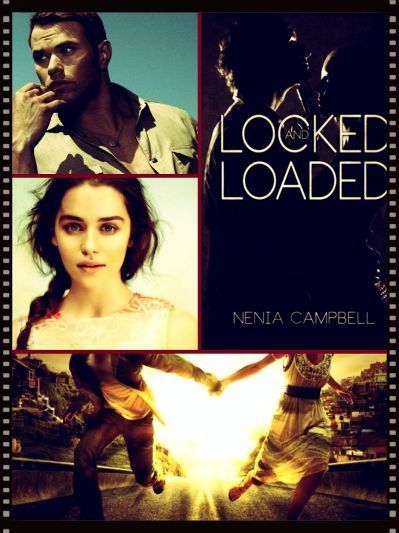
WARNING: Spoilers and a looooooooooong review await!
It took me a while to get around to reviewing this, and there exists a reason for the delay; there is very little left for me to say. While Locked and Loaded isn't the great leap forward in quality Armed and Dangerous was, it was an improvement on all fronts. It offered more of everything I liked about the series and less of what I didn't. Not much to put into a review...except one, the one question I had yet to answer in my own head.
Why do I like this so much?
My enjoyment of The IMA remained a mystery to me for three books. On the surface it contains everything I don't care for in romance and novels in general; two first-person perspectives, a spoiled brat for a heroine, a dick-driven jerkoff of a male lead, a relationship characterized by lust, angst and abuse, and two people who fuck and hate in equal measure, all delivered by herky-jerky prose in dire need of an editor. I should have wanted to toss Cloak and Dagger aside with great force. I should have hated the hell out of it.
Instead not only did I find myself drawn into the continuing tale by purchasing the next two books, I was inspired by it, coming back to my own stalled project (a romance series now titled The Freak Patrol MC) and borrowing elements from Campbell's work, elements I had previously despised. My one novel became four; I hated quadrilogies. One first-person perspective became two; I previously despised the technique. My male lead took on a much darker tone; I don't care for abusive jerks.
The IMA and Campbell's work in general had graduated from "something I read" to "something I study and borrow from". I found myself asking why the hell that had happened.
I am relatively new to writing, but thanks to a long career as an RPG gamemaster I have twenty years experience as a storyteller, experience which has served me well now that I have decided to publish my stories instead of giving them away for free. One advantage gamemastering has over writing books is the availability of immediate and interactive feedback. When players don't like your style, you find out in a big awful hurry - fans of tabletop and LARP alike often have the social graces of a howler monkey and aren't shy about expressing their opinion. I might have hated dealing with their bullshit at the time but these days I bless the experience; it both toughened me up to aggressive criticism and forced me to be more analytical about tropes and archetypes, so that I would better know how and when to employ them.
Thus did I realize; before I went any further with my own project, I had to understand The IMA's appeal to me before I could safely borrow from it, for appropriation without comprehension is also known as plagarism. I went back and read the first two books a second time, and skimmed Loaded as well, this time with an eye towards divining my reasons for appreciating it so.
Instead of reviewing Locked and Loaded what follows is my analysis of The IMA thus far, as well as where it fits in romance in general.
The first thing I noticed was the more I looked, the more I found. Early on I was hesitant to classify The IMA as residing in the "romance" genre despite it clearly being so; the primary conflict is the love affair between two protagonists and after three books said story appears to be heading in the direction of a happy ending...both basic rules of the romance genre. After a second look, I now know why I resisted calling The IMA what it was.
It's just too damn smart.
As a genre, romance has historically gotten no respect even from most of its fans; almost every woman I know who reads them either doesn't own the fact or views reading them as a guilty pleasure - much the way men react when questioned about their porn habits. The writers in it are often either jaded cynics rehashing old standards because they sell or bored-to-tears housewives exploring their masturbatory fantasies. Thus the derisive nicknames of "slut-novel" and "mommy porn".
As I said in my review of Cloak and Dagger, Campbell isn't having any of that bullshit. The IMA is dense and cerebral;it asks cogent and pointed questions regarding sex, love, abuse, rape, power, trust...hell, if there's a concept involving society's views on romance the story doesn't take a swing at I haven't found it yet.
Early on in Cloak and Dagger I did notice the story had a habit of confounding my expectations...and I'm not a reader who is used to getting fooled. Again, twenty years experience in storytelling talking. I can usually see at least a couple of steps ahead before the story unfolds. Not this time.
The biggest example; Michael's rape of Christina. I do have to admit that his constant creepy threats were repetitive during my first reading, but I could never quite hate them...somehow they made sense, as well as all of his other abusive behaviors - rough manhandling, abusive language, etc.
(Note: keep that thought, I'll get back to it.)
For her part Christina annoyed me with her yes-no-maybe-so cocktease coquette act. I kept asking why the hell an insecure teenage girl would toy so blatantly with a guy who keeps threatening her. Still, like Michael's behavior hers had a weird kind of authenticity to it. A second reading likewise increased my understanding.
(Again, hold that thought.)
Then we have the deal Michael cuts with Christina, which was basically sex in exchange for his assistance. By now I knew there was some reluctant attraction evident between the two; I figured we were heading either for the land of rape-is-love or asshole-has-a-change-of-heart. My money was on a change of heart.
Neither happened. Michael goes through with it...and Christina is left just as hurt and confused as reality says she should have been. I can be fooled by a story, but I haven't screamed "BOOK, WHAT THE ACTUAL FUCK?!"in quite a while.
Moreover, Michael raping her was not a left-field play on Campbell's part, but rather something the narrative built carefully towards. On a second reading I caught all the signs that he would go through with it; my imagination had seen it coming, my analysis had not. I'd been legitimately taken in by my own cynicism regarding romance and its tropes. Thus why I bought in so hard.
After all...if a story could so cleverly defeat my analysis, what else did it have to offer? As a storyteller I'm always looking for new tricks.
I've mentioned in my two previous reviews about how the spy-thriller elements felt a bit flat and most of the other characters likewise, but after a deeper look I now believe that's intentional. The IMA is a romance, and the primary story is the love between the two protagonists; the rest is just present to create action, tension and conflict. Its an excuse plot, but a sturdy one. It does what it is supposed to. The relationship and its vagaries are the going concern.
But first let us look at the characters.
THE RAGGED ANGEL
My biggest peeve with most romance novels is in how the male leads are characterized; the most odious traits of masculinity are on display, and worse yet they are glamorized by the "heroine" and her insipid devotion. The situation has gotten so bad the term "alpha male" has become a synonym for "asshole", and between fiction and reality I can hardly blame women for going there. After a year dealing with such douchebags as a bouncer I almost did too.
On the surface, Michael appears to be just another self-centered, angst-ridden, dick-driven boyman...mostly because he often acts the part. But as with many of The IMA's clever secrets, all is not as it first appears. Yes, Michael is a jerk. The difference; Campbell did it on purpose, and moreover for a purpose.
The legitimate alpha-male archetype can be tough to define, but in his essay "Marxism and the Mystery" crime author Robert B. Parker came the closest to getting it right. To quote:
It took Chandler to point out that the hard-boiled hero was not concerned with economics. He was concerned with honor; what they do, as opposed to what they say, is honorable. The hard-boiled hero is aware that honor has no definition. He knows there are things a man does and things he doesn't do, and it is not usually very hard to decide which is which. It is often wearisome to choose.
The fact that such men elect to be honorable in a dishonorable world makes them heroic. As in most fundamental things that humans care for, honor is indefinable, but easily recognized. He is not of the people; he is alone. His adventures are solitary statements. His commitment is to a private moral code without which no other code makes any sense to him. He regularly reaffirms the code on behalf of people who don't have one.
He is the last gentleman, and to remain that he must often fight. Sometimes he must kill.
Michael is pretty far from Parker's ideal...but deeper analysis shows that he is not completely removed from it. Instead of giving us a fully-fledged alpha male, Campbell serves up an insecure, thuggish jerk with the makings of one...and over three books puts the archetype together right before our eyes.
Michael has ferocity; over time he learns patience. He pushes back when pushed; experience teaches him how to negotiate. He is brutal; a want for tenderness forces him to learn how to be gentle. He has passion; mistakes made in the heat of the moment give him cause to discover restraint. All of it is driven by his feelings for Christina; for Michael, she is the prod which drives his self-improvement.
At bottom the alpha-male archetype is a warrior archetype, and a warrior is superior to a simple thug in two basic ways; the warrior has the heart of a poet and the mind of a philosopher - and while it can be hard to see, Michael has both. He is constantly analyzing the world around him and he has a basic sense of right and wrong; when he has both time to consider and a reason to act, he does the right thing...cursing his stupidity and asking "why the hell am I DOING this?" the whole way, but he still does it. Thanks to Christina, he is learning to act on it by habit.
He isn't all the way there, not yet. However, we do have one more book to go.
THE WOUNDED GAZELLE
My second biggest complaint about romance novels is the heroine. Reviewer Navessa Allen accurately summed up the problem by describing a typical heroine as "nothing more than a receptacle for copious quantities of the male lead's sperm", and such is both crude and apt. Christina has all the makings of such a character; she's childish, spoiled, insecure, mousy and at times hopelessly naive.
But there is one thing she isn't...an object.
Unlike the average romance novel heroine, Christina has agency. Her choices breed consequences both positive and negative. Moreover, as with Michael we are shown good and solid reasons (not excuses, logical and realistic explanations) for why she is the way she is. She's a naive spoiled brat because her family cloisters and pampers her. She's insecure and mousy because her harpy mother considers her a fat cow and isn't shy about saying so. She's imperious and demanding with Michael (often past all reason) because that is the example her mother set for her when dealing with men; it buys her trouble because Michael is most definitely not the hen-pecked noodle-soft everyman her father was.
Again, Campbell doesn't give us a heroic character, or try to sell us on how Christina starts out as one. Instead the narrative shows us an unpleasant person with the makings and hammers a proper heroine out of an insecure child using the same tool; a driving need to understand and master her feelings. As with Michael Christina demonstrates a heroic spirit when she has the time and the ability to reason things out...but also like her counterpart, under sudden stress she reverts to type as a spoiled brat. By the end of Loaded however, she's learned how to 'check herself before she wrecks herself', much as Michael has.
Christina has not yet made the transition from child to adult. But again, there is still the matter of the final book.
THE LONG STRANGE TRIP
Another place where romance novels fall apart for me is in the hows and whys of the romance itself; in most cases the author employs what is colloquially known as 'insta-love'...the characters get twidderpated with each other because the plot demands it. Worse, in story arcs similar to The IMA (where abuse enters the picture) no attempt is made to explain why the (usually female) abused party stays with the (almost always male) abusive one. Books which paint such a picture as "love" (lookin' at YOU, Stephanie Meyer) make me want to reach for a bucket.
On the surface that is what occurs in The IMA; an insecure and mousy female lead falls for a thuggish jerk-jock and stays with him because the sex is good. But again, if one digs there is much to find. Through the expert use of the dual-first-person dynamic (as well as I'm guessing a richly earned psychology degree), Campbell paints a more nuanced picture. Yes, Michael and Christina have sexual chemistry, but that is a requirement in romance both real and fictional. Underneath that, one finds the real source of their irrational devotion and attraction to one another.
Empathy.
It is a truism in real-world intimacy that like attracts like, and Michael and Christina share the common trait of having suffered a lifetime of abuse and neglect. In a stunning and clever irony, the thing which brings them together is the reason why they have such difficulty getting along. Humans are animals...and the abuse victim is a wounded animal, biting anyone and everything which tries to get near - and in Michael and Christina's case this includes each other. Michael is the obvious instigator of abuse, what with his kidnapping and his rough handling of her...but if one pays attention Christina gets her hits in as well.
Thus the reason why Michael rapes her; its a desperate attempt to hurt her badly enough to push her out of his life, because abuse victims often do exactly that to people who attempt to care about them. When it does not work he is almost as tormented by doing it as Christina was in having it done to her. It takes longer for the guilt to set in, but set in it does.
Eventually both of them stop bickering...first out of simple exhaustion and necessity, then because they both discover the joy in legitimate interaction. However, there's a problem; according to society's perception rapists aren't 'supposed' to love their victims...and rape victims aren't 'supposed' to forgive their attackers enough to stay with them. Thus must both of them figure out how to become a person who can love...and in this endeavor both are on equal footing, as neither has any understanding of where to start. Worse, they have to do this without any guidance, as in attempting it they have stepped off society's map regarding love, sex, consent and trust. Which brings me to what is in my eyes the genius of The IMA and my take on its underlying theme - consent is a construct.
Nobody consents to attraction. Nobody consents to being the target of it. Nobody consents to empathy or understanding, and nobody consents to being understood. All simply happen by accident as a consequence of living, and since relationships are as personal as a fingerprint all anyone can do is the best they can with what they're given - or walk away and wonder what might have been. There is no third choice. Chemistry is a devil's bargain with the unknown.
If there's a way to take a love story and boil it any harder, I'm not sure what it would look like.
THE FUTURE
Where is the story going from here? I'll be honest...I've no idea, but I sure as hell want to find out, and now that I think I've got a handle on my enjoyment of Campbell's vision I feel more comfortable being inspired by it. And while I'm on the edge of my seat regarding The IMA's final chapter, I'm content to sit here for as long as it takes the author. I'm sure it will be great, and I'm sure I'll be surprised.
Now if you'll excuse me, there's a little yarn about some bikers I need to see about writing. Congrats, Nenia...you've officially become an influence.